
Europe scrambles to save euro
European leaders raced yesterday to save the euro from impending collapse, as momentum gained for a radical proposal in which countries that use the common currency would cede control of a big chunk of their budgets to a central authority.
In the run-up to the next European summit on December 9, hopes were rising that, with their backs to the wall, leaders will finally come up with a solution that will once and for all bring an end to a crisis that has threatened to wreck the global economy.
A raft of hitherto taboo ideas gained sudden prominence. Chief among them: a fast-track move to a fiscal union between the 17 countries that share the euro—a proposal some say would be a big leap toward a United States of Europe. Such a move could greatly enhance European stability, but at a cost, critics say, of national sovereignty and democratic accountability.
Another plan gaining support in the face of fierce German resistance is for the eurozone’s six triple A rated nations to pool their resources through a joint bond to prop up some of the single currency bloc’s most indebted members. Germany, the EU’s richest member, rejects the idea because it fears it would be tapped for the lion’s share of the bailout.
A critical test comes today when European finance ministers meet for a summit in Brussels and Italy tries to tap markets for billions more in cash. US President Barack Obama was meeting top EU officials yesterday at the White House to discuss the crisis.
Whatever materialises, the euro is in grave danger—with experts saying the currency could fall apart within days without drastic action. Evolution Securities economist Gary Jenkins said a series of government bond auctions this week “may determine the future of the EU.”
Financial Times columnist Wolfgang Munchau wrote Monday that the common currency “has 10 days at most” to avoid collapse and big decisions need to be taken, including moves to a fiscal union and the creation of a common treasury with wide-ranging powers.
As experts predicted the endgame for the euro, Europe buzzed with talk of a central treasury authority for the eurozone — an idea that just a week ago would have seemed impossible.
Unlike the United States, which has centralised institutions in Washington DC for raising taxes and spending, the eurozone has 17 independent treasuries with little oversight from Brussels. That would change under the fiscal union proposal being aired ahead of the EU leaders’ summit in less than two weeks.
While not explicitly backing such a move, Germany and France, the eurozone’s two biggest economies, have promised to propose new measures that will make the 17 operate under strict and enforceable rules—the hope being that no country, however small, can wreak such damage again.
The idea of fiscal union is controversial not least because it raises fears among some members that economic policy around Europe will be run by the EU’s biggest player: Berlin.
But with Europe on the brink, it may be a price that many nations are willing to accept. The break-up of the euro, established only in 1999, could have catastrophic effects around the global economy. Among the unappetizing prospects are a massive bank run, the seizing-up of the global financial system, and chaotic currency fluctuations for those that go back to their historic money.
“Everyone knows that if the eurozone crashes the consequences would be very dramatic and in the race after that there would no winners, just losers,” said Finland’s finance minister Jutta Urpilainen.
Already, the Paris-based OECD is warning that the global economy is in for a hugely rocky road over the coming months ahead. In its half-yearly report Monday, it said the continued failure by EU leaders to stem the debt crisis that has spread from Greece to much-bigger Italy “could massively escalate economic disruption” and end in “highly devastating outcomes.”
The latest bout of turmoil to afflict the eurozone came last week after Germany failed to raise all the money it wanted in a bond auction and Italy had to pay through the roof to get investors to part with their cash.
If a busy bond schedule this week meets—Italy is planning to raise €8 billion today—with an equally poor reception, then the euro’s countries will be in real danger of being locked out of international markets and facing the devastating prospect of defaulting on their debts.
Germany, as Europe’s only powerhouse economy, would then have to decide whether to bail its partners out—or bail out itself. As governments nervously tap bond markets, Germany appeared to be readying to ask its eurozone partners to back measures for deeper fiscal union. “The common currency has the problem that the monetary policy is joint, but the fiscal policy is not,” Germany’s Finance Minister Wolfgang Schaeuble said in a meeting with foreign reporters in Berlin. “Consequently, we are working now to expand the common currency through a common stability policy.”
Schaeuble said the proposal, which Chancellor Angela Merkel is to bring up during the December 9 EU summit, would only require passage by the 17 eurozone member states, although the other ten EU countries, such as Poland and Sweden, would be welcome to adopt it if they wanted.
The prospect of a deeper fiscal union has been greeted positively in the markets, with the Stoxx 50 index of leading European shares closing up 3.6 per cent and the euro rising 0.4 per cent to US$1.3337.
“There appears to be a sense of greater urgency among eurozone leaders after some very worrisome developments last week,” said Vassili Serebriakov, an analyst at Wells Fargo Bank. However, analysts said such a move would take a long time to come to fruition. (AP)

China ‘keen’ to invest in West’s infrastructure
China’s sovereign wealth fund wants to invest in improving neglected US and European roads and other infrastructure to spur global growth, the fund’s chairman said in comments published yesterday. The announcement reflects a shift in strategy for the US$410 billion fund, which was created in 2007. Until now, it has limited its investments mostly to small stakes in publicly traded companies to avoid stirring political opposition overseas.
China Investment Corp. wants to begin in Britain by teaming up with fund managers or investing directly in infrastructure projects, Lou Jiwei said in a commentary in London’s Financial Times newspaper. “China is keen to get involved” in improving US and European infrastructure, which “badly needs more investment,” Lou wrote. He cited energy, water, transport, digital communications and waste disposal but gave no indication of possible projects or the size of Chinese investment.
Some commentators in both Europe and China have suggested Beijing might use its US$3.2 trillion in foreign reserves to gain leverage on political or trade issues at a time when other governments urgently want investment. Also Monday, Commerce Minister Chen Deming said at a business conference that he wants to send a delegation to Europe next year to find investment opportunities, according to the director of the ministry press office, Huang Minghai. The proposal still requires Cabinet approval.
Beijing is encouraging Chinese companies to expand investments abroad to diversify an economy that relies heavily on exports and investment. It has sent trade and investment delegations in the past to the United States, Europe and elsewhere. CIC was created to invest abroad in hopes of earning a better return on China’s foreign reserves, the bulk of which are in US and European government bonds. It says investments are made on commercial rather than political grounds.
The move into infrastructure probably reflects CIC’s commercial views, rather than those of the government, said Citigroup economist Minggao Shen. He said it could help CIC earn a more stable profit and reduce Beijing’s exposure to US and European government bonds amid volatile markets. Some Chinese commentators have called for Beijing to reduce its exposure to the financial woes of Western governments by buying fewer bonds. China is Washington’s biggest foreign bondholder, with US$1.15 trillion in Treasury debt as of September.
“There is a general thought that maybe China should not invest in US Treasurys or European sovereign bonds. Instead, why can’t we hold direct assets in the economy?” Shen said. By investing in individual projects, he said, “you don’t have to depend on government guarantees and it should be affected less by the sovereign debt crisis.” CIC faced criticism over the performance of investments made just as the financial crisis was developing. But its results have improved and the fund reported an 11.7 per cent return on assets last year.
Lou stressed that CIC is a commercial investor and wants to make a profit. “CIC believes that such an investment, guided by commercial principles, offers the chance of a win-win solution for all,” he wrote. Lou gave no indication in which other countries the CIC might invest but cited an estimate that the United States needs to spend at least US$2.2 trillion in infrastructure repairs or rebuilding.
“Free of the inflationary pressure that afflicts many emerging economies, the US and Europe should make substantial investment,” he said. “We cannot count on developing countries to deliver a stable economic recovery on their own.” (AP)
Japan households reduce spending as unemployment rises
Japanese household spending fell while the unemployment rate rose in October, raising concerns about the country's economic recovery.
Household spending fell by 0.4% from a year ago, while the jobless rate rose to 4.5% from 4.1% in the previous month.
However, in a positive sign, retail sales rose by 1.9% from a year earlier, the first increase in three months.
Despite strong retail numbers, analysts said domestic demand may remain slow.
"We have to note that household income has been declining, while household spending has been pretty much flat, meaning people are using their savings," said Hideki Matsumura of Japan Research Institute.
"This could put pressure on household spending as we go forward," he added.
Slowing recovery?
Japan has been trying to stimulate growth after the earthquake and tsunami earlier this year caused widespread damage to the economy.
However, a slowdown in key markets such as the US and Europe have affected Japan's export-dependent economy.
Data released by the Ministry of Finance last week showed that shipments dropped 3.7% in October.
At the same time, a sluggish recovery has seen consumers in Japan hold back on spending, which is hitting domestic demand.
Analysts said the combination of these factors may hurt the economy.
"I don't see anything that will help consumption and the job market ahead as we haven't seen fully fledged reconstruction demand yet, and the global economy is slowing down," said Takeshi Minami of Norinchukin Research Institute.
"But if those factors improve, that would help the economy," he added.
Stocks rally on robust Black Friday sales
U.S. stocks posted sharp gains Monday, following reports of strong Black Friday weekend sales and amid optimism that European leaders may be working toward a solution to the continent's debt crisis.
The Dow Jones industrial average (INDU) soared 291 points, or 2.6%, the S&P 500 (SPX) added 34 points, or 2.9%, and the Nasdaq composite (COMP) rose 86 points, or 3.5%. The advance broke a 4-day losing streak for the Dow and seven consecutive days of declines for the S&P 500 and Nasdaq.
The rally was broad, with all 30 Dow components gaining ground. All but a small handful of the S&P 500 and Nasdaq were also trading higher.
Financials were among the biggest winners, with Morgan Stanley (MS, Fortune 500), Wells Fargo (WFC, Fortune 500), Citigroup (C, Fortune 500), Goldman Sachs (GS, Fortune 500), and JPMorgan Chase (JPM, Fortune 500) and surging between 2% and 6%.
The mood on Wall Street was cheerful after major retailers reported record sales of $52.4 billion over Black Friday weekend -- up 16% from last year -- according to a survey by the National Retail Federation released Sunday.
Black Friday surge won't change ho-hum outlook
Retailers like Wal-Mart (WMT, Fortune 500), Kohl's (KSS, Fortune 500), Costco (COST, Fortune 500), Target (TGT, Fortune 500), Gap (GPS, Fortune 500) and Home Depot (HD, Fortune 500) were up between 0.5% and 2.5%, while Best Buy (BBY, Fortune 500), Macy's (M, Fortune 500), Tiffany & Co. (TIF) and Saks Inc. (SKS) climbed between 3% and 6%.
"Holiday sales seem to be off to a strong start, and that's providing fuel to the market," said Dave Hinnenkamp, CEO at KDV Wealth Management. "Stocks have been trading down for days now, so this is a bounce on good news, but I wouldn't expect a straight-up rise from here."
Hinnenkamp cautioned that investors will keep a close eye on the debt crisis in Europe, which could continue to spark jerky moves in the market.
"As long at Europe's situation remains unresolved, we could see more volatility," he said. "But once we have some finite news -- a credible plan that deals with the problems rather than tinkering with the symptoms -- we could see an up trend in stocks."
Despite Monday's healthy rise, the major indexes remain in the red for the month and the year. The Dow is down 3.6% in November, and 0.5% for the year. The S&P 500 and Nasdaq are off about 5% for the month and year.
Last week, European bond yields spiked following a series of disappointing debt auctions, which further heightened fears of a contagion in the region and sent stocks about 5% lower for the week.
CNN
Voting Continues in Egypt
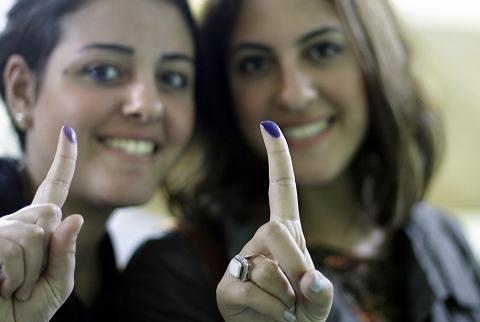 Egyptians lined up for hours Monday to take part in the nation's first post-revolution parliamentary elections. While logistics for the staggered, three-month process are daunting, so far, voters seemed pleased to be able to make their voices heard.
The line stretched for blocks outside a polling station in Cairo, with some voters hopeful that this election, unlike those of decades past, will count.
Student Farah, her uncovered hair standing out in a line mostly of veiled women, said she came to ensure a good future for all Egyptians.
Despite a crackdown in past days on anti-military protests in the capital's Tahrir Square, the vote was proceeding peacefully across much of Cairo governorate, one of several regions of the country taking part in this first stage of elections.
The three month process is being hailed as a milestone for Egypt, a country dominated by a military-backed government for nearly 60 years. Political analyst Hassan Nafae said that as imperfect as the vote may be, it may answer a fundamental question.
"This is a very, very important election in just one sense: It will, for the first time, show us who represents what exactly, because we really don't know," said Nafae.
In Alexandria, where the two-day first round of voting also was underway, a spokesman for the Muslim Brotherhood's Freedom and Justice party told VOA that in two districts where Islamist parties were popular, ballots didn't arrive until noon. He added the army was being cooperative, though, helping to establish security at polling places - a scene he described as "remarkable."
Islamists hope to do well in this voting, both the Freedom and Justice party, and the more fundamentalist [Salafist] Al Nour party.
Marwa Mohammed, standing in line to cast her vote in Cairo, came to give her support to the Salafists.
Fully covered in a niqab, she said the party represents her: "It will fulfill my future demands, God willing."
Nearby, another voter hoped for a more mainstream government. Mariam, a dentist wearing the more common hijab, or headscarf, said her main hope is that this new wave of popular participation continues.
"I'm really not sure how it will go, but I'm aiming for a moderate Egypt. I'm aiming for a better future for our kids and I need to see a more proactive people in the community, and more of a literate community rather than what we had before," said Mariam.
Cairo-based analyst Nafae said that is likely to happen, even though he believes the parliament being elected now will be weakened because there will be no new constitution until next year, and the military vows to prolong its rule.
"I am not optimistic about the next parliament, but I am optimistic about the future because I do believe that the Egyptian people are much more aware than before and they will work very hard until they achieve all the objectives of the revolution," said Nafae.
The first round of voting ends Tuesday, with runoff elections set for two weeks from now. Other regions in the country will begin their voting next month.
DRC Voting Extended After Violence, Late Ballots
Elections in the Democratic Republic of Congo have been extended into Tuesday in areas where people were unable to vote because of violence or undelivered ballots.
Voting materials arrived late or in some cases were not delivered at all in precincts throughout the country.
Some polling stations were also affected by violence, mostly in the southern city of Lubumbashi, where gunmen attacked a convoy of vehicles carrying ballots and a polling station in the Bel-Air neighborhood. Congolese officials say several people were killed in the violence.
VOA correspondent Scott Stearns reports from the capital, Kinshasa, that police fired tear gas to disperse protesters who said they found ballots pre-marked in favor of incumbent President Joseph Kabila.
In Goma, independent election official Juvenal Biyamungu said clashes broke out after a man in charge of one polling station started tearing up ballot papers.
In areas were voting happened peacefully and ended more or less on schedule, electoral officials emptied ballot boxes and started the vote count.
The presidential and legislative elections are Congo's second multi-party vote since the end of a brutal civil war in 2003. The presidential race features Mr. Kabila running for re-election against 10 opposition candidates. In the legislative elections, more than 18,000 candidates are competing for 500 seats in the national assembly.
Mr. Kabila won the last presidential poll in 2006. He is widely expected to win re-election, in part because of a new voting system in which there is no run-off, meaning the candidate that gets the most votes on Monday is the winner.
His main challenger is longtime opposition leader Etienne Tshisekedi, who raised fears of unrest ahead of the poll when he proclaimed himself the winner in advance.
In Washington Monday, a State Department spokesman condemned the election-related violence and said the United States was concerned by reports of what he called “anomalies” in the vote.
Election results are expected by December 5, the day before Mr. Kabila's current term ends.
President Kabila has been in power since 2001, when he assumed the presidency after the assassination of his father, Laurent Kabila.
Biden to Hold First High-Level US Talks with New Greek Government
The White House says Vice President Joe Biden will go to Athens next week for the first high-level U.S. visit with the new Greek government.
Mr. Biden will meet with Greek Prime Minister Lucas Papademos next Monday. The White House says the vice president will show U.S. support for Greek efforts to implement the deal with the European Union and International Monetary Fund for another economic bailout.
Mr. Biden will also meet with the leaders of the parties that make up the new coalition government — former Socialist Prime Minister George Papandreou and conservative party leader Antonis Samaras.
Prime Minister Papademos must convince parliament to agree to the conditions laid out by the EU and IMF so Greece can get a badly-needed installment of last year's bailout. Those conditions include unpopular spending cuts and tax hikes and eliminating thousands of government jobs.
Mr. Biden will arrive in Greece after a three-day visit to Turkey starting Friday. He plans to hold talks with Turkish President Abdullah Gul and Prime Minister Recep Tayyip Erdogan and will attend an entrepreneur summit in Istanbul.
Mr. Biden will discuss expanding trade and investment with Turkey and U.S. cooperation in fighting Kurdish terrorism.
Army: Rockets Fired from Lebanon Hit Israel
Israel's army says several rockets fired from southern Lebanon hit the country's north early Tuesday, but there were no casualties reported.
A military statement said the rockets landed in the western Galilee region and at least one of them exploded, causing minor damage.
The French News Agency quoted army sources as saying Israel retaliated, striking the area from where the rockets had been launched. The agency said local military commanders were assessing the situation.
TCIG Statement on Effect of Monday’s Public Servants Strike
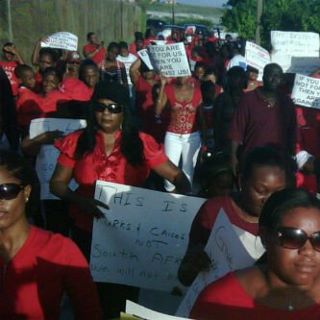 Following the strike again today in the TCI by the CSA, essential and emergency services remained available to the public, although some government departments were operating with reduced staff numbers from today’s public servants strike, the Interim Administration has confirmed to RTC News.
The Ministry of Health reported that clinics and ambulance services were functioning, with adequate numbers of doctors, nurses and support staff.
Both the main Treasury office on Grand Turk and the sub-office on Provo were sufficiently staffed to remain open to the public. The Ministry of Finance also reported adequate numbers of customs officers for the airport and other operations. Immigration and fire services were also in place to cover international flights into TCI.
Two primary schools were forced to suspend their infant classes, but the Department of Education confirmed that all primary and secondary schools were operational, although there were reports that a number of teachers were absent from at least one secondary school.
The public has had telephone and internet access to most government departments throughout the morning.
In the release it states that, 'Government again thanks the public servants who turned out to work this morning, especially those in critical areas including teachers, health care workers and those dealing with the vulnerable.'
RTC News understands that the strike will continue on Tuesday.
TCI National Trust releases Integrated Biodiversity Conservation Project
On Tuesday November 29th 2011 at 11:00 am on the grounds of the Historic Cheshire Hall Plantation the Turks & Caicos National Trust is launching its “Integrated Biodiversity Conservation Project”. The project is to raise awareness of; and invoke appreciation for TCI biodiversity through development and implementation of innovative activities which would be incorporated into annual programmes.
The objectives of the project are:
To promote TCI biodiversity through implementation of specific activities.
Design programmes that would foster volunteerism and unity among communities.
Develop and implement activities that would help youths and adults learn the connection between biodiversity and cultural heritage.
Conduct outreach and implement activities that would demonstrate the relation between biodiversity conservation and occupational opportunities.
To develop and implement activities that would help the public understand the importance of protection of ecosystems.
The purpose of the project is to build on existing foundations, utilizing local knowledge to progress a national established biodiversity conservation programme. Although the national Trust makes an effort to celebrate Biodiversity Day each year, there is a greater need for awareness and a systematic approach for educating all sectors of society about TCI bio-diversity. Activities will be creative and informative and designed to bring communities together in learning to be wise stewards of the natural environment for preservation of
heritage.