
Unrest continues near Cairo's Tahrir Square
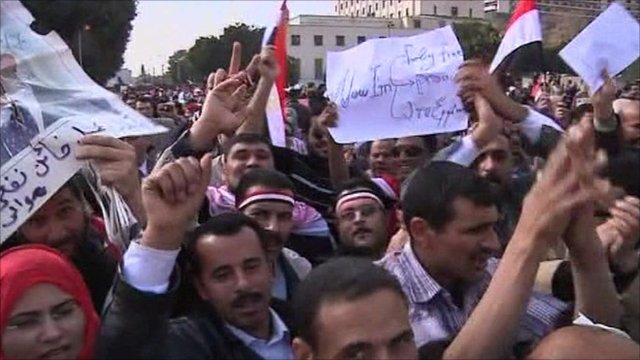 Unrest is continuing in Cairo as protesters step up their demand for Egypt's military rulers to resign.
Street battles with riot police have been heaviest around the fortified interior ministry located on a side street off Tahrir Square.
Gunfire was reported late on Wednesday but the interior minister said security forces were only firing tear gas.
The protesters have rejected a pledge by the ruling military council to speed up transition to a civilian government.
The BBC's Jeremy Bowen in Cairo says the violence threatens to overshadow next week's parliamentary elections.
He says public opinion on the protests is divided. Some Egyptians want elections to go ahead unhindered while others believe the military must be swept from power first.
The clashes, now entering their sixth day, are the longest outbreak of violence since the 18-day uprising that toppled former President Hosni Mubarak in February.
Since then a military council has been tasked with guiding the country's transition to democracy. The latest protests have been triggered by suspicions that the military intends to hang on to power.
On Tuesday Field Marshal Mohamed Hussein Tantawi, head of the Supreme Council of the Armed Forces, sought to defuse the situation by promising presidential elections by the end of June, six months sooner than planned. The military-appointed civilian cabinet also tendered its resignation.
"They [the military] were with Mubarak from the start," said Fatihia Abdul Ezz, 60, who had come to the square to protest.
"I came when I saw our sons being killed."
Steel buckshot
Groups of stone-throwing demonstrators have been locked in pitched battles in the streets between Tahrir Square and the interior ministry for several days.
Riot police blocking streets leading to the ministry have driven back the protesters with volleys of tear gas and rubber-covered steel buckshot.
Protesters have spoken of gunshots and injuries or deaths from live bullets but Interior Minister Mansour el-Essawy said security forces were only firing tear gas.
On state TV he said unidentified people were shooting from rooftops near Tahrir Square, Reuters news agency said.
At one point on Wednesday a truce was apparently brokered by religious leaders, but soon broke down and the clashes continued into the night.
There were also clashes in Egypt's second city, Alexandria, and in Ismailia, on the Suez Canal.
Television pictures from Ismailia showed armoured vehicles patrolling streets as security forces tried to disperse protesters with volleys of tear gas.
In Alexandria protests have been smaller than in Cairo, but one protester said clashes were continuing early on Thursday outside the security headquarters.
One protester, Mahinour, told the BBC the number of injured people there was increasing.
"Most of them are suffocating because of gas. This time they are not using tear gas, it's more nerve gas than tear gas. And as well there are some people injured by rubber bullets," she said.
Despite the clashes, the BBC's Wyre Davies in Alexandria says the appetite for conflict is lessening and people want their country to move on.
'Excessive force'
The main opposition group, the Muslim Brotherhood, is not supporting the protests and expects to do well in the parliamentary elections which start next week and will be staggered over several months.
Earlier on Wednesday, UN human rights chief Navi Pillay condemned the "clearly excessive use of force" by Egypt's security forces during the clashes.
She called for an independent inquiry into deaths since the weekend.
The health ministry said on Wednesday that 35 people had died in clashes since Saturday - all but four in Cairo. Hundreds more have been injured.
State news agency Mena reported that one person had been shot dead in the north-western city of Mersa Matruh as demonstrators tried to storm a police station.

Yemeni President Saleh signs deal on ceding power
Yemeni President Ali Abdullah Saleh has signed a deal under which he will step down after months of unrest.
Mr Saleh signed the agreement, brokered by Yemen's Gulf Arab neighbours, in the Saudi capital, Riyadh.
Under the plan, he will transfer his powers to his deputy ahead of an early election and in return will get immunity from prosecution.
But protesters rallying in the Yemeni capital, Sanaa, said they would reject any deal giving the president immunity.
The demonstrators said the Gulf initiative ignored the "blood of martyrs", BBC Arabic correspondent Abdullah Ghorab in Sanaa reports.
A crackdown on anti-government protests, which began in February, has left hundreds of people dead and thousands wounded in Yemen.
The 69-year-old leader - who has ruled since 1978 - came close to signing the deal several times in the past, only to pull out at the last minute.
Meanwhile, clashes broke out between pro-Saleh troops and gunmen loyal to dissident chief Sheikh Sadiq al-Ahmar in Sanaa on Wednesday.
No casualties were immediately reported in the fighting in Sanaa's al-Hasaba district.
Mr Saleh signed the agreement in the presence of Saudi King Abdullah and other senior Saudi officials after flying to Riyadh on Wednesday morning.
Under the plan, the president will hand over power to deputy Abdrabuh Mansur Hadi in return for immunity from prosecution.
Mr Hadi is then expected to form a national unity government and also call for early presidential elections within 90 days.
The deal envisages that Mr Saleh will remain an honorary president for three months after signing the agreement.
In Riyadh, Mr Saleh pledged to co-operate with the new government which would include the opposition.
He also called on all Yemenis to be partners in rebuilding the conflict-torn country.
The breakthrough comes after intensive talks in Yemen by the UN envoy to the country, Jamal Benomar.
Plane crashes into Arizona mountain; fires burning
An airplane crashed Wednesday evening into a rugged mountain east of Phoenix, creating a small wildfire that crews were unable to immediately reach, Arizona officials said.
The aircraft, possibly twin-engine, crashed around 6:30 p.m. in the Superstition Mountains near Apache Junction, said spokesman Elias Johnson of the Pinal County Sheriff's Office.
A man who said he witnessed the impact told CNN that a mushroom cloud of flames lit up the evening sky.
It's a six-hour hike to the site and crews were uncertain how many people were on the plane or its destination, Johnson told reporters. He indicated crews will be in a recovery operation.
A ranger dropped near the scene saw a tire from the plane that suggests it was not a commercial aircraft, he said.
"This is some of the toughest country you can experience," Johnson said. There were at least two debris fields. "That plane is all over the place up there."
Kevin Cunningham, 44, of Apache Junction, said he was talking on the phone from his back porch and saw the crash a few miles away.
"The flames lit up the mountain," said Cunningham, adding the plane appeared to be flying level before the crash. "I didn't see where it was in distress."
The photogenic peak is popular with hikers and horseback riders, the resident said.
"Somebody didn't know the mountain was there or they had false readings," Cunningham speculated.
Thanksgiving: US travellers hit the holiday roads
The US is preparing to mark the annual Thanksgiving holiday, with more Americans taking to the road or skies for family visits than in recent years.
An estimated 43m people are expected to travel before and after the holiday, the highest number since 2007.
On Wednesday, poor weather on the East Coast caused widely expected Thanksgiving travel delays.
On Friday, eager shoppers are expected to form battle lines as stores open their doors early for sales.
The annual Black Friday shopping extravaganza usually sees retailers open as early as 03:00 or 04:00. This year, though, the rush has crept into Thanksgiving Day itself.
About 1,000 Gap stores will be open on Thanksgiving and several large retailers, including Target, Best Buy and Macy's will open at midnight.
Wal-Mart, which opens many of its "super-centres" 24 hours a day, will also open the rest of its stores at 22:00 on Thanksgiving.
Cutting corners
Despite a projected rise in traveller numbers, 2% fewer people are expected to travel by air compared to 2010, according to the Air Transport Association of America.
High fuel and flight costs have changed travel plans for some, but other travellers are determined to make the trip.
Shun Tucker, a Chicago resident, wanted to spend Thanksgiving with his family in Memphis, Tennessee, but told the Associated Press he did not want to spend an estimated $300 (£193) on a flight.
Instead, he chose to book a ticket for a nine-hour-bus ride at a cost of just $49.
"Family is important and we love the holiday," Bill Curtis, a retiree from Los Angeles told the news agency. "So we cut corners [in] other places so we can afford to travel."
Occupy Thanksgiving
On Thursday, US President Barack Obama officially proclaimed the holiday, which celebrates the Pilgrims' first harvest in what is now the state of Massachusetts.
"As members of our American family make do with less, let us rededicate ourselves to our friends and fellow citizens in need of a helping hand," he said.
Mr Obama fulfilled his other Thanksgiving duty on Wednesday, by pardoning a turkey. Since taking office, he has created his own tradition of pardoning an additional turkey.
Other Thanksgiving arrangements are not so traditional.
Occupy Wall Street protesters will mark the holiday with an "open feast" of 3,000 individually wrapped plates of food at Zuccotti Park, organisers said.
In San Antonio, Texas, volunteers are preparing to serve an estimated 25,000 people at the 32nd annual Jimenez Thanksgiving Dinner.
The event was set up by a restaurant owner, Raul Jimenez, who delivered food to senior citizens on the holiday and noticed how many people spent Thanksgiving alone.
Russia in Europe missile threat
Russian President Dmitry Medvedev has warned that missiles could be deployed on the EU's borders if the US pursues its missile defence plans.
In a televised statement, he said "modern weapons systems" could be deployed in Kaliningrad if Russia, the US and Nato failed to come to a deal.
He added that Moscow may opt out of the New Start arms deal agreed with the US.
Nato chief Anders Fogh Rasmussen said he was "very disappointed" by Mr Medvedev's response.
Washington wants an anti-missile shield ready by 2020 but Moscow considers the idea a threat to its nuclear forces.
The US says the shield is intended to provide protection from the potential missile threat posed by countries like Iran.
Washington had originally intended to locate major parts of its missile defence shield in Poland and the Czech Republic under Bush-era plans.
But Russia had objected vigorously, and when President Obama took office he scaled-back these ambitions.
However, Moscow has yet to be satisfied that the revised plans do not pose a threat to its interests.
Building Materials Ltd boldly thrives after 27 years serving TCI
 Building Materials Ltd Do it Center has boldly taken on the challenges of an evolving country with confident poise and the assistance of a strong global partner and this November commemorates 27 years in business in the Turks and Caicos Islands.
The store was established in 1984 during a season when the modern conveniences of having the right equipment and building supplies were but a dream. These days, Building Materials Ltd Do it Center outpaces even suppliers in the region due to its reliable supply of high quality brands, service excellence, regular technical support and a store which never loses its ability to remain relevant to market demands.
“We started from scratch with a very humble store front, and as the business grew, we continued to expand and improve our retail space. But the real turning point was in 1997 when we became members of Do it Best Corp,” explained Ken Adams, President of BML Do it Center.
The year 2011 started with a bang for the Do it Center, with the grand re-opening of its 60,000 sq ft Providenciales store and the addition of the nation’s first Drive-thru Lumber Depot; massive at 35,000 sq ft.
Now, as the year 2011 comes to a close, Building Materials Ltd Do it Center is saying thank you by taking the unprecedented step of giving it’s valuable customers a major storewide discount, at both locations – Provo and Grand Turk – for three days including Thanksgiving Day, Black Friday and Saturday November 26 which also doubles as a party day where visitors to the store will enjoy free hotdogs and drinks as they savor a 20% discount.
As changes occur in the islands, Building Materials Ltd Do it Center has proven itself open to adaptation. The store, this year, has added a clothing section, has expanded its $1.99 department, has embraced a new mattress brand in Serta, has grown its Lawn & Garden department to include live plants, opened a low-in-cost, high-in-taste deli – Tongue ‘n Grove - at the store and this year presented a three-month Holiday Layaway opportunity which has been widely embraced and has enabled residents to make down payments toward what they want for Christmas.
Marketing and promotions has also moved into the genre of social networks seamlessly; now with a resourceful and informative presence on FaceBook, BML Do it Center enjoys a growing list of ‘fans’ and ‘likes’ to its credit.
“We have the faith and determination to reach our goals, and while Do it Best Corp helps us pave the way, we know that it is the support of customers, staff and family which keeps us going and growing… we really do appreciate that. Thank you, Turks and Caicos.”
TCHTA’s Members and Schools Partner to Make TCI SHINE!
Members of the Turks and Caicos Hotel and Tourism Association (TCHTA) and students from both private and public schools across Providenciales, came
out on Saturday, November 19, 2011 to make “TCI SHINE.”
TCHTA’s annual cleanup campaign, “TCI Shines”, attracted the participation of approximately 250 persons, who came out with one objective – to clean
up the byways and highways of Providenciales. The initiative, spearheaded by the Association and members of its Ambassador Committee, focused on
sensitising Provo’s youth about the negative effects littering has on the environment and how it can adversely damage the country’s tourism
industry. Students cleaning the 14 zones were often heard asking their adult counterparts, why there was so much litter along the roads.
Association Executive Stacy Cox noted, “The event for us is always bittersweet. We are happy to clean up our communities but disappointed
that we are still collecting so many bags of garbage, after hosting “TCI Shines” twice a year for the past three years. We collected approximately
1,100 bags of garbage in addition to washing machines, tyres etc. This large number is mostly because of the great turn out we had this year,
with almost 250 persons participating.”
Cox added, “For this cleanup we focused on sensitising and educating our country’s young minds because they are the ones who will drive the message
home to their peers and families. Education is an important tool and we believe this process needs to start with our young people. The Association
is extremely happy that so many schools participated in the event and we look forward to launching our “Green Project” in April 2012 during our
Earth Day “TCI Shines” cleanup campaign. The “Green Project” will allow schools, both primary and secondary, to come up with a project, that will
encourage the islands to stop littering.”
The Association also thanked its members and all schools which participated in this weekend’s “TCI Shines”:
Provo Primary School
Enid Capron Primary School
Community Christian Academy
Precious Treasures School
Champion for Christ School for Excellence
K K & T Waste Management
TCI Waste Management
Ianthe Pratt Primary School
TCI Middle School
TCIPS Comprehensive High School
Provo Christian School
Clement Howell High School
BEST Institute
The Sands
The Regent Palms
Beaches Resort & Spa
The Tuscany on Grace Bay
Amanyara
La Vista Azul
The Veranda Resort
Alexandra Resort
Gansevoort
Point Grace
Royal West Indies
Villa Del Mar
The Somerset
Department of Environment and Coastal Resources
FortisTCI Ltd
Bornewell Marketing Ltd
Interim Government reflects on TCI strike
The office of the F.C.O today sent RTC news a follow up response, after investigating the affected areas following the strike in the Turks & Caicos Islands on Tuesday.
The release read: Reflecting upon the impact of the strike on 22 November, Martin Stanley, Chief Executive of TCI Government said:
“I can confirm the that while essential and emergency services remained available throughout the strike, some government departments were clearly affected by Tuesday’s public servants action.
“The Health Ministry reported that all clinics were opened to the public throughout the day, and were adequately staffed by doctors and nurses. Most schools also had a full day, but a few closed at midday because of a shortage of teachers.
“Critical immigration and customs operations at Providenciales International Airport were largely unaffected and the Ministry of Border Control and Labour confirmed that the Immigration Department also remained opened.
“The Treasury was affected, with the Grand Turk office closed for the entire day and the office on Provo only opened for a brief period in the morning. The Labour Tribunal was forced to suspend operations because the telephone and other support services were not available for most of the day. The government telephone system was down for most of the day and limited public telephone access to government departments.
“Government again thanks the public servants who turned out to work in critical areas, especially teachers , health care workers and those dealing with the vulnerable.
The CSA has reminded the Interim Government that despite the interruptions to Government services, that they intend to continue demonstrating until all the demands are met.

Digicel Launches 12 Days of Christmas Promotion
Digicel is going 3D for the Christmas Holidays with its 12 Days of Christmas promotion which gives customers the chance to win one of 12 great prizes with the grand prize being the 3D Home entertainment system.
The swanky 60” Samsung LED TV is the featured grand prize for the promotion in which customers may qualify to win by either:
1. Topping up with $15 or more
2. Purchasing a Nokia or Blackberry Smartphone
3. Paying their postpaid bill on time.
The Grand Prize is by no means off limit for only the winner to enjoy but the 3D TV is on display in the Flagship store in Providenciales and there is also one in the Grand Turk store which allows customers to experience the technology and the fun of 3D Entertainment.
Head of Marketing for Digicel, Ava-Dayne Fulford says “3D technology is what is fresh and exciting in the world of technology and the 3D experience which was once only enjoyed in movie theatres is now available to be seen in the comfort of your own home. Digicel wants to make someone’s Christmas extra special this year by giving them this gift that is sure to provide hours of entertainment, fun and laughter. The winner is bound to have a Merry Christmas”.
The Promotion which runs from November 18 through to December 22 will also award 11 other prizes which include:
1. Blackberry Torch
2. Digital Camera
3. Nintendo WII
4. Play Station 3
5. Couples Spa Treatment
6. $200 gas
7. $500 cash
8. Trip for 2
9. An Ipod
10. Laptop Computer
11. $1000 cash
Winners will be delivered the gifts by Digicel’s Santa Helpers. There will be two winners chosen each week initially with the number of winners per week increasing as Christmas draws closer.
Persons may track the winners on Digicel’s Facebook Page at www.facebook.com/digiceltci
KENNEDY AND TROCHA TAKE THE HONOURS
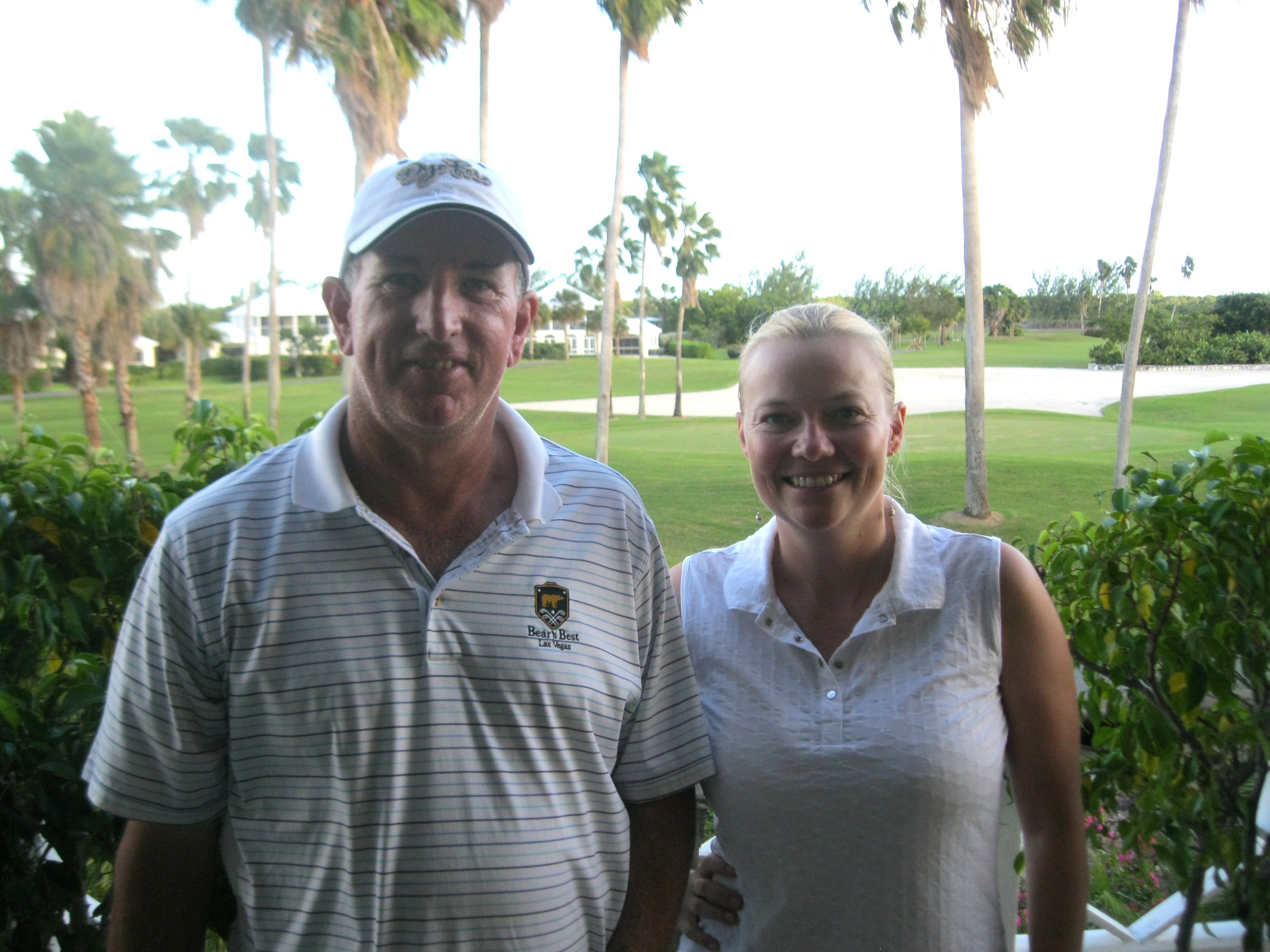
PROVO Golf Club in the Turks & Caicos has two new number ones.
Bryon Kennedy and Dorothy Trocha were crowned king and queen of the course last weekend following the annual club championship.
Scratch golfer, Kennedy, was in sparkling form, scoring rounds of 75 and 78 for a gross total of 153, which proved enough to see off a strong challenge from reigning champion, Jumpol Sirnark.
Meanwhile 11 handicapper, Trocha (81,79), took the ladies' prize for the first time following a couple of near misses in recent years.
Her net total of 138 got her across the finishing line ahead of Andrea Todd, Madelaine Erskine and 2010 champion, Chris Pretorius.
Director of golf, Dave Douglas, said: “We have again enjoyed a great couple of days golf and congratulations go to both Bryon and Dorothy on becoming club champions.
“Saturday's play was particularly challenging because there was plenty of rain that fell and that made for some very difficult scoring conditions.
“But in the end the two best players on the days emerged as winners although everyone who took part, and there were more than 40 players out there, contributed to another highly successful Provo Club Championship.”