
HOSPITAL TREAT IN TCI
 LITTLE Jessica Saunders had the surprise of her life when she celebrated her ninth birthday.
The Ashcroft School pupil was one of more than 20 children who enjoyed an educational field trip to the Cheshire Hall Medical Centre in Provo.
And when InterHealth Canada staff discovered it was Jessica’s big day, they enlisted her help with a couple of exciting demonstrations.
First, physiotherapists borrowed the youngster to show students the hoist system that is used to lower patients into the rehabilitation pool.
And then nurses in the emergency department demonstrated their skills by putting a bright pink plaster cast on Jessica’s arm.
“It was so exciting”, said Jessica, “and I really enjoyed my visit. All the nurses, doctors and physiotherapists were so friendly and kind and I learnt so much about the hospital and how it works.
“It was definitely a memorable birthday.”
For many pupils, it was their first ever visit to the medical centre and they all left highly impressed by the state of the art facilities.
Science teacher, Mary Jimenez, explained: “The children are studying human biology and so the visit tied in really well.
“We were all amazed by what we saw and we now have real understanding and admiration for the hospital and everyone who works there.
“It truly is a fantastic place and we got to see so many incredible things such as the laboratory, ED, maternity, physiotherapy and the imaging department.
“On behalf of everyone at Ashcroft School, can I thank chief executive, Dr Roger Cheesman, and all at InterHealth Canada, for a truly fascinating afternoon.”

Chief Minister & Minister of Finance, Anguilla in London
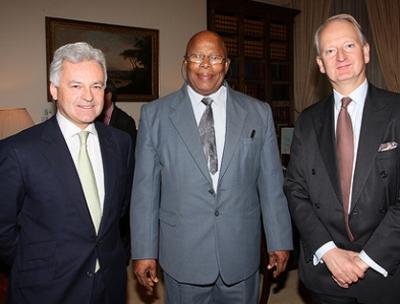 UK Foreign Office Minister Henry Bellingham and Minister of State for International Development Alan Duncan met with Hubert Hughes, Chief Minister & Minister of Finance, Anguilla in London, 22 November 2011.
Chief Minister Hughes met with Minister Bellingham and Minister Duncan on a number of issues ranging from the Constitution (Anguilla is the only remaining OT not to negotiate a constitution), the much discussed transfer of the Permanent Secretaries and the serious anormalies and conflict with the FCO appointed Governor Harrison.
The meeting was said to be spirited but productive. The Chief Minister ahs reportedly managed to garner the support of the other Caribbean OT leaders on the range of issues.
Courtesy of SPICE
Cuba to allow farmers to sell directly to hotels
Farmers in Cuba will be able to sell their goods directly to tourist hotels and restaurants from 1 December 2011, the official Communist Party newspaper Granma has announced.
Under the new rules, Cubans will not have to go through government middlemen to sell agricultural produce.
For the first time in decades, farmers will also be allowed to take their products to market themselves.
The farm reform follows recent moves liberalising Cuban house and car sales.
The government said the new rules were meant to cut down on transportation costs and speed up food delivery to the tourism industry.
'Better supply'
According to Granma, the reform will allow farmers to "develop mechanisms to supply tourist entities and take better advantage of the potential of all forms of local means of production".
Tourism is a key source of revenue for Cuba, but visitors often complain about the poor quality of food.
The government is hoping the reform will help provide fresher and more varied products, boosting Cuba's attractiveness.
Under the current rules, a state-run body has a monopoly on the sale and distribution of agricultural products.
Prices and production volume are set at the start of each harvest.
Critics say the state-run system has led to high volumes of food rotting before it could be distributed.
The reform is part of a larger overhaul of Cuba's Soviet-style economy, which has already led to changes allowing Cubans to set up their own small businesses and buy and sell cars and homes.
Mexican troops seize $15.3m alleged drug cash from car
Soldiers in Mexico have seized $15.3m (£9.8m) in cash, believed to belong to the country's most wanted drug lord, Joaquin "Shorty" Guzman.
The security forces said they found the money when they searched a car in a well-to do neighbourhood of Tijuana, on the US-Mexico border.
They said the money was being taken to a safe house used by Shorty Guzman and his gang, the powerful Sinaloa cartel.
It is the second largest cash seizure since Felipe Calderon became president.
Defence Ministry spokesman Gen Ricardo Trevilla said the find was made during a "surprise operation" in the Cumbres de Juarez neighbourhood of Tijuana, in Baja California state.
He said the soldiers found $15.35m in cash, 3kg (6,6lb) of cocaine, four weapons, and jewellery inside the car.
Gen Trevilla said it was the biggest cache of cash found by the army since soldiers seized more than $26m in a house in Culiacan, in northwestern Sinaloa state in 2008.
He did not say what led the troops to the cash. No arrests were made.
Joaquin "Shorty" Guzman is Mexico's most wanted man and thought to be one of the country's richest.
Two years ago, he made Forbes magazine's list of the 67 World's Most Powerful People. At number 41, he was just below Iran's Supreme Leader Ayatollah Ali Khamenei.
Brazil to fine Chevron $28m for Rio oil spill
Brazil has announced it is fining US oil company Chevron $28m (£17.9m) for causing an oil spill off the coast of Rio de Janeiro.
Chevron has accepted responsibility, saying it had underestimated the pressure of underwater oil deposits while drilling.
Brazilian Environment Minister Izabella Teixeira said Chevron could face further fines if an investigation into the spill revealed more infractions.
Chevron says the leak has been plugged.
The head of Chevron's Brazil operation, George Buck, said the company had underestimated the pressure of underwater oil deposits while drilling, causing oil to rush up the bore hole and seep into the surrounding seabed.
Mr Buck said the leak had been plugged, but that there continued to be a residual oil flow from undersea rock near the well in the Frade oil project, 370km (230 miles) off the Brazilian coast.
'Serious accident'
According to Brazil's National Petroleum Agency (ANP), the leak released between 200 and 330 barrels a day at the height of the spill.
The head of the ANP, Haroldo, Lima said the accident was "serious, but not major".
He said there was "no comparison" between this spill and last year's disaster at BP's Macondo well in the Gulf of Mexico, where 11 people died and some 3,000 barrels a day were leaked.
Police environment experts have been trying to assess the scale of the latest spill.
They have also questioned the methods Chevron was using to clean up the spill.
Head of the Federal Police Environmental Division Fabio Scliar said the company was pushing the oil to the bottom of the sea, rather than gathering it, putting corals in the area at risk of pollution.
In recent years Brazil has discovered billions of barrels of oil in deep water that could make it one of the world's top five producers.
So far there has been little public debate about the environmental dangers of offshore drilling.
Political discussion has instead focused on how future oil revenues should be divided between different states.
Merck & Co agrees $1bn Vioxx settlement in US
 US drugs firm Merck & Co has agreed to pay almost $1bn (£640m) to settle criminal and civil charges arising from the marketing of one of its drugs, the US Department of Justice has said.
The company will pay a $322m criminal fine and $628m to settle civil charges regarding the promotion of the painkiller Vioxx.
The department said Merck & Co promoted the drug for rheumatoid arthritis before it was officially approved.
The drug was withdrawn in 2004.
Merck & Co said the civil settlement did not constitute an admission of liability or wrongdoing.
"We believe that Merck acted responsibly and in good faith in connection with the conduct at issue in these civil settlement agreements, including activities concerning the safety profile of Vioxx," said the company's Bruce Kuhlik.
In October last year, Merck & Co said it would be setting aside $950m to cover the cost of the settlement.
In 2007, the company paid $4.85bn to settle thousands of Vioxx-related lawsuits.
A study found the drug could increase the risk of heart attacks and strokes.
New Jersey-based Merck & Co should not be confused with its German chemicals and pharmaceuticals namesake, Merck KGaA.
Although the two firms share the same historic roots, they are separate companies.
IMF broadens lending power
The International Monetary Fund approved a number of changes to streamline its emergency lending process and deal with the European debt crisis.
The goal: allow the IMF to provide cash in tough times, especially to otherwise healthy countries caught up in a credit crunch -- countries the IMF calls "crisis-bystanders."
The IMF's credit line system, for example, could be used more broadly, providing short-term loans or insurance "to address the needs of crisis bystanders during times of heightened regional or global stress and break the chains of contagion."
Some of the key elements include changes to the "precautionary and liquidity line," which requires a country to have a solid track record of implementing sound economic policies to qualify.
That credit line can now be used as a "liquidity window" that would allow borrowers to pay off short-term loans over six months. Under certain circumstances, borrowers may qualify for longer payment terms of up to two years.
"The reforms enhance the fund's ability to provide financing for crisis prevention and resolution," said IMF managing director Christine Lagarde.
The reforms also expand the IMF's rapid financing instrument, which is meant to aid members in urgent need of assistance.
The rapid financing instrument is being broadened beyond helping those members stricken by natural disaster and or in the aftermath of violent conflict. But borrowers must first prove to the IMF that they have a solid plan in place to address whatever difficulty required the emergency lending.
"This is another step toward creating an effective global financial safety net to deal with increased global interconnectedness," said Lagarde
Stocks slip on worries over growth and Europe
Stocks ended in the red Tuesday, amid worries about U.S. economic growth.
But losses were trimmed after the International Monetary Fund unveiled an enhanced lending program to help countries struggling with short-term liquidity problems from Europe's debt crisis.
The Dow Jones industrial average (INDU) ended down 54 points, or 0.5%. The S&P 500 (SPX) slipped 5 points, or 0.4%, and the Nasdaq composite (COMP) lost 2 points, or 0.1% Earlier, all three indexes were down about 1%.
The turnaround came after the IMF announced that it is revamping its lending facility to better serve "crisis-bystanders," the countries with strong economic policies and fundamentals that are struggling with urgent financing needs during periods of "heightened economic or market stress."
The intergovernmental agency said that its program could be used "as insurance against future shocks" and help "break the chains of contagion."
Though the major indexes bounced off their lows following the news, they remained stuck in negative territory as investors weighed the effectiveness of the IMF's new credit line.
"It's more stimulus, but it doesn't seem that it's going to be enough," said Joseph Saluzzi, co-head of equity trading at Themis Trading. "This is certainly not the bazooka that will end all bailout talks, but it's a step in the right direction."
Meanwhile, investors remained on edge following a downbeat reading on U.S. economic growth.
Eurobonds: The 'solution' that just won't stick
Investors were disappointed by a weaker reading of economic growth in the third quarter, as it "reinforced concerns about the strength in the global recovery," said Kathy Lien, director of currency research at Global Forex Trading.
The ongoing rise in bond yields in Italy and Spain didn't help either.
"European bond holders are very likely to continue pressing for some reason to hold Spanish and Italian bonds," wrote analysts at Wells Fargo Advisors in a research note.
While recent leadership changes in Europe are steps in the right direction for the long term, they do "little to reassure investors that there is a backstop to these bond markets," the analysts wrote.
Market confidence will remain shaky until investors "know who will be Europe's lender of last resort, the ultimate guarantor of European debt," they added.
Spanish bonds signal tough road ahead
Tuesday's move lower came after stocks capped off a brutal day on Wall Street Monday, ending down about 2%, as investors reacted to the congressional super committee's failure to reach a budget deficit deal.
Congress' super committee, which had been given extra powers to tackle the country's seemingly intractable debt problems, said Monday that it could not agree on $1.2 trillion in budget reductions.
There was some relief Tuesday after major ratings agencies reaffirmed the U.S. credit rating.
With no default or downgrade threat looming, the market impact of the super committee's letdown is likely to be "muted" relative to the summer's debt ceiling debacle, said Jeff Kleintop, chief market strategist at LPL Financial.
Still, the collapse of budget talks could have longer-term ramifications, said Sebastian Galy, a senior currency strategist at Societe Generale, in a research note.
Debt committee failure: Red flag for investors
"The super committee's failure didn't stress the rating agencies, but if payroll tax cuts can't be extended -- the risk of recession in 2012 goes up materially," Galy said. "And the 'better than expected' economic data we have been seeing becomes far less relevant, as we all peer through fog at the bleak outlook for 2012. And that makes the S&P look vulnerable or at least, well capped."
Economy: The economy grew at a 2% annual rate in the third quarter -- a half-percentage point slower than originally reported, according to the government's second estimate of third-quarter GDP growth released Tuesday.
Analysts surveyed by Briefing.com expected the estimate would remain unchanged -- an annualized increase of 2.5%.
Investors welcomed signs that the Federal Reserve is at least debating whether or not it should further ease monetary policy in the future.
While members of the central bank's monetary policy committee "generally preferred to retain the existing" measures, "a few members indicated that they believed the economic outlook might warrant additional policy accommodation," according the the Fed's minutes from its November meeting.
Still, the Fed is not willing to use all the arrows in quiver just yet, said Mark Lamkin, chief investment strategist at Lamkin Wealth Management, adding that the minutes prove that "the Fed is still in a wait-and-see mode."
World markets: European stocks closed lower. Britain's FTSE 100 (UKX) slipped 0.1%, while the DAX (DAX) in Germany slumped 1.1% and France's CAC 40 (CAC40) lost 0.4%.
Asian markets ended little changed. The Shanghai Composite (SHCOMP) edged down 0.1%, the Hang Seng (HSI) in Hong Kong ticked up 0.1% and Japan's Nikkei (N225) slid 0.4%.
Companies: Shares of Netflix (NFLX) slumped after the video-streaming subscription service announced that it expects to be unprofitable in 2012. Netflix also said that it will sell $400 million in common stock and convertible notes.
Netflix will lose money for all of 2012
Fusion-io (FIO), which first debuted on the New York Stock Exchange in June, said it will price its follow-on public offering of 8.84 million in common stock at $33 per share. Shares of the company fell.
Shares of Gilead Sciences (GILD, Fortune 500) jumped after the HIV drugmaker announced it is buying Pharmasset (VRUS) for $11 billion.
Campbell's Soup (CPB, Fortune 500) stock dropped after the company's fiscal fourth quarter profit tumbled 5%, as price increases failed to offset lower volumes.
Should you move out of the dollar?
Currencies and commodities: The dollar lost ground against the euro, and the Japanese yen, but rose versus the British pound.
Oil for January delivery gained $1.09 to settle at $98.01 a barrel.
Gold futures for December delivery rose $23.80 to settle at $1,702.40 an ounce.
Bonds: The price on the benchmark 10-year U.S. Treasury rose slightly, pushing the yield down to 1.94% from 1.96% late Monday.
Fed orders stress tests for America's biggest banks
The Federal Reserve wants to know: could America's largest banks endure another shock like the one in 2008?
After the markets closed on Tuesday, the central bank ordered the top 31 U.S. banks, with assets of $50 billion or more, to participate in stress tests simulating another crisis.
Six banks with large trading operations will have an even higher hurdle to clear, simulating a more severe global financial meltdown. Those banks are Bank of America (BAC, Fortune 500), Goldman Sachs (GS, Fortune 500), Citigroup (C, Fortune 500), JPMorgan Chase (JPM, Fortune 500), Morgan Stanley (MS, Fortune 500) and Wells Fargo (WFC, Fortune 500).
"Institutions will be expected to have credible plans that show they have sufficient capital so that they can continue to lend to households and businesses, even under adverse conditions," the Fed said in a press release.
The Fed issued specific instructions that vary depending on the size and operations of each company.
In stress tests the Fed began conducting in 2009, only 19 banks -- those with $100 billion or more in assets -- were required to participate. But now Dodd-Frank regulations require annual testing of banks with more than $50 billion.
The stress tests require banks to see how they would hold up under such conditions as the stock market crash in 2008 and major declines in global economic activity, including an unemployment rate of 13%. The tests will also include scenarios that incorporate a financial crisis in Europe.
Banks will need to show that they can maintain a buffer of at least 5% of their capital on the sidelines, for times of economic stress.
Banks have until Jan. 9 to submit their plans to the Fed. Those that fail the tests may not be allowed to distribute dividends.
The Fed said it plans to release some of the results to the public, including estimates of revenue and losses for the original 19 banks participating in this exercise.
Egypt unrest: Cairo protests continue despite military concessions
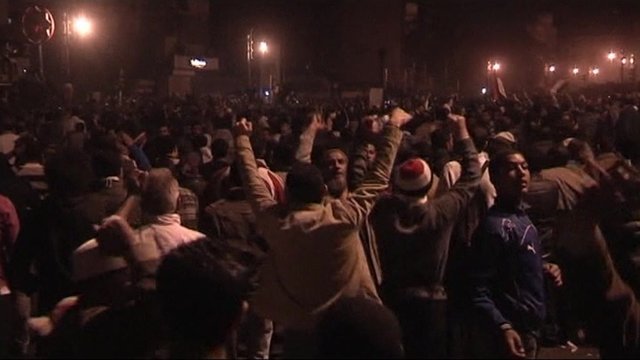 Thousands of Egyptians have continued to occupy Cairo's Tahrir Square despite an offer from the military for a speedier handover to civilian rule.
After four days of violent clashes, Field Marshall Mohamed Hussein Tantawi said presidential elections would be held by July 2012.
But many protesters in the square said the concession was not enough and have demanded the field marshal step down.
Clashes continued after dark between riot police and protesters in Cairo.
Television pictures from Tahrir Square showed ambulances arriving to pick up injured people.
According to Egypt's ministry of health, at least 30 people have been killed since Saturday and hundreds injured.
Police have been using tear gas, rubber bullets and birdshot against protesters who have been throwing stones.
Some protesters said live bullets had been fired.
Clashes have also been reported in several other Egyptian cities including Alexandria, Suez, Port Said and Aswan.
Frustration
Egypt's ruling military council had previously said presidential elections might not happen until late 2012 or 2013. That move, coupled with a draft constitution produced earlier in the month that would exempt the military and its budget from civilian oversight, prompted a mass demonstration in Tahrir Square on Friday.
Events turned violent when security forces attempted to remove the protesters from the square on Saturday.
Many Egyptians have become frustrated with the slow pace of political reforms since Hosni Mubarak was overthrown as president in February after a wave of mass demonstrations.
The Supreme Council of the Armed Forces (or Scaf) took charge after his ouster, promising to implement the transition to civilian rule.
Speaking on national TV on Tuesday, Field Marshall Tantawi, the head of Scaf, said parliamentary elections scheduled to begin on 28 November would take place as planned, despite the unrest.
Those polls, taking place over three months, are due to set in train the transition to democracy.
The military's original timetable called for the new parliament to then choose a 100-member constituent assembly to draw up a new constitution within six months.
A referendum would then approve the document before a presidential election was held. That would mean the military remaining in power until late 2012 or early 2013.
Protesters, however, had demanded the presidential vote take place after the parliamentary elections.
'Not leaving'
The BBC's Kevin Connolly in Cairo says the army's readiness to bring forward presidential elections appears to be a major concession.
Field Marshal Tantawi said that the military was only there to protect the people and did not seek permanent power.
"The armed forces, represented by their Supreme Council, do not aspire to govern, and put the supreme interest of the country above all considerations," he said.
"They are fully prepared to immediately hand over power and to return to their original duty in protecting the homeland if that is what the people want, through a popular referendum if necessary."
He also said he had accepted the resignation of Prime Minister Essam Sharif's cabinet - appointed by the military - and that a national salvation government would take its place.
His announcement followed a day of crisis talks between the military and political leaders.
After he spoke, protesters in Tahrir Square chanted: "We are not leaving, he (Tantawi) leaves."
"We are not happy with this speech," a protester named Tamer Lokman told the BBC's Yolande Knell in Tahrir Square.
"It reminded us of those made by the former president, Hosni Mubarak when he didn't answer our demands," he said.
BBC