
Japan's exports decline for first time in three months
Japan's exports have fallen for the first time in three months, reinforcing worries that the strong yen and global debt crisis are affecting the economy.
Shipments dropped 3.7% in October from a year earlier, said the Ministry of Finance.
 This pushed the balance of trade into a deficit, as imports jumped on high fuel costs.
The Bank of Japan warned last week that the debt crisis in Europe was stifling demand and hurting Japanese exporters.
Hurting recovery
In September, the Japanese economy was looking like it was back on track following the devastating 11 March earthquake and tsunami.
Exports were up 2.3% in that month compared to last year, as carmakers' production levels were back up to pre-quake levels.
However today's figures have renewed concerns over the recovery. The drop in exports was steeper than expected, with analysts predicting a fall of 0.3%.
Analysts said that the fall in demand from countries facing their own economic crises was severe.
"Exports will likely continue to fall for the next few months as the global economy is expected to continue to have an adverse impact," said Takeshi Minami from Norinchukin Research Institute.
Safe yen
The other adverse effect of the European debt crisis has been a move by investors to buy the yen, generally considered a safe investment.
This has driven up the value of the currency, making Japanese good more expensive overseas. This, in turn, has hurt major exporters.
The strong yen is seen as a big threat to Japan's economy, and one the government is taking steps to combat.
Japan has intervened in foreign exchange markets three times this year, most recently on 31 October.
Carmakers are often the most affected by the strength of the yen, as they are major exporters.
Companies such as Toyota, Honda and Pioneer have also suffered recent supply chain disruptions due to the flooding in Thailand.

Toyota resumes Japan output after Thai flood disruption
Toyota Motor said it had restored vehicle output in Japan to "near-normal levels" on Monday, after severe flooding in Thailand disrupted supply chains.
Partial production at three Toyota factories in Thailand itself has also resumed.
Last month the carmaker was forced to cut production around the world.
The flooding in Thailand, the worst the country has seen in decades, has resulted in more than 600 deaths.
It has also forced many businesses to shut down.
Factory closures and other disruptions resulting from weeks of flooding have contributed to an 18.5% fall in Toyota's second quarter profits.
The company has withdrawn its profit and vehicles sales forecasts due to continued uncertainty.
The output cancellations have come at a time when Toyota was starting to ramp up production to make up for lost output after the earthquake and tsunami in Japan in March.
Spokesman Dion Corbett estimates that 150,000 units of production have been lost globally since October due to the floods.
Northern Rock: Osborne to reveal EU deal over 2013 sale
Northern Rock had to be sold by 2013 under a deal signed by the former Labour government, Chancellor George Osborne is to reveal on Monday.
The bank, which was nationalised in 2008 following its near-collapse during the global credit crunch, was sold on Thursday to Virgin Money for £747m.
Mr Osborne will say the sale offered the "best possible deal" for taxpayers.
Labour said the chancellor had to start taking responsibility for his decisions.
Shadow Treasury minister Chris Leslie had sent a letter to Mr Osborne, raising concerns about the value and timing of the sale.
In a strongly-worded response, the chancellor will say that, under the deal negotiated by his predecessor Alistair Darling with the European Commission over state aid to banks, the government had to sell the majority of its stake by the end of 2013.
This deadline had never been made public.
Mr Osborne will also say the sale's valuation of Northern Rock's "price-to-book value ratio" - that is, its assets minus its liabilities - is higher than peers Barclays, Lloyds TSB or the Royal Bank of Scotland.
BBC business editor Robert Peston said as taxpayers had injected £1.4bn into Northern Rock in 2010, the sale would see a "paper" loss of somewhere between £400m and £650m.
But there is the potential for the Treasury to receive a further £280m over the next few years.
'Imperative'
That deal with European authorities "left the new government with a limited window to get Northern Rock Plc back into the private sector," Mr Osborne will say in his reply to Mr Leslie.
"Given we were advised Northern Rock plc would have been likely to remain loss-making at least well into 2012, which would have depleted taxpayer resources still further, agreeing a sale now was even more imperative."
Mr Leslie said: "It's time George Osborne started taking responsibility for the decisions he takes. He should be doing what's best for the British taxpayer, not hiding behind EU rules.
"Last week the chancellor claimed he had secured a good deal by selling off Northern Rock for a substantial loss. If he is now suggesting this was a bad deal for the taxpayer and he would rather have waited why did he not ask the European Commission for an extension?
"With the British economy flat-lining for over a year, bank shares in decline and a deepening crisis in the eurozone, he could have made the case that circumstances had changed."
The previous Labour government in 2010 split the bank into two, Northern Rock plc, and Northern Rock (Asset Management), into which was placed its bad debt.
The so-called "bad" bank was saddled with the cost of being bailed out and still owes the Treasury £21bn.
The government has said it had no plans to sell Northern Rock (Asset Management).
The sale of Northern Rock plc is expected to be completed on 1 January 2012.
Egypt protesters in Cairo's Tahrir Square for third day
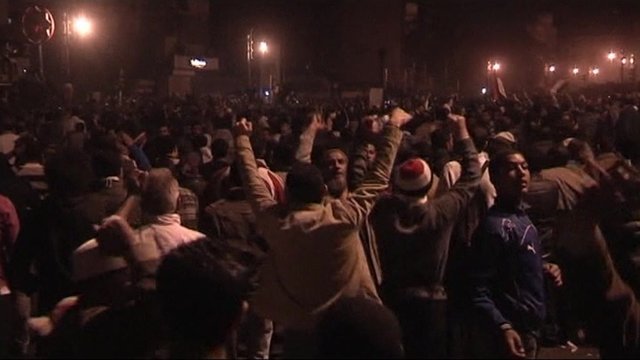 Protesters against Egypt's military rulers remain camped in Cairo's Tahrir Square for a third day, after the deaths of at least 13 people in violence over the weekend.
Security forces launched a major assault to clear the square on Sunday, but protesters returned within an hour.
The unrest casts a shadow over elections due to start next week.
It is the longest continuous protest since President Hosni Mubarak was ousted in February.
Demonstrators say they fear Egypt's governing Supreme Council of the Armed Forces (Scaf) are trying to retain their grip on power.
The council, led by Field Marshal Mohamed Tantawi, is charged with overseeing the country's transition to democracy after three decades of autocratic rule under Mr Mubarak.
'Worst violence in months'
Clashes were reported late into the night, with the injured being taken to makeshift clinics on the streets.
Demonstrators on Sunday were seen throwing stones and petrol bombs at armoured personnel carriers and police. Security forces responded with tear gas and rubber bullets.
Witnesses reported scenes of panic when hundreds of soldiers and police beat protesters on their heads as they chased them out of Tahrir Square.
Protesters - some of them brandishing spent bullet casings - accuse security forces of also using live fire, a claim denied by police.
Violence has also taken place in other cities including Alexandria, Suez and Aswan.
A total of 11 people were reportedly killed on Sunday and two on Saturday, according to medical sources. Health officials say as many as 900 have been injured, including at least 40 security personnel.
A statement from the cabinet said elections, due to begin in a week, would go ahead, and praised the "restraint" of interior ministry forces against protesters.
The military council, in a statement read out on state television, said it "regretted" what was happening, AFP news agency reports.
In recent weeks, protesters - mostly Islamists and young activists - have been holding demonstrations against a draft constitution that they say would allow the military to retain too much power after a new civilian government is elected.
They have repeatedly tried to regain a foothold in Tahrir Square - the focal point of the protests against Mr Mubarak - but until this weekend they had always been removed quickly by the police.
The latest violence is some of the worst in months between the Egyptian authorities and demonstrators.
Parliamentary elections are scheduled to begin on 28 November. In all, the election process will take three months to complete.
Earlier this month, the military council produced a draft document setting out principles for a new constitution.
Under those guidelines, the military would be exempted from civilian oversight, as would its budget.
This has angered protesters who fear the gains they have made during the uprising could yet slip away as the military tries to retain some grip on power.
BBC
Spain election: Rajoy's Popular Party declares victory
Spain's centre-right Popular Party (PP) has won a resounding victory in a parliamentary election dominated by the country's deep debt crisis.
With almost all the votes counted, the PP, led by Mariano Rajoy, is assured of a clear majority in the lower chamber.
The Socialist Party, which has governed Spain since 2004, has admitted defeat.
Mr Rajoy, who is expected to tackle the country's debts amid slow growth and high unemployment, said he was aware of the "magnitude of the task ahead".
He told supporters there would be "no miracle" to restore Spain to financial health, and that the country must unite to win back respect in Europe.
"Forty-six million Spaniards are going to wage a battle against the crisis," said the 56-year-old PP leader.
The PP won about 44% of the votes and the Socialists 29% in Sunday's election, according to near-complete official results.
The PP is expected to take about 186 of the 350 seats in the lower house.
As the results were announced, jubilant, flag-waving supporters danced outside party headquarters in central Madrid.
Socialist Party spokesman Jose Blanco congratulated the PP on its victory.
The BBC's Sarah Rainsford in Madrid says the right is headed for its biggest win since the end of the Franco dictatorship in 1975.
Parliament is expected to meet next month to confirm Mr Rajoy as the new prime minister.
'Sacrifices ahead'
The new government will have little time to show results and people are bracing themselves for a new wave of spending cuts, our correspondent adds.
Over the past week, borrowing rates have risen to the 7% level which is regarded as unsustainable. Unemployment stands at five million.
Miguel Arias, the Popular Party's campaign co-ordinator, said Spain was "going to make all the sacrifices".
"We have been living as a very rich country," he told BBC News.
"People are used to a very high level of public services and it takes time to them to acknowledge the realisation that we now are a poor country, that we have lots of debts and in order to pay them back we must reduce public expenditure and then we must recover the confidence of the markets."
Outgoing Socialist Prime Minister Jose Luis Rodriguez Zapatero was not standing again at this election.
His successor as party leader, Alfredo Perez Rubalcaba, has accused Mr Rajoy of planning severe cuts to health and education.
"Spain is at a historic crossroads," he told reporters in Madrid.
Correspondents say many are angry with the Socialists for allowing the economy to deteriorate and then for introducing tough austerity measures.
Spain's is the third Eurozone government in as many weeks whose fall has been attributed to the debt crisis.
The socialists in Greece and Silvio Berlusconi's Italian conservatives have also been swept from power.
Earlier this year, the governments of debt-stricken Ireland and Portugal also fell.
Gaddafi's spy chief Abdullah al-Sanussi 'captured'
Col Gaddafi's fugitive spy chief Abdullah al-Sanussi has been captured, Libya's interim government says.
He was seized by fighters in the south of the country, officials say.
Mr Sanussi, who has not yet been seen in custody, was one of the last senior figures from the Gaddafi regime still on the run.
Gaddafi's son Saif al-Islam was seized on Saturday. Both he and Mr Sanussi are wanted for alleged war crimes by the International Criminal Court (ICC).
Mr Sanussi, a brother-in-law of Col Gaddafi, is said to have been arrested at his sister's home in the southern town of Sabha on Sunday.
He was regarded as the late leader's right-hand man - and one of the regime's most-feared figures.
Mr Sanussi, 62, is being sought by the ICC in connection with the repression of protests against Gaddafi's rule earlier this year.
He has also been accused of human rights abuses, including his implication in the massacre in 1996 of more than 1,000 inmates at the Abu Salim prison in Tripoli.
'Fair trial'
Mr Sanussi was a close adviser to Saif al-Islam Gaddafi, according to leaked US embassy documents.
Saif al-Islam is due to be interrogated by prosecutors at a secret location in the western city of Zintan, where he was taken by militiamen who seized him in Libya's southern desert.
The commander of the Zintan militia told the BBC their prisoner was being well-treated at a private house, and had seen a doctor on Sunday about a wound to his hand.
The commander also gave details of the capture on Saturday. He said Saif al-Islam had asked to be shot dead but the militias refused.
The interim government has indicated it wants to try him in Libya, and interim Prime Minister Abdurrahim al-Keib said he would receive a fair trial.
Concerns have been raised about the possibility of ill-treatment, after what happened to Gaddafi following his capture in Sirte last month.
ICC prosecutor Luis Moreno Ocampo is to visit Libya to discuss the handling of the case of Saif al-Islam. He is expected to request his extradition to the Hague.
Mr Ocampo has said that while national governments had the first right to try their own citizens for war crimes, his primary goal was to ensure a fair trial.
BBC Middle East correspondent Jon Leyne says allowing Saif al-Islam to be taken out of Libya would be hugely unpopular there and, quite possibly, his Zintan captors would refuse to hand him over.
New York man arrested suspected of bomb plot
A resident of New York has been arrested on suspicion of planning to bomb targets including police cars and postal offices, the city's mayor said.
Jose Pimentel, 27, was charged with terrorism-related offences, Michael Bloomberg said at a news conference in New York.
Mr Pimentel was described as a "lone wolf" who also allegedly planned to target US troops returning from abroad.
He was inspired by al-Qaeda, Mr Bloomberg said.
Mr Bloomberg was speaking at a briefing along with New York Police Commissioner Raymond Kelly and District Attorney Cyrus Vance, the chief prosecutor for Manhattan.
'Acted alone'
Mr Pimentel allegedly got instructions on how to build a pipe bomb from al-Qaeda's Inspire magazine, published by radical cleric Anwar al-Awlaki, who was killed by a US drone attack in Yemen in September.
One of the articles was entitled "How to make a bomb in the kitchen of your mom", according to Mr Kelly.
Mr Pimentel spoke about "killing US servicemen returning from Iraq and Afghanistan, particularly US army and marine corps personnel", Mr Kelly said.
"He talked about bombing post offices in and around Washington Heights and police cars in New York City, as well as a police station in New Jersey," the police chief added.
But officials said Mr Pimentel was "not part of a larger conspiracy".
The mayor said police had constructed a duplicate of an explosive device he alleged the suspect had built, before showed a videotape of it blowing up an unidentified car.
Mr Pimentel, who had been monitored since May 2009, was charged with three terrorism-related counts and two other counts.
According to court documents cited by AP news agency, Mr Pimentel told police he "took active steps to build the bomb, including shaving the match heads and drilling holes in the pipes" and was "one hour away from completing it".
Syrian Baath Party in Damascus 'hit by rockets'
 At least two rocket-propelled grenades have hit a building of Syria's governing Baath Party in the capital Damascus, residents and activists say.
One witness said security forces had blocked off the square, while smoke was seen rising from the building.
If confirmed, it would be the first such attack reported inside the capital since the uprising began in March.
A BBC Arabic reporter at the scene saw no signs of damage but said residents reported an exchange of fire overnight.
The reports come amid growing fears of civil war in Syria, after months of unrest.
Foreign journalists are unable to move around Syria freely, making it difficult to verify reports.
The opposition Local Co-ordination Committees (LCC) said "several" RPG rockets were shot at the Baath Party building in the Mazraa neighbourhood and that two fire brigades have been dispatched to the area.
'Message to the regime'
An unnamed witness told the Reuters news agency the attack happened before dawn and said the building was mostly empty.
"Security police blocked off the square where the Baath's Damascus branch is located. But I saw smoke rising from the building and fire trucks around it," he told Reuters
"It seems to have been intended as a message to the regime," he added.
Syrian President Bashar al-Assad has vowed to continue his crackdown on opposition groups despite mounting international condemnation.
"The conflict will continue and the pressure to subjugate Syria will continue," he told Britain's Sunday Times newspaper.
"However, I assure you that Syria will not bow down and that it will continue to resist the pressure being imposed on it," he added.
BBC
Haiti's president launches plans to restore army
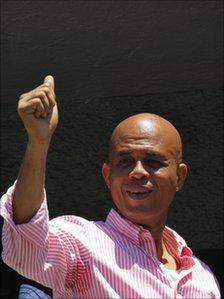 Haitian President Michel Martelly says he is setting up a commission to study plans for a new security force, 16 years after the military was abolished.
Mr Martelly said the panel would look at the aims of the new force and ways of replacing UN peacekeepers who have been deployed since 2004.
International donors have argued that Haiti's focus should remain on rebuilding after the 2010 quake.
The Haitian army was long associated with rights abuses and coups.
Mr Martelly had been widely expected to announce the creation of a military force but his announcement appeared to signal a change in that plan.
Speaking at a ceremony to mark Armed Forces Day, the president said a civilian commission would examine the restoration of the army.
"The commission will have 40 days to prepare a plan to rehabilitate the army which should be presented by 1 January," Mr Martelly said.
"From that moment on we can start to think about the withdrawal of UN troops."
Police training
The army was abolished in 1995 by then-President Jean-Bertrand Aristide, who had been overthrown in 1991 and returned to power three years later.
However, political turmoil continued in the ensuing years and since 2004, the UN's stabilisation mission, Minustah, has operated in the country.
Major donors, including the US and Canada, have said Haiti has the right to have its own army. But they point to what they see as more pressing issues for the nation.
"Canada fears that creating a second security force will significantly reduce the resources available for Haiti's other important priorities," John Babcock, Canadian Foreign Affairs spokesman told AP.
These include rehousing those left homeless by the January 2010 quake; dealing with a cholera epidemic and re-training the national police force.
Mr Martelly campaigned on a promise to restore the army and has tapped into anger directed against Minustah forces, which some Haitians see as foreign occupiers.
"It does seem Martelly has sought to channel anti-Minustah sentiment to bolster support for the reactivation of the armed forces," Mark Weisbrot from the Washington-based Center for Economic and Policy Research told Reuters.
"The risk is that with this move, Haiti's bitter, longstanding divisions, which are never far from the surface, could come back with a vengeance."
Source-BBC
Shell launches Friction Modification Technology
Sol, the Caribbean leader in petroleum products is bringing an improved fuel offering to customers across the region. As licensee of the Shell brand, Sol has announced the introduction of Shell V-Power with Friction Modification Technology (FMT) in seven of its key markets.
The FMT was launched at the Impeccable Banquet Hall, Brickdam, recently. In attendance were Group retail manager Sol Caribbean Ltd, Philip Payne and shell’s scientist, James Marcias. There were also members of the private sector.
According to General Manager of Sol Guyana, Ken Figaro, the brand was launched in Barbados, Belize, Grenada, Guyana, St. Lucia, St. Vincent and Suriname, the new Shell V-Power is an enhanced product developed by Shell in collaboration with Ferrari. The fuel is developed using the same technology used by Ferrari Formula One cars to deliver improved performance from the first fill.
He said that Shell V-Power features a unique double action formulation designed to actively clean your engine and reduce friction to help deliver more power throughout the life of your car.
Figaro noted that Sol as a licensee of the Shell brand remains passionate about offering quality, high performance fuels for your car. The company maintains an unwavering dedication to work with Shell to improve the fuel proposition to the Caribbean since its initial launch across the region in November 2006:
“Our relentless pursuit of excellence and our relationship with Shell has allowed us to offer some of the most advanced fuels in the world. Shell V-Power contains an advanced formulation with performance enhancing components, inspired by what the Shell team has learned on the racetrack with Ferrari.
“This helps to enhance the responsiveness of your engine as it is designed to remove existing power-robbing engine deposits and prevent their build up. In a clean engine, the fuel can burn more effectively enabling the engine to run more smoothly, thus keeping your car fit and strong,” Reidar Karlsrud – Regional Marketing Manager of the SOL Group said.
Locally and regionally, Shell has engaged its customer service attendants, retailers, mechanics and car enthusiasts, in an effort to educate them about the benefits of using Shell V-Power.
Motorists in Guyana can look forward to a range of activities to mark the re-launch of Shell V-Power, including a Happy Hour with giveaways at each Shell service station and promotions. Sol is a Shell licensee and uses Shell trademarks under licence.