
Adele and Taylor Swift rule at American Music Awards
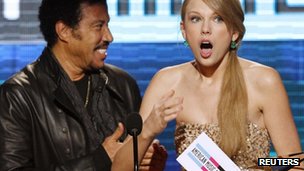 Adele and country star Taylor Swift have won three awards each at the audience-voted American Music Awards.
Adele, absent as she recovers from throat surgery, won the pop/rock prizes for best female and best album, for 21, as well as adult contemporary artist.
Swift, who beat Adele to artist of the year, said "you have no idea what this means to me", having written her album Speak Now solo.
Rapper Nicki Minaj won two gongs, voted for by the US public.
"This is one of the craziest things that has ever happened to me," Swift said at the Los Angeles ceremony.
"I have no idea what I'm supposed to say - I did not think this was going to happen."
The 21-year-old star, who also beat Lil Wayne, Katy Perry and Lady Gaga to artist of the year, also won best female country artist for a second year running and best country album.
Lady Gaga and rapper Lil Wayne went home empty-handed while Katy Perry picked up a special award for becoming the first woman to score five number one US singles from one album, Teenage Dream.
Adele had led the nomination field with four nods.
Minaj, who opened the show in a metallic outfit complete with speakers on her bottom, won the rap/hip-hop prizes for best artist and best album, for Pink Friday.
"This one could actually make me cry," Minaj said, picking up the latter.
Maroon 5 - whose duet with Christina Aguilera on their hit Moves Like Jagger was among 17 performances on the night - were voted best pop/rock group while Bruno Mars was named best pop/rock male.
In the soul/R&B category, Usher was best male, Beyonce was best female and Rihanna won best album for Loud.
Blake Shelton was voted best country male while Lady Antebellum won best country group.
Foo Fighters were favourite alternative rock act while Jennifer Lopez, who performed On the Floor, was favourite Latin artist.
Her performance with Will.i.am on his new single Hard was one of a number of collaborations at the 39th American Music Awards , shown live in the US on the ABC TV network.
Justin Bieber - the winner of four AMAs last year - performed Mistletoe, from his Christmas album Under the Mistletoe, while Kelly Clarkson, Katy Perry, Chris Brown and Enrique Iglesias also sang.

Chevron takes full responsibility for Brazil oil spill
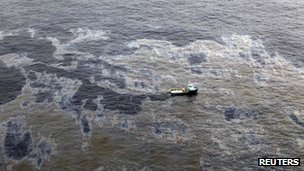 US oil company Chevron says it accepts full responsibility for an oil spill off the coast of Brazil.
Chevron said it had underestimated the pressure of underwater oil deposits while drilling, causing oil to rush up the bore hole and seep into the surrounding seabed.
Brazilian regulators said 416,400 litres had leaked since the accident happened almost two weeks ago.
Chevron said the leak had now been plugged.
But the head of Chevron's Brazil operation, George Buck, said there continued to be a residual oil flow from undersea rock near the well in the Frade oil project, 370km (230 miles) off the Brazilian coast.
Earlier this week, Brazil's Energy Minister Edison Lobao said the company would be "severely punished" if it was found to have failed in its environmental responsibilities.
'Questionable methods'
Chevron initially estimated that 400-650 barrels of oil had formed a sheen on the water after seeping from the seabed near the well.
But the international environmental group Skytruth said satellite images suggested the spill was many times bigger.
Police environment experts have been trying to assess the scale of the spill.
Head of the Federal Police Environmental Division Fabio Scliar also questioned the methods Chevron was using to clean up the spill.
Mr Scliar said the company was "pushing" the oil to the bottom of the sea, rather than gathering it, putting corals in the area at risk of pollution.
In recent years Brazil has discovered billions of barrels of oil in deep water that could make it one of the world's top five producers.
So far there has been little public debate about the environmental dangers of offshore drilling.
Political discussion has instead focused on how future oil revenues should be divided between different states.
Trade unions in T&T talk of bringing down the Govt
The trade union movement plans to bring down the Government by not supporting its re-election, president general of the Oilfield Workers Trade Union (OWTU) Ancel Roget has said.
Speaking at the community meeting held by the Joint Trade Union Movement in Point Fortin on Saturday evening Roget said, "Government would have never been in power if it was not for the labour movement's support and he made no apologies for the trade unions' plan to bring down the Government.
Roget told the Express "Government will not be getting the labour movement's support. They have attacked the labour movement and the workers of this country and have betrayed them and therefore we believe that a campaign must start highlighting all of these issues and if they think that means bringing them down, then so be it."
Roget said the unions are insisting that the State of Emergency which was called was to stymie the progress and the campaign of the trade union movement for better wages and terms and conditions and continue to call for its immediate end because it is hampering their mobilisation.
"The unions pledged their support to resist in whatever way necessary the imposition of the five per cent and we did say that the Government can take us to the courts and ask the courts to impose the unfair five per cent wage settlement on us. But in the hearts and minds of the people of this country we are not taking that just like that, because there is a political price to be paid.
"We will insist that they will not be returned to governance. They have betrayed the trust of the people of Trinidad and Tobago, we cannot support all of the nonsense.
"At the end of the State of Emergency whether it ends next month, next year, or before the elections, it must end and when it ends we are calling on all citizens, all workers to be prepared for a massive street demonstration in the likes of which this country has never seen before."
The demonstration he said will be to highlight their disapproval of the type of governance which has taken place since May 24 last year.
Roget added that despite the inclement weather on Saturday there was a large turnout to the meeting that was initially scheduled to be held at the Point Fortin Town Hall but which had to be relocated to the Festival Square in Point Fortin.
-TRINI EXPRESS
Peru archaeologists find pre-Inca sacrificed babies
Researchers at the Sillustani archaeological site in Peru say they have found the bodies of 44 children thought to have been sacrificed between 600 and 700 years ago.
They were buried in pairs in baskets placed around stone funerary towers.
Researchers said their ages ranged from newborns to three years old.
The archaeologists believe they belonged to the Kolla culture, which ruled parts of the Puno region of southern Peru between 1200 and 1450.
All the bodies had a volcanic stone placed on their chest, and were surrounded by a variety of offerings, including animals, food, dishes and pitchers, archaeologist Eduardo Arisaca said.
Researchers at the site say ceramics with paintings of scenes of war found with the bodies suggest the children were sacrificed during a period of conflict between the Kolla and a rival culture.
They said the bodies were found near a 10m-tall (32ft) circular stone tower known as Chullpa Lagarto.
The bodies of some 200 people have been unearthed near the tower at the Sillustani site some 1,300km (800 miles) south-east of the capital, Lima.
Rihanna `not fit’ – Bajan church leader
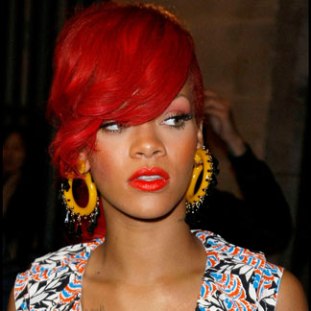 Concerned that Barbados is in a state of decay and immorality, a church leader has accused world-class singer Rihanna of “always doing foolishness”, and called her unworthy of being an ambassador.
At a service launching the Independence anniversary celebrations being put on by the Democratic Labour Party (DLP), Bishop Dr Marlon Husbands took issue with some of the actions of the pop star, and also expressed concerns about the level of indiscipline, immorality and homosexuality in the country.
Speaking at the Sanctuary Empowerment Centre on Country Road, St Michael, before an audience that included Acting Prime Minister Ronald Jones, President of the Senate Sir Branford Taitt and Speaker Michael Carrington and fellow Members of Parliament Steve Blackett and Patrick Todd, Bishop Husbands lambasted Rihanna for the controversy that ensued last September in Dublin when a farmer told her to cover up after she stripped down for a video in a wheat field.
Barbados above US
The World Economic Forum has ranked Barbados’ infrastructure – its roads, bridges, airport, harbour and other facilities – ahead of the United States’.
In its latest global report on competitiveness, the WEF placed Barbados in the 22nd spot, a notch above the United States at 23rd.
In the United States the classification triggered much anguish about the state of the infrastructure and criticism of the Forum’s methodology that measures competitiveness.
American experts and analysts are asking the question: is Barbados’ infrastructure that good or America’s really so bad?
The discussion is being waged in blogs and the Washington Post newspaper.
The American Society of Civil Engineers has given the United States’ infrastructure a failing “D” grade.
Tiger Woods wins winning point for United States in the Presidents Cup
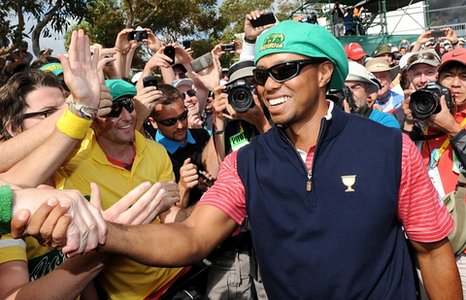 Tiger Woods earned the winning point as the United States beat the International team 19-15 to clinch the Presidents Cup in Melbourne.
Woods beat Australian Aaron Baddeley 4&3 to give the US the 18 points they needed to retain the Cup.
The US led 13-9 going into the singles and lost the first four matches, but on a tense afternoon Woods sealed victory from the penultimate pair.
"It feels good," said Woods. "I hoped it wouldn't come down to my point."
Woods's victory was a repeat of 2009, when he hit the winning putt against South Korea's YE Yang at San Francisco to hand the United States their sixth Cup.
The former world number one, who was a controversial wildcard pick after injuries and a serious slump in form, credited team-mate Steve Stricker for a putting tip.
"I played well all week, but unfortunately didn't make any putts in the first four matches," said Woods, who earned two points out of a possible five. "Today was a different deal - they poured right in."
US captain Fred Couples, celebrating his second win in charge, said: "For Tiger to get the winning point makes us feel very good as a team.
"I don't think I've ever been vindicated in golf, but I feel like I know what I'm doing. When I picked Tiger a month early, he worked six to eight hours a day on his game.
"When a guy looks you in the eye and says: 'Don't worry about me, I'll be right', it brings a smile to your face, especially when it's Tiger.
"I got frustrated a bit (by the attacks on his selection) because I felt I was picking the greatest player I've ever seen play.
"I heard he was the Tiger of old today and Aaron Baddeley said it was phenomenal."
The International team, who last won the Presidents Cup in 1998, also at Royal Melbourne, made a fast start on a sunny day in Victoria.
Wins for KT Kim, Charl Schwartzel, Ryo Ishikawa and Geoff Ogilvy against Webb Simpson, Dustin Johnson, Bubba Watson and Bill Haas respectively gave them hope.
But Hunter Mahan trounced Jason Day 5&3 and David Toms thrashed Robert Allenby 7&5 to nudge the US ahead.
Adam Scott kept the Internationals in the hunt with a 2&1 win over the previously unbeaten Phil Mickelson, while Nick Watney defeated KJ Choi 3&2.
But Jim Furyk maintained his 100% record with a 4&3 victory over Ernie Els to take the US to the brink before Woods sealed victory.
In the two games still going, South Africa's Retief Goosen beat Matt Kuchar and Stricker overcame YE Yang to widen the gap to four points again.
International team captain Greg Norman said: "The guys stepped up to the plate, very, very proud of them for doing that.
"My team can hold their heads up extremely high. We'll take a lot out of this tournament."
South Africa's Garth Mulroy wins Alfred Dunhill title
South African Garth Mulroy won the Alfred Dunhill Championship at Leopard Creek after a final round 68 saw him hold off a challenge from Scotland's George Murray.
Murray, from Anstruther, shot a closing 67 to put pressure on Mulroy, but he eventually finished two shots behind.
Birdies for Mulroy at the 15th and 16th holes meant he could close with two pars to win the title.
Scotland's Peter Whiteford finished tied for third after a final-round 71.
Mulroy led by two shots after the third round and was three under par for his final round until a dropped shot at the par-four 14th.
He responded immediately and the birdies at the 15th and 16th gave him a cushion over Murray that he would not relinquish. He finished on 19 under par.
Murray sparkled in his final round making birdies at the eighth, 10th and 11th holes before an eagle three at the par-five 15th.
He was closing in on Mulroy but could not finish better than level par over the last three holes, ending on 17 under par for the tournament.
England's Steven Tiley finished joint ninth, while compatriots Robert Dinwiddie, Graeme Storm and Sam Little all tied for 15th.
This is the third professional title Mulroy has won in his homeland - in 2008 he won both the Coca Cola Championship and the Vodacom Origins title.
Rafael Nadal battles to beat Mardy Fish in ATP Tour Finals
Rafael Nadal survived a stern examination of his title credentials to edge out the brilliant Mardy Fish in a late-night classic at the ATP World Tour Finals.
Nadal had not played a competitive match since 13 October and it was all-too apparent as eighth seed Fish fought back from losing the first set to threaten a massive upset.
The crowd at London's O2 Arena were treated to a titanic decider as the clock ticked and both men gave absolutely everything to secure an opening-day win.
Nadal eventually emerged triumphant at 2329 GMT, winning 6-2 3-6 7-6 (7-3) in two hours and 53 minutes of enthralling competition.
The event organisers could not have wished for a better start to the season-ending championship - with Roger Federer's victory over Jo-Wilfried Tsonga also going the distance earlier on Sunday.
But the number of spectators in a capacity crowd that had to leave before the Nadal-Fish match drew to a close will raise questions about the decision to schedule the evening singles matches not before 2000 GMT.
Nonetheless, it made for a thrilling spectacle and Nadal, who required a bathroom break for a stomach problem late on, must now recover in time to play Federer on Tuesday, while Fish takes on Tsonga.
Federer and Andy Murray were among those to predict that Nadal, who took time off to rest after defeat by Florian Mayer in Shanghai, could show signs of rustiness and so it proved.
Fast indoor courts have always been the world number two's least-favourite surface and his preparations were further disrupted when he called the trainer to tape his fingers before play had even begun.
Fortunately for the Spaniard, he was facing a tournament debutant who looked nervous in his new surroundings and three poor errors saw Fish broken to 15 in the opening game.
Nadal was posting an unusually low first-serve percentage but dominating all baseline rallies, and he came out on top after a sensational exchange to move 4-2 ahead before striking again with a forehand winner in the following game.
When the left-hander comfortably served out the set with a nod in the direction of his uncle and coach Toni, it seemed he was heading for a carefree evening.
But if that was the script, nobody had told Fish and, by making greater use of his volleying skills to navigate his own service games, he was able to apply serious pressure on the Nadal delivery
Nadal went long and wide to put Fish 2-0 lead in the second set and he almost fell further behind in game six, scrambling all over the court to save two break points for 4-2.
Large sections of the crowd were now pulling for Fish and the American responded with some hugely aggressive tennis, surging to the net at every opportunity.
He forced another four break points in game eight - only for Nadal to hold for 3-5 - before rescuing one himself as he took the match to a third set.
Nadal had won seven of their eight meetings, and that looked certain to become eight of nine when the Spaniard went 2-0 up in the decider with a stunning forehand pass. It was at that point that he left the court for a short time.
However, Fish had nothing to lose and hit straight back with a delicious pick-up that died as it crossed the net, a hold to 15 and backhand winner to for 3-2.
With the remaining spectators routinely being brought to their feet, Nadal broke back to love with a forehand pass before both men held for 4-4.
Fish managed to save two match points in game 10 but showed only flashes of his previous brilliance in the tie-break, netting a backhand volley to end a memorable contest.
Chelsea 1 - 2 Liverpool
Glen Johnson's late winner gave Liverpool victory as Chelsea's indifferent run of form continued.
The Reds recorded a Premier League double over Chelsea last season - and secured three points again as Johnson produced a moment of individual brilliance to clinch victory with three minutes left.
The recalled Maxi Rodriguez crowned a sweeping passing move to give the visitors a half-time lead, but Blues boss Andre Villas-Boas looked to have changed the course of the game when substitute Daniel Sturridge equalised after the interval.
Johnson made his spectacular intervention against his former club just as the points looked set to be shared, taking Charlie Adam's pass in his stride before cutting through the hosts' defence to beat Petr Cech.
Liverpool manager Kenny Dalglish celebrated wildly on the touchline, but it was total despair for Villas-Boas as Chelsea slumped to their third loss in four Premier League games.
And of great concern to Villas-Boas will be the fact that their high-profile meetings with Manchester United, Arsenal and now Liverpool have all ended in defeat.
The Londoners stand 12 points behind leaders Manchester City and on this evidence their hopes of winning the title may have already disappeared.
Chelsea officials insisted before kick-off that reports of the first cracks surfacing in the relationship between Villas-Boas and owner Roman Abramovich were "total nonsense", but there is no question their form has deteriorated after a competent rather than spectacular start to the season.
For Liverpool, the joy at the final whistle was a world away from the jeers that greeted the goalless draw with Swansea at Anfield in their last league game.
Villas-Boas and Dalglish left £85m of striking talent on the bench as £50m Fernando Torres missed out on the chance to start against his former club and Andy Carroll was excluded from Liverpool's starting line-up.
They only made late appearances, with Torres introduced in a vain attempt to win the game for Chelsea and Carroll emerging as Liverpool tried to ensure they would hang on to their lead.
Chelsea's first-half display was lamentable but they did create an early opportunity when Juan Mata fired across the face of goal, while large sections of the Stamford Bridge crowd thought they had taken the lead when Didier Drogba's free-kick hit the side-netting.
Liverpool, in contrast, were composed and ordered with the movement of Luis Suarez and Craig Bellamy a constant threat, especially to the indisciplined David Luiz.
Chelsea were unable to pierce the visitors' midfield and the visitors went ahead after 33 minutes when Jon Obi Mikel conceded possession to Adam in dangerous territory. Suarez then found Bellamy, whose perfect pass was an open invitation for Maxi to sweep his finish past Cech.
Dalglish's side ended the opening 45 minutes in complete command - forcing Villas-Boas to respond by removing the labouring Mikel and sending on Sturridge.
The change was rewarded 10 minutes after the restart when Florent Malouda was allowed too much time and space to run into the area before crossing for Sturridge to tap in to an unguarded net.
As the momentum changed, Pepe Reina produced a brilliant save from Branislav Ivanovic's low header with Chelsea sensing the game was now turning in their favour.
Liverpool, for the first time, were in retreat and Malouda should have put Chelsea in front with 16 minutes left, only to scuff a finish across the face of goal with Reina exposed.
Chelsea introduced their two former Reds players, Torres and Raul Meireles, with six minutes left - but it was Dalglish's side that immediately had a chance to regain their advantage.
Substitute Jordan Henderson skipped past a succession of challenges to allow Downing to set up Dirk Kuyt who shot wastefully wide, much to Dalglish's obvious disgust.
Chelsea failed to heed the warning and Liverpool made no mistake when they created another opportunity with three minutes remaining.
Adam's raking pass found Johnson, who evaded Ashley Cole and Malouda to score with great composure and give Liverpool their latest Stamford Bridge win.