
Hurricane Rina grows in Caribbean
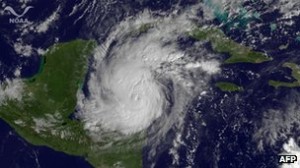 Hurricane Rina has swelled to a Category 2 storm as it sweeps towards Mexico’s Yucatan peninsula and Caribbean beach resorts.
The US National Hurricane Centre (NHC) said Rina was expected to become a “major hurricane” by Tuesday night.
Further south, a Nicaraguan navy vessel that went missing in the storm with 27 people on board has been found safe.
The vessel, which had been evacuating fishermen, was spotted by a shrimping boat after two days adrift.
Destructive waves
At 1500GMT Rina was already packing sustained winds of 105mph (165kph), the NHC said.
It was expected to further increase in strength before hitting the coast of Yucatan on Thursday morning.
A hurricane warning is in force from Punta Gruesa to the tourist resort city of Cancun on Mexico’s Caribbean coast, with tropical storm conditions extending further south.
Destructive waves and rainfall of 8 to 16 inches (20-40cm) are predicted.
Rina formed off the coast of Honduras and Nicaragua but has now turned away from Central America, which is already struggling to recover from weeks of torrential rain.
Floods and landslides have killed more than 100 people in the region, with El Salvador and Guatemala particularly badly effected.
The UN has launched an emergency appeal for $15.7m (£9.8m) in funds to help 300,000 people affected by the downpours in El Salvador.
“El Salvador is facing one of the biggest disasters in its history, given the scale and magnitude of the impact, as well as the damage caused to agriculture and infrastructure,” Elisabeth Byrs of the UN Office for the Coordination of Humanitarian Affairs said.
Throughout the region, 1.2m people had been affected, the UN said.
The presidents of El Salvador, Guatemala and Honduras are meeting in San Salvador to discuss the disaster and issue a joint appeal for international aid.
Source-BBC News

Gadhafi's friend to the death, Chavez calls Libyan leader 'a martyr'
It was the year 2000. Standing at attention, a relatively unknown Venezuelan President Hugo Chavez, only 18 months after taking office, was positioned right next to one of the world's most-controversial dictators.
Libyan leader Moammar Gadhafi, then seeking alternative alliances with leaders in other parts of the world, was receiving Chavez with military honors on August 13 of that year. Chavez appeared proud, standing next to his new and powerful friend in North Africa.
The friendship between Chavez and Gadhafi solidified in 2004, when the Libyan leader awarded Chavez the Al-Gaddafi International Prize for Human Rights, an honor he had already given to another Latin American leader, Cuba's Fidel Castro in 1998.
By 2009, the friendship had become very close. On September 1 of that year, Gadhafi welcomed Chavez to Libya with a warm embrace. Chavez was one of various world leaders attending festivities there, held to commemorate Gadhafi's 40 years in power.
Chavez would return the compliment later that month when Gadhafi visited Venezuela, presenting the Libyan leader with a replica of the sword that belonged to South American independence hero Simon Bolivar, one of the greatest honors in Venezuela.
It was Gadhafi's first visit to Latin America in his 40-year rule. Both leaders were photographed greeting supporters on Venezuela's Margarita Island beach resort, a favorite tourist destination.
And just in case there was any doubt about their closeness, Gadhafi named a stadium just outside Benghazi the "Hugo Chavez Stadium." The stadium was renamed earlier this year "Martyrs of February" by Libyan rebels, who would eventually form the National Transitional Council and put an end to Gadhafi's regime.
Chavez learned of Gadhafi's death as he returned Thursday from Cuba, where he's getting cancer treatment.
"I was talking with (Cuban leader) Raul Castro. He was telling me 'Gadhafi is going to get killed for sure,'" Chavez said.
"Regrettably, Gadhafi's death has been confirmed. He was murdered. Well, this is another attempt against life. What else can I say? ... I will remember him all of my life as a great fighter, a revolutionary and a martyr," he added.
In March, after the conflict in Libya had started, Chavez proposed an international goodwill commission to mediate the crisis while accusing the United States and other Western powers of blowing the situation out of proportion to justify an invasion.
Chavez wasn't the only Latin American leader who supported Gadhafi. In a statement dated February 21, Cuban strongman Fidel Castro wrote that he "couldn't imagine that the Libyan leader would ever abandon his country" when fighting broke out. "He would never avoid his responsibilities," Castro wrote.
The new Libyan government faces some challenges in Latin America. Presidents Evo Morales of Bolivia, Daniel Ortega of Nicaragua, and Cuba's Raul Castro all have refused to recognize Libya's National Transitional Council. As an oil producing country, Libya was Venezuela's partner under OPEC -- a relationship that has to be rebuilt as well.
Source-CNN
Amnesty: Killings by Dominican police 'alarming'
Police in the Dominican Republic were responsible for an "alarming" 10.5% of the nation's killings last year, Amnesty International said Tuesday, citing government statistics.
A report from the human rights organization sharply criticizes the Caribbean nation's police, saying they have been behind "scores of cases of killings, torture and ill-treatment."
"These abuses are committed by the same police who are supposed to protect the people in the country, which is going through a rising crime rate," said Chiara Liguori, Caribbean researcher at Amnesty International.
Speaking to CNN before the organization released its report, National Police spokesman Col. Maximo Aybar said police in the Dominican Republic were committed to protecting the public.
"We are more than aware that we are here to defend members of society, not to assault them. And that is an institutional position. In those cases where excesses may have been committed, investigations have occurred and measures have been taken: members were suspended from their posts and placed at the disposition of the courts," he said.
Police were responsible for at least 260 of the nation's 2,472 homicides in 2010, Amnesty International said, citing statistics from the National Police and the prosecutor general. That figure marked a decrease from previous years. In 2008, for example, police were responsible for 19% of the killings in the nation. Details about the circumstances of those killings were unclear.
A spokeswoman for Amnesty International said the organization does not have comparable figures for other nations. In the United States, the killing of felons by law enforcement officers made up 3% of slayings in 2010, according to FBI homicide statistics.
In the Dominican Republic, the 977 people injured by police in 2010 accounted for 16.6% of violent injuries in the nation that year, according to Amnesty's report.
Amnesty International said Dominican police interviewed by the organization denied torture allegations and argued that the number of deaths corresponds with police efforts to stop crime. Police also said those killed were convicted or suspected criminals, Liguori said.
"Deaths among the police and the criminals occur because the police carry out preventative patrols. If the police wouldn't do that, there would be no deaths, but criminality would remain unchallenged," said one police chief, according to Amnesty's report.
Police also have been victims. So far this year, 97 officers have been killed, and 176 have been injured, police said.
Last month a United Nations report noted that homicide rates have soared in the Dominican Republic, citing rising organized crime as a cause.
Tough conditions for policing are no excuse for human rights abuses, said Amnesty International, which said the nation must reform its police force to increase accountability and stop human rights violations.
"Unlawful and unprofessional conduct by many police officers is contributing to the rise in crime and violence in the Dominican Republic," Amnesty's report said. "Widespread police corruption, aggressive policing and the involvement of law enforcement officers in criminal activities are undermining the capacity of the state to protect human rights and ensure public security."
Source-CNN
New Jamaican PM becomes region’s youngest
History was created on Sunday, when 39-year-old Andrew Michael Holness was sworn in as Jamaica’s youngest prime minister.
In a 90-minute ceremony presided over by Governor-General Sir Patrick Allen and attended by some 4,000 guests, the country’s first Jamaican head of government born in the post-independence era (1962) took the oaths of allegiance and office, before being presented with the instrument of office as the nation’s ninth prime minister.
The changing of the guard also saw the standard of outgoing prime minister, Bruce Golding, being lowered and replaced by Holness’, thereby completing the transition.
Prior to these formalities, Golding formally tendered his resignation on Sunday, and advised the governor-general of the decision by the majority of government members of the House of Representatives to endorse Holness as his successor.
The new prime minister had served as education minister since the ruling Jamaica Labour Party (JLP) won the 2007 General Election. He was also the youngest member of Golding’s Cabinet.
Golding, who assumed the office of prime minister over four years ago, had indicated his intention to demit office in September, stating that the challenges of the last four years had taken a toll and it was appropriate for him to make way for new leadership to continue the programmes of economic recovery and transformation, while mobilising the JLP for the next general election.
He delivered his last national address on Saturday. However, Golding remains leader of the JLP until the party’s annual conference in November.
Holness’ meteoric rise to prime minister came within 14 years, and has seen him move from Member of Parliament (for West Central St Andrew), having been first elected to the House of Representatives in 1997, to opposition spokesman, to Cabinet minister and Leader of the House of Representatives.
He has become the third youngest politician in the English-speaking Caribbean to assume the position, and one of three to do so prior to age 40. The others are: Bharrat Jagdeo, who became president of Guyana in 1999, at age 35; and Roosevelt Skerrit, who was installed as Dominica’s prime minister in 2004, at age 32.
Holness, however, currently holds the distinction of being the youngest head of government in the English-speaking Caribbean, by 40 days, over Skerrit.
In his near one hour-long inaugural address, Holness declared that it was with a deep sense of honour and humility that he took the oath of office and that he was cognizant of the “awesome responsibility” he now has.
“I want to express appreciation to all those who have reposed confidence in me. Rest assured I am totally focused on the task of helping the Jamaican people realize their hopes and aspirations. I pledge to serve the people of Jamaica faithfully, with all my energies, all of my heart, mind and soul,” he stated, while paying tribute to his predecessors, particularly Golding.
The governor-general congratulated Holness, urging him to use the confidence reposed in him by his colleagues, and the “tremendous” goodwill of the nation, to “step forward boldly and respond to the needs of the country”.
“Today, you will embark on an epic journey. (You) will be tasked with the responsibility to catapult us into a rapidly changing world, and allow us to be comfortable doing business and interacting, without losing our identity as a unique group of people. We must position and understand ourselves in the context of global economic and geo-political relationships, and leverage recognition and respect, that the world has for us, to our advantage,” he said.
Paying tribute to Golding’s tenure, the governor-general said the leadership transition symbolized “the end of one cycle and the beginning of another”. He noted that the former prime minister provided leadership at a time of global economic challenges.
“You presided over a watershed period in the history of our country, and successfully provided us with a steady footing from which to transition into our 50th year of independence,” he stated.
The governor-general praised Golding for endeavouring to do what he felt was in the nation’s best interest, adding that “history will be the judge of whether you succeeded (or not)”.
Meanwhile, the secretary general of the Organization of American States (OAS), José Miguel Insulza, on Monday congratulated Holness, and extended the full support of the hemispheric organization as well as his best wishes for a successful term in office.
“It’s a tribute to Jamaica’s unwavering commitment to democracy that the transfer of state power on Sunday passed from one elected Member of Parliament to another,” Insulza said in a letter to the prime minister, adding that his country “should take pride in the smooth transition of leadership in government.”
The head of the OAS recalled in the letter that “Jamaica has been a strong and consistent partner in the work and efforts of the Organization in the Hemisphere.”
“Therefore, we offer full support and cooperation from the OAS,” he concluded.
Source-Caribbean News Now
Trinidad and Tobago to launch first drug treatment court in 2012 with OAS support
Trinidad and Tobago will launch the country’s first drug treatment court in 2012, to include technical assistance, training and cooperation from the Inter-American Drug Abuse Control Commission (CICAD) of the Organization of American States (OAS).
The Minister of National Security of Trinidad and Tobago, John Sandy, said his country “needs to find different and innovative alternatives to improve citizen security.” In response to that need, the drug treatment courts have emerged as a multi-disciplinary practice policy marrying prevention policies, treatment and justice, and have shown results in other countries of the hemisphere to reduce crime and with it, the recidivism rate, the prison population and drug dependency.
This strategy includes the establishment of drug treatment courts where an individual’s recovery is closely supervised by a judge with the power to reward progress and rebuke relapses. To this end, the judge uses a team of prosecutors, defence lawyers, health professionals, social workers and police to rehabilitate and reintegrate individuals back into the community.
The OAS is working with a number of organizations to identify innovations and good practices in addressing the needs of drug-dependent offenders, both through drug treatment courts and other holistic approaches that treat the individual, his or her family, work, health and social wellbeing as a whole, while still ensuring that the community’s security concerns are met.
Other countries of the region to initiate pilot projects or similar developments with support from the OAS include: The Bahamas, Jamaica, Argentina, Dominican Republic and Costa Rica.
The announcement was made by the Chief Justice of Trinidad and Tobago, Ivor Archie, during the opening ceremony of the training workshop “Implementation of Drug Treatment Courts as an Alternative to Incarceration for Drug Dependent Offenders,” held October 18 to 21 in Port of Spain.
The workshop was attended by more than 70 judges, prosecutors, treatment providers, defence attorneys, probation and police officers from Trinidad and Tobago and The Bahamas, who learned about the experiences of countries that have already implemented treatment drug courts as an initiative to promote a comprehensive approach to treatment and the drug problem in the region.
Source-Caribbean News Now
Did Mark Cuban propose dumping cap?
The NBA and its players association can't even agree on what Dallas Mavericks owner Mark Cuban proposed during a meeting between owners and players last week.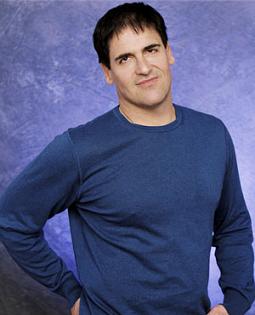
Players association executive director Billy Hunter told Grantland.com's Bill Simmons that Cuban made a proposal he called "the game changer," which would replace the salary cap with a heavy luxury tax for teams that spent beyond certain levels.
NBA senior vice president Mike Bass told The Associated Press that Hunter made "several misstatements" during his hour-long podcast with Simmons. Among them was the revelation of the salary cap plan, which Bass said was actually an exception to the cap, not the elimination of it.
"On behalf of the league, Mark Cuban proposed adding a new salary cap exception, not eliminating the salary cap," Bass said. "It was the union that, in response, proposed eliminating the salary cap, a proposal that was even worse for the NBA than the union's prior proposals."
However, during the interview on Simmons' "BS Report" podcast, Hunter described in vivid detail the proposal to eliminate the salary cap that he said came from Cuban.
"We took that idea back into our room and we in turn responded with something similar," Hunter said. "I saw the reaction that (Cuban) had to it. I saw the reaction he had to it and two or three other owners in the room who were really excited about it.
"But then, keep in mind that when you start talking about no salary cap, the salary cap has existed in the NBA for at least the last 30 years and it was a creation of David Stern. I don't know if there's any pushback because of that, but we were prepared to pursue that whole idea of going into a different direction. We wouldn't have to worry about a cap, so the exception, salaries, all that, there would be no limit with the exception of there obviously being a cap at the top, i.e., a quite heavy tax that teams would have to confront if they went above a certain number.
"But what happened was the owners then decided, at least the leaders of their delegation decided, they had to take it back in a different direction. They said, 'We don't want to address that. We don't want to deal with that idea. We want to go back and proceed along the track that we've been proceeding along for the last year or more.'"
Cuban did not immediately respond to a request for comment from The Associated Press. Stern, the NBA commissioner, has warned that owners, officials or players who comment on the lockout will be fined.
Hunter encouraged Simmons to ask Stern why the NBA wasn't willing to discuss the possibility of eliminating the salary cap. Hunter said the players association has made it clear that they're willing to negotiate on "a minute's notice."
"We're open to the idea that Mark Cuban put on the table," Hunter said.
Tim MacMahon covers the Mavericks for ESPNDallas.com. Information from The Associated Press was used in this report.
WICB advertising three positions
The West Indies Cricket Board is currently advertising for three positions.
The three positions are:
1. Corporate Secretary – based in Antigua
2. Manager – Cricket Development – based in Antigua
3. Head Coach – Sagicor High Performance Centre – based in Barbados
Current Corporate Secretary Mr. Stephen Camacho’s tenure comes to an end this year.
Mr. Anthony Howard, Director of Cricket, has retired following his attaining the age of retirement. Mr. Howard’s retirement was effective at the end of August but his tenure was extended until November.
The WICB is the exclusive governing body for cricket in the West Indies and it is headquartered in St John’s Antigua. The WICB has six constituent members – the Barbados Cricket Association, the Guyana Cricket Board, the Jamaica Cricket Association, the Leeward Islands Cricket Association, the Trinidad and Tobago Cricket Board and the Windward Islands Cricket Board of Control.
The Corporate Secretary will be responsible for all aspects of legal and corporate governance of the WICB.
The Cricket Development Manager will be responsible for the continued implementation and management of the WICB cricket development programmes and will also bear responsibilities for the creation of new development programmes.
The Sagicor HPC Head Coach will be responsible for the facilitation of talent identification and the development of players.
Further details are available on the WICB website at http://www.windiescricket.com/wicb/careers
Former Reggae Boy Griffiths passes on
Former Reggae Boy Winston 'Fanna' Griffiths died at the May Pen Hospital on Sunday.
Griffiths, born September 12, 1978, was seen as one of the most talented footballers to have come out of the parish of Clarendon.
Griffiths, an attacking midfielder, made his debut for the Reggae Boyz in 1998 against Guatemala. He last played for Jamaica in 2002 against Barbados, after playing a total of 28 games and scoring two goals. Up to the time of his death, Griffiths was living in Canada.
As a youngster, he was above his peers, gifted with special dribbling skills, speed and awareness on and off the ball.
Michael Ricketts, Clarendon Football Association (CFA) president and chairman of the Jamaica Football Federation (JFF) Competition Committee, remembering Griffiths, said: "I remember years ago he was playing for the (national) Under-17 team and Downswell (Wendell) was the coach. After the game, Downswell said to me that no one has his talent in his age group.
"I am saddened by his death. He lost his father in his early 20s ... he was a really talented youngster ...," added Ricketts. "The CFA will be doing everything that we can in support. We send condolences to his mother, other members of family and friends."
Griffiths hailed from the community of Hayes. His talent was identified at an early age and he shone while playing for the parish of Clarendon at all youth levels. He was also outstanding representing Jamaica at all youth levels.
Griffiths represented Glenmuir High in schoolboy football. His crowning moments playing for the May Pen-based institution were back-to-back Ben Francis Cup titles in 1993 and 1994.
After leaving Glenmuir High, Griffiths got a football scholarship to Rhode Island University in the United States. He led Rhode Island to the Atlantic 10 Conference regular season and tournament championship in 1999.
After graduating from Rhode Island, Griffiths began his professional career with Connecticut Wolves of the United Soccer Leagues (USL), but later returned to Jamaica to play for Galaxy in the National Premier League.
Dazzling skills
At Galaxy, he lit up the premier league, displaying dazzling skills which caught the eye of then Reggae Boyz coach René Simoes, who brought him into the national senior team programme.
In 2002 after the relegation of Galaxy from the Premier League, Griffiths had stints with Major League Soccer (MLS) clubs New York/New Jersey Metro Stars, Los Angeles Galaxy and New England Revolution. He reached the finals of the MLS with New England in 2002, but lost to his former club Metro Stars.
He signed with Portmore United in 2003, but although showing glimpses of brilliance, it was evident that he was way below his best.
In 2005, he was signed by Arnett Gardens, loaned to Toronto Lynx and later returned to Arnett.
In 2007, he was signed by Toronto Supra of the Canadian Soccer League, scoring a hat-trick on his debut against Canadian Lions in their 5-2 victory. He returned to Jamaica in that same year to play for Sporting Central Academy in the Premier League.
England suffer 5-0 series defeat in India after collapse in Kolkata
England crashed to a 5-0 series whitewash against India after a shocking collapse led to a 95-run defeat in the final match in Kolkata.
Chasing 272, openers Craig Kieswetter (63) and Alastair Cook (60) made a flying start with a 129-run stand.
But the tourists lost five wickets for 12 runs and all 10 for 47 as they were skittled for 176 in only 37 overs, with spinner Ravindra Jadeja taking 4-33.
Mahendra Dhoni's aggressive 75 not out helped India to 271-8 in their innings.
Cook and Kieswetter breezed to their first 50 stand of the tour and brought up the century partnership after only 16.1 overs as they negotiated India's early introduction of spin.
Their 129-run stand was the highest first-wicket partnership in a one-day international at Eden Gardens, but the match was soon turned on its head.
Cook was the first man out - bowled by a Varun Aaron delivery that kept low - and Kieswetter promptly followed, lbw to Jadeja's arm ball.
Ian Bell, back in the side because of an injury to Kevin Pietersen, became the third victim in 17 balls, out for two after outside-edging Ravinchandran Ashwin's carrom ball to Dhoni.
Three deliveries later, Jadeja tossed up a tempter that Jonathan Trott nicked to Virat Kohli at slip to depart for five.
The nightmare spell continued when Jonny Bairstow departed for two, playing against the turn of Jadeja and sending the ball looping to Ajinkya Rahane at backward point.
Incredibly, things got even worse as the part-timer spinners took scalps. First, Suresh Raina bowled Ravi Bopara for four after he again miscued a sweep, leaving England in turmoil on 155-6.
Then came the soft dismissal of Tim Bresnan for a four-ball duck in the next over. Bresnan chipped to cover from the leg-spin of Kolkata local Manoj Tiwary, who was selected in place of Parthiv Patel.
The innings was close to completion when a biting delivery from Jadeja was edged by Samit Patel (18) to Dhoni and Ashwin trapped Stuart Meaker lbw for one with a quicker ball.
Steven Finn was the last man to go, having made just two when he top-edged an Ashwin carrom ball that was caught by Dhoni.
Earlier, India had been inserted in humid conditions and made a comfortable 80-run, opening stand.
Gautam Gambhir was let off on 25 as he edged Meaker and Kieswetter - having an inconsistent tour with the gloves - missed the chance.
Finn, England's outstanding bowler in the series, once more swung the momentum with a double-wicket maiden in the 18th over. Gambhir (38) again chopped on a moving Finn delivery then Kohli (0) was bowled to one that nipped back.
England picked up a third wicket in 10 balls when Kieswetter hung on to an edge by Rahane (42) off Bresnan. Finn should soon have had his third wicket but Graeme Swann - brought in for Scott Borthwick - dropped a simple, second-slip catch after Raina, on one, edged.
Raina went on to construct useful stands with Tiwary and Dhoni as India re-built. Tiwary scored 24 before nicking Meaker to Kieswetter then Raina was run out by Bopara for 38, leaving India 162-5 after 36.5 overs.
Dhoni kept up his superb form against England by giving India late acceleration, including four brutal sixes.
Patel picked up the late wickets of Jadeja, Ashwin and Praveen Kumar as they attempted ambitious shots, but in the end India's 271 was more than enough.
The whitewash made partial amends for the disastrous tour of England in July-September, when India were routed 4-0 in the Test series to lose the world number one ranking and were beaten 3-0 in the one-dayers.
India won this series despite the absence of seven players, including star batsman Sachin Tendulkar, who were part of the team that won the World Cup final against Sri Lanka in Mumbai in April.
WTA Championships Istanbul: Wozniacki wins as Sharapova loses
World number one Caroline Wozniacki beat Agnieszka Radwanska on the first day of the year-ending WTA Championship as Maria Sharapova lost to Sam Stosur.
Wozniacki won 5-7 6-2 6-4, while Sharapova, her nearest rival to top the year-end rankings, lost 6-1 7-5.
Denmark's Wozniacki now needs to win one more round-robin match and reach the final to be crowned 2011 champion.
Wimbledon champion Petra Kvitova beat Vera Zvonareva 6-2 6-4 with the top two from each pool making the semi-finals.
Wozniacki was drawn with Zvonareva, Radwanska and Petra Kvitova in the red group in Istanbul, while Sharapova, US Open winner Stosur, Victoria Azarenka and Li Na complete the line-up in the white group.
In-form Wozniacki struggled in the opening exchanges of her match and handed Radwanska two break points to gift the first set to the Pole, but the second set featured six breaks of serve, with the world number one getting four.
The Dane then wasted a 4-2 lead in the third set but broke again when Radwanska netted a forehand on the 21-year-old's second match point to see her through to the second round.
"I'm very happy to pull through," said Wozniacki. "It was a tough battle out there.
"Agnieszka has been playing very well lately. It was a bit frustrating not to get the first set after having three set points, but I managed to keep my head cool and fight back.
"It was frustrating not being able to get the first set after the set points but I managed to keep my head cool," the 21-year-old added.
Sharapova, who must at least reach the final to have any chance of finishing the year as number one, was playing her first match since pulling out of the quarter-finals in Tokyo with an ankle injury last month.
The Russian failed to produce a single break point against Stosur in the first set and squandered a 3-0 lead in the second.
"It did take me a while to get going," Sharapova said. "It's obviously tough to come back after a month and compete at this level. But the good thing is that I gave myself a chance, and I did everything I could to even be here."
Sharapova finished with six double faults and only hit 59% of her first serves - compared to 74% for Stosur.