
Boeing's Dreamliner set for maiden commercial flight
After three years of delays, Boeing's Dreamliner jet is set for its maiden commercial voyage.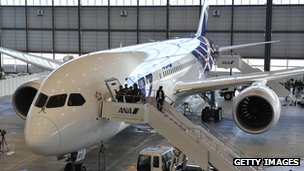
The All Nippon Airlines (ANA) flight will take off from Tokyo around 1230 local time, bound for Hong Kong.
The Dreamliner had originally been scheduled for delivery in 2008, but Boeing has suffered a string of setbacks.
Boeing plans to make 10 of the planes a month from 2013.
Wednesday's flight is a special charter, with normal services due to start in November.
Because of the materials used in construction, Boeing says the Dreamliner is about 20% more fuel efficient than similarly sized models flying today.
That would be a big help for airlines coping with the high cost of jet fuel, which is usually their biggest single cost.
Japan, a country in which Boeing dominates rival Airbus, is a major market for the Dreamliner.
ANA will take delivery of dozens more of the aircraft in the coming years.
But Boeing's delays have hurt its business.
Last week, China Eastern Airlines cancelled orders for 24 Dreamliners, rather than wait for production to pick up.
Source-BBC

Amazon profits dive after heavy Kindle investment
Profits at the online retailer Amazon have dropped 73% after the company invested heavily in the Kindle tablet computer.
The company, the world's largest online internet retailer, said third quarter net income was $63m (£40m, 45m euros).
During the period it launched the Kindle "Fire" model, which runs apps and streams films and other non-text content.
The results left Amazon shares down 12% in after hours trading.
The company said that sales had grown by 44% and that last month, on 28 September, it had its "biggest order day ever for Kindle, even bigger than previous holiday peak days".
It now offers four Kindle devices, including a 3G model.
Lower margins
Jeff Bezos, the founder and chief executive of Amazon, said: "In the three weeks since launch, orders for electronic ink Kindles are double the previous launch. And based on what we're seeing with Kindle Fire pre-orders, we're increasing capacity and building millions more than we'd already planned."
Amazon also forecast lower-than-expected sales for the next quarter, which includes the crucial Christmas period, and said it could even see an operating loss as it continues to invest in the Kindle Fire.
Amazon's profit margins have generally been lower than other technology firms, a situation that analysts say is now catching up with them.
"Investors have always given Amazon a hallpass to invest and it looks like they may have had their patience exhausted," Lawrence Haverty from Gamco Investors told the BBC.
"Its operating margin is only 4%. Most technology companies need an operating margin of over 20% so I think investors are asking themselves if the business will ever really be profitable," he said.
Indiana Town's Economy Benefits from Canadian Oil Boom
The town of Whiting, Indiana, is home to the largest inland oil refinery in the United States. The energy company BP operates the Whiting Refinery, which originally was built by the Standard Oil Company in 1889. Now with heavier crude oil piped into the facility from Canadian tar sands, the facility is getting a multi-billion dollar upgrade. BP’s investment in the refinery is an economic windfall for the small town, but environmentalists say the improvements bring increased pollution.
It’s hard to find signs of high unemployment and a struggling economy along the streets of Whiting, Indiana.
Local resident Brian Lowry of the Whiting Development Commission says that is because Whiting is the beneficiary of one of BP’s biggest investment projects in North America, the upgrade of the Whiting Refinery.
“Thanks to that investment, which is the largest in the state of Indiana’s history, yes, we’ve been sheltered from the [economic] storm,” he said.
BP is spending an estimated $3.8 billion to increase the refinery’s capacity to process heavy crude oil, brought by pipeline from the tar sands of Alberta, Canada.
“So the $4 billion modernization is really providing a huge economic shot in the arm to northwest Indiana, in general,” Lowry said.
“Right now we have roughly 8,000 folks on site, about 6,000 contractors and roughly 2,000 full-time employees,” said Brad Etlin, BP’s local Director of Government and Public Affairs. “There are thousands of people on site each and every day that are out there visiting local stores and local restaurants. There are significant indirect benefits for local towns, local communities. When the modernization project is complete, there will be a significant increase in the tax base for some of the local municipalities.”
Although most people who live in the shadow of the refinery will enjoy lower property taxes and newly constructed public facilities, not everyone is happy that more oil will pass through the refinery.
“Is there going to be a price reduction for gasoline? I don’t think so,” said Steve Kozel, President of the Calumet Project, a citizens group he says that promotes social, economic and environmental justice. The organization has opposed some of BP’s environmental permits with the state of Indiana, citing concerns about the amount of pollution increased refining will create near the facility and along Lake Michigan.
“Our concern is what exactly is it going to be doing to the air," said Kozel. "They’re going to be increasing the sulfur by 20 percent, the particulate matter by 21 percent, and increasing lead by 25 percent into the air, so this is a big increase. You’re talking almost 20 percent, once the refinery is manufactured.”
BP’s Brad Etlin says some of the money for the modernization project is targeted at reducing the amount of pollution the plant produces.
“We’re investing more than $1 billion in environmental improvements - both in our waste water treatment plants as well as other parts of the refinery,” he said.
Local resident Brian Lowry says that so far, he has seen no ill effects.
“My children swim safely in the water here. Certainly we breathe the air here with no issues," he said. "So as far as environmental concerns go, I don’t have any.”
The upgrade to the Whiting facility, which produces about 405,000 barrels of oil a day, is about two-thirds completed. BP says the modernization project, which began in 2008, should be finished by 2013.
US Stocks Decline
U.S. stocks declined in Tuesday's midday trading. The Dow Jones Industrial Average dropped nine-tenths of one percent, the S&P 500 fell 1.1 percent, while the NASDAQ slid 1.2 percent.
European stock markets were down by the close of Tuesday's trading. London's Financial Times 100 index was down four-tenths of a percent to end at 5,526. The CAC-40 in Paris fell 1.4 percent to end at 3,174 while the DAX in Frankfurt retreated one-tenth of a percent to finish at 6,047.
Earlier in Asia, Tokyo's Nikkei index lost nine-tenths of a percent to close at 8,762. Hong Kong's Hang Seng index rose 1.1 percent to end at 18,968.
The price of gold rose nearly $41 to trade at $1,694.45 an ounce.
The dollar fell against the yen but gained value compared to the euro.
Europe Scrambling to Complete Debt-Relief Plan
European leaders are scrambling to finalize a plan aimed at resolving the continent's government debt contagion, ahead of a Wednesday summit in Brussels.
The outline of a package of reforms is emerging, but details have yet to be set, and a pre-summit meeting of European finance ministers was called off. That left some analysts questioning whether the heads of state will be able to keep their pledge to complete the plan when they meet in Brussels.
It will be the European leaders' second summit in four days to try to resolve the two-year crisis.
In broad terms, the plan calls for European banks to forgive billions of dollars of debt for Greece and to sharply increase their own cash reserves. At the same time, the size of the continent's bailout fund would be boosted to assist other debt-ridden countries in the future.
World financial markets have been troubled in recent weeks as the continent's officials have moved slowly in their efforts to keep Greece from defaulting on its international obligations. The European leaders also are trying to keep the debt crisis from spreading to bigger economies in Italy and Spain, and sending other economies into a tailspin.
Greek Prime Minister George Papandreou called the impending decisions “a critical time,” requiring European leaders to “remain clear-headed and calm.”
Reaching agreement on the plan has proved difficult.
European leaders want banks holding Greek debt to write off as much as 60 percent of the money they are owed, nearly three times the amount they agreed to in July when Greece's second bailout in two years was approved. However, the banks only are offering to assume losses of 40 percent. A middle-ground 50 percent loss would amount to about $243 billion.
While agreeing to bigger losses, the banks also would be required to increase their cash reserves next year by about $139 billion. But the exact timing of the requirement remains in question.
The European leaders also are calling for an increase in the $596 billion bailout fund for the bloc of 17 nations that use the common euro currency. It could be increased to nearly $1.4 trillion, without requiring European governments to provide more money. Instead, they hope to craft a plan to ensure against possible future losses in hopes of attracting new capital from private investors and countries like China that have cash to invest.
While the immediate focus has been on debt-ridden Greece, German Chancellor Angela Merkel and French President Nicolas Sarkozy pressed Italian Prime Minister Silvio Berlusconi to move faster to adopt new economic reforms to stave off the need for an Italian bailout.
By late Tuesday, Mr. Berlusconi reached agreement with his Northern League coalition partner on undisclosed austerity measures to send to the European Union ahead of the summit. However, the Italian governing coalition was still at odds over whether to cut spending by raising the country's retirement age to 67.
Turkey's Rescue Teams Pressed to Find Quake Survivors
Time is running out for people believed to be still trapped in collapsed buildings after Sunday's deadly earthquake in southeastern Turkey. The number of dead is more than 400, but that is expected to rise after a second night of freezing temperatures. 
More and more rescue teams are reaching the quake-stricken area in southeastern Turkey, as efforts are intensifying to find survivors buried in the rubble of the thousands of collapsed buildings.
With a second night of freezing conditions, it is a race against time.
In the early hours of Tuesday morning, five people were dug out of their collapsed apartment building. Later, a two-week-old baby, her mother and grandmother were also rescued from the rubble of their home.
But hundreds still remain unaccounted for.
Remote villages
Many of the region's remote villages still have not been reached, with access to numerous roads cut off. Those that have been reached have been devastated, with the traditional houses made of mud and clay offering little protection to the powerful 7.2 quake.
The magnitude of the disaster is leading to increased scrutiny over the government's refusal to accept almost all offers of international help, including from Israel where there are current tense bilateral relations.
But Deputy Prime Minister Bulent Arinc claimed Turkey's refusal of help is not politically motivated.
He says such a claim is horrendous. He says that while Turkey may not be on the best of terms with Israel, to respond negatively to such a humane offer from the Israeli government in the wake of such a disaster because of separate agendas would have been wrong and inappropriate. The deputy prime minister says it is completely untrue that Turkey refused Israel's help for that reason.
International assistance
Nearly 90 countries have offered assistance, but Turkey has only accepted help from Iran and Azerbaijan, which border the area affected by the quake.
The government claims it can deal with the crisis. But with the approach of winter, and snow predicted later this week, pressure is building to accept assistance.
The region is one of the poorest in Turkey, with many people having lost what little they had. Although tent cities and field hospitals have been set up, criticism has been growing that more needs to be done.
Tunisian Islamists, Liberal Partners in Talks to Form Unity Govt.
Tunisia's moderate Islamist party has begun talks to form an interim unity government with a pair of liberal rivals, after preliminary election results showed the Islamists winning more than 40 percent of the vote.
Partial tallies released Tuesday support the Ennahdha party's claim that it has won the most seats in a 217-member assembly. Its chief liberal foe, the Progressive Democratic Party, failed to win much support.
Ennahdha is in coalition talks with two center-left parties – the Congress for the Republic and the Democratic Forum for Labor and Liberties, known by its Arabic name Ettakatol.
The two liberal groups polled better than expected, capturing about 26 percent of the vote so far. They campaigned on progressive values but – unlike other secular groups – also advocated cooperation with the Islamists.
Campaign manager Abdel Hamid Jelassi says Ennahdha “will not shut anyone out” of consultations, promising a broad-based coalition that could include civil society groups and unions.
Party leaders hailed the budding Islamist-liberal alliance as a new, inclusive model for countries emerging from the chaos of the Arab Spring.
The Tunisian electoral commission said Ennahdha so far has secured 37 seats, or about 43 percent. The results include the key cities of Sousse and Sfax as well as half of the 18 seats reserved for expatriate representatives.
The group's main rivals have acknowledged the assembly will be dominated by Ennahdha, whose officials say their interim government will focus on economic development and internal security, not moral issues.
During the campaign, Ennahdha candidates cited as a model the secular, pluralist democracy in Turkey, where the ruling party also has an Islamic identity. Such inclusive models are rare in the region.
In neighboring Algeria, an Islamist electoral victory in 1991 set off a military coup and a decade of bloodshed. When Hamas won 2006 elections in the Palestinian territories, a split in government, armed conflict in Gaza and an international boycott ensued.
Tunisia's newly elected assembly is expected to appoint the interim government and spend a year writing a constitution before elections are held for a parliament and a permanent government.
Election observers predict that women could capture nearly one-third of the seats in the constituent assembly, a far larger proportion than in any Arab country.
Some are concerned that Ennahdha could reverse the progress in women's rights that has been made in Tunisia. But party officials have repeatedly pledged to promote equal opportunities and the freedom to choose or reject Islamic dress like the head scarf.
The landmark election, widely considered free and fair, is the first to emerge from the Arab Spring, which has seen despotic governments topple across North Africa and the Middle East. The vote came a little more than nine months after Tunisians overthrew longtime dictator Zine el Abidine Ben Ali.
After Sunday's historic poll, U.S. President Barack Obama told Tunisians they had “changed the course of history” and “inspired the world.”
Gunfire, Explosions Heard After Yemeni Troops, Rivals Declare Cease-fire
Yemen's government and forces loyal to a dissident general declared a cease-fire Tuesday, but residents in the capital later said they heard explosions and gunfire.
Officials from both sides confirmed the agreement started at 3:00 p.m. local time . However, people in Sana'a's Hasaba district heard fighting after that. Several previous truce accords have failed to hold.
The cease-fire accord came after at least 10 people were killed during fighting in the capital and in Yemen's second-largest city, Taiz.
Medical workers reported two killed and at least 40 wounded in Sana'a when security forces fired on protesters who were calling for President Ali Abdullah Saleh to step down. Government troops also clashed with dissident soldiers.
At least eight civilians were killed in the southern city of Taiz in crossfire between protest-supporting tribesmen and government troops.
The U.S. State Department says the Yemeni president told the U.S. ambassador in Sana'a Tuesday that he is committed to a Gulf Cooperation Council plan that would have him step down amid political violence.
This echoed Mr. Saleh's statement Monday, welcoming a U.N. Security Council resolution urging him to sign the deal to leave office. The president said he is ready for talks to put a deal in motion.
A Gulf Cooperation Council proposal offers Mr. Saleh immunity from prosecution if he hands power to a deputy within 30 days. On at least three occasions, Mr. Saleh has refused to sign the plan, saying he first wants international guarantees about a timetable for its implementation.
Also Tuesday, Yemeni security officials say a military plane crashed while landing at an air base in the country's south, killing at least four of the 15 people on board.
Officials said the crash in Lahej province likely was caused by a technical problem.
Reports say the plane carried eight Syrians and seven Yemenis.
US Dismantles Last of Huge Cold War-Era Nuclear Bombs
It was the end of an era Tuesday when experts near Amarillo, Texas dismantled the United States' oldest and biggest nuclear bomb, the B53.
Officials say dismantling the bomb involved separating 136 kilograms of high explosives from a uranium “pit” at the heart of the weapon.
The Cold War relic, which was put into service in 1962, weighed 4,500 kilograms and was the size of a minivan. Military experts say its large size was meant to make up for its lack of accuracy. They say it was hundreds of times more powerful than the atomic bomb dropped on Hiroshima, Japan in 1945.
The weapon was the last in the arsenal of the B53 nuclear bombs. They were built at the height of tensions between the United States and Soviet Union, but are now obsolete because of the end of the Cold War, better technology, and arms control treaties.
U.S. experts refuse to say how many B53s were built before they were retired in 1997.
Tuesday's dismantling ceremony was part of President Barack Obama's goal to reduce the number and role of nuclear weapons in America's arsenal.
Gadhafi Buried at Secret Site in Libyan Desert
Libya’s ousted leader, Moammar Gadhafi, was buried before dawn Tuesday in a secret desert location five days after he was captured, killed and his slowly decomposing body put on public display in a meat locker in the city of Misrata.
Officials from the Misrata military council said Gadhafi, his slain son Mutassim and former defense minister Abu Bakr Younis were buried together after a brief ceremony attended by a handful of people, including three relatives of the dead.
Muslim clerics loyal to the ousted leader were ordered to pray over the bodies, which had been wrapped in white shrouds.
Libya’s National Transitional Council is under intense international pressure to investigate the circumstances of Gadhafi’s death. The Associated Press quotes an NTC statement issued late Tuesday as saying its leaders “disapprove” of any prisoners being hurt or killed.
The NTC added that “regardless of the hatred Libyans held for Gadhafi…we did not want to end this tyrant’s life before he was brought to court.” It was the first time the new leadership has spoken out against Gadhafi’s killing.
On Sunday, Libyan doctors performed an autopsy on Gadhafi’s body and said he died of gunshot wounds to the head and abdomen during last week’s takeover of Sirte. Cellphone video shows provisional government fighters taunting and abusing a wounded Gadhafi shortly before he died.
Libyan officials said the former leader was shot in a crossfire between his loyalists and provisional government forces. Fighters on the scene have acknowledged beating the ousted leader after his capture.
Peter Bouchaert of the New York-based Human Rights Watch said there are strong indications Gadhafi and Mutassim were “killed while in detention.”
Meanwhile, the last top figures of Libya’s former government – Gadhafi’s son Seif al-Islam and former intelligence chief Abdullah al-Senussi – are reported poised to flee to neighboring Niger. Officials in Niger said Tuesday the two are receiving help from ethnic Tuaregs, a tribe that was among the former leader’s strongest supporters.
Separately, Human Rights Watch has asked Libya’s new authorities to investigate a possible mass execution of suspected Gadhafi supporters during the battle for Sirte.
The group says it found the bodies of 53 people who appear to have been executed in an area that was controlled by NTC fighters at the apparent time of the deaths about a week earlier.