
Former pitcher Hideki Irabu dead in apparent suicide
Former professional baseball pitcher Hideki Irabu was found dead at his California home, the Los Angeles County Sheriff's Department said.
Homicide detectives and representatives from the Los Angeles County Coroner's Office determined that he committed suicide, Sgt. Diane Hecht said Thursday. She did not know the method he used.
His body was discovered in his Rancho Palos Verdes home about 4:20 p.m. Wednesday, Hecht said.
Irabu, 42, was a successful and well-established player in Japan when he came to the United States after being drafted by the San Diego Padres in 1997, according to CNN affiliate KTLA.
But Irabu refused to play for the Padres. He insisted that he would play only for the New York Yankees, a stand that helped create the system that Japanese players currently use if they wish to join the Major Leagues before they are eligible for free agency, according to an article on Major League Baseball's website.
It was during Irabu's three seasons with the Yankees that he had an infamous altercation with owner George Steinbrenner, who called Irabu a "fat toad," the website said.
He played for the Montreal Expos and Texas Rangers before ending his time with the Major Leagues in 2002. Upon his retirement, he had a win-loss record of 34-35 and an earned-run average of 5.15, with 405 strikeouts in six seasons.
In the years since he retired, he spent some time pitching in his native Japan and for a team in an independent league in California.

Bradley sacked as U.S. national coach
United States national coach Bob Bradley has been fired less than a year into a four-year contract extension he signed last August after leading the Americans to the second round of the World Cup.
U.S. Soccer spokesman Neil Buethe said Thursday the organization is "not getting into specifics at this point" as to why Bradley was let go. The move comes a month after the team lost the final of the Gold Cup to Mexico in Pasadena, California.
"We want to thank Bob Bradley for his service and dedication to U.S. Soccer during the past five years," U.S. Soccer President Sunil Gulati said in a statement released Thursday.
"During his time as the head coach of our men's national team he led the team to a number of accomplishments, but we felt now was the right time for us to make a change.
It is always hard to make these decisions, especially when it involves someone we respect as much as Bob. We wish him the best in his future endeavors."
Gulati's announcement came after he met with Bradley and U.S. Soccer CEO Dan Flynn in Carson, California, according to the statement. U.S. Soccer said it would make another announcement Friday -- 12 days before the squad's next friendly match, against Mexico in Philadelphia on August 10.
Buethe declined to say whether a replacement for Bradley has been lined up, and refused to reveal the subject of Friday's announcement.
The 53-year-old compiled a 43-25-12 record as the team's head coach after taking the position in January 2007.
He guided the team to a 2007 Gold Cup title, and the U.S. defeated top-ranked Spain in the semifinals of the 2009 Confederations Cup in South Africa.
Having reached its first-ever final in a major FIFA tournament, the U.S. took a 2-0 lead against Brazil , but lost 3-2.
The United States qualified for the 2010 World Cup, finishing first in its CONCACAF qualifying group. In South Africa, the team went undefeated in the group stages for the first time in its history, drawing twice and winning once, before losing 2-1 to Ghana in the second round.
In his final tournament in charge, Bradley led the Americans to their third straight Gold Cup final, which they lost 4-2 to Mexico on June 25.
Italy pays higher interest rate on latest bond sale
 Italy has had to pay much more to borrow than a month ago as investors continue to worry about its huge debts.
Italy had to pay an interest rate of 4.8% to sell 3.5bn euros ($5bn; £3.1bn) of three-year bonds - up 1.1 percentage points from June.
Despite multiple attempts to contain the Greek debt crisis spreading, Italy and Spain have seen their borrowing costs rise in recent weeks.
Italy has the largest sovereign debt of any European country.
The rate on benchmark 10-year bonds, also sold by Italy on Thursday, was 5.77% - up 0.8 percentage points from June.
As a percentage of output, Italy's debt is second only to Greece in the eurozone - whose huge debts have led to two bailouts.
'Difficult environment'
Since the Irish Republic and Portugal have also been bailed out in the past year, investors have begun to fear that Italy might be next.
The inability of the US to agree a deal to pay its debts has also put pressure on financial markets.
"The auction came in a very difficult market environment, with the issue of US debt ceiling still unresolved", and speculation about the future of Italian finance minister Giulio Tremonti, analysts at Unicredit said.
"All this did not help to create a friendly environment for the auction."
Italy passed a 70bn-euro austerity package earlier this month to reassure investors that the country will not succumb to the debt crisis.
Meanwhile, the French finance ministry says that French banks and insurers have promised to give Greece easier lending terms on 15bn euros of bonds they hold.
As part of the latest eurozone bailout deal for Greece, private lenders to the country have been given the option of extending their bonds into new debt with longer maturities and lower interest rates.
Nintendo shares plunge 20% after company reports a loss
Shares in Nintendo have plunged on the Tokyo stock exchange a day after the company said it made a loss in the first quarter.
Its shares fell by 20% in early trading as investors reacted to the worse-than-expected earnings report.
On Thursday, Nintendo reported a net loss of 25.5bn yen ($324m, £201m) for the April-to-June quarter, its first-ever quarterly loss.
The company also cut its full-year profit forecast.
Nintendo said it now expects a net profit of 20bn yen for the year to March 2012, down 82% from its previous projection.
Nintendo earnings were hit by weak sales of its new gadget, the handlheld 3DS console.
In an attempt to boost sales the company has announced huge price cuts.
The price in Japan will be about 40% less - retailing at 15,000 yen. In the US, the price will drop next month to $169.99 from $249.99.
However, analysts said the price cut may hurt the company's earnings even further.
"The timing of the 3DS hardware price cut is surprising, given the major in-house software releases," said Hiroshi Kamide of JP Morgan.
"We believe the 3DS will be a heavy weight on earnings over the medium term," he added.
JP Morgan also cut its rating on Nintendo from "overweight" to "underweight," saying the current situation was worse than feared and the outlook uncertain.
Tired customers?
To make matters worse for the gaming giant, industry watchers say sales of the 3DS are unlikely to turn around anytime soon.
"Software is a big problem. Right now there are not many games available for the 3DS," said David Abrams, of CAGCast Video Game.
Mr Abrams added that while the 3DS has had a lukewarm response, smartphones continue to capture an increasing share of the gaming market.
He said easy availability of games and their low cost meant more and more people were preferring smartphones over specialised gadgets.
"The question is, are people willing to spend a premium to play the next Mario game or would they spend that amount to buy close to 40 games on their smartphones," he said
Mr Abrams added that despite the launch of its latest version, the DS gadget has been losing its charm.
"The reality is that people may be tired of the whole DS concept. It has been around for almost seven years," he said.
"May be its not that exciting to people anymore," he added.
Vodafone shareholders to get £2bn Verizon dividend
Vodafone shareholders will finally receive a return on the company's investment in Verizon Wireless after the US telecoms firm approved the payment of a $10bn (£6.1bn) dividend.
Vodafone owns a 45% stake in Verizon, and so will receive $4.5bn, due to be paid on 12 January next year.
Shareholders will then get a special dividend of £2bn, equivalent to 4 pence a share, in February, the company said.
The balance of the dividend will be used to reduce debt levels.
This is the first dividend Vodafone shareholders will have received from Verizon.
"Our long term partnership in Verizon's strong and successful wireless business has seen the value of our investment increase significantly over recent years," said Vittorio Colao, Vodafone's chief executive.
"The dividend from Verizon Wireless allows us not only to reward our own shareholders with an immediate and sizeable cash return, but also to continue to reinvest in our business.
Last week, Vodafone reported a small rise in quarterly service revenues, as weak trading in southern Europe was offset by strong growth in India and Turkey.
The company also confirmed its outlook for the full year, which had previously been stated as an adjusted operating profit of between £11bn and £11.8bn.
Unemployment claims drop below 400,000
Finally, some better news about the job market: the number of first-time filers for unemployment benefits fell below 400,000 for the first time since early April.
There were 398,000 initial unemployment claims filed in the week ended July 23, the Labor Department said Thursday.
That marks the first time since April 2, that the weekly initial claims number has fallen below 400,000, a level typically associated with payroll growth and a lower unemployment rate.
It also beats the 415,000 claims economists surveyed by Briefing.com had expected, and was 24,000 lower than the previous week.
Earlier this year, it appeared initial claims were on a downward track. But they then hit a speedbump in April, as high oil prices, bad weather and Japan's tsunami started to weigh on businesses.
Are my job skills useless?
Now, although last week's data were slightly encouraging, economists are still hesistant to say initial claims are completely back on track, because the data can be volatile.
"It's way too early to tell," said Jennifer Lee, senior economist with BMO Capital Markets. "There's still so much uncertainty out there and economic growth is still very subpar. If it does continue to improve, it would be very moderate."
Earlier in the month, Minnesota's shutdown caused an upward blip in the numbers, but that proved only temporary after the state government passed a budget on July 20.
Overall, the four-week moving average of initial claims --calculated to smooth out volatility -- fell by 8,500 to 413,750 in the latest week.
Continuing claims -- which include people filing for the second week of benefits or more -- fell to 3,703,000 in the week ended July 16, the most recent data available. That was slightly more than economists' forecasts for 3,688,000.
The current unemployment rate is 9.2%
Exxon profits up on higher oil prices
US oil giant Exxon Mobil has reported a rise in quarterly profits on the back of higher oil prices.
The company said that net profit rose to $10.7bn (£6.6bn) for the three months to June, up 41% from the same period last year.
The profit was its largest since the third quarter of 2008. The firm said production had risen by 10%.
Higher oil prices have also boosted rivals such as Royal Dutch Shell, which reported a 77% jump in profits.
The price of oil has surged in the past year, driven by political unrest in oil-producing countries.
The price of a barrel of benchmark US light sweet crude oil is up to around $97 a barrel currently, from $78 a year ago.
Record demand
Exxon said its increase in production had been driven by its fields in Qatar and its gas portfolio.
Chairman Rex Tillerson said the company was "investing at a record level of over $10bn to develop new supplies of energy to meet growing world demand".
In the quarter, Exxon announced two new oil discoveries and a gas field in the Gulf of Mexico after drilling the company's first deepwater exploration well since a moratorium on drilling in the area ended.
The moratorium was put in place following the huge oil spill last summer from the Deepwater Horizon well.
Earlier this week, BP announced second-quarter profits of $5.3bn.
US debt: House vote on Republican spending cuts delayed
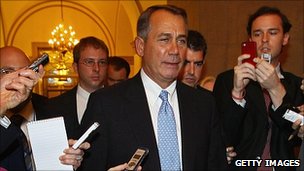 A vote on a Republican bill to raise the US debt ceiling, cut spending and avert default has been delayed in the face of conservative resistance.
House Speaker John Boehner and Republican leaders were struggling on Thursday to convince rank and file lawmakers to vote for his bill.
The plan, however, is almost certain to fail in the Democratic-led House, and the White House has warned of a veto.
Congress must raise the US debt limit by a deadline of next Tuesday.
The US Treasury has warned the government will run out of money to pay all its bills unless a $14.3tn (£8.7tn) borrowing limit is increased by next Tuesday.
'Untenable situation'
A vote on Mr Boehner's bill was postponed for a few hours late on Thursday, as Mr Boehner and his lieutenants endeavoured to win support among rank and file conservative Republicans.
But eventually Republican Representative Kevin McCarthy announced that there would be no vote on Thursday evening.
Some Republicans - including Tea Party supporters who won House seats in 2010 are opposed raising the debt limit under any circumstance - feel the bill did not cut enough from the US budget.
Senate Democratic Leader Harry Reid predicted that even if the bill passes in the House, it fail to pass the Senate, where Democrats and independents voting together hold 53 of 100 votes.
Republicans hold 240 of the 433 votes to be cast in the House, and need 216 of their members - plus Speaker Boehner in the event of a tie - to back the bill to pass it.
Meanwhile, International Monetary Fund chief Christine Lagarde warned that if the debt ceiling was not increased there could be an impact on the US dollar.
"One of the consequences could be a decline of the dollar as a reserve currency and a dent in people's confidence in the dollar," she said.
Mr Boehner's plan would trim $917bn from the US budget deficit over 10 years and raise the debt limit by up to $900bn.
President Barack Obama supports another plan by top Senate Democrat Harry Reid, which would cut $2.2tn from deficits, and raise the debt ceiling by $2.7tn.
But that is thought unlikely in its current form to pass the Republican-controlled House.
The Boehner and Reid plans overlap in key ways - trimming spending over 10 years, shunning President Obama's call for tax increases on the wealthy and creating special lawmaker committees to craft future cuts.
But Mr Boehner's approach would force another debt-limit showdown during next year's presidential campaign, something Mr Obama has fiercely opposed.
Senate Majority Leader Reid's plan would see the ceiling lifted until after the November 2012 elections.
"No Democrat will vote for a short-term Band-Aid that would put our economy at risk and put the nation back in this untenable situation a few short months from now," Mr Reid said on Thursday.
Endgame?
Senior Republicans goaded Democrats, saying they would have to accept responsibility for the economic consequences of default if they did not pass the Republican plan.
"It's inconceivable to me that the president would actually follow through on this [veto] threat," Senate Republican Leader Mitch McConnell said on Thursday. He accused Democrats of "playing with fire".
Analysts say success in the House for the Boehner plan would lend it legitimacy, but it would not be able to pass in the Senate.
The most probable scenario is thought to be a last-minute scramble for a compromise and razor-edge votes in both chambers, with the high-stakes game of legislative brinkmanship expected to continue all weekend.
Senate Finance Committee Chairman Max Baucus predicted an endgame that would see lawmakers modify Mr Reid's bill to make it more appealing to Republicans.
Speaking on Thursday, White House spokesman Jay Carney said a possible compromise would involve "significant deficit reduction, a mechanism by which Congress would take on the tough issues of tax reform and entitlement reform, and a lifting of the debt ceiling beyond - into 2013, so that we do not have the cloud of uncertainty that is hanging over our economy right now".
Washington hit its debt ceiling in May, but has used accounting adjustments, as well as higher-than-expected tax receipts, to continue operating.
In recent decades, the US Congress has increased the government's borrowing authority dozens of times as a matter of routine, but this year newly elected conservative Republicans have demanded steep cuts to the budget deficit as the price of an increase.
Nato takes over Kosovo border posts after clashes
Nato has deployed peacekeepers in the north of Kosovo after a border post with Serbia was burnt down and a Kosovo policeman killed.
Serbian nationalists in Kosovo attacked the post on Wednesday after Kosovo's government sent police to enforce a ban on imports from Serbia.
Border posts in the area, which rejects Kosovan independence from Serbia, had been staffed by ethnic Serb police.
Kosovo's government suspected them of turning a blind eye to banned imports.
Nato officials said only small vehicles were being allowed through two border posts at the centre of the dispute, and that they were being checked for weapons.
Serbia has also reinforced police on its side of the border, to prevent "extremists from Serbia going to Kosovo", Serbian police chief Milorad Veljovic told Reuters news agency.
Wednesday's violence was the worst in several months, according to the BBC's Mark Lowen in Belgrade, Serbia.
It began when a group of about 200 Serbian nationalists approached the Jarinje crossing, throwing firebombs.
They forced the Kosovan police and customs officers, and the EU police assisting them, to flee across the border into Serbia.
The post was burnt down and bulldozed.
One of the Kosovan police officers was killed and several others wounded when they were shot at.
The move by Kosovo's Prime Minister Hashim Thaci to reassert Pristina's control over the region has been criticised by the EU and the US as provocative.
The region has not accepted the mandate of the Pristina government since Kosovo's ethnic Albanian majority declared independence from Serbia in 2008.
Serbia itself has also refused to recognise its former territory's independence.
Libyan rebel commander Abdel Fattah Younes killed
The military commander of the Libyan rebels fighting to topple Col Muammar Gaddafi has been killed, the rebel National Transitional Council says.
NTC head Mustafa Abdul-Jalil said Gen Abdel Fattah Younes was killed by assailants, and the head of the group responsible had been arrested.
He said Gen Younes was summoned for questioning about military operations, but never made it to the meeting.
Reports said Gen Younes was suspected of ties to pro-Gaddafi forces.
Two aides to Gen Younes, Col Muhammad Khamis and Nasir al-Madhkur, were also killed in the attack, Mr Jalil said, adding that there would be three days of mourning in their honour.
The exact circumstances of the killings were unclear, and Mr Jalil did not say directly that the assailants were allied with Col Gaddafi.
Gen Younes is a former Libyan interior minister who defected to the rebel side in February. He was also part of the group that helped bring Col Gaddafi to power in 1969.
Some unconfirmed reports said Gen Younes and two aides had been arrested earlier on Thursday near Libya's eastern front.
Shortly after the announcement of Gen Younes' death, gunmen entered the grounds of the hotel in the eastern city of Benghazi where Mr Jalil was speaking, reportedly firing into the air before being convinced to leave.
UN divisions
Earlier on Thursday, rebels said they had seized the strategically important town of Ghazaya near the Tunisian border, after heavy fighting with Col Gaddafi's forces.
They reportedly took control of several other towns or villages in the area.
The rebels are struggling to break a military deadlock five months into the uprising against Col Gaddafi's rule.
Rebels control most of eastern Libya from their base in Benghazi and the western port city of Misrata, while Col Gaddafi retains much of the west, including the capital, Tripoli.
Late on Thursday AFP news agency reported explosions shaking the centre of Tripoli, as state TV reported that planes were flying over the Libyan capital.
Nato, acting under a UN mandate authorising military action for the protection of civilians, has carried out regular airstrikes in the Tripoli area.
Meanwhile, the South African ambassador to the UN, Baso Sangqu, warned that supporters of the rebels were in danger of violating UN sanctions.
His comments came a day after Britain granted the rebels diplomatic recognition and said it would unblock £91 million ($149m) in frozen Libyan oil assets for the rebels.
"We have noted the calls for Gaddafi must go," Mr Sangqu said. "We maintain that such statements do not bring us any closer to a political solution."
The BBC's Barbara Plett reports from the UN that the growing trend to grant diplomatic recognition to the Libyan rebels is facing opposition on the Security Council, and that moves to back the rebels will further polarise Council members.
Portugal has become the latest of about 30 countries to have recognised the NTC.