
Thousands march to support Chavez
A march by thousands of Venezuelans for the country's bicentennial celebrations became a show of support for ailing President Hugo Chavez today while he remained in Cuba recovering from surgery that removed a cancerous tumour. The president's red-clad supporters waved flags, beat drums and chanted "Long live Chavez!" They also displayed signs reading "Get well soon, commander" and "Venezuela is with you."
A message on Chavez's Twitter account said he was doing his "daily exercises and receiving that bath of love" from the demonstrators in Caracas.
"It's the best medicine!" he said in the message.
Venezuelan state television showed new video footage today of Chavez chatting with his foreign minister and taking a stroll hand-in-hand with two of his daughters, Rosa and Maria. He wore a sports jersey with his name on the back, holding his daughters' hands as they walked along a concrete path surrounded by grass and palm trees.
Chavez has lost weight following his surgeries and appeared thin, though energetic and animated as he reminisced with Foreign Minister Nicolas Maduro about old friends. State television said the video was recorded Friday. Photographs of the encounter were also published by Venezuela's state news agency and the state-run Cuban news media.
"President Chavez, fulfilling the recovery plan he has in our country, walked for about 10 minutes with his family, Foreign Minister Maduro and part of his medical team. He got some sun and exercised," newspaper Juventud Rebelde said in a brief story.
Maduro said during an interview televised Saturday that Venezuelan and Cuban doctors removed a cancerous tumour from Chavez's pelvic region last month and conducted tests that showed the president's vital organs are healthy.
"They were able to completely remove the tumour," Maduro said. "They examined all of his organs and they are in perfect condition."
The state-run Venezuelan News Agency, or AVN, quoted Maduro as saying Chavez "is in a new phase of recuperation, doing his exercises."

Rocky start to Caribbean Airlines/Air J marriage
Friday’s official takeover of the operations of Air Jamaica by Caribbean Airlines was marked by a controversial flight cancellation and more job cuts.
Scores of passengers at the Sangster International Airport in the western city of Montego Bay were reportedly furious after learning that their New York flight was again grounded following its cancellation on Thursday.
Boisterous verbal confrontations between angry passengers and Caribbean Airlines customer agents were reported.
“We were supposed to leave at 6:10 (Thursday). When we got to the airport, we were sitting down waiting for boarding until they announced that the flight was cancelled indefinitely,” said passenger Donovan Hyatt.
As part of the new operations following the merger, the airline’s reservations department is to be relocated to Trinidad.
While passengers sparred with the airline, more Air Jamaica workers lost their jobs on merger day one.
The latest round of job cuts followed the termination of 54 positions in May and a long list of dismissals since Caribbean Airlines took over a year ago and promised a leaner operation.
Those who were retained from the previous cut were given two-month contracts, which reportedly expired on Wednesday.
Those who signed Caribbean Airline contracts in May were given six-months’ probation, but their fate was not known on Friday.
The National Workers Union (NWU) which represents air Jamaica employees described the latest job cuts as unfortunate.
Outraged at the cuts, NWU Vice President Granville Valentine urged Labour Minister Pearnel Charles to ensure that a commitment he gave to protect Jamaican jobs was not jeopardised.
Cruise ship rescues 7 Cuban migrants
A Royal Caribbean cruise ship rescued seven Cuban migrants as it returned to South Florida on Friday, the cruise line and the US coast guard said here.
The Oasis of the Seas was on its way back to Port Everglades when passengers on board spotted the Cubans floating in a small blue raft, the Coast Guard said.
This is the second cruise ship to conduct a rescue in the last two months. Another Royal Caribbean ship, Allure of the Seas, rescued nine Cuban rafters in May.
A group of six men and one woman were rescued on Friday, Royal Caribbean International said in a statement.
Passengers spotted a tiny blue raft in the ocean around 3:00 pm Friday, and the captain turned around the 220,000-ton ship to rescue the rafters, who were taken aboard and given food, water and medical treatment, said Royal Caribbean spokeswoman Cynthia Martinez.
The ship notified US Coast Guard officials and the seven rafters later were transferred to their custody, she added.
Passengers snapped pictures and captured video of the group of migrants as the cruise ship came to their aid.
“They announced on speaker, ‘There are some refugees, and we're about to pick them up’,” passenger Monica Abreu told reporters here.
“They had power to their little raft,” said Mike Hope, another cruise ship passenger. “They were able to move with the raft, and they actually came to the ship.”
The ship's captain turned around the massive vessel to rescue the rafters, who raised their hands in victory before they boarded the ship, Hope said.
The Cubans’ fate is to be determined by the US-Cuba Immigration Accord, more commonly known as the “wet-foot, dry-foot” policy, under which Cubans who reach American shores are allowed to stay here while those found at sea are sent back to Cuba or a third country.
Wimbledon 2011: Novak Djokovic beats Rafael Nadal in final
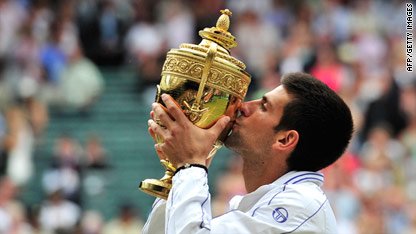 Serbia's Novak Djokovic won his first Wimbledon title and proved himself the best player in the world with a stunning win over Rafael Nadal.
Djokovic came through 6-4 6-1 1-6 6-3 to end Nadal's reign as Wimbledon champion, before overtaking the Spaniard as world number one on Monday.
It was his 50th win in 51 matches and his fifth win over Nadal this year.
He becomes the first Serbian man to win Wimbledon, his third Grand Slam title after two Australian Open victories.
Djokovic had done enough before Sunday's final to guarantee himself the top ranking on Monday no matter what the result.
He came into the match having beaten the Spaniard in four finals already this year, but Nadal - on a 20-match winning streak at the All England Club - was still favoured by many to claim a third Wimbledon title as he had won all five Grand Slam meetings with Djokovic.
That record felt like ancient history as the Djokovic of 2011 overcame a slightly edgy start to take a stranglehold on the match.
In a desperately tight opening set, the pace and accuracy of the Serbian's groundstrokes began to draw errors from the usually faultless Nadal and earned him the first break point of the day at 5-4.
A Nadal forehand into the net gave Djokovic the set and the Spaniard appeared rattled, firing a smash over the baseline in a rare moment of promise at 30-30 at the start of the third.
Djokovic, brimming with energy and confidence, needed little encouragement and came haring in to chase down a drop shot in the next game, angling away the backhand to break before turning to his supporters to celebrate.
What followed was a breathtaking set that flew by as the Serbian fired 13 winners in what must rank among the best passages of play seen on Centre Court.
Nadal was in desperate trouble and needed a lifeline, which was handed to him when Djokovic played backhand into the net in the third to slip behind.
The champion grabbed the initiative, powering through a 6-1 set of his own and threatening a real comeback with a thumping forehand that made it 30-40 at the start of the fourth.
It was Djokovic who now had to change the momentum of the match and he saw off the danger with a forehand that Nadal just failed to return down the line.
The Nadal storm had passed for now and Djokovic sensed it, stealing into the net to play a beautiful drop volley and then forcing an error with some superb, deep groundstrokes to move 2-0 clear.
Victory was within sight for the Serbian but the match was quickly back in the balance in the cruellest of manners, when a Nadal return on break point clipped the net and rolled over.
The contest remained on a knife-edge but Nadal was always flirting with danger having dropped two sets, and a poor game at 4-3 down saw him broken to 15 and gave Djokovic the chance to serve for the title he had described beforehand as "a dream".
A very nervous forehand was hardly the way Djokovic would have chosen to start but two Nadal errors helped him out, and a brave serve volley at 30-30 brought up championship point.
Djokovic moved forward behind a heavy forehand and fell backwards onto the Centre Court turf in celebration as Nadal's desperate backhand flew long to give him the title.
"It's really hard to describe this with any words except as the best day of my life, the most special day of my life," said Djokovic, who was so overcome with emotion that he knelt down and ate some of the Centre Court grass.
"This is my favourite tournament, the tournament I always dreamed of winning, the first tournament I ever watched in my life. I think I'm still sleeping, I'm still having my dream.
"When you're playing the best player in the world, Rafael Nadal, who has won two out of the last three Wimbledons and he has always been winning the big matches against me in the Grand Slams, I had to be on the top of my game, I had to play my best.
"I think I played probably my best match on the grass courts ever."
David Haye to make decision on future 'in next few weeks'
David Haye has told the BBC he will make a decision on his boxing future "in the next few weeks" after losing to Wladimir Klitschko in Saturday's heavyweight unification clash.
"My cut-off date is in three months [13 October when he turns 31], which in boxing terms is not a long time," the Briton told BBC Sport's Olly Foster.
However, the 30-year-old also said he would "love a rematch" with Klitschko.
"He said he can knock me out and I'd love him to give it a go," added Haye.
The Londoner battled for the full 12 rounds before losing by a unanimous decision after the judges scored the fight 117-109, 118-108 and 116-110 in favour of the 35-year-old Ukrainian.
Haye praised Klitschko, stating he was a "brilliant fighter", but said the reason for his own poor performance was a broken toe.
He also said that other factors had affected him at Hamburg's Imtech Arena.
"There were a lot of shenanigans," added Haye, who lost his WBA title to IBF and WBO title holder Klitschko.
"We had a dodgy referee that let him get away with all sorts of infringements. They also sent me down [to the ring] through the crowd instead of down a barricaded ringwalk. I was getting trampled by people. There were loads of little things behind the scenes.
"But I thought, even if the ref is dodgy I'll find a way to win somehow. But he was too good on the night."
Haye's manager and trainer Adam Booth also vented his anger at Chicago referee Genaro Rodriguez.
"I'm disgusted with the referee," he said. "Absolutely disgusted. Counted him [Haye] when he got pushed to the canvas instead of saying something. I let my feelings be known to him at the end," said Booth.
Bermondsey-born Haye, who had planned to fight once more before his retirement in October, said he would consider a rematch.
"Listen, will he want to give me a rematch when I'm 100% fit? I don't know," Haye said. "If not, then I don't know. I really don't know. I'd love him to give me a rematch.
"If he couldn't knock me out on one leg, pretty much, then how about when I'm fit?
"I think it would be interesting. I think I hurt him more than he hurt me but that's boxing."
Klitschko responded: "You know what? If the guy wants a rematch and comes into the press conference shouting 'I want a rematch, that was nothing,' then OK.
"But I didn't see from David Haye a real desire to have a rematch. Instead the rematch was actually pushed to him [by reporters] and he was like 'OK, maybe, I don't know, whatever'.
"If there is a rematch I will definitely knock him out and right now I'm in the driver's seat and I'll have a think about what I'm going to do next."
Britons James Morrison & Mark Foster lead French Open
British pair James Morrison and Mark Foster share the lead at the French Open in Paris after three rounds.
Morrison led overnight on 10 under and was on course to retain his advantage but dropped three shots in the last two holes for a one-over-par 72.
That allowed Foster to join him on nine under following the 35-year-old's third successive round of 68.
They lead by a shot from Scotland's Richie Ramsay, while world number four Martin Kaymer lies joint fourth.
Kaymer, the winner two years ago, fired a 67, which was matched by France's Thomas Levet - the pair are three shots off the leaders.
Morrison, 26, stormed clear of the field when he birdied four of the six holes before the 17th, but he lost form from there following a three-putt for a six.
Off another perfect drive down the 470-yard last, he then pulled his approach into a bunker and failed to get up and down.
He had earlier gone into the lake for a double-bogey five on the par-three second.
Germany's Kaymer had an eagle on the 14th but it was home favourite Levet who made the biggest move before he became another victim of the 18th.
The former Ryder Cup player and 2002 Open runner-up was six under for the day but then pulled his drive into the water and ran up a double bogey six.
"I felt like I was in the Ryder Cup - it was so noisy," said the 42-year-old, who has been mentioned as a possible captain of Europe when the venue hosts the 2018 match.
"Imagine if you multiply the numbers by six or seven - it's going to be nuts. Days like today keep me competing. You make putts, you make people happy."
Kaymer said: "My short game was very good and the eagle kept me going - it's put me in a good position.
"Last year I had a chance and made double bogeys on 15 and 18. Hopefully it will be different tomorrow."
Colin Montgomerie managed only a 74 to fall back to two over and now looks unlikely to claim the top-five finish he needs to earn the Open spot on offer. He is in 36th place.
WICB reiterates its position re Chris Gayle
The West Indies Cricket Board has noted the statement of July 1 by Chris Gayle.
The WICB is disappointed by the continued unprofessionalism being displayed by Mr. Gayle in dealing with this matter. It does not help that whilst matters are under discussion, Mr. Gayle, rather than expressing his views directly to the Board through one of the numerous channels open to him, chooses instead to make public his version of events and to create further antagonism.
The WICB does not wish to engage in a public debate with Mr. Gayle or his representatives but presents the following in an effort to ensure that the public has a balanced view of the situation.
The WICB has made every effort to resolve the issues with Mr. Gayle in an amicable manner by proposing meetings with him and his representatives.
The WICB reiterates its stated position, that there is a history of difficulty in communicating with and relating to Mr. Gayle and wishes to bring this matter to a resolution; but from his latest statement and his expressed views in the meetings with the WICB it would appear as though he is of the unshakeable view that he has conducted himself impeccably. The WICB insists that his conduct cannot simply be swept under the carpet as is the apparent desire of Mr. Gayle.
As previously communicated to Mr. Gayle, the WICB wishes to ensure that Mr. Gayle’s services remain available to West Indies cricket, but not at any cost and not on his inflexible take-it-or-leave it terms.
There must be mutual respect and a commitment to put West Indies cricket first. The WICB has written to Gayle making it clear that it is willing to seek a compromise resolution. Gayle’s position is that he has nothing to account for and expects to be automatically re-instated to the West Indies team whenever he decides that he is available.
Even though at a follow up meeting between Mr. Gayle and the Team Management, the Head Coach indicated what was required to assist in his return to the West Indies team, Gayle has refused and has demonstrated no inclination to compromise; instead he has been antagonistic and unrepentant in the entire process.
The Board will continue its efforts to meet with Mr. Gayle to resolve all outstanding issues
Mets rally against Rivera, avoid sweep by Yanks
Pinch-hitter Ronny Paulino came through with a tying single off Mariano Rivera , Jason Bay drove home the winning run in the 10th inning and the feisty New York Mets ended the Yankees' seven-game winning streak with a 3-2 victory Sunday.
Playing without an ailing Jose Reyes , the Mets were shut down by Freddy Garcia for seven innings before rallying against Rivera in the ninth to avoid a Subway Series sweep at Citi Field.
With two outs and nobody on in the ninth, Bay walked on a full-count pitch. He went to third on Lucas Duda 's single and scored the tying run when Paulino punched a 1-2 delivery through the right side.
Rivera, selected for his 12th All-Star team earlier in the day, dropped his head on the mound after his fourth blown save in 25 chances this season.
Ruben Tejada then hit a sharp grounder that scooted under the glove of fill-in shortstop Ramiro Pena for an error, and Duda tried to score from second. With fans of both teams in a frenzy, left fielder Brett Gardner came up throwing and cut down Duda at the plate to send the game to extra innings.
Pinch-hitter Scott Hairston drew a leadoff walk from Luis Ayala (1-2) in the 10th and the Mets loaded the bases when Pena booted Daniel Murphy 's slow grounder with two outs.
Hector Noesi entered to face Bay, who lined an 0-1 pitch into right-center for a single. Hairston raised his fist as he crossed the plate and Bay, stuck in a two-year slump since signing a $66 million contract with the Mets, was mobbed by teammates on the infield.
Francisco Rodriguez (2-2) pitched two scoreless innings for the win.
Gardner tripled off Jason Isringhausen in the eighth and scored on a sacrifice fly by All-Star starter Curtis Granderson , giving the Yankees a 2-1 lead.
Reyes sat out as the Mets anxiously awaited MRI results on his injured leg. The speedy shortstop, elected by fans to start for the National League in the All-Star game July 12, left Saturday's loss after two innings with tightness in his left hamstring.
Manager Terry Collins said after the win that Reyes had the most mild form of a strain.
The Mets were hit with another injury when knuckleballer R.A. Dickey was pulled because of tightness in his buttocks.
Rain fell much of the morning and the start was pushed back by 89 minutes, though it hardly drizzled during the delay. Yankees manager Joe Girardi intercepted the umpires as they walked out onto the field and engaged them in a discussion that lasted a few minutes.
By the time Dickey was ready to go, Garcia had just begun to walk in from the bullpen. So everyone waited while Garcia crossed the outfield and Dickey took some extra warmup tosses.
Girardi also came out for a long argument after Russell Martin was tagged out in a seventh-inning rundown.
Mets All-Star Carlos Beltran doubled with two outs in the first and scored on Murphy's single.
The Yankees tied it in the fifth. Robinson Cano led off with a double for the first hit off Dickey, and Nick Swisher followed with an RBI single. An error by second baseman Justin Turner helped the Yankees load the bases, but Dickey escaped when Granderson grounded out on a full-count pitch.
Dickey crouched by the mound as Turner fielded the one-hopper and threw to first, perhaps breathing a sigh of relief. But the right-hander never threw another pitch.
He was lifted for a pinch-hitter in the bottom of the inning and the Mets later announced that Dickey slipped on a fourth-inning pitch and felt tightness over his left glute.
Beltran barely missed a line-drive homer in the sixth when it hooked foul.
Greece crisis: Eurozone backs 12bn euros in aid
Eurozone finance ministers have approved the latest tranche of emergency help for the Greek economy.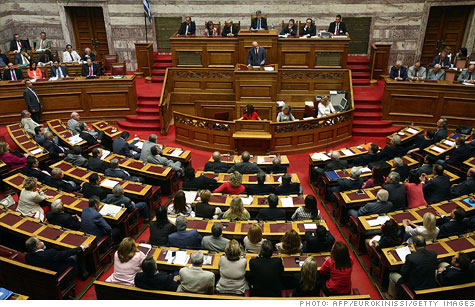
They will release 12bn euros (£10.4bn, $17.4bn) in the next two weeks to help Greece meet spending commitments and avoid defaulting on its huge debts.
Earlier this week, the Greek parliament passed tough austerity measures demanded by the European Union and International Monetary Fund.
MPs backed the measures despite angry protests on the streets of Athens.
The EU and IMF have already agreed to provide Greece with a total of 110bn euros in emergency loans, with eurozone finance ministers discussing the details of a second bail-out designed to help Greece pay its debts until the end of 2014.
Greek Finance Minister Evangelos Venizelos welcomed the eurozone move, saying it "strengthened the country's international credibility".
He added: "What is crucial now is the timely and effective implementation of the decisions taken in parliament, so we can gradually emerge from the crisis in the interest of national economy and the Greek citizens."
'Breathtaking'
Earlier on Saturday, Polish Finance Minister Jacek Rostowski criticised Europe's handling of the Greek debt crisis.
He suggested that too much emphasis had been put on austerity measures and not enough on growth.
And he accused opposition parties in some unnamed eurozone countries of showing "breathtaking short-sightedness" in their opposition to support for Greece.
His comments come after Poland took over the six-month presidency of the European Union (EU) on Friday.
Mr Rostowski will now chair meetings of EU finance ministers, and hopes to join talks among eurozone finance ministers - even though Poland has not adopted the euro as its currency.
Russia rescues Bank of Moscow in record bail-out
Russia's fifth largest bank, Bank of Moscow, has been given the biggest bail-out in Russian history.
The $14bn rescue came after another bank, VTB, gained control through a hostile bid, only to uncover bad loans valued at $9bn - a third of the bank's assets.
Bank of Moscow's former head, Andrei Borodin, has fled the country, and a warrant has been issued for his arrest.
The bank was used by ex-Moscow Mayor Yuri Luzhkov to fund property projects.
'Fraudulent lending'
Mr Luzhkov was sacked by Russian President Dmitry Medvedev last year.
In a statement issued in London, Mr Borodin said he was shocked at the size of the bail-out, and claimed that VTB's takeover of the bank was politically motivated.
VTB, for its part, accused Bank of Moscow of committing "fraudulent lending" under Mr Borodin's control, while Russian Finance Minister Alexei Kudrin has called for a criminal investigation.
Under the rescue deal, the Russian central bank will provide a 295bn rouble ($10.6bn) 10-year loan at a negligible interest rate to Bank of Moscow.
Meanwhile, VTB will invest a further 100bn roubles to recapitalise the bank - taking its ownership share from 46% to 75%, enough to qualify for state aid.
VTB, Russia's second-biggest lender, had itself to be rescued by the Russian state to the tune of $6.4bn during the financial crisis.