
Suns president Babby: Nash will not be traded. Period.
The Phoenix Suns are again shooting down Steve Nash trade rumors.
Suns President of Basketball Operations Lon Babby emphatically said that the two-time league MVP isn't going anywhere, and he added center Marcin Gortat to the untouchable list.
In an email on Wednesday, he repeated the statement he made earlier in the day to The Arizona Republic, saying, "We are not trading Marcin Gortat, period. End of sentence. We are not trading Steve Nash, period, exclamation point."
The latest denial came after ESPN reported that the Suns were in talks with the Minnesota Timberwolves over trading Nash for the No. 2 pick in Thursday's draft.
Earlier, the New York Post mentioned a possible trade to the Knicks for Chauncey Billups, a deal that made little sense unless Nash asked for it.
The 37-year-old Nash has never publicly expressed any interest in being traded as he enters the final year of his contract with Phoenix. When his contract expires, the team could use that money for free agent acquisitions if the Suns decide to move on without him.
"I only focus on trying to get our team back into contention and making the playoffs," Nash said before hosting a charity soccer match Wednesday in New York City. "I don't pay attention to anything else. But it's nice that they say, you know, 'We want you here."'
A prolific user of Twitter, Nash has not mentioned the Suns or his contract status in recent tweets, mostly concentrating on his soccer match, his reaction to the Stanley Cup finals and subsequent riot in his beloved Vancouver. His Facebook wall is filled with pleas for him to come to the poster's favorite team, or to go nowhere at all.
It seems the only way Nash would be traded is if he asked for it.
"They've told me plenty of times they don't want to move me, so I don't think they need to call me every day. I'm not up to date on all the rumors," said the two-time league MVP. "Right now I have a contract with the Suns. I hope this year is better than last and I'm ready to keep playing in Phoenix and continue to build the team and win a championship."
Nash said he'd entertain an extension so he can play at least two more seasons.
The Suns have had difficulty finding a point guard to groom as his successor. Aaron Brooks, acquired in a late-season trade with Houston, struggled in that role and it's uncertain whether the Suns will exercise the team option for another year of the ex-Oregon star's contract.
That led to speculation that Phoenix might draft BYU's dynamic Jimmer Fredette and try to convert him into an NBA guard. Conventional wisdom, though, has them going for a power forward with the No. 13 pick Thursday night, their only selection in the draft.
Nash said he hasn't been keeping track of the draft or who the Suns might pick.
Read more: sportsillustrated.cnn

Warner condemns leaked FIFA bribery report
Former FIFA executive Jack Warner has condemned the leak of an excerpt of FIFA Ethics Committee Report, which brands him as “an accessory to corruption,” as part of an ongoing “malicious agenda” to destroy the cohesion of the Caribbean Football Union (CFU). Yesterday, the Press Association reported that it had seen a FIFA report which says “there is ‘overwhelming evidence’ that Qatar’s Mohammed bin Hammam used bribery in his presidential campaign.” The same report, quoted the Press Association, stated that former FIFA vice-president Jack Warner was “an accessory to corruption.”
The embattled Warner stated: “I, Jack Warner did not partake in the distribution of any cash gifts to my members.” He said, as far as he could establish, “the purported FIFA Ethics Committee report which is being scurrilously circulated is merely a summary of the considerations on which the FIFA Ethics Committee decided on provisional suspensions and its call for a full hearing involving the subjects of the allegations on bid rigging.” He observed that the investigation into these allegations is still ongoing and therefore any suggestion that the report being circulated is the final conclusion of the FIFA Ethics Committee is both misleading and false.
The allegations arose after Bin Hammam entertained members of the CFU on May 10-11 at the Hyatt, Trinidad in his failed FIFA Presidential bid. Both 68-year-old Warner, and Bin Hammam, 62, were provisionally suspended on May 29. Subsequently, Warner resigned his FIFA vice presidential post, president of CFU and president of Concacaf on Monday. The Press Association’s story comes one day after FIFA exonerated Warner after his resignation. Warner said that the Secretariat of the FIFA Ethics Committee have dispatched four copies of the conclusions of the preliminary investigation into FIFA bid-rigging to him—one by fax (which he’s not yet received by press time), one by courier—DHL, one to Lalla, and the last to Concacaf’s office in New York.
“ The copies sent to me and my attorney could not possibly have been accessed by any scurrilous party bent on the malice manifestly intended in the anonymous leaks to the media in an investigation that is still ongoing,” he said. “I can only therefore conclude that this development is part of an ongoing malicious agenda to destroy the cohesion which has made the Caribbean Football Union a factor to be reckoned with in FIFA affairs; and thus diminish CFU's significance in various areas of FIFA decision making,” he added.
British High Commission launches 2012 Olympic competition
In an effort to help generate more public interest in the London 2012 Olympic Games, the British High Commission has launched an innovative Olympic competition.
Up for grabs is a bag full of London 2012 memorabilia, signed by none other than Barbados’ own World Champion, Ryan M. Brathwaite.
“We are very excited about the prospect of hosting the Olympic Games,” said Paul Brummel, the British High Commissioner.
He was speaking to the media at Ben Mar, his official residence, as Brathwaite autographed the limited-edition memorabilia. The lucky winners of the competition will also be invited to a “One Year to Go’ celebratory party at Ben Mar in a month’s time.
The competition is simple. To enter, contestants must visit the British High Commissions’ Facebook page at www.facebook.com/UKinBarbados. From there, aspirants will be asked to answer three questions pertaining to the London 2012 Olympic Games. The British High Commission will then choose two correct entries.
The competition is open to citizens of the Eastern Caribbean.
“It is important that the Olympic Games in London is something that survives,” Brummel continued. “This is why the Games are being held in five of the traditionally poorest areas in London. A huge amount of effort has been set aside to help regenerate London during the course of the Olympic preparations.”
An estimated 9.3 billion pounds have been set aside by the British Treasury for the London 2012 Games, making it one of the most expensive Games in the history of the Olympic movement.
“It demonstrates our commitment to a successful Games,” the Commissioner added. “Around 75p in every pound – around three quarters of the funding going in to the Games – is spending that will have a long-term effect. For example, a great effort has been taking place around the Olympic Park to clean the old polluted soil which has been contaminated from a century of industrial neglect. We want these Games to have a lasting legacy. This is the way we play our little part.”
The London 2012 Olympic will run between July 27 and August 12.
Venus prevails in thriller
Five-time champion Venus Williams needed three sets and nearly three hours to overcome the oldest player in the field yesterday and reach the third round at Wimbledon.
With rain delaying play on the other courts at the All England Club, Williams outlasted Kimiko Date-Krumm 6-7 (6), 6-3, 8-6 in a compelling battle under the sliding roof of Centre Court that featured great shot-making from both players.
Williams relied on her big serve at key moments to overcome a gritty challenge from the 40-year-old Japanese player, who was the second-oldest woman to reach the second round here in the Open era after Martina Navratilova.
"She doesn't play anywhere near her age,'' said Williams, who again wore her original one-piece jumpsuit with a triangle cut out in the back, a gold belt and gold zipper.
Following Williams on Centre Court was defending men's champion Rafael Nadal, who cruised past Ryan Sweeting 6-3, 6-2, 6-4 to move into the third round, showing just how tough he'll be to stop as he chases a third Wimbledon crown.
The top-ranked Spaniard, who beat the American for the third time this year, all in straight sets, had only seven unforced errors to go with his 38 winners. Nadal broke Sweeting five times and lost serve just once.
"I was playing very well,'' said Nadal, who finished in style on the last two points with a running backhand passing shot down the line and a forehand volley into the open court. "The second and beginning of the third I had the match completely under control, but he had a few good shots.''
Also advancing was fourth-seeded Andy Murray, who beat Tobias Kamke of Germany 6-3, 6-3, 7-5. The 24-year-old British player never lost serve, saving the only break point he faced, as he again pursues his bid to become the first home-grown male champion here since Fred Perry in 1936.
In women's play, 2010 runner-up and No. 2-seeded Vera Zvonareva beat fellow Russian Elena Vesnina 6-1, 7-6 (5).
standing ovation
The opening contest ended with Date-Krumm hitting a backhand passing shot just wide to lose serve on match point after 2 hours, 56 minutes of play. Among those giving the players a standing ovation were all guests in the Royal Box, including Camilla, the Duchess of Cornwall and wife of Prince Charles.
Williams, who fell behind 5-1 in the first set before climbing back into the match, finished with 12 aces and 45 winners, one less than Date-Krumm. Williams had 24 unforced errors, while Date-Krumm had 31.
"It was tough. She came out and I just couldn't seem to get a game,'' Williams said. "She played so well and before I knew it the ball was past me every time in the first set.''
It was the first time the two players - who have a combined age of 71 - have met in their long careers.
"I thought she played unbelievable today,'' Williams said. "I thought she had some luck on her side, too, with net cords, balls hitting lines. I just thought today was a perfect storm for her to try to get a win. Thankfully, I had some answers.''
Sammy gives West Indies some hope
Captain Darren Sammy shrugged off an ordinary start to the match to claim four for 52 while opener Adrian Barath hit a stroke-filled 38 to give the West Indies some hope of pulling off a surprise victory on today's fourth day of the fourth Test against India at Sabina Park.
Set 326 for victory after they had dismissed India for second-innings 252, the West Indies reached 131 for three at close of play still needing another 195 runs to win with seven wickets in hand.
Sammy who, prior to yesterday's bowling performance, finished with 0-42 and made one in the West Indies' first innings, and dropped century maker Rahul Dravid on six in the Indians' second turn at bat, bowled a steady length and line to force some of India's batsmen into rash strokes. Then the West Indies, thanks to a near run-a-ball innings from Barath, 27 from fellow opener Lendl Simmons, 30 not out from Darren Bravo, and 24 not out from Shivnarine Chanderpaul, set the stage for a memorable fourth day.
"It feels good to end with the figures that I did as after a not so good first innings, I was able to put the ball in the right areas in the second and it paid off," said Sammy.
"It was also good to see Bishoo, who took three wickets in the first innings continuing his form, as we needed to restrict them so that they did not post a very big score.
"We were able to restrict them to 252 which while not ideal is reasonable. It's just for us now to continue from this fairly decent start that we have, and try to win the match."
A day of two halves, it began with India on 91-3 and looking to build a huge total that would put the West Indies out of the game.
partnership
However, thanks to Sammy and Bishoo, they were constantly kept in check, and were unable to establish any solid partnership until the ninth wicket when Dravid, who made 112, was accompanied by leg-spinner Amit Mishra, who chipped in with 28.
Knowing what was necessary to take a surprise 1-0 lead in the three-match series, Barath and Simmons, then came out with all guns blazing with a barrage of sixes and fours around the ground, which had the small crowd on its, and together the pair brought up the West Indies 50 in 9.1 overs.
The entertaining start, however, was eventually cut short when debutant fast bowler Praveen Kumar got the better of Barath with the score on 62.
This brought Ramnaresh Sarwan to the crease but as soon he came he departed as playing loosely outside his off stump he was caught by Virat Kholi in the slips without scoring off the bowling of pacer Inshant Sharma with the score on 63.
Simmons was then joined by Bravo and together they added 17 for the third wicket before Simmons, who playing down the wrong line was bowled by pumped up Sharma with the score on 80.
That, however, was the last scare that West Indies would suffer, as thanks to Chanderpaul who joined Bravo, the team was able to see the day through without further mishap.
Play resumes today at 10 a.m.
SCOREBOARD
India 1st Innings 246
West Indies 1st Innings 173
India 2nd innings
(overnight 91 for three)
R. Dravid c Sarwan B Bishoo 112V. Kohli c wk Baugh b Edwards 15S. Raina c Sammy b Bishoo 27M.S. Dhoni c Edwards b Bishoo 16Harbhajan Singh lbw b Sammy 5P. Kumar b Sammy 0A. Mishra c Bravo b Sammy 28I. Sharma not out 5Extras (b8, lb2, nb9) 19Total (all out; 94.5 overs) 252
Fall of wickets: 1-0 (Vijay), 2-56 (Mukund), 3-57 (Laxman), 4-100 (Kohli), 5-148 (Raina), 6-166 (Dhoni), 7-183 (Harbhajan Singh), 8-183 (Kumar), 9-239 (Mishra), 10-252 (Dravid)
Bowling: Edwards 20-1-70-1, Rampaul 22-3-49-1, Sammy 27-11-52-4, Bishoo 24.5-2-65-4, Nash 1-0-6-0
West Indies 2nd innings
A. Barath c Raina b Kumar 38L. Simmons b Sharma 27R. Sarwan c Kohli b Sharma 0D. Bravo not out 30S. Chanderpaul not out 24Extras (lb12) 12Total (3 wkts; 33 overs) 131
To bat: B Nash, +C Baugh,D Sammy, R Rampaul, D Bishoo, F Edwards.
Fall of wickets: 1-62 (Barath), 2-63 (Sarwan), 3-80 (Simmons)
Bowling: Kumar 9-1-27-1, Sharma 8-2-41-2, Mishra 4-0-23-0, Harbhajan Singh 6-1-19-0, Raina 6-1-9-0.
Toss: India.
Presidents of Guyana and Germany focus on combating climate change
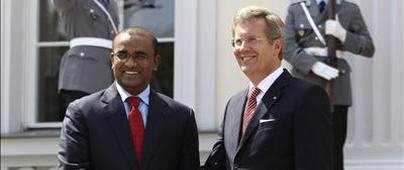 Guyana's President Bharrat Jagdeo spent Wednesday in a series of meetings with German leaders and senior officials.
Discussions centered on the need for sustained political action on climate change, and in particular on Guyana and Germany's upcoming joint chairing of the Interim REDD+ Partnership from July 1, 2011. The group consists of most of the world's forest countries and key developed countries.
Jagdeo met with President Christian Wulff at Bellevue, the German president's official residence.
Speaking afterwards, Jagdeo said, "In the run up to Copenhagen, the issue of climate change and green growth received an unprecedented level of first-order political attention. Sadly, that attention has faded in many cases. However, Germany has remained firm in its commitment, both to the deep emissions cuts required to stabilize our planet's climate, and to the protection of bio-diversity and the alleviation of poverty across the world. Chancellor Merkel and the German Government's leadership continue to be needed. I am confident that Guyana and Germany will both apply the necessary political leadership to the issue of deforestation and forest degradation in our upcoming co-chairing of the Interim REDD+ Partnership."
Jagdeo also met with Dr Christoph Heusgen, Chancellor Merkel's Foreign Policy Advisor and with Wener Hoyer, the Deputy German Foreign Minister.
Jagdeo spoke of Chancellor Merkel's commitment to combating deforestation, and her decisiveness at the side meeting of the G20 in April 2009, when Guyana was one of three non-G20 countries invited to discuss how to put in place an emergency package for the fight against deforestation and forest degradation. It was the G20 side meeting that led to the foundation of the Interim REDD+ Partnership.
Speaking in Berlin, Jagdeo said, "We cannot solve climate change without solving deforestation. And after the work initiated in 2009 at the G20 side meeting, we know that it will be possible to deliver a 25% reduction in global deforestation rates within five years."
The meetings in Germany followed Jagdeo's trip to Korea, where he took part in a meeting of the board of directors of the Global Green Growth Initiative. He concluded his visit to Seoul when he attended the Global Green Growth Summit, and met with Korean President Lee Myung-bak and Foreign Minister Kim Sung-Hwan to talk about investment opportunities in Guyana and other bilateral matters.
UN mission urges formation of Haitian government without delay
The United Nations peacekeeping mission in Haiti on Wednesday urged the country’s authorities to immediately form a government that will serve the people and fulfil their expectations, after Parliament rejected the man nominated by President Michel Martelly to serve as prime minister.
The UN Stabilization Mission in Haiti (MINUSTAH) called for the setting up of a government that will work with all concerned parties, including Parliament, politicians, civil society and the international community, to formulate a strategy on education, employment, the rule of law and the environment.
The Caribbean nation remains without a fully constituted government more than a month since Martelly was inaugurated as president. He had put forward Daniel-Gerard Rouzier as prime minister designate, but the Chamber of Deputies – which must ratify the nomination – on Tuesday rejected Rouzier.
MINUSTAH stated in a communiqué that each day that passes with a fully functioning government further thwarts the aspirations of the Haitian people, which they have expressed through the ballot box in the past year.
“There is no doubt that all Haitians are united in their desire to see future major projects, including those related to improving their living conditions, moving as quickly as possible,” the UN mission said.
US diplomatic cables examine Bahamian views on gay rights
As many Bahamians remain divided on the issue of gay rights in light of a recent United Nations Human Rights Council vote, some of them may find US diplomats’ views on Bahamian sexual attitudes telling.
A US diplomatic cable obtained by The Nassau Guardian through WikiLeaks described Bahamian culture as one that “celebrates heterosexual prowess”, while still proclaiming its “overt religiosity.”
”Bahamians also wryly acknowledge their compartmentalized religious beliefs, commemorated in a popular Bahamian ballad recounting the shortcomings of the ‘Sunday Christian’ who weekly repents their previous six days of sinfulness,” the cable asserted.
Bahamians who came out publicly against gay rights were also described as more “loud” than “violent.”
This opinion was espoused shortly after plans were announced to protest the arrival of thousands of gay cruise ship passengers and their families in Nassau on July 16, 2004.
The passengers were traveling on ‘The Norwegian Dawn’.
When news of a counter-protest by gay rights organization Rainbow Alliance at the same time and location was also announced, US officials asked Bahamian law enforcement personnel to commit extra resources to ensure the safety of American tourists
But the cable noted that The Bahamas has a “peaceful culture where the fire and brimstone generally stays verbal rather than physical.”
However, despite the feeling that those planning to protest were merely posturing, the US Embassy still prepared meticulously for any unrest, monitoring media coverage of the upcoming events.
In preparation, officials at the US Embassy also made contact with the Ministry of Tourism, former Bahamas Christian Council (BCC) president Dr William Thompson and now retired Anglican Archbishop of the West Indies Drexel Gomez.
“The newly-elected (BCC) had been taking a more modulated stance on many issues since taking office, including homosexuality, than did the previous administration,” claimed the cable.
“When contacted… on July 14, Reverend Dr Thompson… said that he stands by his ‘don't ask, don't tell’ policy,” the cable reported.
The cable claimed Thompson said the council welcomed anyone to The Bahamas but did not want visitors to “push their beliefs” on Bahamians.
According to the cable, Gomez told a US Embassy official that he saw "no advantage or benefit" to demonstrating against the visit.
The cable said that then Prime Minister Perry Christie found himself “between a rock and a hard place on this controversy.”
“He owes his election to the active intervention of the conservative end of the Bahamian Protestant religious spectrum. He also knows that 60 percent of the country's gross domestic product (GDP) depends on tourism,” the cable noted. “The (conservative) churches who were his main backers in the last election expect some payback.”
The cable further commented: “The Free National Movement opposition is enjoying watching him squirm and doing its best to tighten the screws by repeatedly calling upon him to take a principled stand.”
There was a moderate protest when the cruise ship arrived, but there were no notable developments.
The Bahamas recently came out squarely in favour of the right to choose sexuality being a human right and the UN decision to condemn discrimination against gay, lesbian, bisexual and transgender people.
Attacking crime in the Cayman Islands
The Cayman Islands National Security Council (NSC) on Wednesday presented to the public its crime reduction strategy, a long-term strategy to address crime in the Islands. The strategy was approved by the Cabinet in May.
Governor Duncan Taylor, who chairs the NSC, called the document a "frank" report that calls for greater coordination and collaboration among ministries and departments as well as the private sector in delivering early intervention, prevention and rehabilitation programmes.
"This strategy addresses the causes of crime and not just crime. It is about reducing the risk of young people turning to a life of crime. It also aims to reduce the high rates of re-offending."
Premier McKeeva Bush confirmed Cabinet's support for the strategy, calling it a good effort.
He further urged the community to join the endeavour: "We can't have police on every corner and at every bank's door. Yes, they can patrol the hot spots, but people have to let police know what they know."
Bush also pointed out that the crime reduction strategy is not a "quick fix and entails far more than just operational solutions."
The strategy document was compiled by the NSC's crime prevention working group with input from the civil service, public and the private sector. It also drew on previous reports including the 2006 Forde report on Pre-Disposing Factors to Criminality in the Cayman Island and reports by the private sector Prevention of Crime Group.
What is the crime reduction strategy?
• It is a long-term, preventative strategy that deals with the causes of crime.
• It aims to coordinate and streamline social programmes with the ultimate goal of reducing crime.
• The primary focus of the strategy is on early intervention of children at risk; and on reducing re-offending (e.g. through prisoner rehabilitation).
• It is not a quick fix and entails far more than just operational solutions.
• It takes a hard look at what is currently on the table and how to make it work better.
• It calls for community involvement, partnerships and coordination for more effective early intervention, prevention, enforcement, and a reduced recidivism rate.
• It also lists practical interventions to help reduce crime, e.g., duty concessions on security equipment.
Why is this strategy needed?
• A long-term solution has the potential to tackle the causes of crime as opposed to just the effects. Simply employing more police officers will not solve the Islands' crime problems.
• This strategy is an investment in the future. We owe it to today's children to address current social problems for a better tomorrow.
• In recent years, several reports have pointed to the fact that criminal behaviour is usually rooted in social and developmental problems. And at more than $56,000 per inmate per year, it makes economic sense to invest in a long-term solution.
Over the years there have been many reports and strategies. Why is this one different?
• The Crime Reduction Strategy tells it like it is: There is little coordination between agencies and a severe lack of performance measures. But this strategy will force departments and agencies to be accountable. In other words, people will have to show that their programmes work, i.e. have the desired impact, else funding will be redirected to those with proven success records.
• There will be a single person tracking performance. The new Director of Policy Coordination will monitor programme success and prevent duplication.
• A critically important strategy feature is involving the public in its success. One of the Director of Policy Coordination's main functions will therefore be to inform people on the strategy's progress.
When will we see the strategy in action?
The strategy was researched and drafted last year and was launched in June 2011. Many recommendations have already been implemented, such as:
-- Installing the CCTV system.
-- Providing support and funding for the multi-agency BEST programme.
-- Introducing the new legislation, including the new Police Law, and amendments to the Evidence Law and a Criminal Procedure Law to strengthen law enforcement officers' and the courts' ability to deal with offenders.
Buju to know destiny today
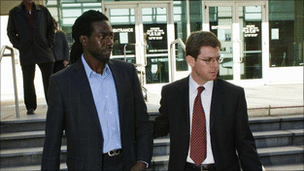
Grammy-winning reggae superstar Buju Banton is scheduled to learn the length of his prison term today.
At the same time, the United States (US) Attorney's Office for the Middle District of Florida is remaining tight-lipped on whether it will go after Buju's assets.
"The United States Attorney's Office has not initiated forfeiture proceedings in the Mark Myrie case," wrote Amy Filjones, a public affairs specialist in the office, in an emailed response to The Jamaica Gleaner.
"We cannot comment any further at this time," Filjones added when asked if her office has decided against initiating those proceedings.
US District judge James Moody is expected to impose the sentence when Buju, whose real name is Mark Myrie, appears in a Tampa Federal courtroom.
Moody is also expected to issue a ruling on a motion filed by Buju's legal team, seeking an acquittal and a new trial.
This comes four months after Buju was convicted in the US Middle District Court, Florida Division, of conspiring to set up a drug deal in a Florida warehouse.
The reggae icon, who has been in custody since his arrest in December 2009, faces a mandatory minimum sentence of 15 years to life in prison.
Plea for leniency
However, Buju, through his attorney, David Oscar Markus, has asked the court for a shorter sentence.
Markus argued in court documents that a 15-year sentence is "way more than necessary" in Buju's case.
He contended that Buju's limited participation in the drug buy, his charitable work in Jamaica, and his otherwise clean record, entitled the singer to a reduced sentence.
American actor Danny Glover is among a number of celebrities who have pleaded for leniency for Buju.