
Missy Elliott Has Been Battling Graves Disease Since 2008
Missy Elliot has revealed she has been quietly battling a major autoimmune disease.
In 2008, the rapper-producer was diagnosed with Graves’ disease – a disorder which affects the thyroid – and she admits the symptoms came on so fast, she almost lost her ability to do everyday things like drive and write.
“I was (driving and) trying to put my foot on the brake, but my leg was jumping,”she tells People magazine. “I couldn’t keep the brake down and almost crashed… I couldn’t write because my nervous system was so bad – I couldn’t even use a pen.”
After suffering a number of other side effects, including hair loss and mood swings, Elliot turned to radiation – which ultimately improved her condition.
“I’m 30 pounds lighter because I’ve been exercising,” she says. “My thyroid is functioning, so I haven’t had to take medication in about nine months. (But) you live with it for the rest of your life.”

More Celebs Set for BET Awards: Mars, Latifah, Bieber, Knight, Minaj
More additions have been added to Sundays BET Awards ’11. Queen Latifah, Gladys Knight , Bruno Mars, Nicki Minaj and Justin Beiber are now set to appear
The show will be broadcast live from the Shrine Auditorium in Los Angeles.
Already scheduled to appear and perform at the star-studded event are Beyonce, Alicia Keys, Lil Wayne, Jill Scott, Drake and Mary J. Blige.
The BET Awards honor the year’s top actors, athletes and musicians. Chris Brown leads nominees with six nods, followed by Lil Wayne with five.
Kanye West, Drake and Rihanna are up for four awards each. Minaj, Mars, Trey Songz, Cee Lo Green and B.o.B. also received multiple nominations.
For more about the BET Awards ’11. go here: http://www.bet.com/shows/bet-awards/2011.html
Laila Ali: Son Has No Jealousy Over Newborn Sis…Yet
Laila Ali says the sibling bond between her 2½-year-old son C.J. Muhammad and daughter Sydney J., 11 weeks, has been way better than she expected.
“Right now he’s being a little brat because he wants to keep going on the slide, but he loves her,” the former boxer tells People.com at the Elizabeth Glaser Pediatric AIDS Foundation‘s A Time for Heroes Picnic on Sunday.
“I was concerned that he was going to be jealous, but he’s not. He loves her to death, and he’s been nothing but a good big brother.”
With both of her children thriving, Ali has turned her attention to other important issues: shedding the pregnancy pounds and regaining her body after baby.
“I have 20 more pounds to go. People always say it’s easy for me because I’m an athlete, but I have to work. I have to eat right, I have to work out, and now I’m working out at home,” she says. “I have a spin bike, I have a treadmill. I’m running, I’m doing hills, I’m doing sprints … and 45 to 70 minutes of cardio.”
But while she’s seen some success, Ali — who is currently breastfeeding — is being forced to take her time.
“The hardest part for me is taking it slow. You can’t hit it too hard when you’re nursing, and I’m nursing,” she explains. ”I could get it off much faster, but I have to take it slow while I’m nursing. The most I can lose is a pound a half to two pounds a week. I’d probably be doing double that if I weren’t nursing.”
Mariah Carey Happy To Stop at Two Kids; Nick Wants More
As Mariah Carey and Nick Cannon continue to figure out how to release the first photos of twins Monroe and Moroccan, the two have been at odds over whether or not to expand their family further.
Asked if he wanted to have more children, Nick told In Touch magazine: “I do, Mariah doesn’t! She was like, ‘That’s it, I’m done! Two at once!’ It was an intense pregnancy to carry twins around. She was a trooper. She’s feeling amazing now. She’s back on her feet doing her thing.”
Despite the showbiz background of both their parents, the “America’s Got Talent” host insists the little ones should try a different career path when they grow up.
“There are so many other aspiring things to be in life,” he said. “I always think we put too much emphasis on the entertainment world. I would love it if my children were doctors.”
Nick says fatherhood so far is easy – even through their middle-of-the-night cries.
“I never slept before! I’m kind of cut out for fatherhood because I never sleep. So now, instead of doing other stuff, I’m with my kids,” he said. “Other than that, definitely more sensitive to my moves because I’m responsible for people now.”
Great strides made at London constitution talks, says PDM leader
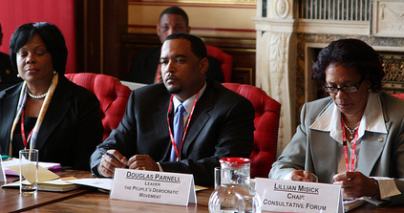 The People’s Democratic Movement seven-member team led by Doug Parnell claims to have achieved great strides at the London constitution talks, as the team was able to successfully argue against a change of fundamental provisions of the 2006 Turks and Caicos Islands Constitution.
Parnell said the PDM team had a few disappointments but for the most part he was pleased with the outcome of the talks and now wants to focus on rebuilding the Turks and Caicos Islands.
Asked about the outcome of the London talks, the PDM leader said, “Well, I’ll never be satisfied until we can achieve the type of self determination for our people that would provide every man and woman who call themselves a Turks and Caicos Islander full and complete satisfaction of what’s in our own constitution; however, I must say that given the point where we started from in the draft, and certainly coming out of the recent history where the constitution was suspended and the legislature disbanded, I must say I think we have made some great strides in these direct talks with UK Ministers.”
Composition of House of Assembly and Voting System
Parnell explained what was achieved as it relates to the voting system.
“The voting system remains what our people are accustomed to, which is first past the post, and I’m pleased about that, and it’s a complete first past the post system. I argued and all the other persons who felt like I did argued very strongly on retaining the first past the post system for our people and I do believe that was a great move away from that mixed member proportional system that would have taken a mathematician a while to figure out who was elected in the Turks and Caicos Islands; we’ve moved away from those confusing clauses that found their way into the draft. So it’s actually fifteen first past the post. The FCO is very clear on that, the minister is very clear on that. The constituencies will be decided by a first past the post basis, and the five at-large constituencies would be decided on a first past the post basis, which would basically mean that the first five with the highest votes would win and that is well understood by ministers here in the UK and I understand it to be the case, and they’ve now written that in an FCO statement.”
Four Appointed Members
“As far as the appointed membership is concerned, one of the concerns we have is that if it is simply left up to the Governor to make those appointments then it may affect the numerical strength of the government and perhaps the confidence of the government and we’re very concerned about that.”
Responding to a statement made Minister Bellingham that there will four Appointed members of the House of Assembly, two by the Governor and the other two by leaders of the two main political parties, Parnell said he is awaiting the exact language of that amendment .
“We have to see the exact wording of that. I’m very eager to make sure that those two appointments satisfy me that it would not affect the numerical strength, the stability and the confidence that a government would need to have in the Westminster system to run a government.”
Two Party System
Parnell said the country has spoken loud and clear in favour of the two party system.
“I don’t believe that the party system is still on trial (after these talks). We were very successful at taking the two party system off trial. I think most of the people got the message loud and clear. I think Minister Bellingham, himself, being a democrat understands this. That’s a matter for an elected government to decide and as a democrat I was proud that he left certain elements of talks up to an elected government to solve. You can’t stuff all these things in one big constitutional bag.”
Powers of the Governor
“We went a great deal in the position paper criticizing the statement of governance principles, powers that the draft constitution sought to give the Governor and in these talks we moved far away from what was in the draft. Again I’m waiting to see the draft of what that looks like and hopefully that would reflect that what we agreed in those talks would be suitable for us. I think it’s very clear we can’t have a Governor that’s above the law, and we got those provisions out, we can’t have a governor that turns down the advice of the Cabinet willy-nilly, that’s out and I think we got those provisions out. But it also gives the system in the Turks and Caicos an opportunity to function. And when I say that I mean it gives the Governor an opportunity to say no in very rare circumstances if he cannot get in touch with the Secretary of State, but cabinet must be kept very well informed of what he is thinking ahead of time. This makes for better functioning of government in the Turks and Caicos Islands and these are all things that weren’t there in the draft that we got done, and so I’m pleased about that, that we have moved a long way from where we were in the draft about the Governor’s powers.”
Trial By Jury
“I’m not pleased with the fact that the request that my party made to have the right to trial by jury reinserted in the constitution as a fundamental right, only to be denied in very exceptional circumstances, was not considered. I must say I was disappointed that I did not get the type of support that I was expecting to get from other delegates on that provision, so I’m very, very disappointed in that, that’s a very sad thing for me to report. After we come out of this period and we have an elected government we won’t be able to go back immediately to reinsert that right to trial by jury. We will have to live with something that was done by a body that’s not elected by the people and to me that’s unacceptable”
Belongership
“One provision that makes me proud is that we were able to strike out those long and lengthy provisions for the definition of belonger in the Constitution and we have also changed the name of belonger to Turks and Caicos Islander. Which will help with our own understanding of who we are, number one, and we have also made it clear that there are certain minimum pre-conditions which were in the draft but were in keeping in alignment with what was in the Blue Ribbon Commission, an immigration review that was conducted some time back, and I’m pleased about that and I think that all members seem to support that provision that I put forward.”
Deputy Governor
Under the new constitution, the Deputy Governor shall be appointed by the Governor and must be a Turks and Caicos Islander. Parnell would like to see consultation between the Governor and the political leaders before any appointment is made.
“What I’m concerned about there is that person is appointed after consultation with the Premier and the leader of the opposition. To me this is extremely important, because the Deputy Governor would be head of the civil service and could be called upon to exercise some authority, some decision making authority as it relates to the civil service. And so what I wanted to make sure was that the process would be made after consultation. There was general agreement about that. The Deputy Governor could be somebody that transcends different governments and so I think it is important that the person is someone who reflects the type of person that the House of Assembly would like to seen in that position. And to me that is extremely important. I think that we were very clear even in the 2006 Constitution though it is not a political position at this point.”
New Governor
“It was good that the timing of it came about when we were able to be informed about the new Governor. I haven’t look at his bio yet but I’ll soon do that, but we’ll see what he’s made up of and what he’s like. I believe that we still have a while left with Mr Wetherell and we’ve weathered a lot of storms with him here in the Turks and Caicos Islands and we have to get through this period with him then look forward to a strong capable Governor who can represent the views of the United Kingdom Government properly to the people of the Turks and Caicos Islands and the Government of the Turks and Caicos Islands, someone who respects the people of the TCI and takes into deep consideration our values, and I can’t assess that, I haven’t met him yet.”
Achievement of Milestones and Date for Elections
“What I can say is that at the public meetings, it was very clear that Floyd Seymour said we gave you our car to clean and you’re looking up in the transmission and so we need our car back. Mr Seymour is here with me in the talks and we have a date that we will get the car back on the road, and that date is coming closer and we have a date that will be announced soon and we expect that we will get that car back very, very soon.”
Independence
“The political parties in the UK have different views about the overseas territories. It is very clear that the Conservative Party who leads this coalition government in London feel very strongly about their territories and their links to the United Kingdom. That’s a matter for the people in the Turks and Caicos Islands. And we’ll have to assess coming out of this period when we are ready. In my mind I think there are certain periods of time that will be important to keep under review for when and if a question should be put. So that is where my thinking is at this point.”
Youth Ambassador
“I would like to pay a special compliment to the youth ambassador. I know there was a great deal of criticism of all the members leading up to these talks. I know I was very keen not to publicly in any way criticize any of the members… some of them with their own ideas however they came about acquiring those ideas about what they want to see in their constitution and I supported that, but Mr Farrington did a tremendous job as the youth ambassador and supported the views of my party and the other party which related to the voting system were in sync, he ought to be commended for that. As a young man coming to the United Kingdom he could have easily said no, this is not territorial waters for someone my age, but he stood up and sat up in the meeting and performed, and he was a man of his word to what was discussed at the Common Ground meeting.
Putting God In The Constitution
The PDM leader said the PDM team was in full support of the preamble brought to the table by the TCI church and incorporating God into the constitution.
“I can’t say I would say anything negative about any of the members. Pastor Handfield brought the preamble which we sought to add a word or two and I am looking forward to seeing the amendment on marriage between a man and a woman. We fully supported the church in those respects.”
Two Term Limits of Premier
Parnell commented on whether he was bothered by the two term limit for the office of Premier.
“We need to get back to democratically elected government. It’s not a big if, just do your work and leave the rest to God. No matter what comes my way I wouldn‘t say that’s a deal breaker at this juncture. The Secretary of State was very clear on what he wanted to see… the constitution of the Turks and Caicos Islands is in fact UK law until we are prepared to have that question put, we have to take some of it and move along so that we could rebuild our country developing our people and get back to the point of providing hope to the disillusioned and making sure that we can rebuild our economy which is badly suffering. One of the points we made was most people of the TCI if you had assets before the constitution was suspended if you have lost fifty percent of those assets. It is not a deal breaker; my views could be heard in a more substantive way for that provision.”
National AIDS Programme Regional testing June 24th
The National AIDS Programme in partnership with the Caribbean Broadcasting Cooperation and Scotia Bank will partake in the Regional Day of Testing, which is scheduled for the 24th June 2011 throughout the Caribbean.
Testing sites are as follows Grand Turk Scotia Bank in between the buildings to the right and on Providenciales Scotia Bank main branch and the Grace Bay branch.
Persons are encourages to come out and be tested knowledge is power, Know your status this is one of the most important decisions that you can make stop guessing just take the test. We have a responsibility first to ourselves then our families and followed by the community. If ones test is negative it is an opportunity to put measures in place to stay negative if positive it is an opportunity to seek treatment early as early detection means early treatment or management for a healthier life.
Police investigates an allegation of Attempted Rape
The Royal Turks & Caicos Islands Police Sexual Offences and Domestic Violence Unit are actively investigating an allegation of Attempted Rape made to the Grand Turk Police Station on Monday the 20th of June 2011. The subject of interest in this incident is a serving officer of the Royal Turks and Caicos Islands Police who was off duty at the time of the alleged incident.
The integrity of Royal Turks & Caicos Islands Police remains of paramount importance. This matter will be thoroughly investigated by the Criminal Investigations Division and, in parallel, the Professional Integrity Unit.
Traffic Division in Provo investigates two motor vehicle collision
The Royal Turks and Caicos Islands Police Traffic Division in Providenciales are investigating a two motor vehicle collision which occurred at approximately 8.37pm on Monday 20th June 2011 in the vicinity of Associated Medical Practice located on Leeward Highway Providenciales. Both drivers were taken to The Cheshire Hall Medical Centre with non life threatening injuries for medical attention and later released. The cause of the accident is still under investigation.
The Royal Turks and Caicos Islands Police in Providenciales have arrested a male suspect in connection with an Aggravated Burglary which occurred on Monday 20th June 2011 in Five Cays Providenciales. This male subject is presently in police custody and the investigation is continuing.
Jill Scott Says Ex-Husband Left Because of Her Cooking
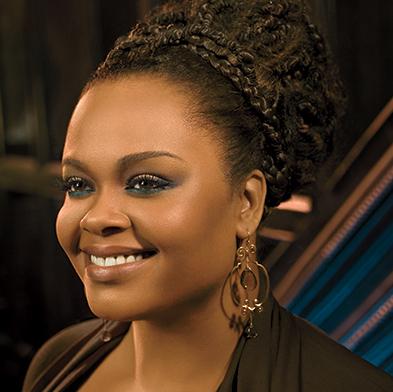 Songstress Jill Scott recently revealed why she and her ex-husband split, saying one reason was over her cooking.
According to her interview with UK’s Guardian newspaper, her husband, DJ and graphic artist Lyzel Williams, would leave specially prepared food uneaten for days. After six years of wedded bliss, or just the opposite, the couple divorced in 2007.
“One of the reasons my ex-husband and I broke up is that he stopped eating my food. He was pissed (off) for other reasons, but the best way to show me was by leaving what I’d made for him uneaten for days on the kitchen counter. It was a smack in the face.”
After their breakup, Scott fell quickly in love with her drummer Lil John Roberts. They then announced their engagement and welcomed their first child, Jett Hamilton Roberts in 2009. However, the couple split shortly after that the same year.
Now single and doing her thing, Scott is busy promoting her latest album, “The Light of the Sun.”
No new recordings for Buju
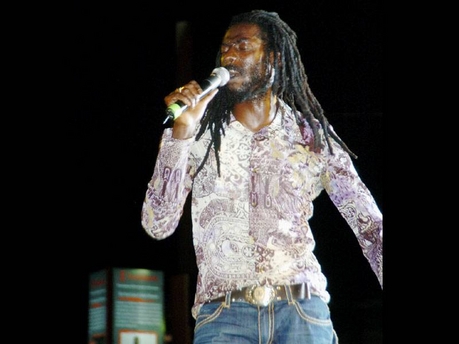 Reggae superstar Buju Banton will be barred from recording any new materials if he is sent to a United States (US) federal prison when he is sentenced in a Florida court tomorrow.
However, Buju, whose real name is Mark Myrie, might not have to cut off his trademark dreadlocks and will be allowed to practise his Rastafarian beliefs under strict supervision.
Chris Burke, a public affairs specialist at the Federal Bureau of Prisons in Washington, DC, said federal prison guidelines bar inmates from conducting "business activities" while they are incarcerated, but added that they do not "normally" require inmates to remove body hair.
Burke said a number of federal prisons have music programmes that include instruments which inmates are allowed to play, but made it clear that recording equipment is banned from these facilities.
"It (recording music) is on our list of prohibited activities for which inmates are subject to disciplinary action," he wrote in an emailed response to The Jamaica Gleaner.
The bureau is the agency responsible for the custody and care of inmates being held in the 116 federal prisons in the US.
Buju was convicted in February on three of four federal drug and gun charges in the US Middle District Court, Florida Division, in Tampa.
He faces 15 years to life in prison when he is sentenced tomorrow.
There has been concern that Buju, who converted to the Rastafarian faith in 1994 after the death of his friend, dreadlocked reggae artiste, Garnett Silk, could lose his locks if he is sent to a federal prison.
Courts spilt
US-based Jamaican law professor David Rowe triggered those concerns when he pointed out that US federal circuit courts are split over whether Rastafarians in custody should submit to prison grooming regulations.
He pointed to two cases (Gartrell v Ashcroft and Hines v South Carolina) where the courts upheld federal prison grooming policies to cut excessively long beards and hair.
In another case, however - Benjamin v Coughlin - the court ruled that a Rastafarian was not required to cut his dreadlocks for a prison photograph.
A US circuit court has also suggested that, if necessary, the federal government's prohibition of dreadlocks should be upheld for security reasons.
However, Burke emphasised that the bureau recognises the Rastafarian faith as a religion, and insisted that the agency does not force inmates to cut their hair.
In addition, he said arrangements about religious diets are discussed with inmates.
According to the bureau's website, the agency does not require inmates to indicate their religious beliefs.
The website said inmates may designate any or no religious preference during their initial screening.
That can, however, be changed at any time by notifying the chaplain in writing.
The Rastafarian movement began in Jamaica in the 1920s.
The Rastafarian lifestyle usually includes the ritual use of marijuana, the wearing of dreadlocks, and vegetarianism.