
Yankees place Jeter on 15-days
 Derek Jeter went on the 15-day disabled list Tuesday because of a strained right calf, an untimely setback for the New York Yankees star as he pursues 3,000 career hits.
The Yankees put the All-Star shortstop on the DL for the first time since 2003, making the move prior to their game against Texas. Jeter limped off the field Monday night, four innings after he got his 2,994th hit.
"I'm still pleading my case," Jeter said, to no avail, about an hour before the Yankees made the announcement.
Jeter and his teammates hoped he would be able to get the historic hit at Yankee Stadium. New York has three games left against Texas on this homestand, then goes on a six-game road trip to Wrigley Field in Chicago, and Cincinnati.
He still might get his chance at home, too.
Jeter will be eligible to come off the DL during the middle of a three-game series at home against Milwaukee. The Yankees then start a six-game visit, taking on the crosstown Mets and Cleveland, before returning to the Bronx.
Infielder Ramiro Pena was called up from Triple-A Scranton/Wilkes-Barre. He has played well for the Yankees in stints over the past couple of years.
Backup shortstop Eduardo Nunez took over after Jeter left the 1-0 loss to Cleveland.
Jeter is known for trying to play through injuries, but hobbled away in the fifth inning and immediately left the game. An MRI exam revealed a Grade I sprain, the mildest kind.
"That's what we are really talking about, that it will take at least a week," manager Joe Girardi said before the game.
Jeter said his calf had been sore for a couple of days. He said there was discomfort when he ran off the field in the top of the fifth -- it felt as if he'd been hit by a pitch, he said -- and more trouble when he jogged down the line after a flyout in the bottom half, ending his night.

LeBron clarifies postgame remarks
 Everyone wanted the circus to end. That is, until the circus actually ended.
Such is life for the Miami Heat now, heading into the offseason.
A season of intense scrutiny, criticism, attention and intrigue ended without a championship, and while getting out of the spotlight for a while this summer may be of some consolation to LeBron James, Dwyane Wade and Chris Bosh, nothing will completely soothe the fact that Year One of the Big Three ended with a loss in the NBA finals.
"There was really no way to prepare for a season like this," Heat coach Erik Spoelstra said Tuesday, after Miami gathered for its exit meetings.
Even at the end, James found his some of his words overly dissected and, he said, misinterpreted.
His offseason began with a clarification of something said after Sunday's night's season-ending loss to the new champion Dallas Mavericks, when part of his answer to a question about people being happy to see the Heat lose included the phrase "they have to wake up tomorrow and have the same life that they had before they woke up today. They have the same personal problems."
On Tuesday, James tried to clean up the mess he inadvertently created.
"Basically, I was saying, at the end of the day, this season is over and with all the hatred not only myself, everyone else has to move on with their lives as well," James said. "They have to move on with their lives and their day-to-day, good or bad, and I do, too. At the end of the day, I've got to move on with my life. So it wasn't saying that I'm superior or better than anyone else, any man or woman on this planet. I'm not."
James' fourth-quarter offensive struggles in the finals are still a talking point, even with the series now over and Dallas celebrating its crown. There were some reports Tuesday that he had skipped the team meetings for a vacation in the Bahamas. Privately, some team members told him at times during the season to stop paying attention to news reports about the team entirely.
"I always feel like LeBron does a great job of dealing with things," Wade said. "No one, no athlete gets scrutinized more than he does, for good or bad things. And I always commend him for the way he handles it. A lot of people can say a lot of things about him, but if you're not in his shoes, if you don't go through the things that he goes through than you don't understand, you don't know how you would react to things and respond."
James offered some respect to the new champs later Tuesday. He posted a message on LeBronJames.com where he congratulated the Mavericks, especially Dirk Nowitzki, Jason Kidd and Jason Terry. He also lauded the Miami fans, teammates, coaches, team president Pat Riley and owner Micky Arison.
James closed the message with this: "A lot to learn from this year, a lot to build on, and a lot of work to do this summer."
NBA Finals give ABC best summer ratings in decade
 The NBA's championship-winning game for the Dallas Mavericks on Sunday was seen by nearly 24 million people, leading ABC to its most-watched week during the slow summer season in nearly 10 years.
The Nielsen Co. said the Mavericks' series victory over the Miami Heat was seen by an average of 17.3 million people over the six games. That's a little less than the viewership for last year's Lakers-Celtics series, which had the advantage of going to a climactic seventh game.
The fourth, fifth and sixth games of the Heat-Mavericks series eclipsed those corresponding games last year despite the presence of the NBA's most storied franchises. Many tuned in this year to see if LeBron James would win his first championship after his much-maligned decision to leave the Cleveland Cavaliers.
Take away basketball, and it was a good week for NBC. Two editions of that network's "America's Got Talent" and the singing competition "The Voice" did better than any other broadcast network show.
For the week, ABC led with an average of 9.2 million viewers in prime time (5.5 rating, 10 share). CBS had 6.5 million viewers (4.2, 7), NBC had 5.8 million (3.5, 6), Fox had 4.5 million (2.7, 5), ION Television had 1.1 million (0.7, 1) and the CW had 790,000 (0.5, 1).
Among the Spanish-language networks, Univision led with a prime-time average of 3.5 million people (1.8, 3), Telemundo had 940,000 (0.5, 1), TeleFutura had 620,000 (0.3, 1), Azteca had 220,000 and Estrella had 190,000 (both 0.1, 0).
NBC's "Nightly News" topped the evening newscasts with an average of 8.2 million viewers (5.4, 11). ABC's "World News" was second with 7.1 million (4.7, 10) and the "CBS Evening News," on Scott Pelley's first week as anchor after Katie Couric's departure, had 5.7 million viewers (3.8, 8).
A ratings point represents 1,147,000 households, or 1 percent of the nation's estimated 114.7 million TV homes. The share is the percentage of in-use televisions tuned to a given show.
For the week of June 6-12, the top 10 shows, their networks and viewerships: NBA Finals: Dallas vs. Miami, Game 6, ABC, 23.88 million; "NBA Trophy Presentation," ABC, 21.85 million; NBA Finals: Miami vs. Dallas, Game 5, ABC, 18.32 million; NBA Finals: Miami vs. Dallas, Game 4, ABC, 16.13 million; "America's Got Talent" (Tuesday), NBC, 12.93 million; "America's Got Talent" (Wednesday), NBC, 12.64 million; "The Voice," NBC, 12.31 million; "60 Minutes," CBS, 9.33 million; "NCIS," CBS, 9.06 million; "NCIS: Los Angeles," CBS, 8.9 million.
Kim Clijsters is injury doubt for Wimbledon
World number two Kim Clijsters is a doubt for Wimbledon after re-injuring her ankle at the Unicef Open.
Clijsters, who recently missed two months with an ankle problem, stumbled in her 7-6 6-3 round two loss to Romina Oprandi but did not have treatment.
"I took some medication on the court that helped with pain in my knee but not my ankle," she said afterwards.
When asked if it would affect her playing at Wimbledon, she said "it depends on results from the hospital".
World number 82 Oprandi admitted she was amazed by her victory, but was aware that her opponent was not playing at full capacity.
"There is no bigger thing in tennis, it was a miracle," she said.
"I think maybe she was not 100% and I tried drop shots. It came out good for me."
Australian Open champion Clijsters, 28, originally injured her ankle dancing at her cousin's wedding in April.
After some time out to allow it to heal, she wore strapping on the injury when she competed at the French Open, where she made a second-round exit.
Her second early exit in consecutive tournaments leaves her short of practice for Wimbledon, a tournament which the four-time Grand Slam winner has never won.
It comes on the same day that reigning Wimbledon champion Serena Williams made a winning return to action at the Aegon International in Eastbourne, after a year out because of serious injury and illness.
Andy Murray says winning Queen's boosts Wimbledon hopes
Andy Murray will head to Wimbledon confident he can win his first Grand Slam title after beating Jo-Wilfried Tsonga to win the Aegon Championships at Queen's Club.
The British number one beat Frenchman Tsonga 3-6 7-6 (7-2) 6-4 to claim his second Queen's Club title and 17th on the ATP World Tour.
And after reaching his first French Open semi-final earlier this month, Murray is confident he can improve on two Wimbledon semi-final appearances when play begins at the All England Club on 20 June.
"I'm going to Wimbledon with the feeling that I'm going to win the tournament," said Murray. "I don't think you can go in with any other attitude.
"I feel like I'm playing good tennis. I'll need to improve the next week or so and work on some things going into Wimbledon, but I need to play my best tennis throughout the tournament.
"I'll be switched on for the first match. I'm really looking forward to the next five or six days to get ready for it, because for me it's one of the most important tournaments of the year, if not the most."
Murray's victory on Monday made him the first British man since Francis Gordon Lowe in 1914 to win a second Queen's title, but the Scot said: "I don't think about that stuff too much, but you realise it is that long, it's a nice thing to be able to do and say that you've done it."
One of the highlights of Monday's final was an impromptu between-the-legs shot from the Scot as he closed in on victory in the final set.
"You don't get a chance to do that very often," he said. "It just came off. Sometimes it's just a reaction. I was up 40-0 in the game, probably wouldn't have gone for it if it was 30-30. But I felt comfortable on the court once I got ahead in the match.
"It was nice letting something off, hitting that shot, because I had been behind for 90% of the match."
And Murray described as "amazing" the queue that began forming at 0200 BST, with people trying to get tickets following Sunday's washout, and the Centre Court was a sell-out for the 12.30pm start.
"You never know how busy it's going to be when something like that happens," said Murray. "Because the decision to call it off was late [on Sunday], you don't know how many people are going to hear about it. It was packed - I think it's great."
Asked about Murray's trick shot in the penultimate game, a smiling Tsonga admitted that after his initial anger at losing the point he had said "good play", adding: "It's good to watch on the screen when you've lost."
The Frenchman served superbly throughout the first two sets but felt it had been imperative to keep the Murray return game at bay.
"During the game he can read the serve," said Tsonga, "Even if you hit the ball really hard he will put the ball in."
And Tsonga, the world number 19, will head to Wimbledon optimistic of at least matching last year's run to the quarter-finals, where he fell to Murray in four sets.
"I was disappointed that I lost today, not because I lost against Andy, but because I lost a final," said Tsonga. "It's difficult when you have this run in the tournament and just the last step you miss, but I feel good. I hope I will play well in the future."
US Open: Holder Graeme McDowell pleased with venue
Defending champion Graeme McDowell was in upbeat mood after playing his first practice round of the week at US Open venue Congressional.
McDowell played alongside fellow Irishman Shane Lowry and qualifier John Ellis and said he was "buzzing".
"My energy levels are good and I really enjoyed my practice round," said McDowell, who triumphed at Pebble Beach last year.
"The golf course is up to speed and I can see a way around it."
McDowell added that the course was a different proposition to what he had faced during a reconnaissance visit to Maryland a number of weeks ago.
"Then it was cold, it was wet and a difficult test.
"We enjoyed the golf course this morning and I did have a little spring in my step.
"It's very different to be here as the defending champion and very exciting to come to a golf course and I guess know that you have the capability to win it.
"Typically, when you come to a US Open type set-up, you're always in awe of it and of how difficult it is.
"But if you know you can do it, you can win over 72 holes on one of the toughest tests there is, it gives you a lot of confidence."
McDowell acknowledged that the Maryland venue will be a more exacting examination of the long game than was the case 12 months ago at Pebble Breach.
"It's going to test every aspect of the game. You've got to drive it well.
"By modern standards, Pebble Beach is not the longest golf course but this golf course is long.
"You've got to drive it and hit three woods and really position it well off the tee as these greens are really, really difficult.
"(With the approach shots) You have to keep it under the flags. Over the back of these greens is typically dead.
"You are really going to have to play smart going into these greens."
McDowell has confirmed that he will compete in the Dunlop Phoenix event in disaster-ravaged Japan in November.
"Like everyone, I have been truly saddened by the hardship and suffering caused to so many Japanese people," said McDowell.
"I look forward to trying to bring some joy to the people of Japan."
McDowell played in the tournament in 2002 when he finished in a share of 44th place.
Jo Jackson and Lizzie Simmonds seal Championship spots
Jo Jackson and Lizzie Simmonds sealed their places in Great Britain's world championship squad with wins at the National Championships in Sheffield.
Both swimmers failed to qualify at the first trials in Manchester in March but were lucky second time round.
Jackson produced her fastest time for two years to win the 400m freestyle in one minute 58.32 seconds.
Simmonds won the 200m backstroke in a time of 59.86 seconds to take the last squad place left for the event.
The return to form of Olympic bronze medallist Jackson was particularly heartening after 18 months of ill-health and severe asthma problems.
"I wanted to go quicker but to get the qualifying time and book my spot for the worlds, I can't explain how happy I am," she said.
"This time last year I didn't think it would happen so I am so relieved and that is what the smile is for.
"It has been really hard but I put in a lot of effort these last few months changing so much and its definitely starting to pay off."
Simmonds said the difference between her performance in Manchester and the one in Sheffield was all down to a more positive mental attitude.
"I've just been enjoying it," she said.
"I had a dip there and found it quite hard to pull myself out of that.
"With not qualifying in the 100 I got a bit more down and when I didn't qualify in the 200 it was the be all and end all.
"I then reassessed it and looked at my swimming and thought 'this is something I should love doing' and I do love doing it."
The world championships take place in Shanghai from 16-31 July.
Fed chief Bernanke warns of US debt ceiling threat
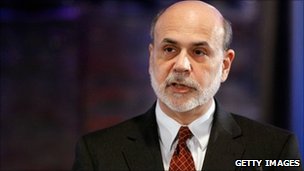 The chairman of the US Federal Reserve, Ben Bernanke, has warned that the country's creditworthiness is at risk if its borrowing limit is not raised.
He said the US could lose its coveted AAA credit rating if Congress did not vote in favour of lifting the $14.3 trillion (£8.7 trillion) debt ceiling.
If there is no deal by August, the US may start defaulting on obligations.
Vice-President Joe Biden and congressional leaders have resumed efforts to find a bipartisan solution.
They are trying to reach an agreement that would tie spending cuts with an increase in the debt limit. They are expected to discuss annual spending levels, budget process reforms, taxes and healthcare benefits.
"We're making real progress, we're down to the tough stuff now and everybody's still in the room," Mr Biden said after Tuesday's meeting.
President Barack Obama and the Speaker of the House of Representatives, John Boehner, want an agreement by 4 July.
'Wrong tool'
At a conference on Tuesday organised by a think tank, the Committee for a Responsible Federal Budget, Mr Bernanke said any delay in the US government making payments could cause chaos on global financial markets.
It could also damage the dollar's status as a reserve currency, he warned.
Mr Bernanke said he understood the desire of many politicians to use the deadline to force some necessary and difficult policy adjustments, but said the debt limit was "the wrong tool for that important job".
"Failing to raise the debt limit would require the federal government to delay or renege on payments for obligations already entered into."
"Even a short suspension of payments on principal or interest on the treasury's debt obligations would cause severe disruptions in financial markets and the payments system."
In addition, Mr Bernanke said US government debt risked being downgraded, creating fundamental doubts about the nation's creditworthiness.
Long-term damage to the "special role" of the dollar and of treasury securities in global markets was also possible, he said.
Instead of allowing a default, Democrats and Republicans needed to develop a credible long-range plan to rein in the nation's budget deficit, Mr Bernanke added.
An increase of $2.5 trillion would allow the government to operate until early 2013.
He suggested stabilising the deficit as a proportion of the total economy, and lowering the figure over time. Deficit-reduction goals should be set and enforced with a mechanism triggering automatic cuts.
TCIG successful in recovering Joe Grant Cay land: first judgment in major civil recovery case
 TCIG has been successful in obtaining the recovery of Joe Grant Cay, following proceedings brought against the Star Platinum companies, controlled by Dr Cem Kinay.
In a judgment (enclosed with this press release) handed down by the Court on 14 June, in connection with the political donation of $500,000 made by Dr Kinay to Michael Misick on 9 January 2007, the Judge found (paragraph 33) "there to be a very strong probability that the money was paid as a bribe in order to ensure that the Defendant companies obtained the benefit of the proposed development".
The Judge also found (paragraph 37): "The grant of development rights, the sale of the hotel land at a gross undervalue, and the lease of the other land at substantially less than the market value were all made at the instigation of Michael Misick. The values were approved by Cabinet as the result of the suppression of evidence of what was at the very least a respectable alternative opinion (from the Government’s own valuer) as to the true values. No satisfactory explanation has been put forward for not reporting Mr Hoza’s valuations to cabinet; or for the payment of $500,000 to Michael Misick. Not only did the Defendants get the development; they got it cheaply. There is a very strong probability that Michael Misick with the help of McAllister Hanchell secured the grant of these benefits to the Defendants as a result of this inducement."
Proceedings were issued in July 2010 following the identification by the Commission of Inquiry of Joe Grant Cay in its report, and the appointment of the Civil Recovery team. After initially defending the proceedings and filing a full Defence, the Defendant companies then defaulted on Court orders.
As a result, the Government applied for judgment, and the Government opted for a trial of the case which was held on 6 June at the Court in Providenciales. The Defendants did not attend or give evidence at that trial. The Judge noted (paragraph 6) that the Government "could not simpy rely on what was pleaded but had to show what could be proved by evidence or admissions". The Judge also observed (paragraph 41): "I emphasise that this judgment should not be treated as a conclusive finding that any individual has acted corruptly. Nobody should be declared corrupt if he has not had the opportunity to defend himself at trial, and that has not happened in this case. The decision has been reached without any active participation by the Defendants, and without hearing from those alleged to have acted corruptly. That was because the Defendants chose to disregard court orders and to absent themselves from the hearing. No oral evidence was given, and there was no cross examination. Had this occurred the outcome could have been different. Conclusions which have been drawn are for the purpose of this case only".
The Court has ordered the return of the whole of Joe Grant Cay to the Government, subject only to a charge in favour of Temple Trust which remains on one parcel of the land. The Court has also given judgment for damages to be assessed, and has awarded the Government the costs of the action.
"This is the first of the major civil claims arising out of the Commission's work to conclude, and we are pleased that the outcome is a successful one for the Government and the Civil Recovery team of EAPD and Chambers. Joe Grant Cay will now be rightfully returned to the Government's ownership" commented the Attorney General, Huw Shepheard.
JUDGEMENT BY COURT
IN THE SUPREME COURT OF THE Case No CL 89/2010
TURKS AND CAICOS ISLANDS
BETWEEN
The Attorney General
of the Turks and Caicos Islands
Plaintiff
and
(1) Star Platinum Island Limited
(2) Star Platinum Hotels Limited
(3) Star Platinum Villas Limited
(4) Star Platinum Golf Limited
(5) Star Platinum Development Limited
(6) Star Platinum Utilities Limited
(7) Star Platinum Transportation Limited
(8) Star Platinum Hotel Management Limited
(9) Star Platinum Construction Limited
Defendants
Heard 6 June 2011
For the Plaintiff: Mr L Harris
The Defendants did not appear
_______________
J U D G M E N T
_______________
(References in square brackets are to page numbers in the exhibits to Mr Harris’s second affidavit)
1. Dr Cem Kinay, through various companies that he controls, obtained the right to develop Joe Grant Cay. The Defendant companies entered into a Development Agreement with the Crown. The Plaintiff says that he got those rights “by means of corrupt transactions, fraud or misrepresentation”. On this ground it has terminated the Development Agreement, which if effective will terminate leases granted under it. The Defendants denied the allegations of corruption, and therefore disputed that it had been validly terminated. On 24 March 2011 I ordered [11-12] that unless the Defendants complied with previous orders to exchange lists of documents and provide further and better particulars of their defence by 26 April 2011, the defence in this action be struck out. The Defendants failed to comply with that order and the defence was therefore struck out. The Plaintiff’s application for judgment in default of defence was listed for hearing on 6 June 2011 at 9.30 am.
2. For the avoidance of doubt, I am satisfied that notice of this hearing was properly served. Notice of the application was served on the Defendants’ then attorneys Misick and Stanbrook on 28 April 2011. On 13 May 2011 I gave directions, inter alia, for the hearing today. On the same day Misick and Stanbrook were notified of the hearing date. On 11 May 2011 an order had been made removing them from the record, but they did not comply with O 67 r 5(3) (filing certificate) until 18 May 2011. On 13 May they therefore remained on record for the Defendants. In addition Mr Harris has e-mailed Dr Kinay details of the hearing date, and a copy of his skeleton argument.
3. Dr Kinay on behalf of the Defendants indicated in e-mails that he wished to apply for relief against the sanction of striking out, and later lodged a formal application. I caused a message to be sent to him by e-mail that on 6 June, before embarking on the hearing of the Plaintiff’s summons, I would consider any written representations he wished to make, and any documents he wished to file out of time. Shortly after 9.30 am, before the hearing commenced I ascertained that no such documents had been received. I therefore proceeded to hear the Plaintiff’s summons.
4. At 1341 on 6 June a bundle of documents from Dr Kinay was delivered to the court reception desk by FedEx. At 1433 on 9 June, three days later, an envelope from Dr Kinay containing written submissions was received. Those documents were received after the hearing had concluded and too late to be taken into account. The first bundle was large; but it is not clear why Dr Kinay chose to send the second document by FedEx when he had previously corresponded with the court by e-mail. He must have known that it would arrive after the hearing.
5. Under O.19, r.7 affidavit evidence is not normally required but the judge may require it. The declarations sought by the Plaintiff require the court to exercise a discretion, so for this purpose and at my direction on 13 May 2011 Mr Harris has filed a further affidavit exhibiting the documents on which the Plaintiff relies.
6. In this situation a plaintiff has an election to proceed by way of Order 19 rule 7, when the court is simply required to determine what remedies the Plaintiff is entitled to on the basis of what is pleaded in the Statement of Claim; or to proceed to trial. Mr Harris elected trial, and the matter was transferred into open court. That of course made his task harder. He could not simply rely on what was pleaded but had to show what could be proved by evidence or admissions. Although the Defence has been struck out, it was proper for its contents to be taken into account in order to ascertain which facts were been disputed and which not. Many of the facts alleged were admitted in the defence. What was not admitted was the motivation behind the Defendants’ actions.
The application for declarations
7. I consider first whether declarations should be made at all. It is a well established practice that in general courts should not declare something to be a fact which on full investigation might turn out not to be. In Wallersteiner v Moir [1974] 1 WLR 991 Lord Scarman set out the approach which the court should take1:
“R.S.C., Ord. 19 declares the consequences of a default of pleading. Rule 2 provides that, where a claim is for a liquidated demand only, the claimant may have final judgment. Rule 3 provides that, where a claim is for unliquidated damages, he may have judgment for damages to be assessed. Rules 4 and 5 deal with claims in detinue and for possession of land and rule 6 with the situation that arises where there are in one action several claims of the sort or sorts mentioned in rules 2 to 5 . Rule 7 makes provision for all other descriptions of claim (of which claims for declaratory relief are one). R.S.C., Ord. 19, r. 7 (1) provides that in all such cases the consequence of a failure to serve a defence within the proper time shall be that the claimant “may … apply to the court for judgment, and … the court shall give such judgment as [he] appears entitled to on his statement of claim.” Notwithstanding the word “shall,” the case law has established that the court retains the right to refuse the claimant judgment even when upon his pleading he appears entitled to it. If the court “should see any reason to doubt whether injustice may not be done by giving judgment,” it may refuse judgment at this stage: Charles v. Shepherd [1892] 2 Q.B. 622 , 624, per Lord Esher M.R.
This discretion is a valuable safeguard in the hands of the court. Take the instant case: though I entertain grave doubts as to the bona fides and honesty of Dr. Wallersteiner both in the financial dealings the court is now considering and in the conduct of this litigation, injustice might well be done to him if without the benefit of trial the court should declare him fraudulent, guilty of misfeasance and of breach of trust. For the very reason that the case reeks of the odour of suspicion, it is, I believe, the duty of the court to exercise caution before committing itself to sweeping declarations: to look specifically at each claim, and to refrain from making declarations, unless justice to the claimant can only be met by so doing. Generally speaking, the court should leave until after trial the decision whether or not to grant declaratory relief, and if so, in what terms: see Williams v. Powell [1894] W.N. 141.”
Pausing there, this is just such a case.
8. In Patten v Burke Publishing Co Ltd [1991 1 WLR 541 Millet J said
“It is not the normal practice … to make a declaration when giving judgment by consent or without a trial as in the case of a judgment in default of defence or of notice of intention to defend the proceedings. That is a practice of very long standing. It was confirmed in Wallersteiner v. Moir [1974] 1 W.L.R. 991 where the claim, which was contained in a counterclaim, sought a declaration that the plaintiff had been guilty of fraud, misfeasance and breach of trust. The judge granted the declaration in default of defence and the Court of Appeal struck it out.”
He continued2:
“There was of course a strong objection to the inclusion of the declaration sought in that case. Even after trial it is not the normal practice of the court to make a declaration that the defendant had been guilty of fraud or negligence. Justice can be done to the plaintiff by awarding him damages. If he wishes to parade the basis on which damages have been awarded to him, he has a judgment which he can produce. The judgment will contain the findings of fraud or negligence on the basis of which the damages have been awarded, and that should be sufficient for the plaintiff's purpose. But in the absence of a judgment reached after hearing evidence a declaration can be based only on unproved allegations. The court ought not to declare as fact that which might not have proved to be such had the facts been investigated. Quite apart from this, however, it is clear from Wallersteiner v. Moir that the rule is a rule of practice only. It is not a rule of law. It is a salutary rule and should normally be followed, but it should be followed only where the claimant can obtain the fullest justice to which he is entitled without such a declaration.”
9. It is therefore a discretion to be exercised with caution. In Animatrix Ltd v O’Kelly [2008] EWCA Civ 1415 Arden LJ described the case as one of the “rare cases where it is necessary to grant the declarations in order to do justice between the parties”, which suggests that the court should do so only when it is necessary. I adopt the same approach. A declaration should only be made on an application for judgment in default of defence if it is necessary in order to do justice between the parties.
10. The declarations which he Plaintiff seeks are that
(i) By reason of the termination on 24 June 2010 of the Development Agreement dated 7 November 2008, the leases of the Buffer Zone land3, the Star Villas land4, and the Golf Course land5 dated 7 November have been determined;
ii) that the transfer of the transfer of the Hotel Land be set aside, and a direction that the Crown be registered at the Land Registry as the freehold owner of the Hotel land6;
(iii) that the Plaintiff is entitled to possession of the Hotel land, the Buffer Zone land, the Star Villas land, and the Golf Course land.
The whole of the Plaintiff’s case depends on it obtaining a declaration that the Development Agreement, and consequently the leases, have all been effectively determined. Without that, it can obtain none of the other orders sought. This is one of those rare cases where it is necessary to make declarations in order to do justice. For that purpose it is necessary to determine whether facts that entitled the Plaintiff to terminate the Agreement have been proved.
The facts
11. Joe Grant Cay is a small island between Middle Caicos and East Caicos. The following facts are alleged:
12. On 18 October 2006 Cabinet approved in principle a proposal by Mr Arturo Malave, a Venezuelan businessman, to develop the island. There is no evidence of this, but it appears to be accepted in the Defendants’ pleadings. In any event, it is background only.
13. The land was divided into different parcels, identified in the Development Agreement:
(i) About 200 acres forming parcel no 30101/25 for construction of a hotel (“the Hotel Land”);
(ii) Parcel nos 30101/1, 2 and 3 to be used as a buffer zone (“the Buffer Zone Land”);
(iii) About 300 acres forming parcels 30101/27 and 28, to be used for Star Villas (“the Star Villas Land”); and
(iv) about 212 acres forming parcel no 30101/29 to be used as a golf course (“the Golf Course Land”)
14. On 7 November 2006 the Government Chief Valuation Officer, Mr Hoza, provided a valuation of the land [14 – 17] for commercial use at $23,000 per acre, but advised the Government to negotiate a price of up to $330,000 per acre. The combined valuation was for a minimum of $163,760,000.
15. On 15 November 2006 Dr Cem Kinay, a developer, was granted Belonger status. This was the date when it was approved. The defence says that his certificate was not issued until 1 May 2007. It is unlikely that he did not know of the approval.
16. In December 2006 Cabinet decided not to grant final approval for Mr Malave’s proposal, after which the Chief Minister, Michael Misick, informed Dr Kinay of the opportunity to develop Joe Grant Cay [admitted in para 43 of defence]. With the assistance of Chal Misick, the brother of the chief minister, Dr Kinay entered into negotiations with the government. [admitted in para 25 of defence]
17. On 9 January 2007 Turks Development LP, a company controlled by Dr Kinay, made a payment of $500,000 to Michael Misick by paying it into the client account of Chalmers and Company, a law firm of which Chal Misick is the principal. It was paid for onward transmission to Michal Misick. The payment was made with the knowledge of the defendant companies. [admitted in para 37 of defence] It was made from funds borrowed from a bank which declined to advance the money unless it were described as being for “legal expense 2006 for construction and planning issues”.[admitted in para 39 of defence] The defence claims that it was paid at the request of Michael Misick who had solicited a political donation in anticipation of an election.
18. On 20 January 2007, allegedly at the direction of Dr Kinay, Star Lions Ltd entered into a joint venture agreement with a TCI company, Oceanic Development Ltd Development Ltd, (“Oceanic”) by which Oceanic would hold one third of the issued shares in Caicos Platinum Ltd – the company through which Dr Kinay then intended to develop Joe Grant Cay. Dr Kinay originally denied that he controlled Star Lions Ltd but later admitted [particulars of defence under para 15] that he has a 60% shareholding. The shares in Oceanic are held by Chalmers Management Ltd, a company owned and controlled by Chal Misick, in trust for Albright Gardiner, Alwood Gardiner and Clifton Black pursuant to an undated declaration of trust executed in or about November 2006 [199 – 200, 201]. The beneficiaries of that trust are all said to be nephews of Michael Misick. The defendants say that they did not know that; that they believed the owner of Oceanic to be Don Gardiner who was to contribute the required Belonger interest.
19. On 16 May 2007 Cabinet approved the substitution of Star Lions Limited and Oceanic as the prospective developers of Joe Grant Cay. [18]
20. On 30 May 2007, at the request of Michael Misick, Cabinet approved, inter alia [19]
-
The grant of a conditional purchase lease of the Star Villa land;
-
The grant of a long term lease of the Golf Course land;
-
The sale of the Hotel Land for $2 million
-
The payment to the Crown of 15% of the gross value of end sales of Star Villas; and
-
The grant of an option to purchase the Star Villas land for 15% of its value.
21. On 20 September 2007, after Dr Kinay had decided to develop through the various defendant companies, Oceanic was gifted one third of the issued shares in Star Platinum Island Ltd [admitted in para 53 of defence]. The defendants say they believed the transfer was to Don Gardiner’s company.
22. On 10 June 2008 Mr Hoza valued the freehold interest in the Star Villas land for commercial use at $75 million ($250,000 per acre) [20 – 23]. At that valuation the Hotel land was worth $50 million, and the combined value of the Hotel land, the Star Villas land and the Golf Course land was $178 million.
23. After receiving this valuation the Minister or Natural Resources, McAllister Hanchell, instructed Mr Hoza to value the land on the basis of agricultural use. On 13 June 2008 Mr Hoza valued the Hotel land on that basis at $7.5 million or $37,500 per acre [24 – 27]. His combined value on the basis of agricultural use of the Hotel land, the Star Villas land and the Golf Course land was $26,766,000. The Defendants say that they were not aware of Mr Hoza’s valuations, but in any case that they were unrealistic.
24. Also on 13 June 2008 Mr Hanchell requested a valuation of those three blocks of land from a local valuation company, BCQS Limited. On 17 June 2008 BCQS valued the Hotel land, based on a desktop study, at $3.2 million and gave a combined value for the three blocks of $7.7 million [28 – 45].
25. On 18 June 2008 Cabinet approved [46]
-
The sale of the Hotel land to Star Platinum Hotels Ltd (the second defendant) for $3.2 million;
-
The sale of the Star Villas land to Star Platinum Villas Ltd (the third defendant) for $3,450,000; and
-
The grant to Star Platinum Golf Ltd (the fourth defendant) of a conditional purchase lease of the Golf Course land, with a freehold purchase price of $1,050,000.
26. On 20 June 2008 the transfer of the Hotel land from the Crown to Star Platinum Hotels Ltd for $3.2 million was registered at the Land Registry, subject to a charge to Temple Mortgage Fund Ltd. [53-4]
27. On 22 October 2008 Cabinet approved a draft Development Agreement with the Defendant companies [61-2]. This was completed on 7 November 2008 [63 – 139] Clause 8.4 [79] gave the Crown “the right to terminate the Agreement forthwith and to recover any loss resulting from such termination” in the event of a company giving or offering any bribe in relation to the Agreement. Clause 8.6 [79] provided that in the event of termination the companies would be liable to pay any sums which would have been payable to the Crown or Government but for concessions granted by a Development Order. Each of the leases provided that the lease would terminate if the Development Agreement were terminated.
28. Also on 7 November 2008
-
The Star villas land was leased to Star Platinum Villas Ltd (the third defendant) for 20 years at a rent of $86,250 per annum, subject to rent review, permitting construction and operation of Star Villas [151 – 167]. It granted an option to purchase parcel 27 for $650,000 and parcel 28 for $2.8 million if exercised within 3 years, and thereafter at open market value [161, 77]
-
The Golf Course land was leased to Star Platinum Golf Ltd (the fourth defendant) for 99 years at a rent of $26,250 per annum subject to rent review, permitting use as a golf course. It granted an option to purchase the land at $1,000,050 if exercised within three years [178, 77]
-
The Buffer Zone land was leased to Star Platinum Hotels Ltd for 50 years at a rent of $50 per annum, permitting use as a buffer zone and the installation and use of a road.
29. From those facts I am invited to find that the moneys paid to Michael Misick and the shares transferred to his relatives were “secret commissions, illicit rewards or inducements, and/or bribes.” The conclusions to be drawn are set out in paragraphs 24 and 25 of the Statement of Claim.
30. The Development Agreement provided for service of all notices on Chal Misick. By a letter dated 14 June 2010 [202 – 3] relying on clause 8.4 of the Development Agreement, the Plaintiff by its solicitors7 wrote to him to terminate the Agreement. It claims that following termination
-
the transfer of the Hotel land should be rescinded
-
the three leases have been determined and it is entitled to possession of the demised land;
-
it is entitled to recover its loss arising from the termination; and
-
it is entitled to recover all sums which would have been payable to it but for the concessions granted to the defendants.
Conclusions
31. With the warning of Lord Scarman in Wallersteiner v Moir8 firmly in mind, I consider what conclusions can be drawn from those facts. The standard of proof required to establish that the giving of money and shares was dishonest, and reciprocated by the grant of benefits, is a high one. To succeed in its claim the plaintiff must show a strong probability that its assertions are correct.
32. In relation to the payment of $500,000
(1) It was made by a company controlled by Dr Kinay; and admittedly at the request of Michael Misick.
(2) It was paid indirectly to Michael Misick shortly after Dr Kinay began discussions about taking over the development of Joe Grant Cay. If it was a genuine political donation
(i) I would expect it to have been paid direct to the political party;
(ii) Even if it was to be paid direct to Michael Misick there was no need to do so indirectly;
(iii) in the circumstances of these islands the amount was unusually large;
(iv) Dr Kinay made no enquiry as to how it was spent; and there is no explanation as to how it was used.
(v) It was made with borrowed money. While a wealthy individual might wish to make such a donation to a political party of whom he approved, most businessmen spending borrowed money would expect to obtain some benefit from it.
(vi) The lending bank was misled as to the true purpose of the payment [paras 39.4 – 39.6 of the defence]
(vii) The explanation given in the defence differs from that given to Williams J in Trinidad and Tobago Unit Trust Corporation v Kinay and another recorded in para 50 of his judgment.
(3) Within four months of the payment of $500,000 Cabinet approved the substitution of Dr Kinay’s company and Oceanic as developers; and shortly afterwards approved the grant of development rights to those companies.
33. In the light of these matters I find there to be a very strong probability that the money was paid as a bribe in order to ensure that the Defendant companies obtained the benefit of the proposed development.
34. In relation to the transfer of shares to Oceanic:
(1) The original grant of shares in Caicos Platinum Ltd gave the beneficiaries of the trust a one third share in the Joe Grant Cay development. On 20 September 2007, after Dr Kinay had decided to develop through the various defendant companies, Oceanic was gifted one third of the issued shares in one of them - Star Platinum Island Ltd - thus preserving their one third share.
(2) The defence [para 54] pleads that the original allocation was made to satisfy the Belonger interest requirement; and that failure to continue the arrangement after Dr Kinay became a Belonger would have exposed Star Lions Ltd to a claim as constructive trustee. That seems unlikely. Dr Kinay knew from November 2006 that he would be granted Belonger status. The actual date of his certificate is irrelevant. Even if he believed that Don Gardiner was the beneficial owner of Oceanic, he also knew that there was no need to involve him as the Belonger in the project. If so, the transfer of shares, made with the knowledge of the defendants, was gratuitous. There was no necessity for it; and there is no suggestion that the beneficiaries of the trust made any contribution, let alone a commensurate contribution, to the development intended.
35. However, there remains a slight doubt as to whether Dr Kinay could have believed that he still needed a Belonger interest at the material time. Further, there is no evidence, and no admission, of the relationship of the beneficiaries of the trust to Michael Misick. This aspect of the claim is not as strong as that in respect of the payment of money. It raises a strong suspicion, which will no doubt be further investigated if that has not already been done. But it is not enough to satisfy the “strong probability” standard of proof required to show that the shares were transferred as a bribe in order to ensure that the Defendant companies obtained the benefit of the proposed development.
36. What did the Defendants get in return? In relation to the sale or lease of Crown land to the Defendants:
(1) Their fiduciary duty required Michael Misick and McAllister Hanchell to try to obtain the best possible price for the hotel land. For this purpose Mr Hoza’s valuations of 7 November 2006 and 10 June 2008 would have been invaluable; but were not used by them to negotiate a higher price.
(2) Although he knew the intended development use of the land, McAllister Hanchell instructed Mr Hoza to re-value it on the basis of agricultural use.
(3) When instructing BCQS to give an alternative valuation, McAllister Hanchell did not tell them of the proposed development, so that their valuation made no allowance for the intended use of the land.
(4) Michael Misick and McAllister Hanchell induced Cabinet to approve the Development Agreement, the sale of the Hotel land and the lease of the other land without informing it of Mr Hoza’s valuations.
(5) The sale price of the Hotel land, and the rent of the leased land, were therefore substantially below open market value as ascertained by the Government’s own valuer.
37. The grant of development rights, the sale of the hotel land at a gross undervalue, and the lease of the other land at substantially less than the market value were all made at the instigation of Michael Misick. The values were approved by Cabinet as the result of the suppression of evidence of what was at the very least a respectable alternative opinion (from the Government’s own valuer) as to the true values. No satisfactory explanation has been put forward for not reporting Mr Hoza’s valuations to cabinet; or for the payment of $500,000 to Michael Misick. Not only did the Defendants get the development; they got it cheaply. There is a very strong probability that Michael Misick with the help of McAllister Hanchell secured the grant of these benefits to the Defendants as a result of this inducement.
38. As a result of that finding the Plaintiff is entitled to rescind the contract for sale of the Hotel land. Unusually, it claims the right to do so without the customary restitution of the sum paid for it - $3.2 million. The land is charged to Temple Trust so the Plaintiff takes it subject to that charge, on which at 28 April 2011 the outstanding sum was $2,402,449.74. Mr Harris argues that the difference - $797,550 - is more than covered by the amount that the Plaintiff will inevitably recover by way of damages, and that it is entitled to set off one against the other. I accept the principle that a plaintiff in these circumstances can set off any damages to which it is clearly entitled against the sum it would otherwise have to pay in restitution. I have yet to be satisfied as to the total amount of those damages.
39. At common law on termination of a contract for bribery you can recover either the amount of the bribe (as money had and received), or damages, but not both. The Plaintiff elects to claim the bribe - $500,000. Despite termination of the Development Agreement the Defendants remain liable in contract for the sums they agreed to pay under it, including scholarship contributions under clause 3.3.1 amounting to $1.2 million. I accept that the amount to which the Plaintiff is entitled on termination will exceed the amount it would otherwise have to pay in restitution. I therefore order rescission without restitution, on the basis that the amount to which the second Defendant is entitled on rescission is exceeded by the sums due from it to the Plaintiff on termination of the Development Agreement.
Orders
40. The orders made are:
(i) The transfer of the Hotel land to the second defendant is set aside and I direct that the Crown be registered as its freehold owner.
(ii) There will be declarations that the leases of the Star Villa land, the Golf Course land and the Buffer Zone land have been determined; and that the Crown is entitled to possession forthwith.
(iii) Judgment will be entered against all Defendants for damages to be assessed. I do not have sufficient information to enable me to give judgment for any specific sum at this stage.
(iv) The Defendants are to pay the Plaintiff’s costs of the action.
41. I emphasise that this judgment should not be treated as a conclusive finding that any individual has acted corruptly. Nobody should be declared corrupt if he has not had the opportunity to defend himself at trial, and that has not happened in this case. The decision has been reached without any active participation by the Defendants, and without hearing from those alleged to have acted corruptly. That was because the Defendants chose to disregard court orders and to absent themselves from the hearing. No oral evidence was given, and there was no cross examination. Had this occurred the outcome could have been different. Conclusions which have been drawn are for the purpose of this case only.
Dated 14 June 2011
Justice G W Martin
1 At p 1029-1030
2 At p 543-4
3 Parcel nos 30101/1, 2 and 3
4 Parcel nos 30101/27 and 28
5 Parcel no 30101/29
6 Parcel no 30101/25
7 Edwards Angell Palmer & Dodge
8 [1974] 1 WLR 991, 1029-30
TCIG explains PPC Mishap
PPC’s disruptive action in disconnecting power supplies to Government buildings on Providenciales yesterday and earlier today was most regrettable.
The Ministry of Finance has been in discussion with PPC since early 2011 in an effort to resolve differences in relation to TCIG’s account with the company. While funds have been available to pay PPC since the completion of the refinancing package on 22 February 2011, TCIG's position is that PPC has not provided all the information needed to fully verify the outstanding amount due to them.
It would be irresponsible of TCIG to use the taxpayers’ money to make full payment until the liability has been properly established. Nonetheless, as a gesture of goodwill TCIG made a payment of $500,000 on 31 May, which PPC acknowledged.
TCIG and PPC reached an agreement to restore power to Government buildings this afternoon. TCIG officials will meet with PPC on 15 June to continue discussions aimed at reaching a mutually satisfactory settlement.