
QQ denied entry into England
 Young dancehall artiste QQ was recently denied entry into England according to his father and manager Joseph 'GQ' Dawkins.
He said QQ was supposed to tour some schools and meet with Kenyan ministers on Monday as hundreds of fans came to the airport to receive and welcome the young star.
The only problem was, there was no QQ.
Dawkins explained to The STARthe circumstances under which QQ was denied entry saying, "What really happen is that QQ was suppose to be in Kenya on Monday. We were refused entry into England based on my circumstances. I didn't do my community service so they refused him entry based on the fact that he's a minor and he was travelling with me."
He went on to say, "I pushed an officer when I was in England before, but I didn't know that he was a police. I went to court and pled guilty and I had to do 80 hours of community service. I didn't get to complete my service though and they said I never did anything like write to get a pardon or such. I had to work it out with some officials there for them to allow him to get on a next flight to New York."
QQ had to divert to New York, then to Dubai (his location at the time GQ was contacted) and then to Kenya.
According to GQ, QQ's absence caused some amount of commotion in Kenya as all wanted to know where he was.
"There was some confusion because when he hadn't landed in Kenya and people were asking why, others were posting on his Facebook page saying like he was in Jamaica. The hundreds of people who were there thought he wasn't coming. But the promoter did his checks and I also spoke with the promoter (Tuesday night) and explained that he had to stop over in Dubai. We're trying to arrange the tours and meetings which were disrupted to be rescheduled," he said.
However, GQ says he does not understand why the England officials would use his circumstance to affect QQ.
He said, "Dem a use my circumstances to affect this child. Why is it that dem a do dat? A the first time something like this has happened. Me nuh see why?"

Rihanna tops list of Billboard awards nominations
 Rihanna has nominations in 18 categories at this year's Billboard music awards, with Eminem and Lady Gaga following close behind.
The singer is up for top female artist, hot 100 artist and R&B artist, while her collaboration with Eminem, Love the Way You Lie, is up for six awards.
Eminem has 16 awards nods, including top male artist and rap artist and Lady Gaga has 12.
They are up against Rihanna, Taylor Swift and Justin Bieber for top artist.
Bieber has notched 11 nominations and is also a contender for top new artist with Taio Cruz, Ke$ha, Bruno Mars and Nicki Minaj.
There are 46 categories at this year's awards and finalists are based on a combination of factors including sales, radio play, social media interaction, streaming and tour earnings.
The winners will be announced at a ceremony in Las Vegas on 22 May, which will include performances from Jennifer Lopez, Rihanna and Black Eyed Peas.
Catherine Zeta Jones treated for bipolar disorder
Catherine Zeta Jones has received treatment for bipolar disorder after dealing with the stress of her husband's battle with throat cancer.
Zeta Jones, 41, made a decision to check into a "mental health facility" for a brief stay, said her publicist.
Michael Douglas, who was diagnosed last year, said in January his tumour had gone and he was beating the disease.
Last September, Zeta Jones said she was "furious" that doctors failed to detect the cancer earlier.
Bipolar, also known as manic depression, causes severe mood swings, that usually last several weeks or months.
Zeta Jones's publicist Cece Yorke said the actress sought treatment for the condition following the stress of her husband's cancer fight.
"After dealing with the stress of the past year, Catherine made the decision to check in to a mental health facility for a brief stay to treat her Bipolar II disorder," said Yorke.
"She's feeling great and looking forward to starting work this week on her two upcoming films."
It is unclear when Zeta Jones, who is from Swansea, was diagnosed with bipolar disorder or where she received treatment.
Mark Davies, from mental health charity Rethink, said the actress had shown courage in revealing the disorder as there was still a stigma around mental illness.
"Although she'll be feeling pretty fragile and vulnerable, she will have - in a sense - given some comfort to a lot of other people who are probably suffering in silence and probably feeling a great deal of fear," he added.
Mr Davies said the disorder could be triggered by a range of factors and that no individual case was the same.
He said the star was likely to be given medication and talking therapy, recognised as increasingly effective in cases of serious mental illness.
About 1% of the population suffers from bipolar disorder.
Alun Thomas of the Welsh mental health charity Hafal said: "The important part of this news is Catherine has sought help.
"Many parts of the press can sensationalise this but I think it's important to discuss the issues sensitively and raise awareness.
"Many creative and famous people have been diagnosed with bipolar disorder... there are many people out there who have recovered and gone to be very productive in their lives."
Shortly after her husband was diagnosed with cancer, the actress revealed she was "furious" that doctors failed to detect the disease earlier.
In an interview with People magazine last September, she said: "He sought every option and nothing was found. I knew something was up. He knew something was up."
"It makes me furious they didn't detect it earlier," she added.
The star, who won a best supporting actress Oscar for her role in Chicago, was made a CBE by the Prince of Wales at Buckingham Palace in February.
She first found fame in the UK on the small screen in the 1991 comedy drama, the Darling Buds of May, before heading to Hollywood to star in Entrapment, Traffic and The Mask of Zorro.
New Pirates of the Caribbean to be screened at Cannes
Pirates of the Caribbean: On Stranger Tides is to be shown out of competition at this year's Cannes Film Festival, organisers have announced.
Johnny Depp's Captain Jack Sparrow is joined by Penelope Cruz in the fourth instalment of the hugely successful Disney franchise.
Jodie Foster film and Scottish director Lynne Ramsey's film of best-selling book We Need to Talk About Kevin will also be screened.
The festival runs from 11 to 22 May.
The previous Pirates movie, At World's End, earned more than $960 million (£590m) worldwide in 2007.
The new film sees Depp's Jack Sparrow on the trail of the fountain of youth and sees him come up against the fearsome pirate Blackbeard, played by British actor Ian McShane.
The Beaver, which will also be shown out of competition, reunites Mel Gibson with his Maverick co-star Jodie Foster.
The latter both directs and appears in its story of a depressed toy company executive who uses a beaver hand puppet to communicate with his family.
Terence Malick's long-awaited The Tree of Life, starring Brad Pitt, is also to be shown during the festival as part of the main competition line-up.
So will Spanish director Pedro Almodovar's latest film The Skin I Live In (La Piel Que Habito), starring Antonio Banderas.
Cannes favourite Lars Von Trier, who won the prestigious Palme d'Or for Dancer in the Dark in 2000, will return to the event with his new film Melancholia.
Kirsten Dunst, Charlotte Gainsbourg and Kiefer Sutherland feature in this tale of two sisters who find their relationship challenged as a nearby planet threatens to collide with Earth.
Sean Penn plays an ageing rock star in director Paolo Sorrentino's English language debut This Must Be the Place.
In all there are 19 titles competing for the Palme d'Or, with another 19 films showing in the Un Certain Regard sidebar.
This year's festival will begin on 11 May with a screening of Woody Allen's latest film, Midnight in Paris.
Italian director Bernardo Bertolucci is to receive an honorary Palme d'Or on the opening night, while actor Robert De Niro will chair this year's main competition jury.
NBA fines Lakers, Jackson $75K for coach's lockout comments
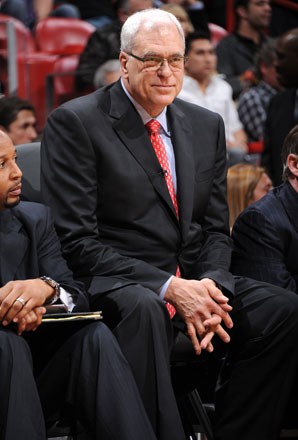 The NBA appears to have found its most effective revenue-sharing model.
And so long as the Lakers continue with their perceived missteps, the league's most successful franchise will just keep sharing the wealth.
A league source confirmed that Phil Jackson has been fined $75,000 and the Lakers fined a separate $75,000 for the coach's recent lockout-related statements. This comes one day after Kobe Bryant was assessed a $100,000 fine for aiming a homosexual slur at an official during the Lakers' game against San Antonio on Tuesday.
Jackson, who had a fireside chat of sorts with the team's beat reporters at hotel in Portland on April 7, spoke of the likely lockout and how it impacted his decision to retire after this season.
"It was really about the fact that there's going to be a lockout," Jackson said. "It's the perfect time to help the organization cover a gap if there's a lockout. My staff, all those guys who work with me. All those things played into it. I felt like an obligation.
"Who knows what the NBA is going to look like next year?" It's going to take on a whole different proportion. How long is it going to last? I think there are some people who are pretty convinced there's not going to be a year next year."
The league clearly didn't take kindly to the public assumption that there would be a work stoppage, especially considering the labor negotiations between the owners and players are approaching a critical stage with the collective bargaining agreement set to expire on June 30. The story was first reported by ESPN.com.
Source: sportsillustrated
Rafael Nadal cruises to win over Richard Gasquet
Rafael Nadal extended his unbeaten run at the Monte Carlo Masters to 34 matches as he reached the last eight with a solid win over Richard Gasquet.
Nadal was rarely threatened and two breaks in the first set and two in the second gave him a 6-2 6-4 win.
He will now play Ivan Ljubicic, who beat fifth seed Tomas Berdych 6-4 6-2.
Second seed Roger Federer beat Marin Cilic 6-4 6-3 and next faces seventh seed Jurgen Melzer, who was a surprise 6-1 6-4 winner over Nicolas Almagro.
World number one Nadal said he was "very happy" with his form against Gasquet.
"I think I played better than yesterday, easier. In general, I think it was a very positive victory against a very difficult opponent," Nadal continued.
"I feel when I'm playing well with the forehand, it is a very important shot for me, so I can have the control of the point most of the time.
"When I am playing well with the forehand, everything is a little bit less difficult."
After breaking in the first game of the match, Nadal found his first service game a tricky affair. However, after fighting off several deuces, he duly held and, even at that early stage, there was only going to be one winner.
France's Gasquet tried to be aggressive and produced some good shots but his opponent was a class apart and a second break at 4-2 helped Nadal take the first set in 44 minutes.
The Spaniard dropped only six points on his serve in the opening set and was equally in control for much of the second.
Gasquet fought off a break point at 2-2 with the help of three big serves in a row and continued to try to take the game to Nadal with some brave shot making.
But, in his next service game, he found himself facing two break points and, although he saved the first, a looping forehand on the run that just clipped the baseline gave Nadal a 4-3 lead.
It looked like being decisive but Gasquet was in no mood to lie down and after forcing a break point, a running forehand pass resulted in him drawing level at 4-4.
However, Nadal immediately earned two break points of his own and duly broke back before serving out to reach the last eight.
Federer cruised through his early service games but, although Croat Cilic struggled to get his first delivery in play, the world number three found it difficult to get to grips with his 6ft 6in opponent's high kicking second serve.
It looked as though the first set was headed for a tie-break but at 5-4 Cilic's steady form suddenly deserted him and a series of errors handed the break and the set to Federer.
The second set soon settled into a similar pattern as the first with service dominating until the sixth game, when Federer secured the decisive break with a fizzing backhand pass.
A couple of Federer errors resulted in him taken to deuce on his serve in the next game but the Swiss star refocused and eased into the last eight with no further alarms.
"Today was another solid performance, which I'm very happy about," Federer reflected. "I think I was consistent and didn't allow him to get into the points he wanted to on my own serve.
"The first set was close until he had that loose game. He can be dangerous, so I'm pleased to go through."
Fourth seed David Ferrer reached the quarter-finals with a 6-1 6-3 win over Milos Raonic but fellow Spaniard Tommy Robredo was leading Viktor Troicki 6-3 1-2 when forced to withdraw through injury.
There was another surprise when Portugal's world number 82 Frederico Gil beat French eighth seed Gael Monfils 7-6 (8-6) 6-2 to set up a quarter-final against Andy Murray, who defeated Gilles Simon 6-3 6-3.
Windies drop Gayle and recall Samuels
West Indies Cricket Board (WICB) CEO Dr Ernest Hilaire said that, while the Board has a policy of exposing more players to international cricket, there has been no move to axe any player permanently from playing for the West Indies.
“The selectors have a selection policy and are moving forward and building a broad pool of international players. The first action is to expose more players. And that does not mean that the WICB is abandoning older players,” Hilaire said as he participated in an exclusive interview with regional commentator Andrew Mason for the Mason and Guest radio show on the Starcomm Network.
“Having established in your mind what the core of your team is that you will build around, you now need to find the other players who will fit into the squad and that is what the selectors are seeking to do and in the application of the policy we expect that players will be rotated from time to time,” Hilaire said.
“I have read sensational stories in the media about players being sacked and axed but I would appeal to the public to understand that this is about building a pool of players for the future. We are exposing players at the international level to see how comfortable, competent and capable they are.
“If you go back to October 2010, the Board had set out a selection policy to guide the selectors moving forward. We had set the 2015 World Cup as a target for when we should have a team which will challenge as World Champions,” the CEO outlined.
“The selectors have not said that they are axing, dropping or dismissing any particular player permanently. They are pursuing a policy of exposing newer players and giving other players an opportunity to play. I would not go down the road of saying that any player will not play for West Indies again,” Hilaire clarified.
“We expect that there will be public criticism because we are a diverse region and there are always some people who believe that some players must always play and there will be some people who believe that we need to try new players,” he said.
“But there is no indication that any player has been axed or will not play for West Indies again. The selectors will speak to each of the players to explain what the plans are and how they fit into the plan. The players will not always be happy but there is a bigger picture which is West Indies cricket and we expect that confidential discussions between players and selectors will remain as such,” Hilaire added.
Speaking specifically about opening batsman Chris Gayle, Hilaire explained that Gayle has not yet undergone a fitness test following his injury sustained during the Cricket World Cup.
Cooper, Narine cleared of suspect bowling actions
Two of Trinidad and Tobago’s brightest cricket prospects have had a cloud of suspicion lifted from their young careers after undergoing a series of tests on their bowling action at the West Indies Cricket Board’s High Performance Centre in Barbados. And according to Kumar Rampath, Territorial Development Officer of the WICB, Kevon Cooper of T&TEC and Sunil Narine of Queen’s Park have been cleared to play for their respective Premier League clubs but have been advised not to bowl while they complete remedial work on their bowling actions under the supervision of their club coaches. Both Cooper, a penetrative fast bowler and Narine, a spinner were reported for suspect bowling actions during the Caribbean T20 Championships last January in Antigua/Barbuda and Barbados. T&T cricketers won the tournament but a shadow was cast on both players when the news was later made public.
However, Rampat said the nature of the problem in the bowling actions of both Cooper and Narine were not career threatening and that a series of drills were prescribed for the bowlers who are expected to be closely monitored to assess the progress. Rampat said the initial phase of the remedial work for Cooper will be done under the supervision of Junior Joseph at T&TEC. Narine, who has also been selected by the T&T team will work with the experienced Parkites coach David Furlonge to iron out the kinks in his action before he can be considered to bowl again in the domestic league. Rampat said both bowlers who are seen as future West Indies players because of their huge potential visited the HPC on April 4 and 5 (Narine) and April 6 and 7 (Cooper) where careful and detailed analyses were done.
The bowlers were subject to video tape analyses when they were filmed from different angles including front, side and back and were examined bowling their stock deliveries by a team of qualified coaches including Andre Cooley of Jamaica; Tony Radford of England; and Simon Graham, a sports psychologist.
Rampat said he was present at the sessions with the officials who are all associated with the HPC in Barbados to observe in his capacity as Territorial Development and to assist if called upon. He said following the tests a meeting was subsequently held with the players and coaches along with T&T national team coach Kelvin Williams and Clem Hercules. Rampath said the players and the coaches agreed with the summation of the test results and pledged to work to implement the recommendations in an effort to correct the flaws in their actions so they can resume their careers at the national and regional levels. In related news Rampath was scheduled to leave for Dubai on Thursday in the United Arab Emirates to participate in an international coaching course under the auspices of the International Cricket Council.
The course runs for two weeks and have attracted top coaches from all around the world.
US crude rises as traders eye weaker dollar
 US crude oil futures rose nearly one per cent yesterday, as a weaker dollar offset worries that surging prices would erode demand. With no clear end to fighting in Libya that has cut supplies from the OPEC nation and lifted oil prices to 32-month highs, the market focused on US economic data and the dollar. The dollar fell after US data showed an unexpected rise in jobless claims and an increase in producer prices in March. “When the (producer prices) and the weekly job claims number came out, we saw a reversal in the dollar and we saw a corresponding (rise) in oil prices,” said Stephen Schork, editor of the Schork Report, in Villanova, Pennsylvania.
Futures were also boosted by news that Sunoco Inc shut a gasoline-making unit at its 335,000-barrels-per-day Philadelphia refinery after a small fire. On Wednesday, US data showed gasoline stockpiles plunged seven million barrels last week, the biggest weekly drop in more than 12 years, raising concerns about supplies ahead of the summer driving season. US crude for May delivery gained US$1 to settle at US$108.11 a barrel. Upward pressure came in part from options on the contract, in which concentrations of calls were at a level above current prices. In London, ICE May Brent crude expired, settling at US$122.36 a barrel, down 52 cents.
Brent’s premium to US crude narrowed to US$14.25 from US$15.77 at the close Wednesday. US crude volume hit 715,000 lots as of 4.25 pm EDT, 5.5 per cent above the 30-day average, with less than an hour of the day’s trading left. Brent crude volume was nearly 400,000 lots, 17 per cent below the 30-day average.
Dollar slips, Libya news sidelined
First-time claims for US unemployment benefits rose unexpectedly last week, raising questions about the health of a labour market recovery. Also, producer prices picked up pace in March as the disruption caused by Japan’s earthquake began to be felt in the auto industry. The dollar fell against a basket of currencies after the data. “The spike in jobless claims back over 400,000 hit the dollar, which once again is supporting energy and precious metal prices. It’s a troubling data point from an area that we thought some progress was being made,” said John Kilduff, a partner at Again Capital LLC in New York.
Libyan rebels begged for more Nato air strikes, saying they faced a massacre from government artillery barrages on the besieged city of Misrata. But Nato allies rebuffed French and British calls to contribute more to the air war in Libya. Libyan rebels have said they are exporting a minimal amount of crude from fields, pumping about 100,000 barrels per day, far less than usual production of 1.6 million bpd. Elsewhere, the oil market had little reaction to news that inflation in China accelerated faster than expected in March.
China’s first-quarter GDP figures and March consumer price data are due today, and will be scrutinised for signs of out-of-control growth. That could prompt further monetary tightening and potentially affect oil demand, analysts said.
(Reuters)
Ireland starts action on subordinated bank debt
Ireland’s High Court opened the way on Thursday for the government to force burden sharing on the owners of subordinated debt in nationalised Allied Irish Banks, the finance ministry said. Last month, Ireland said it would seek significant contributions from junior debtholders in its banks to help pay for recapitalising the industry, a cost that has so far fallen mainly on taxpayers. The country had to take an €85-billion-euro bailout from the European Union and International Monetary Fund last November after the collapse of a construction boom crippled the banks that had financed it.
Finance Minister Michael Noonan said Allied Irish Banks’ €2.6 billion in subordinated debt could lose up to four-fifths of its value. “It’s a matter for negotiations, but the ballpark figure would be something like 80 per cent,” Noonan told national broadcaster RTE. The High Court on Thursday issued a Subordinated Liability Order that will amend certain subordinated debt coupon terms and maturity dates, and permit the AIB to purchase debt instruments, the finance ministry said in a statement.
“Today’s action is intended to ensure that AIB’s subordinated debt holders share the burden of the capital position of AIB and reduce the level of capital sought from the taxpayer,” the statement said. “If this exercise is not successful, the government intends to take whatever other action is necessary to ensure appropriate burden sharing by remaining subordinated bondholders.” AIB said in a statement that it would not pay interest or coupons on some subordinated bonds, and would extend the maturity of some other bonds to 2035.
Irish lenders have around 7 billion euros worth of outstanding subordinated bonds, according to Central Bank figures released earlier this month. Holders of the 2.7 billion euros in subordinated debt in Bank of Ireland may be offered a debt-for-equity swap, Noonan told RTE. Bondholders in the other banks will be offered cash, he said. Allied Irish Banks posted a loss of €10.4 billion on Tuesday. It has been effectively nationalised and saved from collapse by emergency ECB funding after being shut out of debt markets and losing €22 billion in deposits last year.
Noonan said he hoped between five billion and six billion euros could be raised through imposing losses on holders of subordinated bank debt. The finance minister dropped a previous threat to impose losses on senior unsecured bonds in Bank of Ireland and Allied Irish Banks, the two “pillar banks” the government plans to build a new banking system around.
(Reuters)