
NFL, players disagree on who should oversee talks
A day after the judge handling the NFL lockout lawsuit urged the sides to go "back to the table," the players and owners both expressed a willingness to do so. The hitch: Each offered to meet for talks in a setting the other finds unpalatable.
A lawyer representing MVP quarterbacks Tom Brady, Peyton Manning and other players suing the NFL wrote U.S. District Judge Susan Richard Nelson on Thursday to say they're willing to engage in mediation overseen by her federal court in St. Paul, Minn.
And NFL executive vice president Jeffrey Pash sent a letter Thursday to another lawyer representing players, James Quinn, with a copy going to Nelson, proposing to resume talks about 1,000 miles from her courthouse — instead returning to the Washington office of federal mediator George Cohen.
Since filing suit in Minnesota on March 11, the players repeatedly have said they only are interested in meeting with the league to discuss settling the litigation. And since the lockout began at midnight later that night, the NFL repeatedly has said it only is interested in returning to mediated bargaining.
So Thursday's flurry of letters doesn't really represent meaningful progress. There were more, too, including a message to Nelson from NFL outside counsel David Boies that referred to a conference call with the court Friday "to discuss mediation."
Boies also wrote: "The purpose of the mediation would be to negotiate a settlement not only of the issues raised in the complaints, but also the many other issues that must be resolved to permit the upcoming season to be played and for the league to operate effectively."
In his letter to Quinn, the NFL's Pash said: "We are prepared to resume discussions as promptly as possible and to have significant ownership involvement in those discussions. Our thought would be to resume discussions under the auspices of George Cohen and his colleagues at the Federal Mediation and Conciliation Service. After spending the better part of three weeks with us, they know the issues, they know the parties, and I think we all agree that they were effective at getting both sides to look openly at each other's positions and try to find solutions."
Pash also told Quinn: "We understand that you will want appropriate assurances that the players will not compromise any legal position as a result of entering into those discussions. We are prepared to give reasonable and appropriate assurances to that effect."
Cohen mediated 16 days of negotiations in February and March that failed to result in a new collective bargaining agreement, and the old one expired. The union dissolved itself, saying it no longer represented players in bargaining under labor law, which allowed them to sue the league under antitrust law. Owners locked out the players, creating the NFL's first work stoppage since 1987.
Boies referred to the "head start over any other potential mediator" that Cohen would have, and added, "We cannot see any reason to start back at square one with a different mediator."
Quinn, meanwhile, replied to Pash by saying: "Your invitation to 'resume' discussions in front of Mr. Cohen makes no sense as collective bargaining between the NFLPA and the NFL is over."
During Wednesday's hearing in St. Paul on the players' request for a preliminary injunction that would lift the lockout, Nelson recommended court-supervised talks, saying such negotiations should take place at "not the players' table, not the league's table, but a neutral table, if you will."
"This is really a matter that should be resolved as soon as possible," added Nelson, who said she would take "a couple of weeks" to rule on the players' bid for an injunction.
Nelson said she "would be glad to facilitate" negotiations, if the sides were interested.
"As class counsel on behalf of the Brady class, we think this is an excellent suggestion and are prepared to engage in such mediation without delay," an attorney for the players, Barbara Berens, wrote to Nelson on Thursday. "Our agreement is, of course, contingent on the NFL defendants' agreement that they will not attempt to use this, our willingness to mediate, against the Brady class in some way, for example by arguing that such mediation efforts constitute 'collective bargaining' or otherwise arise out of a 'labor relationship.'"
Also Thursday, Nelson received yet another letter accepting her offer of facilitating mediation — this one from a lawyer representing Hall of Famer Carl Eller and other retired players whose case was combined with the Brady case.

Shutdown talks yield no deal as clock ticks
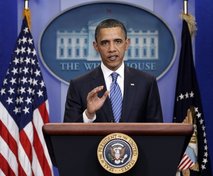 Time growing short, President Barack Obama and congressional leaders failed to reach agreement Thursday night on a compromise to cut spending and head off a midnight Friday government shutdown that no one claimed to want.
Obama, House Speaker John Boehner and Senate Majority Leader Harry Reid all said the differences had been narrowed in a pair of White House meetings during the day. They directed their aides to work through the night in pursuit of a deal.
"I expect an answer in the morning," Obama said in an appearance in the White House briefing room shortly after his second sit-down of the day with the lawmakers.
The comments capped a day in which the president, Reid, D-Nev., and Boehner, R-Ohio, bargained and blustered by turns, struggling to settle their differences over spending cuts and other issues while maneuvering to avoid any political blame if they failed.
With the economy just now beginning to create jobs in large numbers, the president said a shutdown would damage the recovery. "For us to go backwards because Washington couldn't get its act together is just unacceptable," he said. The White House announced he had postponed a scheduled trip to Indianapolis for the morning.
But agreement remained elusive, and Republicans passed legislation through the House at mid-day to fund the Pentagon for six months, cut $12 billion in domestic spending and keep the federal bureaucracy humming for an additional week. "There is absolutely no policy reason for the Senate to not follow the House in taking these responsible steps to support our troops and to keep our government open," said Boehner.
Obama flashed a veto threat even before the bill passed on a 247-181, mostly party-line vote. The administration issued a statement calling it "a distraction from the real work" of agreeing on legislation to cover the six months left in the current fiscal year, and there was no indication Reid would allow a vote on it.
As they left the White House after the evening meeting, Reid and Boehner issued a brief written statement that said they had narrowed their disagreements and said they would "continue to work through the night to attempt to resolve" the remaining ones.
Republicans want deeper spending cuts than the Democrats favor and also are pressing for provisions to cut off federal funds to Planned Parenthood and stop the EPA from issuing numerous anti-pollution regulations.
"They're difficult issues. They're important to both sides and so I'm not yet prepared to express wild optimism," said the president.
For all the brinksmanship — and the promise of more in the Senate on Friday — there was agreement that a shutdown posed risks to an economy still recovering from the worst recession in decades.
The political fallout was less predictable, especially with control of government divided and dozens of new tea party-backed Republicans part of a new GOP majority in the House. Twin government shutdowns in the mid-1990s damaged Republicans, then new to power in Congress, and helped President Bill Clinton win re-election in 1996.
This time, individual lawmakers worked to insulate themselves from any political damage. Sens. Sherrod Brown, D-Ohio, and Ben Nelson, D-Neb., both seeking new terms in 2012, became the latest to announce they would not accept their congressional salary during any shutdown. "If retroactive pay is later approved, I'll direct my part to the U.S. Treasury," said Nelson.
One day before the shutdown deadline, events unfolded in rapid succession.
In a shift in position, Obama said he would sign a short-term measure keeping the government running even without an agreement to give negotiations more time to succeed.
That was one of the options available to Reid, although Boehner said he was confident Democratic lawmakers would persuade "Reid and our commander in chief to keep the government from shutting down" by signing the House-passed bill.
At the White House, a senior budget official said the impact of a shutdown "will be immediately felt on the economy."
It also would be felt unevenly, said Jeff Zients, deputy director of the Office of Management and Budget. Military troops would not receive their full paychecks, but Social Security recipients would still get monthly benefits, he said.
"National parks, national forests and the Smithsonian Institution would all be closed. The NIH Clinical Center will not take new patients, and no new clinical trials will start," he added in a roll call of expected agency closings.
But the air traffic control system would stay up and running, the emergency management agency would still respond to natural disasters and border security would not be affected.
There was no indication Reid planned to bring the House-passed stopgap bill to a vote, and he accused Republicans of blocking a deal by demanding anti-abortion provisions and a blockade on Environmental Protection Agency regulations on greenhouse gas and other pollutants.
"We don't have the time to fight over the tea party's extreme social agenda," he said.
It was unclear whether the day's maneuvering marked attempts by negotiators to gain final concessions before reaching agreement, or represented a significant setback to efforts to avoid a shutdown.
Either way, Boehner pointed out that the current clash was only the first of many likely to follow as the new, conservative majority in the House pursues its goals of reducing the size and scope of government.
"All of us want to get on with the heavy lifting that is going to come right behind it, dealing with the federal debt and putting in place a budget for next year," he said.
For all the tough talk, it did not appear the two sides were too far from a deal.
Officials in both parties said that in the past day or so, Democrats had tacitly agreed to slightly deeper spending cuts than they had been willing to embrace, at least $34.5 billion in reductions.
Agreement on that point was conditional on key details, but it was a higher total than the $33 billion that had been under consideration.
It also was less than the $40 billion Boehner floated earlier in the week — a number that Republicans indicated was flexible.
There also were hints of Republican flexibility on a ban they were seeking to deny federal funds to Planned Parenthood. Officials said that in talks at the White House that stretched on after midnight on Wednesday, Republicans had suggested giving state officials discretion in deciding how to distribute family planning funds that now go directly from the federal government to organizations such as Planned Parenthood.
That would presumably leave a decision on funding to governors, many of whom oppose abortion, and sever the financial link between the federal government and an organization that Republicans assail as the country's biggest provider of abortions.
Democrats seemed unlikely to accept the proposal, and it was not clear whether it might form the basic framework for an agreement.
But Republicans quickly circulated a list of previous instances in which Obama had signed a similar provision or Reid and House Democratic leaders had supported it as part of a larger measure.
Legislation passed by the House six weeks ago called for $61 billion in cuts and dozens of non-spending provisions.
The Senate has yet to pass an equivalent bill of its own, but Congress has passed a pair of short-term measures in the intervening time to keep the government running, approving a total of $10 billion in spending cuts at the same time.
___
Source:Associated Press
Trump hammers away at Obama's citizenship question
Real estate tycoon Donald Trump said Thursday he isn't convinced that President Barack Obama was born in the United States, but says he hopes the president can prove that he was.
Officials in Hawaii have certified Obama's citizenship, but "birthers" have demanded additional proof. And Trump, who is weighing whether to seek the Republican presidential nomination, says not all the questions have been answered.
In an interview broadcast Thursday, Trump told NBC News he plans to decide by June whether to run, and said that if he is the GOP nominee, "I'd like to beat him straight up," not on the basis of the question of where Obama was born.
Trump insisted he didn't introduce the citizenship issue, but he isn't letting go of it either. Since he was asked about it during an interview several weeks ago, the real estate executive said, he's looked into it and now believes "there is a big possibility" Obama may have violated the Constitution.
"I'd like to have him show his birth certificate," Trump said. "And to be honest with you, I hope he can."
Asked in the interview how genuine his presidential ambition is, Trump said, "I always take things seriously, but I've never taken it seriously like this. I wish I didn't have to do it."
"I wish this was the greatest place in the world," Trump said. But he said the United States is losing respect in the world at a time when jobs at home are vanishing. He accused Obama of giving the country "a terrible presidency."
Trump said that if the current fight over budget issues forces a shutdown, "I think the president will be blamed."
He accused Obama of conducting a confusing policy on the civil war in Libya, saying "nobody knows what's happening, and now it looks like (Libyan strongman Moammar) Gadhafi is going to beat the United States."
"I'm only interested in Libya if we get the oil," Trump said. He said Obama "doesn't have a doctrine (on foreign affairs.) Foreign affairs is, we take care of ourselves first"
Of Obama, he said, "I want him to do well. ... I love this country, but this country is going to hell. ... The world laughs at us. They won't be laughing if I'm elected president."
___
Strongest aftershock since Japan tsunami kills 2
A strong aftershock ripped through northeastern Japan, killing two, injuring dozens and piling misery on a region still buried under the rubble of last month's devastating tsunami.
The quake late Thursday was the strongest tremor since the March 11 jumbo and did some damage, but it did not generate a tsunami and appeared to have spared the area's nuclear power plants. The Fukushima Dai-ichi complex — where workers have been frantically trying to cool overheated reactors since they lost cooling systems last month — reported no new abnormalities. Other facilities retained a connection to the grid or switched to diesel generators after the 7.1-magnitude quake knocked out power to much of the area.
Many people in the area have lived without water and electricity for nearly a month, and the latest tremor sunk more homes into blackness: In total, around 3.6 million households — about 60 percent of residents in the area — were dark Friday, said Souta Nozu, a spokesman for Tohoku Electric Power Co., which serves northern Japan.
Five conventional plants in the area were out, and it was not clear when power would be restored, he said.
Matsuko Ito, who has been living in a shelter in the small northeastern city of Natori since the tsunami, said there's no getting used to the terror of being awoken by shaking.
"I was almost as scared as much as last time," said the 64-year-old while smoking a cigarette outside. "It's enough."
She said she started screaming when the quake struck around 11:30 p.m.
"Something has changed," she said. "The world feels strange now. Even the way the clouds move isn't right."
Thursday's quake initiated a tsunami warning of its own, but it was later canceled. Two people were killed, fire department spokesman Junichi Sawada reported Friday. A 79-year-old man died of shock and a woman in her 60s was killed when power was cut to her oxygen tank. More than 130 people were injured, according to the national police agency.
The temblor's epicenter was in about the same location as the original 9.0-magnitude tremor, off the eastern coast and about 40 miles (65 kilometers) from Sendai, an industrial city on the eastern coast, according to the U.S. Geological Survey. It was strong enough to shake buildings for about a minute as far away as Tokyo, about 200 miles (330 kilometers) away.
At a Toyota dealership in Sendai, most of a two-story show window was shattered, and thick shards of glass were heaped in front of the building. Items fell off store shelves and a large automated teller machine crept across the floor at a FamilyMart convenience store.
Police directed cars through intersections throughout the city on Friday because traffic lights were out. Small electrical fires were reported.
While the city is far enough inland that it largely escaped tsunami damage, people there lived without regular services for weeks. Within an hour of Thursday's quake, they rushed convenience stores and cleared shelves of ice, water and instant noodles — items that were in short supply after the bigger quake.
The operator of the tsunami-ravaged Fukushima Dai-ichi plant said there was no sign the aftershock had caused new problems there. Workers briefly retreated to a quake-resistant shelter in the complex and suffered no injuries.
After the March 11 quake knocked out power in the region, the wave flooded the plant's diesel generators, leaving the complex without any electricity. Workers have been struggling to stem a tide of radiation since, using makeshift methods to pump cooling water into the reactors. That work continued uninterrupted after the latest quake, according to Japan's Nuclear and Industrial Safety Agency.
Other facilities along the northeastern coast remained connected to a power source Friday, and the agency said they were all under control. Backup generators kicked in at two — Rokkasho and Higashidori.
At a third north of Sendai — which has been shut down since the tsunami — one of three power lines was supplying electricity, and radiation monitoring devices detected no abnormalities. The Onagawa power plant's spent fuel pools briefly lost cooling capacity, but it resumed because a power line was available for electricity.
"It's the way it's supposed to work if power is lost for any reason," said David Lochbaum, director of the nuclear safety project for the U.S.-based Union of Concerned Scientists.
Blackout hits large swath of Venezuela
A blackout hit a large swath of Venezuela on Thursday, darkening street lights, shutting down the Caracas subway and prompting the government to announce temporary rationing measures.
The power outage affected the capital of Caracas and 11 states stretching across the northern half of the country, Electricity Minister Ali Rodriguez said.
He told state television Thursday night that power had been completely restored throughout the country about two hours after the outage began. He said it had been a power loss of "enormous size."
A forest fire apparently caused the problem by overheating major transmission lines in western Venezuela and knocking them offline, Rodriguez said. He said that failure forced various power plants to shut down and caused a cumulative drop of about 10,000 megawatts, a large share of the country's generating capacity of roughly 24,000 megawatts.
Vice President Elias Jaua vowed a thorough investigation of the causes of the forest fire. He said it was unclear how the fire started but that "we never stop investigating situations of possible sabotage."
He suggested sabotage wouldn't be beyond some hard-line opponents of President Hugo Chavez, saying Venezuela has "extremist sectors that still don't accept the democratic game."
Various power plants were being gradually restarted after the blackout, Rodriguez said.
But he said that power would be rationed during a three-hour period during the night and that some areas would see rolling blackouts lasting 20 minutes or less. "It will be temporary," Rodriguez said.
In Caracas, the outage forced subway stations to close in the afternoon, and some passengers had to be evacuated from stranded trains. Heavy traffic jams filled the streets, where stoplights were off in some places.
There are no immediate reports of problems in Venezuela's oil industry. The country's refineries are equipped with emergency generators.
Throughout the first half of 2010, Venezuela experienced recurring power outages across the country as a lack of rainfall caused water shortages and starved the hydroelectric dams that produce about three-fourths of the South American country's electricity.
Earthquake shakes wide area of southern Mexico
A magnitude-6.5 earthquake shook a wide area of southern and central Mexico on Thursday, sending people fleeing into the streets, but causing only minor reported damage.
The epicenter was located near Las Choapas, a town of about 83,000 residents about 370 miles (600 kilometers) southeast of Mexico City. It swayed buildings for several seconds in the capital, and in the Gulf coast state of Veracruz, people ran from their homes and school children assembled on playgrounds.
Near the epicenter, cracks in walls forced the evacuation of one elementary school, said Bernabe Hernandez Perez, head of civil protection in Las Choapas.
Gov. Javier Duarte de Ochoa said earlier that he had no reports of damage in the oil-producing state.
"Veracruz is completely quiet without problems," he told state television. "It was felt all over the state, but nothing major happened. It was only a scare."
The temblor also was felt strongly in the state of Chiapas, bordering Guatemala, where there also were no immediate reports of damage or injuries, as well as the Pacific coast state of Guerrero.
The U.S. Geological survey said the quake hit at a depth of 104 miles (167 kilometers).
Clinton Dismisses Gadhafi Letter, Reaffirms He Must Yield Power
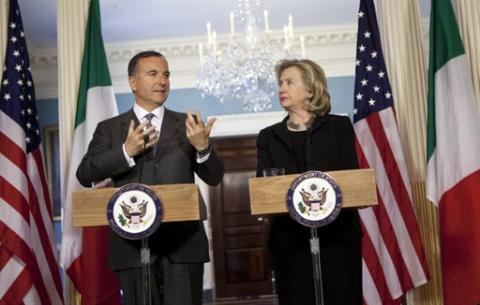 U.S. Secretary of State Hillary Clinton Wednesday brushed aside a personal appeal from Libyan leader Muammar Gadhafi for an end to the NATO air campaign in support of Libyan rebels. Clinton, who discussed the Libyan crisis with Italian Foreign Minister Franco Fratini, said Mr. Gadhafi must yield power and leave the country.
Clinton is dismissing an unusual personal appeal from the Libyan leader to President Barack Obama for NATO to halt its air operations, and reaffirming that an end to the conflict requires Mr. Gadhafi’s departure from power.
In the letter, conveyed to the U.S. government Wednesday, Mr. Gadhafi accuses NATO of waging an "unjust" war against Libya, and that the conflict in the country should be left for Libyans to resolve within the framework of the African Union.
In a text of the rambling note made available to reporters, Mr. Gadhafi repeats charges that al-Qaida is behind the rebellion against him.
The Libyan leader refers to Mr. Obama, the first African-American U.S. president, as a son of Africa and says despite the NATO intervention, he hopes Mr. Obama wins another term in office.
Secretary Clinton addressed the Libyan message at a joint press event with Italian Foreign Minister Franco Fratini.
"I think that Mr. Gadhafi knows what he must do. There needs to be a cease-fire. His forces need to withdraw from the cities that they have forcibly taken at great violence and human cost. There needs to be a decision made about his departure from power, and as the foreign minister said, his departure from Libya," she said.
,
Mr. Fratini, whose government has joined France and Qatar in recognizing Libya’s opposition Transitional National Council as the country’s legitimate government, declined under questioning to publicly call on the United States to do the same.
But he welcomed this week’s dispatch of a U.S. diplomat, Chris Stevens, to the rebel stronghold of Benghazi, which she suggested will put the Obama administration in a better position to decide the issue of recognition.
"I know perfectly that the United States has to know more about this group in Benghazi. Maybe Italy did so because we know for a longer time, from inside the country, who they (the rebels) are, how the situation is. So it’s absolutely necessary for these people to be a bit (more) well-known to the public opinion of the rest of the world, to offer the opportunities and the elements that are necessary to take a decision like the one Italy has taken," he said.
Amid rebel complaints that the air campaign has lagged since the United States ceded the lead role in operations to NATO partners a week ago, Clinton said the allies have performed well given shifting tactics by pro-Gadhafi forces.
"We do know it is difficult when you have a force such as that employed by Gadhafi that is insinuating itself into cities, using snipers on rooftops, engaging in violent, terrible behavior that puts so many lives at risk, for air power alone to be sufficient to take out those forces. So given the mission that NATO is performing, it is performing admirably," she said.
Clinton said she and Fratini discussed how NATO can accelerate the training of rebel forces, a conversation expected to continue next week when both attend a NATO foreign ministers meeting in Berlin.
Their talks also covered the surge in migration of Tunisians and others to Italy since political unrest began in the region.
Clinton said Italy is "bearing more than its share of responsibilities" on migration flows, while Fratini said it is not just an Italian problem but a "truly European issue" and that Italy wants more burden-sharing.
Mass Grave Found in Mexico
Authorities in Mexico say security forces have found at least 59 bodies in a mass grave in the northern state of Tamaulipas, near the U.S. border.
Government officials said police and military personnel found the mass grave while investigating the March 25 disappearance of several buses in the area. The state prosecutor's office said they are trying to determine whether the grave contains the bodies of the bus passengers.
Eleven suspects were arrested during the investigation.
The grave in the township of San Fernando is in the same area that 72 Central American migrants were found shot to death last August. Survivors of the attack say the victims were shot for refusing to work for an illegal drug cartel.
Also Wednesday, thousands of people in a number of Mexican cities protested the violence that accompanies Mexico's fight against the illegal drug trade.
Drug-related killings have taken some 34,000 lives since 2006, when the Mexican government launched an offensive on drug trafficking.
Charlie Sheen live show bombs in Detroit
 Actor Charlie Sheen was booed off stage by fans on the first night of his Violent Torpedo Of Truth: Defeat Is Not An Option one-man show in Detroit.
The former Two And A Half Men star had initially been greeted with rapturous applause, but fans reportedly began to walk out within 15 minutes.
Sheen had promised to tell "the real story", but critics said he instead gave "a series of nonsensical rants".
The show ended after an hour when Sheen failed to return after a musical break.
Entertainment Weekly described the show as an "unmitigated disaster".
"The padded and disjointed show was a hodgepodge of video clips and Sheen-isms that felt hastily assembled and misjudged the patience of even the hardest of hardcore fans," it said.
The Hollywood Reporter said: "Call it 'tiger blood' or 'Adonis DNA' if you will. Just don't call it entertainment."
Sheen opened with a monologue saying: "I am finally here to identify and train the Vatican assassin locked inside each and every one of you."
After talking about his "napalm dripping brain" and describing himself as "a giant and leaky bag of mayhem", he added: "Is anybody else as confused by this as I am?"
He also showed film clips including one he wrote, produced and directed entitled RPG, but was abruptly halted after more booing from the audience.
The 45-year-old responded to one heckle by saying: "I already got your money, dude."
He later told the crowd the show was "an experiment" adding: "You paid your hard-earned money without knowing what this show was about."
Fans walked out chanting "Refund!" and were quick to express their disappointment outside.
"I was hoping for something. I didn't think it would be this bad," said Linda Fugate from Detroit, who said she paid $150 (£93) for two tickets.
"I expected him to at least entertain a little bit. It was just a bunch of ranting," said Rodney Gagnon, who travelled from Ontario in Canada for the show.
Others blamed the audience: "I thought it was good. It was what I expected," Lori Caputo of Battle Creek, Michigan, told USA Today.
"I was disappointed in everybody booing."
The Detroit performance was the first of 22 sold-out planned shows in 20 US and Canadian cities.
Sheen's publicist Larry Solters declined to comment after the show.
Sheen was fired from hit comedy Two and A Half Men last month amid a frenzy of US media reports on his controversial personal life.
Meanwhile, Martin Sheen has spoken to the BBC about the "roller coaster ride" his family have experienced in trying to support his son.
"Charlie is dealing with the most profound problems and addiction - there's no secret, his behaviour has been an example of that," he told Kirsty Young on Radio 4's Desert Island Discs.
LeBron James becomes minority stakeholder in Liverpool
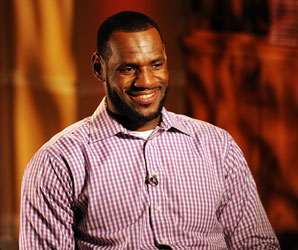 Basketball star LeBron James has become a minority stakeholder in Liverpool after signing a representation deal with the club's owners.
Fenway Sports Group (FSG) has struck a deal to partner the Miami Heat player's marketing firm to become his exclusive worldwide representative.
The report in the Wall Street Journal said James received an undisclosed stake in Liverpool as part of the deal.
"This is a great opportunity for me," said NBA star James.
"The first time I stepped on an NBA court I became a businessman."
Referring to Liverpool's title honours James added: "Eighteen championships. I see myself trying to do the same things they have."
The Wall Street Journal said Maverick Carter, chief executive of LRMR Branding & Marketing, had expressed his desire to build James' portfolio internationally.
"We're not interested in talent or athlete representation but we think he is one of the most remarkable athletes of his time," FSG and Liverpool chairman Tom Werner told the newspaper.
"We believe we can open doors for LeBron and LeBron can open doors for us. Without purchasing Liverpool, we never would have been able to have this conversation."