
Eurozone sets bail-out terms as Portugal fears increase
European leaders have agreed a restructuring of a financial bail-out fund that they hope will resolve the bloc's debt crisis.
Eurozone ministers bowed to German demands to renegotiate the time-frame for contributions to the massive fund.
But the deal was overshadowed by concerns about Portugal and a growing row that the UK may be forced to contribute to a financial bail-out.
Portugal says it does not need aid, but many analysts say Lisbon is in denial.
The eurozone debt deal follows months of negotiations.
"We decided a comprehensive package of economic measures... Today almost all the strands of this enterprise have come together," European Council President Herman Van Rompuy said.
The new plan provides for the creation of a permanent fund in 2013, the European Stability Mechanism, to help troubled eurozone countries.
A major sticking point was the speed with which countries had to pay cash into the 700bn-euro (£615bn) fund.
The agreement requires 80bn euros of cash provided by eurozone countries in five equal annual instalments. There will be a further 620bn euros in guarantees.
Originally, eurozone finance ministers agreed to put 40bn euros into the fund immediately it is created in 2013.
There had been expectations that the two-day summit in Brussels would agree a resolution over rescuing Portugal's stricken economy.
But Portuguese ministers said they had no intention of following Greece and the Irish Republic in tapping the bail-out fund.
Even so, analysts believe it is only a matter of time before other countries are forced to provide support to the ailing economy.
'Furious'
UK Prime Minister David Cameron refused to respond to suggestions that Britain may have to pledge billions of pounds to any emergency funding.
He said: "It's not right to comment and speculate on another country's finances, and I'm not going to do that."
He has faced angry calls from his own Conservative MPs to refuse to contribute British money towards a bail-out.
"Can I remind you that we have just had an austerity Budget?" said former frontbencher Bernard Jenkin in the Commons on Thursday.
"Can you imagine how absolutely furious British voters would be if it turns out that the British taxpayer has to continue contributing to the bail-out of euro countries, even though we are not a member?"
European Commission President Jose Manuel Barroso insisted that member states had not discussed bailing out Portugal.
"We [EU leaders] expressed confidence in the capacity of Portugal to overcome the current situation and also to find the funding the country needs in the months to come."
The financial markets are also worried as Portugal must repay a large chunk of debt to lenders in April.
On Friday, Standard & Poor's downgraded Portugal's credit ratings by two notches to BBB and warned it could cut it further.
S&P followed a two-notch cut by Fitch on Thursday.

David Cameron wants Japan EU trade deal
The European Union (EU) should offer Japan a free trade deal to help it recover from the earthquake and tsunami two weeks ago, UK Prime Minister David Cameron has said.
"One of our priorities must be to invite Japan to enter into a free trade area with the EU," Mr Cameron said.
This would give Japan a trade boost and aid its economic recovery, he said following an EU summit in Brussels.
The Japanese government has estimated the rebuilding cost to be £192bn.
Mr Cameron said he had "secured a specific reference" to his proposal in the conclusions of EU documents.
The documents will be published later.
Manageable costs
Earlier, the International Monetary Fund said it believed Japan's economy was strong enough to afford the cost of rebuilding the damage from the earthquake and tsunami.
It said it expected a short-term drop in the economy, but no long-term impact.
"Despite the extensive damage we are of the view that the economic costs are manageable," said Ken Kang, the IMF's Asia Pacific chief.
However, it said that power shutdowns would complicate Japan's prospects.
Spanish airport workers call off major strike
Airport workers in Spain have called off 22 days of strikes which threatened to cause major disruption over the Easter holidays and into the summer.
Union members voted to cancel the strike after receiving guarantees over job security and conditions.
The strikes were called over concerns about the part-privatisation of national airport operator Aena.
The government plans to sell up to 49% of Aena, in a drive to reduce Spain's budget deficit.
Workers had feared the sale of the company would result in job losses and a deterioration in conditions.
Union leaders said about 70% of their more than 10,000 members voted to call off the industrial action.
"The ratification of this deal means the cancellation of the call for 22 days of strikes planned on different days between April and August," said a statement from the CCOO union.
The strikes would have involved security staff, baggage handlers, ground crew and others at 47 Spanish airports.
It would have dealt a serious blow to Spain's tourism industry in the busy Easter and summer seasons.
Spain is seeing an increase in visitor numbers as tourists avoid trouble spots in the Middle East such as Egypt and Tunisia.
Saab chief goes as losses mount
The chief executive of Saab is stepping down as the carmaker continues to struggle with weak sales and large losses.
Saab suffered a 218m euros ($308m; £191m) loss last year, according to parent company Spyker Cars.
Jan Ake Jonsson has worked for Saab for about 40 years.
As chief executive during the last six years, he was instrumental in saving Saab from closure.
"He's done an incredible job getting Saab back on track," Victor Muller, owner and chairman of Saab, told BBC World in an interview.
Mr Jonsson said: "The last three years have of course been very demanding and forced me to focus on one thing only - my work.
"Now it is time for me to also spend some time on other things that had to stand back for my duties to Saab."
Saab sold only about 30,000 cars last year, a slight improvement on 2009.
It hopes to sell about 80,000 this year, though the departure of Mr Jonsson will make this target harder to achieve, analysts said.
"This is certainly a negative," said Martin Crum at AEK.
"He is a very experienced manager and it will be very difficult to find a proper replacement. It will make it more difficult than before."
Mr Muller said the focus should be on profits rather than volume.
"We are constantly being confronted with sales targets, and this is logical because they're easy to measure," he said.
"But I'd rather sell 50,000 cars and make a profit."
Spyker and its owner Mr Muller bought Saab last year from General Motors following major restructuring at the US car giant.
Mr Muller insisted Saab is recovering and pointed to new models coming on stream soon.
"The launch of new products, the real pivot in this business plan is the launch of the new 9-3 in October 2012. That's the tipping point," he said.
"The company will have the widest and the newest product range the company has had in its entire 64 year history," said Mr Muller.
Last month, Spyker announced plans to sell its sportscar arm and focus instead on expanding Saab.
It signed a provisional deal to sell the business to UK-based, Russian-owned, CPP Global Holdings for some 32m euros.
Anti-cuts march: Tens of thousands at London protest
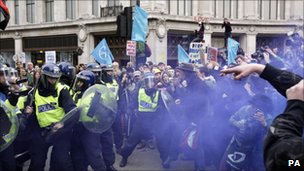 More than 250,000 people have attended a march and rally in central London against public spending cuts.
Labour leader Ed Miliband addressed crowds in Hyde Park and the main march organised by the Trades Union Congress passed off peacefully.
But small groups attacked shops and banks with a stand-off in Piccadilly. There have been 214 arrests and 66 people injured, including 13 police.
Ministers say the cuts are necessary to get the public finances in order.
In the largest public protest since the Iraq war rally in 2003, marchers from across the UK set off from Victoria Embankment to Hyde Park, where TUC general secretary Brendan Barber was first in a line of speakers.
"We are here to send a message to the government that we are strong and united," he said.
"We will fight the savage cuts and we will not let them destroy peoples' services, jobs and lives."
A very small group of protesters, maybe three to four hundred people, stopped outside Topshop.
The police are being careful to communicate with people on the ground using social media, knowing many are young. One update is that there are no kettles so far.
Protesters are very worried they will get caught within police cordons - so there is a bit of a game of cat and mouse.
Lots of these protests are very fast-moving. We walk miles with these protesters as they try to keep out of police cordons.
We saw some scuffles with police. Watching all the time are shoppers - this is Saturday afternoon. It is not a violent atmosphere, but it's certainly a lively atmosphere.
Mr Barber was followed by Mr Miliband, who said: "The Tories said I should not come and speak today. But I am proud to stand with you. There is an alternative."
The march began at 1200 GMT and it took more than four hours for the protesters to file past the Houses of Parliament on their way to the park.
The TUC, which organised the event, said more than 250,000 people had taken part, and the Metropolitan Police confirmed the numbers.
BBC political reporter Brian Wheeler, in central London, said there were lots of families and older people, and the atmosphere was good-natured but the anger was real.
"The noise in Whitehall was deafening as thousands of protesters banged drums, blew whistles and shouted anti-cut slogans, slowly making their way towards Trafalgar Square.
"The crowds were booing as they went past Number 10, but the demonstration was good-natured and friendly.
"There are hundreds of trade union banners, but we have also spoken to public sector workers who have come to make their voices heard."
One of those protesting was Peter Keats, 54, from Lowestoft, Suffolk, who works for Jobcentre Plus.
He said: "Personally, I think it's wrong the way we are hitting the poor.
"I'm not so much worried about myself but the customers I deal with are vulnerable and I'm worried about them and I'm worried about the kids of this country."
Demonstrator Christine Nugent, a university research fellow, said: "The size and scale of it, and the range of people here, is great."
The veteran of anti-Margaret Thatcher demonstrations in the 1980s said protesters came from all walks of life, adding: "There are a lot of trade unionists here, but it's not just the usual suspects."
There have been separate incidents involving a number of protesters, some with their faces covered by scarves, away from the main march:
- A sit-in organised by the campaign group UK Uncut took place at Fortnum & Mason department store in Piccadilly. The group has previously mounted protests against tax avoidance measures by big businesses
- A bonfire was lit by protesters at Oxford Circus, where earlier police said light bulbs containing ammonia were thrown at officers
- Topshop on Oxford Street had its windows smashed and was doused with paint
- Missiles were thrown at the Ritz Hotel, Piccadilly
- Bank branches including the Royal Bank of Scotland were attacked with paint and had windows broken, while branches of HSBC and Santander were broken into.
Scotland Yard said there had been 202 arrests for public order offences, criminal damage, aggravated trespass and violent disorder.
Commander Bob Broadhurst said: "The main TUC march has been going well. We have had more than a quarter of a million people with hardly any problems.
"Unfortunately we have had a group of approximately 500 criminals committing some disorder including throwing paint at Topshop in Oxford Street and at the police, and scaring the public who are trying to shop."
Policing minister Nick Herbert said the government was "committed to supporting peaceful protest" and blamed the violence on "a small minority of individuals".
Mr Miliband condemned the violence, saying: "There is no excuse for it. It is unlawful and wrong."
Civil rights group Liberty said the march had been "infiltrated by violent elements" who attacked buildings before "melting into the demonstration once more".
Earlier, the largest union involved, Unite, said so many of its members had wanted to take part that it could not find enough coaches or trains to ferry them to London.
Its general secretary Len McCluskey said the scale of the deficit had been exaggerated.
Outlining his economic plan to the BBC, he said: "Our alternative is to concentrate on economic growth through tax fairness so, for example, if the government was brave enough, it would tackle the tax avoidance that robs the British taxpayer of a minimum of £25bn a year."
Education Secretary Michael Gove said he could understand the disquiet and anger.
"But the difficulty that we have as the government inheriting a terrible economic mess is that we have to take steps to bring the public finances back into balance," he said.
Mr Miliband is attending the march but is yet to sketch out an alternative, he added.
Matthew Sinclair, director of the Taxpayers' Alliance which lobbies for lower taxes and greater government efficiency, said: "It's understandable that people feel upset...
"But in the end it's not valid and what politicians should be doing is not encouraging this rally but saying look, you've got to be more realistic about the options facing this country."
TUC condemns post-rally violence in central London
Violence which followed a day of anti-spending cuts protests in London has been condemned by union leaders.
Hours after a peaceful march to Hyde Park, there were clashes between police and protesters in Trafalgar Square.
The TUC said the activities of a few hundred people should not detract from the main message of the official protest, which it said was attended by "between 250,000 and 500,000 people".
Police said a total of 201 arrests had been made during the day.
Business Secretary Vince Cable has said the government will not change its economic strategy as a result of the protest.
He told the BBC's Politics Show: "Certainly we're listening. I talk regularly to the trade union movement, I think it's important we have a dialogue with them but we're not going to change the basic economic strategy.
"No government - coalition, Labour or other - would change its fundamental economic policy simply in response to a demonstration of that kind."
Saturday's arrests were largely for a variety of public order offences, they said. In addition, 66 people were reported to have been injured, including at least 31 police officers, 11 of whom required hospital treatment. The injuries were described as relatively minor.
Police - who have agreed with the TUC's estimation of numbers on the main march - would be studying photographs and CCTV footage and may make more arrests, said the BBC's Daniel Boettcher.
Commander Bob Broadhurst, who was in charge of the Metropolitan Police operation, said his officers had to deal with "mindless yobs" in and around Trafalgar Square in central London.
"We've had a number of - I hesitate to call them protesters - a bunch of people that ended up in Trafalgar Square," he said.
"All was peaceful for quite a long while but then for some reason one of them made an attack on the Olympic [countdown] clock, we moved in to make an arrest, the next minute they're attacking us and they're trying to attack and damage the Olympic clock in Trafalgar Square."
Commander Broadhurst said a group of about 100-150 people had run off, ripping open litter bins and throwing bottles and bricks at police.
He added: "This is just mindless vandalism, hooliganism, it's nothing to do with protest."
The trouble began after demonstrators broke away from the main march and headed towards the shopping district in London's West End.
A group of about 500 people gathered in Oxford Street, before targeting fashion chain Topshop's flagship store and the banks Santander, HSBC and RBS.
Anti-cuts group UK Uncut occupied luxury grocery store Fortnum and Mason in Piccadilly in protest over alleged tax avoidance by the business's owners.
Later in the evening, the protests moved to Trafalgar Square where police kettled demonstrators while they tried to restore order.
One of the people caught up in the trouble in Trafalgar Square, named Sophie, gave an account of events.
She said: "All of a sudden about 10-20 Met police came storming down the steps of the National Gallery, ran straight to the Olympic clock.
"I have never seen such a fast escalation of violence in my life. Everything just kicked off, glass everywhere, police hitting people, people being dragged across the floor. I just can't believe it."
After a few hours of containment by police, during which people in the square were allowed to leave only in small groups via its north-eastern corner, there were just a few protesters remaining. BBC Radio 5 live's Dotun Adebayo reported that the square was completely calm after 0200 BST.
Labour leader Ed Miliband, who spoke at the earlier rally, said there was "no excuse" for the violent scenes.
"I unequivocally condemn those who have committed acts of violence," he said.
Policing minister Nick Herbert said "a small minority of individuals were intent on disorder".
Libyan Rebels Push West as Coalition Strikes Hit Gadhafi Forces
Libyan rebels have retaken several coastal towns leading to Sirte, amid bombing support by coalition warplanes.
Libyan rebel forces made a series of quick advances, re-occupying the strategic oil ports of Ras Lanouf and Brega, which they lost almost 10 days ago. Witnesses say pro-government forces withdrew without a fight. Some soldiers who stayed behind surrendered.
Al-Arabiya TV showed images of burned out government tanks and military vehicles along the coastal highway to Ras Lanouf. It also showed footage of British planes bombing several pro-Gadhafi targets.
Rebel fighters told al-Jazeera TV their next major push would be on the port city of Sirte, the symbolic hometown of Libyan leader Moammar Gadhafi. A former army colonel who defected to the rebels indicated Gadhafi loyalists had placed landmines on the outskirts of Sirte.
Closer to the capital Tripoli, witnesses in the besieged port city of Misrata told al-Jazeera TV that pro-Gadhafi snipers continued to attack them using artillery and sniper fire. Water and electricity remain cut and living conditions are increasingly desperate. A group of Egyptian workers in the city begged their government to help evacuate them and their families.
Libyan government TV broadcast images of Gadhafi supporters chanting and dancing as they waved posters of the embattled leader. Some supporters read tributes to Mr. Gadhafi and pledged loyalty to him, despite recent military setbacks.
A top government spokesman, Deputy Foreign Minister Khaled Kaim, complained to journalists in Tripoli the Western coalition is “trying to push the country to the brink of civil war.”
But Secretary of State Hillary Clinton told CBS’ Face the Nation program Colonel Gadhafi’s attacks on his own people far outweighed military actions by the coalition. "What has been happening there the last few weeks is deeply concerning, but there is a difference between calling out aircraft and indiscriminately strafing and bombing your own cities than police actions, which frankly have exceeded the use of force that any of us would want to see," she said.
Secretary of Defense Robert Gates also told CBS’ Face the Nation the outcome of the conflict in Libya is uncertain, but there is a strong possibility that Gadhafi supporters would desert him as the military pressure on him continued. “Any number of possibilities are out there, particularly as long as the international pressure continues and those around him see no future in staying with him. Do not underestimate the potential for elements of the regime themselves to crack and to turn," he said.
Gates also defended the fact the coalition has not outlined a clearly defined set of goals in its Libya mission, insisting that “in a military campaign you do not set as a mission or a goal something you are not sure you can achieve.
Israel Deploys Anti-Rocket System Near Gaza
Israel has stationed the first batteries of a long-anticipated anti-rocket shield in the south of the country, but cautioned residents the experimental deployment would not completely protect them from incoming fire.
The Israeli military Sunday positioned the Iron Dome system outside Beersheba, a southern city twice hit by rockets during this month's flare up of cross-border violence with Palestinian militants in the Gaza Strip.
The system went into operation shortly after Israeli aircraft killed two militants in Gaza earlier Sunday.
Israel's air defense chief, Brigadier-General Doron Gavish, said Iron Dome has passed a series of tests and is expected to be fully operational within months. He said deployment was “accelerated” because of the recent attacks from Gaza.
Prime Minister Benjamin Netanyahu told his Cabinet in Jerusalem he did not want to “create an illusion” that Iron Dome would offer comprehensive protection. He said the “real response” to the missile threat is a combination of offensive, deterrent and defensive measures with a “firm stance by the government and [Israeli] public.”
The government says the multimillion-dollar interceptor system is capable of shooting down rockets fired from a range of five to 70 kilometers. A second anti-rocket battery will be deployed near the port city of Ashkelon.
Iron Dome uses sophisticated cameras and radar to track incoming rockets, determine where they will land, and destroy them far from their targets.
Analysts have estimated the cost of shooting down a rocket could be up to $25,000, compared to just a few hundred dollars to produce the mostly inaccurate and homemade projectiles often fired at Israel. Other Palestinian rockets are factory grade.
But Gavish said the “real test” is the damage caused by an unintercepted missile, the price in human life if it hits. The system's operators say it is designed to intercept only those rockets that are determined will hit residential areas, and ignore those on a harmless trajectory.
Islamic Jihad, a Palestinian militant group that often attacks Israel, said the two men killed Sunday belonged to its armed wing, the al-Quds Brigades. The Israeli airforce confirmed it had fired on a group of militants in northern Gaza “preparing to fire a rocket at Israel.”
Tensions between the two sides have escalated during the past week, with Palestinian militants firing dozens of rockets and mortar shells into Israel and Israeli forces responding with air strikes.
Palestinian militants, including Gaza's Hamas rulers, said Saturday that they will cease fire if Israel does. There was no immediate reaction from Israel.
Obama Administration Defends Libya Decision
The Obama administration is defending its decision to intervene militarily in Libya, but says the North African country is not a “vital interest” of the United States.
U.S. Defense Secretary Robert Gates and Secretary of State Hillary Clinton appeared on television talk shows Sunday morning to defend the U.S. decision to help enforce a no-fly zone over Libya.
Gates said that while Libya is not a vital U.S. interest, it is part of a region that is a vital interest. He also said the violence in Libya could put the revolutions in Egypt and Tunisia at risk. Clinton said Libya is a vital national interest for Britain, France, Italy and other NATO allies, as well as for Arab partners of the U.S.
Clinton said on ABC's This Week that if Libyan leader Moammar Gadhafi's forces had overrun the rebel-held city of Benghazi, tens of thousands of people could have been slaughtered and hundreds of thousands forced to flee. She said the United States would have been criticized for doing nothing.
Clinton and Gates told CBS's Face the Nation that the Libyan opposition may not have a well-organized fighting force, it is getting help from Libyan military members who have given up on Mr. Gadhafi.
Gates said Mr. Gadhafi's military may start to see that it is in a no-win situation. He also said that there is no proof so far that the United States is responsible for civilian casualties in Libya.
Gates said intelligence reports say Mr. Gadhafi is placing bodies of people he killed at sites of U.S. attacks and blaming the deaths on American bombs.
President Barack Obama plans to address the American people Monday on the U.S. role in Libya after some in Congress say the mission and its objectives are still unclear.
Former Soviet Warplane Crashes at Florida Air Show, Killing Pilot
U.S. federal investigators are looking into what caused a former Soviet warplane to suddenly drop out of the sky and crash at a Florida air show Saturday.
Officials say the pilot was killed instantly when the Yak-52 plane fell out of a formation with other jets and plummeted to the ground.
It crashed less than a kilometer from where thousands of people were enjoying the Wings Over Flagler show, north of Daytona Beach.
The Aerostar Yak-52 plane was built in 1983.