
DMX Sent To Arizona Mental Health-Unit
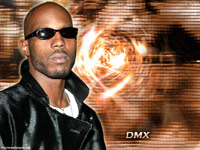
Troubled rap star DMX was admitted to a mental health unit in an Arizona prison facility on December 20th.
According to reports, the rapper, born Earl Simmons, was sent to the Flamenco Mental Health Unit inside the Alahambra Prison complex.
The rapper was transferred to the mental-health unit on December 20th, after serving over a month in the infamous Tent City jail, run by Sheriff Joe Arpaio.
According to reports, DMX is barred from having visitors for 30 days while he is inside the mental-health unit.
When the rapper was being sentenced to a year in prison for violating his probation on December 16th, Judge Christine Mulleneaux noted that the rapper may suffer from bi-polar disorder or some sort of mental affliction.
DMX is serving the year in prison for violating his probation by drinking alcohol during a concert in November.
He later tested positive for cocaine, Oxycontin, driving with a suspended license and other infractions.

US soul singer Bernard Wilson dies at 64
US soul singer Bernard Wilson, a member of Harold Melvin and the Blue Notes, has died at the age of 64.
The baritone vocalist died on 26 December from undisclosed medical complications in Voorhees, New Jersey.
Wilson was part of the classic Blue Note lineup that also included lead singer Teddy Pendergrass - who died in January.
The group had a huge international hit with the songs If You Don't Know Me By Now and Don't Leave Me This Way.
The dance track The Love I Lost has been credited as one of the first disco records.
Wilson left the band in 1977, a year after Pendergrass's departure.
The singer's cousin Faith Peace-Mazzccua told the Associated Press that Wilson "left home at 16 as a pauper and came back home a millionaire".
She said her cousin kept performing until recently, adding, "He didn't take no stuff and he loved people."
Billy Taylor, US jazz musician and composer, dies at 89
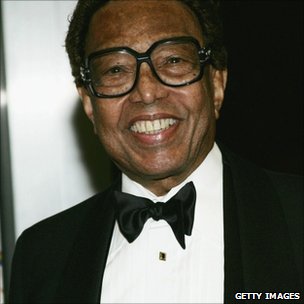
The jazz musician and composer Billy Taylor has died in New York of heart failure at the age of 89.
Taylor had been playing professionally since the 1940s, and later became a TV and radio personality, presenting several jazz programmes.
His most famous song, I Wish I Knew How It Would Feel To Be Free, became the unofficial anthem of the US civil rights movement.
Taylor was considered to be one of the most ardent advocates of jazz music.
He began his career in the 1940s in New York's jazz clubs, becoming house pianist in the legendary Birdland club, playing alongside jazz greats including Charlie Parker, Dizzy Gillespie and Miles Davis.
He later formed the Billy Taylor Trio, for which he composed hundreds of songs, including his most famous, which was later covered by Nina Simone.
Taylor believed jazz was America's classical music, and was committed to its proper teaching.
"One of the things that we have not done is to put jazz in the position that it deserves in our society," he told an interviewer in 2007.
"If you really listen to that, study that, everything you need to know about America is right there, and it's up to us who've experienced much of that to be able to share that."
Driven by this believe, Taylor set up the Jazzmobile movement in the 1960s, which promoted education through the arts and staged free concerts by high-profile jazz musicians in deprived areas of the US.
In later life, Taylor presented jazz programmes on National Public Radio in the US and was an arts correspondent for the CBS channel.
Taylor had a doctorate in music education, several honourary degrees, numerous awards including a Grammy and had served as Duke Ellington Fellow at Yale University.
He is survived by his wife, Theodora, and a daughter.
Indian Citibank 'fraudster' arrested
Police in India have arrested a Citibank employee accused of defrauding clients out of millions of dollars.
Shivraj Puri, 32, who is expected to appear in court later, told an Indian newspaper he was innocent.
The alleged fraud was discovered earlier this month in a branch of the global bank in Gurgaon, a wealthy suburb of Delhi.
The bank has said duped investors were promised quick, high returns from a bogus financial scheme.
It is alleged that Mr Puri funnelled the money into accounts controlled by three relatives.
Mr Puri reportedly handed himself in on Thursday, a day after police said he was wanted for questioning.
The accused told the Times of India newspaper after his arrest: "I have already given full details to the police. I have full faith in the judiciary. Truth will come out."
The alleged fraud came to light earlier this month when a client mentioned the scheme to a senior bank manager.
Citibank has not publicly put a figure on the sums involved, but investigators have said at least $20m (£13m) was stolen.
According to a police complaint filed by Citibank, and seen by the BBC, funds were transferred suspiciously at the bank's branch in the Delhi suburb from October 2009.
FSA fines treble to £89m in 2010
 Fines handed down by the UK city regulator almost tripled during 2010 from the year earlier to £89m, figures compiled by the Financial Times show.
The year saw the Financial Services Authority (FSA) impose the largest fines in its history on JP Morgan and Goldman Sachs.
It also banned 60 people from working in the financial sector.
In a shake-up of regulation, the FSA will be replaced by the Consumer Protection and Markets Authority.
'Obsessed'
The figure for penalties compares with £35m in 2009.
However, fines in the UK are considerably lower than in the US, where big banking groups regularly pay more than $500m (£323m) between them each year.
JP Morgan was fined £33.3m in June - a UK record - after failing to keep client money in separate accounts.
Meanwhile, Goldman agreed to pay £17.5m after the investment bank did not tell the FSA that it was being investigated by US authorities.
Not all are supportive of the FSA's policy of levying large fines.
"The regulator continues to be obsessed with how its enforcement cases will play out in the media," Nathan Willmot, a partner at law firm Berwin Leighton Paisner, told the FT.
Source: FT
New £32m Thames road bridge at Walton approved
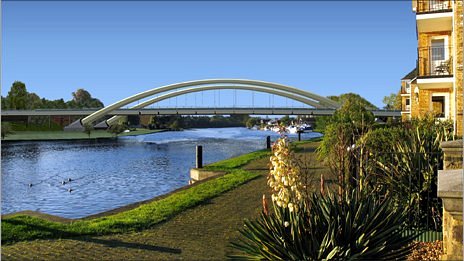
A £32.3m bridge over the River Thames has been given the go-ahead by the government.
The new Walton Bridge in Surrey will be the first road crossing to be built over the river in 20 years.
The structure, which will replace two "temporary" bridges at Walton and Shepperton, is due to be completed by the summer of 2013.
The Department of Transport will invest £23.8 with the rest of the money coming from Surrey County Council.
The decision comes after the authority reduced the scheme's cost by up to £5m.
'Hugely important'
Ian Lake, of Surrey County Council, said: "The new bridge will open another chapter in the long history of the River Thames.
"With Surrey's roads carrying nearly twice the national average traffic flow and the county being a powerhouse of the national economy, this is a hugely important scheme.
"Walton's new bridge will make a real difference to residents, commuters and businesses."
Liberal Democrat transport minister Norman Baker said: "The new bridge will bring long-term benefits for all those travelling in the area.
"Without this investment motorists would have faced huge disruption and delays as the temporary bridge reached the end of its life."
The project was approved in 2008 by the previous government but put on hold as part of the coalition's spending review.
Surrey County Council was granted a compulsory purchase order for the land last year.
The authority expects work to start on the bridge in January.
China corruption problem 'still very serious' - report
China says its corruption problem is "still very serious" and has set out new measures to tackle it.
In a new report on the fight against corruption, the authorities say more than 200,000 cases have been investigated since 2003.
They say their efforts to date have "yielded notable results" but resolve to make them more effective.
Critics say that corruption is ingrained in the system and new regulations will not solve the problem.
The report carried by the official state news agency Xinhua says that between 2003 and 2009, prosecutors investigated more than 240,000 cases, including embezzlement and bribery.
It highlights new rules requiring members of the governing Communist party to report incomes and investments.
The party also says it will curb excessive spending on official parties and seminars.
The document praises the role of the news media and the internet in exposing corrupt practices, declaring that "sunshine is the best antiseptic".
'Huge sums'
The report acknowledges that tackling corruption will be a massive task.
"Since the relevant mechanisms and systems are still incomplete, corruption persists, with some cases even involving huge sums of money," it says.
"The situation in combating corruption is still very serious, and the tasks are still abundant."
China has launched several anti-corruption campaigns in recent years.
One of the biggest involved a powerful party boss in Shanghai, Chen Liangyu, who was jailed for 18 years in 2008 for his role in a pension fund scandal.
In July 2010, the top justice official in the city of Chongqing, Wen Qiang, was executed after being convicted of accepting bribes, rape and shielding criminal gangs.
Israel ex-President Moshe Katsav found guilty of rape
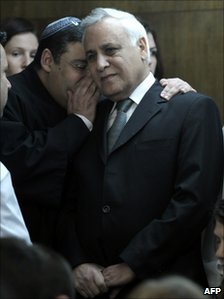
Israel's former President Moshe Katsav has been convicted of rape by a court in Tel Aviv and could go to jail.
He was found guilty of raping an employee in the 1990s when he was tourism minister and of later sexual offences while he was president.
The judges said they believed the evidence of the woman whose testimony had led to two charges of rape.
Moshe Katsav resigned from the largely ceremonial post of head of state in 2007 and was indicted in March 2009.
While his resignation caused shock across Israel, it had limited political consequences.
Rape commands a jail term in Israel of at least four years, although Katsav is thought to be likely to contest the conviction in Israel's supreme court.
State prosecutor Ronit Amiel said the verdict carried a message to other victims of abuse of power that they should not remain silent.
The former president, 65, who was in office for seven years from 2000, had denied the charges, the most serious ever levelled against an Israeli head of state.
When he stepped down in 2007, he initially agreed to plead guilty to sexual misconduct and avoid more serious charges, but he withdrew the plea bargain the following year.
According to the indictment, the rape charges dated back to April 1998 when the former employee described as Woman A alleged he had first raped her at the tourism ministry office and later at a hotel in Jerusalem.
The further charges related to claims of sexual harassment of two women in 2003 and 2005 during his presidency.
Reading the verdict, Judge George Karra who presided over a panel with two other judges, said: "We believe the plaintiff [Woman A] because her testimony is supported by elements of evidence, and she told the truth."
Katsav's evidence, the judges decided, was "riddled with lies".
Although members of his family were with him in court, his wife Gila was not. He appeared to be visibly distraught as the verdict was read out and one of his sons was heard saying repeatedly "it's not true".
Sentencing is expected to take place next month and before the former president left court, he was told to surrender his passport.
His son, Boaz, told reporters the family would fight on to prove his innocence. "We will continue to walk with our heads high, so all the nation throughout its generations, with God's help, will know that father, the eighth president of the State of Israel, is innocent."
Source:
Khodorkovsky facing new jail term at second trial
The judge at the second trial of imprisoned Russian oligarch Mikhail Khodorkovsky has ruled out a suspended sentence.
His former business partner Platon Lebedev likewise faces a new prison sentence, correspondents report.
"Khodorkovsky and Lebedev may only be reformed if they are isolated from society," the judge's verdict says.
The two men were convicted of fraud on Monday but the reading of the 800-page verdict has still to be completed.
Vatican sets up watchdog to combat money laundering
The Vatican has set up a new financial authority to fight money laundering and make its financial operations more transparent.
The Pope has signed into law new rules to bring the Vatican's banking regulations in line with international efforts to combat money laundering and the financing of terrorism.
The move comes ahead of an EU deadline.
It follows accusations the Vatican had been contravening international rules on money laundering.
In September, Rome prosecutors formally put the director of the Vatican Bank, Ettore Gotti Tedeschi, and his deputy under criminal investigation after receiving a tip-off from the Bank of Italy about possible money laundering.
The Italian justice authorities seized 23m euros ($30m; £19m) which the Vatican had deposited at a branch of an Italian commercial bank near Saint Peter's Square, allegedly without properly identifying either the depositor or the recipient.
The Vatican said there had been a misunderstanding and there had been no wrongdoing by their bank or its employees.
On Thursday, Pope Benedict XVI signed the documents, saying the Vatican wanted to join other countries in cracking down on legal loopholes that have allowed criminals to exploit the financial sector.
The Vatican is acting ahead of a 31 December deadline to create a compliance authority to oversee all its financial operations, which is required by the EU and other international organisations.
The Vatican's centuries-old secrecy over the way it handles its money will no longer be an excuse to avoid its obligations under international and Italian criminal law to combat money-laundering operations by third parties, says the BBC's David Willey in Rome.
Exempt
The Vatican Bank - known officially as the Institute for Works of Religion - has hitherto exempted itself from international banking regulations on the grounds that it is not a real bank in the normal sense of the word, our correspondent says.
It handles accounts for the Pope, his cardinals and religious orders, and has only one branch inside the apostolic palace in Rome.
The new laws are due to come into effect by 1 April, after the new authority is set up and its members chosen, the Vatican said.
It will take some time, however, for the Vatican to be put on the so-called "white list" of the Organisation for Economic Co-operation and Development, our correspondent adds. The list identifies countries that have agreed to share tax information and crack down on tax havens.
The Vatican Bank was:
- Set up by Pope Pius XII in 1942
- Its based in Vatican City, has no other branches, operates as offshore institution outside EU rules
- Headed by professional banker overseen by commission of cardinals
- No shareholders, no policy-making functions
- All profits set aside for charitable or religious works