
Residents of South Korean island fleeing ahead of military drills
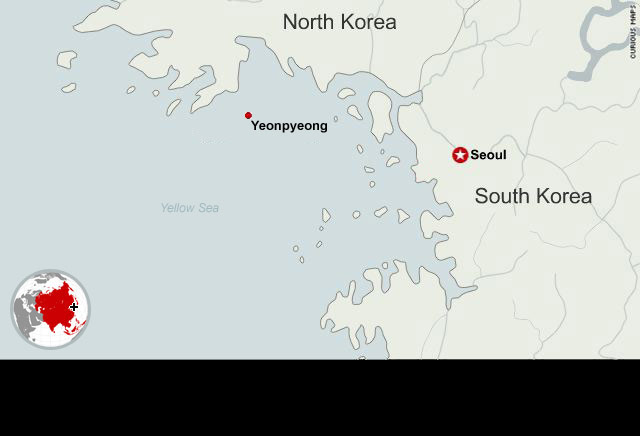
Amid South Korean plans to hold live-fire military drills this week and North Korean threats of retaliation, many residents of Yeonpyeong Island are evacuating, afraid of being caught in the middle.
Villagers streamed onto what they believed was the last ferry to Incheon, South Korea, on Sunday, carrying what belongings they could. Some were holding their children as others helped the elderly.
"I'm leaving because they said the drills are tomorrow," said Kim Ok Jin, 66. Kim said the island was once a good place to live and she does not want to leave.
"Of course I'm angry," she said. "But that's not going to change anything."
Many Yeonpyeong residents are evacuating for a second time. This time, however, they have warning. On November 23, they had none before North Korea began shelling the island. Two civilians and two South Korean Marines died in the attack.
The South Korean military said Thursday that its drills will take place in the seas southwest of Yeonpyeong Island between December 18 and 21, but bad weather forced a delay Saturday. South Korea's Yonhap news agency reported the drills will take place Monday or Tuesday in the Yellow Sea off the island.
As villagers departed, few signs of life remained on the island -- only military trucks patrolling and waiting for possible North Korean retaliation for the drills.
Not everyone on Yeonpyeong, however, was leaving. Song Young Ok said she has not been told to stop selling tickets for the ferry off the island, and doesn't know when the military drills will take place.
Song said she is planning to stay put, holed up along with others in a military bunker.
She said she doesn't know why it has to be this way -- if South Korea carries out the drills, North Korea has threatened to retaliate even more strongly. South Korea's insistence on conducting the drills is picking a fight, she said.
Others were more optimistic. "It's OK," said ferry passenger Lee Chun Nyeo, 83. "The soldiers need to do (the exercises), right?"
Yeonpyeong is located just south of the Northern Limit Line, the line drawn in 1953 by the United Nations just after the Korean War. The U.N. drew the line three nautical miles from the North Korean coast and put five islands close to the coast under South Korean control.
That was supposed to be a temporary arrangement. But in the absence of a full peace agreement, the Northern Limit Line remains in place.
North Korea has suggested an alternative line, but South Korea has resisted, as it would bring the North's maritime boundary close to Incheon, a main port.
Waters in the Yellow Sea are important for fishing and crab. For North Korean fishermen especially, the blue crab season between June and September is an important source of income. Crabs have a habit of migrating south during that time, so the water is sometimes crowded with boats from both countries, as well as vessels from China. However, the Yellow Sea has seen armed clashes in the past few years, the most serious of them in 1999 and 2002.
China and Russia have asked South Korea to reconsider holding the drills. Russia called for an emergency meeting of the U.N. Security Council on Sunday.
Source:CNN


Australia to provide AU$63 million in assistance to CARICOM over next four years
Representatives of the Caribbean Community (CARICOM) Secretariat and Australia met at the Secretariat Headquarters, Turkeyen, Guyana, on Friday for the inaugural CARICOM-Australia high level meeting on the development assistance partnership.
This meeting was conducted within the framework of the memorandum of understanding between the parties, which was signed on 29 November, 2009 in the margins of the Commonwealth heads of government meeting hosted in Port-of-Spain, Trinidad.
CARICOM secretary-general, Sir Edwin Carrington, in opening remarks at the high level meeting said that both sides were pleased at the pace and intensity with which the CARICOM-Australia relationship had deepened over the past year.
Director-general of the Australian Agency for International Development (AusAID), Peter Baxter pledged that Australia’s cooperation with the Caribbean Community will “see real outcomes and practical assistance.” Australia will provide AU$63.8 million in assistance to Caribbean countries over the next four years.
The meeting focused on the present technical cooperation relationship particularly against the background of the current global economic climate. The two sides discussed the various areas and modalities through which they could partner to improve the economic resilience of the Community, including the areas related to climate change and disaster risk reduction.
Australia has committed to providing AU$17.5 million to support the region’s efforts to adapt to climate change and to manage the impacts of natural disasters.
The director-general announced that “the majority of this assistance for climate change is part of Australia’s global A$599 million fast-start climate change finance package announced in June 2010, and will support the work of key regional organisations and fund community-level activities across the Caribbean.”
He also shared that about 25 percent of Australia’s fast start funding package will be targeted to the needs of small island states which are highly vulnerable to the likely impacts of climate change, like those in the Caribbean and in the Pacific.
The meeting also discussed Australia’s support to Haiti, including current and potential projects to assist in the reconstruction and development of the CARICOM member state. The government of Australia has been one of the first to provide to Haiti, immediately following the January 12 earthquake and again at the outbreak of cholera in October.
One of the modalities to be used in the CARICOM-Australia partnership will be people to people and institutional links. In this regard, Baxter also announced that an additional 30 scholarships for the Caribbean region, worth AU$3.8 million, would be granted over the next four years, increasing the overall number from 80 to 110 over the period.
The CARICOM delegation to the talks was led by Lolita Applewhaite, deputy secretary-general and included senior officials of the directorates of trade and economic integration, human and social development and foreign and community relations.
Trinidad billionaires win another stay of extradition
Two Trinidadian billionaires, who have been fighting extradition for the past three years, won their appeal in the Trinidad and Tobago Court of Appeal when the court ordered a stay of the extradition order and ruled that the attorney general's extradition decision be reviewed by a High Court judge,
The Trinidad Guardian newspaper reported that attorneys for the attorney general served notice of appeal, to challenge the decision at the Judicial Committee of the London Privy Council. This means that this aspect of the matter will have yet another prolonged delay since extradition proceedings started more than three years ago.
Appellate Court Judge Wendell Kangaloo was critical of Justice Joan Charles' handling of the application for judicial review. He suggested that it was hurried and decided without careful consideration, especially as it was arguable whether the attorney general had acted irrationally.
Attorney General Anand Ramlogan signed an order about two months ago extraditing the two wealthy businessmen, who sources say financed the United National Congress (UNC) party led by Prime Minister Kamla Persad Bissessar.
The two men are wanted in the United States to face several charges of fraud and money laundering totalling millions of dollars, arising out of the billion dollar Piarco Airport scandal.
They were charged with six other Americans, who have already been jailed, for a series of offences two years ago.
Immediately after the appellate court ruled in favour of the two men, their attorneys filed an application for bail, but the Court of Appeal dismissed the request, stating that they had no jurisdiction to hear such an application. The lawyers will no doubt file their application and seek a hearing before a High Court judge.
Guyana loses all confidence in CARICOM trade negotiator
The government of Guyana has written to Caribbean Community (CARICOM) secretary general Sir Edwin Carrington affirming that it has lost all confidence in senior trade negotiator in the Office of Trade Negotiations Carl Greenidge and will not allow him to represent Guyana’s cause because he acted unprofessionally by making statements that Guyana lacks visionary leadership and is in a nightmare.
Minister of Labour Manzoor Nadir, who was acting foreign minister during the time of Greenidge’s statements, said that not only did he act unprofessionally but he also has no moral grounds for making such statements.
Greenidge, who is also a former finance minister under the People’s National Congress (PNC), in his capacity as a trade negotiator for CARICOM represents all the governments of the region including Guyana and it was unprofessional of him to make those pronouncements on Guyana, Nadir said.
According to Nadir, there are certain professional ethics that Greenidge should have adhered to since he works for the government and this prevents him from being critical of it.
“If you are working with an organization it is unprofessional for you to criticize it from within. If you don’t believe in what it is doing and if you feel strongly you should quit before criticising it,” Nadir said.
He added that, as a citizen of Guyana, Greenidge is allowed to make those comments but as an employee of the government of Guyana Greenidge acted very unprofessionally.
This, he said, is also Cabinet’s position.
“Greenidge does not qualify if we compare the performances of the two administrations the People’s Progressive Party/Civic (PPP/C) and the PNC when Carl Greenidge was finance minister. They are poles apart,” the labour minister stated.
Nadir recalled the period under Greenidge’s tenure as finance minister when the per capita debt was in excess of US$8,000 per person.
“That is why we say that he has no moral authority whatsoever to say that this country lacks visionary leadership and it is in this nightmare. We have done an exceedingly good job in the PPP/C administration of rebuilding the economy and putting it on a path of four years of sustained positive economic growth,” Nadir declared.
The labour minister further stated that if the performances of Greenidge as finance minister versus Dr Ashni Singh or former finance minister and now President Bharrat Jagdeo were to be compared they would be poles apart; a hopeless one and the other one of consistent growth, more opportunities and expansion of the economy.
Greenidge as Finance Minister under the PNC was an utter failure given that there was a freeze in wages in all state corporations for a number of years. However, under the PPP/C administration every year the public sector wages increased, the minister stated.
Nadir also dispelled views that Greenidge’s statements represent the majority of Guyanese.
He added that with the per capita debt that Guyana and with the wages at the time of Greenidge’s stewardship as finance minister it would have taken every man woman and child working for seven years at an average income to pay off his or her portion of the debt.
French manufacturer says its planes are safe after safety issues raised by Trinidad government
French aircraft manufacturer ATR says its planes are safe and that suggestions made by the People's Partnership government in Trinidad and Tobago that there may be safety issues with its aircraft have no basis in fact.
The Trinidad Express newspaper reported that the southern France-based turboprop aircraft maker said on Wednesday that it has noted discussions in Trinidad and Tobago during the past couple of weeks about the acquisition by state-owned carrier Caribbean Airlines (CAL) of nine ATR airplanes to renew its fleet.
Approved by Cabinet and agreed to by ATR and Caribbean Airlines in September, the contract for the 68-seat ATR 72-600 aircraft is valued at US$200 million. However, the deal and the firing of former CAL CEO Capt. Ian Brunton are now at the heart of an impasse between the George Nicholas-led board and Works and Transport Minister Jack Warner.
The ongoing discussions on the deal have elicited concerns about the safety of ATR aircraft and the need to review this in the context of CAL's choice of aircraft. ATR, however, has not taken too kindly to the insinuation of such safety issues.
Cuban programme helps 60,000 Guatemalans learn to read and write
A year considered as a year of consolidation for the Cuban “Yes I Can” literacy teaching programme, by way of which some 60,000 illiterates learned how to read and write, is coming to an end in Guatemala.
A total of 11 municipalities in that Central American country were declared free of illiteracy, according to the parameters of the United Nations Education, Science and Culture Organization, the Prensa Latina news agency reported.
Osmany Justis, national coordinator, offered a comprehensive explanation of the development of this programme as 2010 is about to end, a year in which the number of people who were taught how to read and write was tripled, following the decision to bring the program to the country’s 22 departments.
The National Commission for Literacy Teaching, under the presidency of Alvaro Colom, adopted the Cuban audiovisual method, conceived to teach people how to read and write in three months, with few human resources.
Due to the short duration of “Yes I Can”, the rate of attendance and permanence in classrooms is higher. The programme stands out for its flexibility, since it adapts to the characteristics and cultural conditions of the places where it’s implemented, and allows for the learning of illiterates in their own homes or near them.
Justis announced that educators are getting ready to apply the method in mam and quiche, two of the most spoken languages among natives in Guatemala, a nation of Mayan roots.
 Source: Jamaica Observer
South Korea to begin exercises near border with North
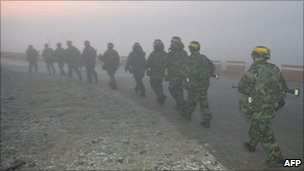 The South Korean military will begin live-firing exercises on an island close to the border with North Korea in the coming hours, its military says.
The move comes despite repeated threats of retaliation from Pyongyang.
Four people were killed when the North shelled the island during an earlier drill last month.
The UN Security Council has been discussing the situation in New York, but has failed to reach any agreement.
Speaking to reporters after more than eight hours of discussions, Russian ambassador Vitaly Churkin called on South Korea to cancel its plans.
"It's better to refrain from doing this exercise at this point in time," he said.
He said the UN had failed to reach an agreement on the crisis, but contacts would be pursued between the main powers.
The issue has threatened to divide permanent members of the Security Council - with China and Russia urging South Korea to put off the exercise, but the US saying its ally is entitled to make sure it is "properly prepared in the face of... ongoing provocations".
The US ambassador to the UN Susan Rice said it was "safe to predict that the gaps that remain are unlikely to bridged."
Residents on the island of Yeonpyeong have been told to move into air-raid shelters - part of regular procedure ahead of military exercises in the area.
Initially, it was reported that the exercise would begin at 0200 GMT, but it has now been put back to 0400 GMT, because of fog, according to a Defence Ministry spokesman.
The drill is expected to last for two hours.
Pyongyang has said it will retaliate if the South goes ahead with the exercise on Yeonpyeong - which is close to the two countries' disputed sea border, the Northern Limit Line, and within view of the North Korean mainland.
It says it will deal an "unpredictable self-defensive blow" at the South Koreans, "deadlier" than when the North shelled the island during similar live-fire exercises on 23 November.
Two civilians and two marines were killed in that clash.
For its part, South Korea will "immediately and sternly" deal with any North Korean response, said an officer at the Joint Chiefs of Staff (JCS).
An unofficial US envoy - New Mexico Governor Bill Richardson - is in North Korea and has held several meetings with senior officials there. The situation is "very, very tense, a crisis situation", he told CNN.
He was speaking after meeting North Korean Maj Gen Pak Rim-su, who leads North Korean forces along the border with the South.
That meeting was "very tough", but "some progress" was made, Mr Richardson said.
"They said there would be a response, but at the same time they hope a UN Security Council resolution would tamp down the situation. It was very clear they were very upset by the potential exercise," he told CNN from Pyongyang.
He suggested a military hotline be set up to address incidents along their border.
The BBC's Jane O'Brien in Washington says the Obama administration is in a tough spot, as the US has 28,000 troops stationed in the South and it would almost certainly be drawn in if hostilities erupt
The US is walking a diplomatic tightrope, trying to avoid that unfavourable option while remaining a strong ally to the South, our correspondent adds.
The JCS has said that artillery guns on Yeonpyeong will be aimed south-west and away from North Korea for the drill.
But the North claims any ammunition fired would inevitably land in its territorial waters.
In the event of an attack from the North, the South's Air Force would put its F-15K and KF-16 fighters on emergency standby, Yonhap quoted the JCS as saying.
The island is normally home to some 1,300 residents along with hundreds of marines, but most civilians have fled to the mainland, leaving only about 100 remaining, Yonhap said.
Deadly blast on oil pipeline in Mexico's Puebla state
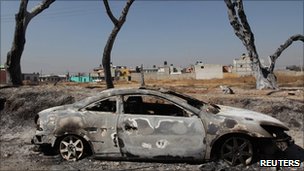 At least 28 people have been killed and many others injured in an oil pipeline explosion in central Mexico, officials say.
The blast in a town in Puebla state was apparently caused by thieves attempting to steal fuel from the pipeline.
Oil gushed through the streets and caught fire, destroying homes and cars and forcing hundreds of people to flee.
Mexican President Felipe Calderon has visited the scene and promised to launch an investigation.
Puebla State Secretary Valentin Meneses said the explosion injured 52 people as well as destroying 32 houses and damaging scores more in San Martin Texmelucan - a small community about 80km (50 miles) east of Mexico City.
He said that according to early indications, a criminal gang had punctured the pipeline.
"They lost control because of the high pressure with which the fuel exits the pipeline. The streets began to flood, then came a spark and we saw rivers of fire in the streets," he said.
One local resident said she awoke at about 0530 local time to a strange, overpowering smell, like petrol.
Minutes later, her street looked as if it was flowing in tar, and then it erupted in flames. Her husband knocked down a wall, allowing them to escape from the back of their home.
"It was like we were living in an inferno. Everything was covered in smoke," she said, quoted by AP news agency.
The fire was brought under control by midday, and the state oil monopoly Pemex said it had shut the pipeline down.
President Calderon arrived in the town later on Sunday to survey the damage and visit the injured.
He offered his condolences to the victims' families and said those responsible for the incident would be brought to justice.
Pemex says that theft of oil from its pipelines is a chronic problem, costing it hundreds of millions of dollars a year.
Snow at Heathrow and Gatwick ruins plans of thousands
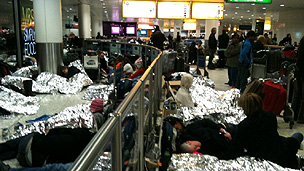 The Christmas travel plans of thousands of Britons are in disarray after snow left Heathrow Airport all but shut.
Thousands remained in terminals for hours as few flights departed on Sunday. Knock-on delays hit most UK airports, including Gatwick.
The Met Office warns of more heavy snow in Yorkshire, north-east England and eastern Scotland, advising essential travel only in the Edinburgh area.
Icy roads affect much of the rest of the UK. There is some rail disruption.
An extreme weather warning is in place for Edinburgh, Lothian and Borders, with some 15 to 20cm (6-8in) of snow expected between 1100 and 1800 GMT.
Up to 10cm (4in) are expected in other snow-affected areas, with up to 20cm on high ground.
Edinburgh airport was closed until 1430 GMT and then opened for departures only on Sunday.
Temperatures struggled to get above -5C (23F) overnight and BBC forecaster Matt Taylor said there were lows of -19C (-2F) in parts of Worcestershire and Shropshire. They are likely to stay below freezing throughout the day.
The Met Office also issued warnings of heavy snow in parts of Sussex, East Sussex and Kent on Sunday.
Trains between London and Peterborough were suspended late on Sunday due to problems with overhead wire problems, train company East Coast said.
No trains are running between Oxford and Hereford, while some Chiltern Railways, South West Trains and First Capital Connect services have been weather-affected.
With France also suffering severe weather, Eurostar said it had cancelled some trains and switched to a contingency timetable, with last-minute cancellations possible. Speed restrictions were adding an additional 90 minutes to journeys.
Drivers are facing queues of up to eight hours on the A34 in Oxfordshire, where more than 80 cars were abandoned on Saturday night and several jack-knifed lorries were blocking the route. The nearby Cherwell Valley services on the M40 has run out of fuel.
The M25 has re-opened after being closed in both directions between junctions five and six, causing long delays following a liquid petroleum gas tanker overturning at 0900 GMT.
But airports were worst hit, on a weekend when travel association Abta said hundreds of thousands of Britons were due to fly.
The BBC has received hundreds of e-mails from stranded passengers, with many saying they have no idea where they will be spending Christmas.
BA said "several thousand" of its stranded passengers were being put up in hotels but when asked if the company was confident of getting everyone to their festive destinations, a spokeswoman said: "We are in the hands of the weather."
People are advised against travelling to Heathrow Airport, which said "a few thousand" spent the night in the terminals. Just four short-haul and three long-haul flights left on Sunday morning.
By late on Sunday night, BAA said three flights had landed at Heathrow, with more maybe due later.
The airport earlier said it hoped to be operational on Monday, but warned of more cancellations and delays "in the days that follow" as airlines move diverted aircraft and crew back to their normal positions.