
Morgue Overcrowded in the Bahamas
With 94 murders on the books so far for the year in addition to a number of other deaths, PMH Administrator Coralee Adderley said 2010 has been sort of a whirlwind year for the hospital’s morgue.
Whether by murder, suicide, natural cause or some other reason, it has had to deal with a mass number of dead bodies this year.
"Given the numbers we have been having in our morgue we are at capacity almost all the time," she said. "What you would hear in the public is just those deaths from violence, but think about the number of deaths we have in the hospital or at home as a result of old age or heart attacks that are never reported.
"Our morgue has been extremely continues to grow in terms of demand. So we’ve been working closely with physicians and funeral home sot get persons out of our morgues as soon as we can."
But the PMH administrator added that things do not always go as planned.
Mrs. Adderley said sometimes a dead body is left in the morgue for various reasons.
She added that while the number of unclaimed bodies varies from time to time, the numbers are not extremely high.
In the odd case that there is an unidentified body left, Mrs. Adderley added that the hospital works closely with the Coroner’s Court.
Mrs. Adderley said usually, once all the legal work is sorted out, a pauper’s burial is then performed, a service which is facilitated by the government.
Mrs. Adderley added that there are a number of reasons why bodies are left in the morgue.
"You do find sometimes people are in the morgues, and we know who their families are, but it the bodies are left for financial reasons," Mrs. Adderley said. "Because no funeral home is going to take you until there is some commitment.
"So until such time they remain with us. Until that family has identified a funeral home and made arrangements with the family… that sometimes causes the delay. So sometimes families can’t decide on a funeral home or commit to one because they don’t have the means and then the bodies would stay with us."
But Mrs. Adderley said even before this year’s 94 murders were recorded, the morgue saw an increase due to deaths by non-communicable diseases.
But she said the murders definitely took the numbers up a notch.
The PMH administrator added that the city morgue is looking to add an additional cooler that would store an additional 20 to 30 bodies.
The cooler should be in place by early next year.

Clico payout next year
THE STATE will not begin releasing payments to Clico policyholders before the end of the year, Attorney General Anand Ramlogan said yesterday, as the Government revealed the Ministry of Finance has retained British Queen’s Counsel Gabriel Moss to advise on the matter.
“We are looking at the new year,” Ramlogan said in an interview. “I am in the process of finalising the legal agreement,” he said. The Attorney General had met with officials of the Ministry of Finance and CL Financial Limited (Clico’s parent company) on Monday night to examine the terms and conditions of an agreement which policyholders will sign if they agree to the State’s bailout. The bailout is an offer of $75,000 for policies equal to or below this value, and a 20-year, zero rated bond for policies worth more than $75,000.
The Attorney General disclosed that the Ministry of Finance — upon advice from the Office of the Treasury Solicitor — has retained Moss to advise a legal team comprising of officials from the Ministry of Finance and the Ministry of the Attorney General.
Moss, of 3-4 South Square Chambers, London, is an expert on insolvency. He has functioned as a Deputy High Court Judge in the Chancery Division (which deals mainly with finance cases) of the United Kingdom’s High Court.
Ramlogan also yesterday afternoon confirmed that another meeting of officials of the Ministry of Finance and CL Financial is expected to occur next week, after the Christmas holidays.
An official with knowledge of the talks yesterday indicated that payout would “more than likely” begin in the first week of January.
“We continue to meet and fine tune the matter,” the official said yesterday. “By and large everything is agreement and is in its final stages.” The official added, “a payout is not too far off.”
Since September, Finance Minister Winston Dookeran announced that policyholders would be paid out under specific terms which he detailed in his Budget 2011 presentation. Since then, the payout process has faced several challenges, some of which has come from policyholders themselves.
While some — including the acting chairman of the Clico Policyholders Group (CPG) Peter Permell and Opposition Leader Dr Keith Rowley — have criticised the Ministry of Finance for delays in the payout, a major cause of delay since September has been the fact that the State has engaged in consultations with policyholders after some raised legal objections.
The very month of the Budget, a group of policyholders called the Clico Policyholders Protection Association, associated with dropped UNC MP Ramesh Lawrence Maharaj, said the Finance’s Minister’s planned payments were illegal, arguing the Government did not have powers to pay out given the terms of the Central Bank Act.
The matter was taken up by the CPG, who revealed the State planned to bring legislation to shield itself from legal action. However, Government, on October 2, backed down from bringing legislation and instead began a process of consultation under a committee chaired by Minister of Food Production Vasant Bharath.
That committee met over several weeks with several submissions being made to the Cabinet.
At the same time, there has been the problem of Clico records reportedly being “in a mess”, and another problem of the precise terms of the legal agreement which policyholders are to sign on to should they accept the Government’s bailout.
Woman Died in Dump Accident in St.Maarten.
On Tuesday morning between 09:00 and 10:00 am police and detectives responded to the Philipsburg landfill after they received a call informing them that a woman identified ad Patricia Brooks (41) years of age who collects empty bottles on the dump had accidentally been ran over by a garbage compacter and as a result had suffered severe damage to both legs.
Police Spokesman Ricardo Henson said the paramedics were sent to the scene where the victim was given first aid, after which she was immediately transported to the St. Maarten Medical Center. Henson said the victim succumbed to the injuries she sustained from the accident.
The police traffic, detective and forensic department are busy investigating this case to determine exactly how this accident took place.
Press Prosecutor Rienk Mud said the victim in question was warned on several occasions to stay away from the dump (landfill). Mud said based on information his office received the victim was chased away on a number of occasions but she kept going back to look for items that are of value to her. Mud said the victim died of internal bleeding.
Europe airports battle snow backlog
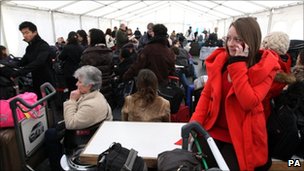 European airports are struggling to help thousands of passengers stranded after severe wintry weather paralysed parts of Europe's transport network.
Freezing temperatures, snow and ice has grounded flights, trapping travellers returning home for Christmas.
Airport operators defended their handling of the crisis amid criticism from the European Commission.
Officials at the worst-affected airport, London's Heathrow, rebuffed offers to bring in the UK Army to help.
Since Saturday, when 12.7cm (five inches) of snow fell in just one hour, Heathrow airport - the world's busiest - has cancelled hundreds of flights.
The airport said it planned to operate two-thirds of its scheduled flights on Wednesday.
Delays at Heathrow also had a knock-on effect on other northern European airports.
In Ireland, the Dublin Airport Authority said the airport would be closed until at least 0800GMT on Wednesday, the The Irish Times reports.
'Unacceptable disruption'
In Germany, Frankfurt airport cancelled 550 of almost 1,300 flights on Tuesday because of the bad weather.
Air France said that some 5,000 people spent the night at Paris' Charles de Gaulle airport on Tuesday - 4,000 of whom were trying to fly into London, according to Le Monde.
While in Sweden, Scandinavian airline SAS said flights to London's Heathrow were the most problematic.
"It is the absolute worst there," SAS spokeswoman Elisabeth Manzi told The Local.
"From Frankfurt and Paris, things are running smoothly and we are getting passengers out. In London, we currently have about 5,000 to 6,000 SAS customers."
Many passengers sought to travel by rail instead of plane, causing Eurostar to recommend that passengers trying to leave from London should cancel their tickets and stay at home.
But rail expert Christian Wolmar said the real problem was not bad weather but bad management.
"Eurostar ought to be ashamed of themselves," he told Associated Press.
"It would seem possible to put on extra trains, but they can't get the crews or they can't get the trains in place. It's inexplicable."
The European Commission said it was "extremely concerned" about the level of disruption caused by the severe snow, saying that it was "unacceptable and [...] should not happen again".
But Airports Council International (ACI), the professional association of European airport operators, said 88% of flights to and from European airports had been operating.
It said airports in northern Europe found it easier to cope with severe weather because the temperatures there remained largely below freezing, so the condition of the runways did not change, whereas the fluctuating temperatures in western Europe had caused problems.
UK Prime Minister David Cameron said he was "frustrated" it was taking so long to get Heathrow fully operational again.
"If it's understandable that Heathrow had to close briefly, I'm frustrated on behalf of all those affected that it's taking so long for the situation to improve."
Inside the terminal, passengers who had spent several days waiting to catch their flights home were equally angered. Some were being accommodated in tents on the edge of the terminal.
"It's not even snowing!" 19-year-old Candie Sparks, who was trying to get back to Santa Fe, New Mexico, told AP. "It's crazy."
UN chief warns of 'real risk' of Ivory Coast civil war
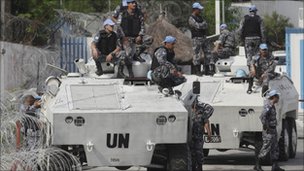
The UN's secretary-general has warned there is a "real risk" of a return to civil war in Ivory Coast after the disputed presidential election.
Ban Ki-moon said the incumbent, Laurent Gbagbo, was illegally trying to expel the UN's peacekeeping force after it recognised Alassane Ouattara as victor.
Earlier, an ally of Mr Gbagbo warned the peacekeepers that they could be treated as rebels if they did not go.
And in his first TV address since the poll Mr Gbagbo stressed his legitimacy.
He also offered to let a panel representing international powers examine the results of the election.
Mr Gbagbo said Mr Ouattara could leave the Golf Hotel in Abidjan, where he has set up his headquarters, protected by the UN.
The army meanwhile announced the lifting of a nightly curfew, so families could "enjoy the end of year holidays and the New Year".
In a speech to the UN General Assembly on Tuesday, Mr Ban said he was worried about the 10,000-strong mission in Ivory Coast (Unoci).
Forces loyal to Mr Gbagbo were obstructing Unoci operations, and had blockaded the 800 peacekeepers protecting Mr Ouattara, he warned.
"I am concerned that this disruption of life-support supplies for the mission and the Golf Hotel will put our peacekeepers in a critical situation in the coming days," he said.
"I therefore strongly appeal to member states who are in a position to do so to prepare to support the mission.
"Facing this direct and unacceptable challenge to the legitimacy of the United Nations, the world community cannot stand by," he added.
The BBC's John James in Abidjan says roads leading to the lagoon-side hotel have been blocked and no supplies have been received for days.
Mr Ban said that any attempt to "starve the United Nations mission into submission" would not be tolerated, and warned those who perpetrated such acts would be held accountable under international law.
He also revealed Unoci had confirmed "mercenaries, including freelance former combatants from Liberia, have been recruited to target certain groups in the population", and that an arms embargo was being broken.
SOURCE: (BBC)
Iraqi parliament approves new government
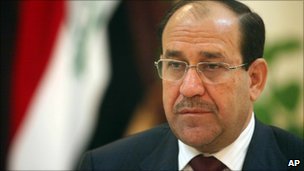 Iraq's parliament has approved a new government including all major factions, ending nine months of deadlock after inconclusive elections.
In a special session, MPs voted for the 29 ministerial candidates nominated by Prime Minister Nouri Maliki, a Shia, who was reappointed for a second term.
But doubts persist about whether all the political groups can work together.
The key ministries of interior, defence and national security remain unfilled because nominees could not be agreed.
The BBC's Gabriel Gatehouse in Baghdad says these portfolios are especially sensitive as Iraq's rival factions watch keenly for signs that the country's security forces might be being used to promote sectarianism.
US President Barack Obama called the approval of the cabinet a "major step forward in advancing national unity".
"Their decision to form an inclusive partnership government is a clear rejection of the efforts by extremists to spur sectarian division," he said.
The parliamentary election held on 7 March left no one group with a majority in Iraq's 325-seat Council of Representatives.
Former Prime Minister Iyad Allawi's Sunni-backed al-Iraqiyya bloc beat Mr Maliki's State of Law coalition by two votes, but he was unable to form a government.
It was Mr Maliki who eventually garnered enough support by merging State of Law with the Iraqi National Alliance of the radical Shia cleric Moqtada Sadr in June to form the National Alliance, and then agreeing a power-sharing deal in early November with the Kurdistan Alliance and a reluctant al-Iraqiyya.
The pact also returned Jalal Talabani, a Kurd, as president and made Osama al-Nujaifi, a Sunni Arab, speaker of parliament.
Mr Maliki had been due to unveil his 42-member cabinet on Monday, but last-minute negotiations between rival parties postponed the move.
The following day, with some of the sticking points supposedly resolved, the Council of Representatives was asked to approve a list of 29 permanent ministers that Mr Maliki read out.
The 13 acting appointments do not need to be approved by MPs.
Oil Minister Hussein al-Shahristani, a Shia, was promoted to deputy prime minister for energy, with his post taken by his deputy, Abdul Karim al-Luaibi, also a Shia.
The prominent Sunni Arab politicians, Saleh al-Mutlaq and Rafi al-Issawi, were appointed deputy prime minister and finance minister respectively, while veteran Foreign Minister Hoshyar Zebari, a Kurd, retained his post.
The parliament also approved the creation of a National Council for Strategic Policies, headed by Mr Allawi. It is intended to oversee foreign policy and security issues, but it is not clear how much power it will have.
MPs also backed a plan to liberalise Iraq's economy, fight terrorism, address ongoing sectarian divisions, and repair relations with neighbouring Sunni-dominated Arab countries.
'Difficult task'
In a speech before the votes, Mr Maliki acknowledged that it had been a considerable challenge to form a government acceptable to all factions.
"I do not say that this government, with all its formations, satisfies its citizens' aspirations, nor the political blocs', nor my ambition, nor any other person's ambition, because it is formed... in extraordinary circumstances," he said. "[But] this is what we have."
The prime minister said he had delayed proposing ministers for the three security portfolios because he needed more time to evaluate the options, having received some proposals as late as Tuesday.
"I need more time to choose better, and I will continue to study the [candidates] to be able to choose on the basis of efficiency and professionalism," he said, adding that he would head the ministries himself until then.
He also said the lack of women nominees for any of the ministries had also been a reason for the postponement of the cabinet appointments.
"I find myself obliged... to wait for the political entities to present women candidates," he said.
Minister of State Bushra Hussein Saleh was the only one approved on Tuesday, while there were four women in the previous government.
Mr Allawi told MPs that his bloc would participate fully in the government.
"We wish the government success in its task to meet demands of the Iraqi people, who have waited long to see this accomplishment," he said.
"We as the al-Iraqiyya bloc declare our full support for this government and we will play an active, productive and co-operative role. We will also also work to bolster trust as long as we find a similar spirit from our partners in the political process," he added.
Our correspondent says there are still some negotiations ahead, but the big test now will be whether the members of this new national unity government, who have spent the past nine months fighting and arguing with each other, can pull together for the good of the whole country.
New South Korea exercises to test border tension
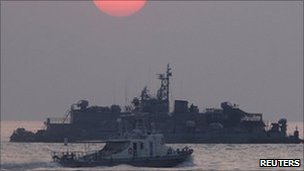 South Korea has said it will hold new large-scale military drills involving ground and air live fire on Thursday.
Artillery, jets and about 800 soldiers will take part, the government said, alongside separate naval exercises that began on Wednesday.
Tension has been high since North Korea shelled the South's Yeonpyeong island last month, killing four South Koreans.
Drills by the South on Monday near Yeonpyeong sparked Northern threats of retaliation that did not materialise.
An army spokesman said Thursday's drill would be held at Pocheon, 20km (12 miles) south of the border - about 50km from central Seoul.
Exercises have been held at Pocheon before, but this would be on an unprecedented scale, the spokesman said.
"The scale of mechanised assets taking place is enormous. When we would normally have 6 K-9 mechanised artillery, we'll have 36.
"We'll have the F-15 jets firing. We'll have choppers. You can say most of the mechanised assets taking part will be firing live ammunition," the spokesman said.
"We will retaliate thoroughly if the North commits another provocative act like the shelling of Yeonpyeong," First Armoured Battalion commander Choo Eun-sik told Yonhap news agency.
"Through this exercise [at Pocheon], we will demonstrate our solid military preparedness," he said.
The BBC's Kevin Kim in Seoul says this is the largest winter live-fire exercise ever conducted on land here.
Separately, a "routine" four-day naval firing exercise has begun off the east coast of South Korea, involving six warships and helicopters.
The North Korean shelling of Yeonpyeong shocked South Koreans.
It sparked the replacement of the country's defence minister and the development of a more active defence and deterrence policy among South Korean planners.
South Korea and the US - with which it has a long military relationship - had already been conducting large-scale military exercises, following the apparent torpedoing of a South Korean warship by the North on 26 March, which killed 46 south Korean sailors.
The pace of military drills has been stepped up in recent weeks, despite frequent denunciations from North Korea and its closest ally China.
Efforts to redirect the Korean issue back to the negotiating table have been unsuccessful.
China and the North say it is time to return to the six-nation talks about North Korea's nuclear programmes.
But the US, South Korea and Japan have said they will not return to such talks, which have previously involved rewards for the North if it cuts back on nuclear development.
After a visit to North Korea, the US politician, New Mexico Governor Bill Richardson, said North Korea agreed to let international monitors back into the country to inspect its nuclear sites.
China has also urged the North to invite staff from the International Atomic Energy Agency but there has been no word from the North on the subject.
"The six-party talks will be restarted again when the North Koreans display a willingness to change their behaviour," White House spokesman Robert Gibbs said.
North Korea walked out of the six-party talks in April 2009 and expelled UN nuclear inspectors from the country.
New Start nuclear arms treaty 'headed for ratification'
The New Start nuclear treaty between the US and Russia has cleared a key procedural hurdle in the US Senate and now looks set to be ratified.
Senators voted to end debate on the issue, clearing the way for a final vote on the treaty, set for Wednesday.
Ratification would be a victory for President Barack Obama and the Democrats, who have pushed hard for it.
Some Republican senators oppose the treaty on a variety of grounds, though Mr Obama has called it crucial.
Treaty 'needed now'
"We are on the brink of writing the next chapter in the 40-year history of wrestling with the threat of nuclear weapons," Senate Foreign Relations Committee chairman John Kerry, a Democrat, said after the vote.
The 67 votes in favour of the parliamentary motion to end debate puts the treaty above the threshold needed for ratification at the final ballot, and Mr Kerry said he expected as many as 70 votes.
"In our nation's security interest we need a New Start treaty now," Republican Richard Lugar told reporters, dismissing the calls from others in his party to hold more hearings next year.
The New Start treaty would trim US and Russian arsenals to 1,550 deployed nuclear warheads - a cut of about 30% from a limit set eight years ago. It would also allow each side visually to inspect the other's nuclear arsenal to verify how many warheads a missile carries.
The previous missile treaty expired more than a year ago, and Mr Obama and Russian President Dmitry Medvedev signed the New Start pact in April.
For the treaty to take effect, it needs the votes of two-thirds of the US Senate, or 67 if all 100 senators are present.
Top Republicans, including Minority Leader Mitch McConnell, John McCain and Jon Kyl, have said they oppose the treaty.
South and West See Large Gains in Latest Census
The Census Bureau rearranged the country’s political map on Tuesday, giving more Congressional seats to the South and the West at the expense of the Northeast and the Midwest — changes that will have far-reaching implications for elections over the next decade.
The reallocation of seats was based on a new decennial population count of 308,745,538 Americans. The total was up by just 9.7 percent over the last decade, the slowest rate of growth since the 1930s. Demographers attribute the decline in part to falling birth rates among whites and the slowdown in immigration because of the recession.
These are the first results from the census conducted this year, and they will be used to reapportion seats in Congress, and, in turn, the Electoral College, based on new state population counts. The figures will influence the landscape for the 2012 presidential race and the makeup of the Electoral College, with Republican-leaning states from the Sun Belt gaining more political influence at the expense of Democratic-leaning Rust Belt states.
According to the new counts, Texas will gain four seats, Florida will gain two, while New York and Ohio each lose two. Fourteen other states gained or lost one seat. The gainers included Arizona, Georgia, Nevada, South Carolina and Utah; the losers included Illinois, Louisiana, Massachusetts and New Jersey.
If President Obama were to win in the next election the same states he carried in 2008, he would receive six fewer electoral votes under the new map. Yet that shift would be significant only if the race were very close.
It is also unclear if the gains will go mostly to Republicans, since more than three-quarters of the population gains in the last decade were members of minorities, populations that tend to vote for Democrats.
The changes followed a long-running trend of population growth in the South and the West, and loss in the Northeast and the Midwest. In 1910, the West made up just 7 percent of the American population, compared with nearly 25 percent today, said Robert M. Groves, the director of the Census Bureau. About 40 percent of the decade’s growth was driven by immigration, he added.
The release rang the opening bell for the inevitable battles over redrawing Congressional districts. With a presidential election just two years away, and Republicans enjoying momentum after their sweep of state legislatures in November, the stakes are high.
On the surface, Republicans would seem to have an overwhelming advantage. Most of the states gaining seats trend Republican, and most of those losing them tend to elect Democrats. What is more, Republicans will be well-placed to steer the process, with Republican governors outnumbering Democratic ones 29 to 20, with one independent, come January.
“Republicans are in the best position since modern redistricting began,” said Tim Storey, an expert on redistricting at the National Conference of State Legislatures.
Of the 336 districts whose borders are drawn by state legislatures, Republicans have full control of 196, Mr. Storey said. Democrats control legislatures for 49; a further 91 are split. The rest would be drawn by divided legislatures or appointed commissions.
But population gains in the South and West were driven overwhelmingly by members of minorities, particularly Hispanics. The new districts will need to be drawn to reflect their numbers, opening potential advantages for Democrats.
“Just because Texas is getting four new seats does not mean Republicans will get four new Republicans to Congress,” Mr. Storey said. “You don’t have unfettered ability to redraw new boundaries.”
It is a complex landscape of shifting advantages, and lawyers for both parties are already designing legal strategies in the event of stalemates in state legislatures, where redistricting battles play out. The last census, in 2000, set off litigation in about 40 states. The real work of redrawing begins in February, when the Census Bureau releases detailed geographic counts for each state.
“You either have a deadlock or a compromise plan, and I don’t see a lot of compromise going on these days,” said Gerald Hebert, a lawyer who represents Congressional Democrats. “Parties really prepare for war on this thing.”
The census results provided the starkest warning yet that the survival of both political parties could turn on how their candidates appeal to greater numbers of Hispanics, particularly in Arizona, Florida and Texas. Still, the Hispanic population includes people who cannot vote because they are not American citizens.
In Texas, for example, more than 85 percent of the population growth has been minority, according to Kenneth Johnson, a demographer at the University of New Hampshire. And even though Republicans control every statewide elected office and both chambers of the legislature, state Republican officials concede that the district lines will most likely be drawn so Democrats are in position to win as many as two of the new seats.
Legislatures are required to follow the Voting Rights Act, which outlawed discriminatory voting practices, and Matt Angle, the director of the Lone Star Project, a Democratic policy group, warned that Republicans would face court challenges under the act if they “got too greedy.”
Even so, Democrats have struggled to make significant inroads in Texas in recent elections, with Mr. Obama losing by 12 percentage points in 2008.
Ohio, which has long been among the most influential presidential battleground states, is losing two House seats, bringing its total to 16, the fewest since 1820. The state has lost seats every decade going back to 1970, reflecting its painful economic decline as its industry contracted.
“It’s distressing to all of us, to anyone from Ohio,” said Senator Sherrod Brown, Democrat of Ohio. “It’s a difficult thing because we lose a lot of influence that way.”
Arizona, with the second-highest population rise after Nevada, is the state most likely to become a new presidential battleground. Mr. Obama considered competing there two years ago, but decided against spending money in the home state of his Republican opponent, Senator John McCain.
White House advisers said the new census map still left plenty of paths to reach 270 electoral votes needed to win the election in 2012. The losses in eight Democratic-leaning states were expected, aides said, and were slightly offset by gains in Nevada and Washington.
“I don’t think it will have a huge practical impact,” Robert Gibbs, the White House press secretary, said Tuesday.
(SOURCE: New York Times)
Stuntman playing Spiderman fell about 30 feet
Broadway might need a superhero to save the new Spider-Man musical. "Spider-Man: Turn Off the Dark," the most expensive production in Broadway history, suffered its fourth accident in a month when a stuntman playing the web-slinger fell about 30 feet into a stage pit during a preview Monday night. The safety tether that clips to his back failed to prevent the spill.
The performer, Christopher W. Tierney, was wheeled out of the Foxwoods Theatre on a stretcher, still in his costume, and taken by ambulance to Bellevue Hospital with minor injuries. He suffered broken ribs and internal bleeding, said a castmate, who spoke on condition of anonymity because the person was not authorized to speak publicly about the musical.
An uncle in Florida, Michael Tierney, said when reached by phone Tuesday night that he had spoken with his nephew a few hours ago. "He sounded pretty good," Tierney said, adding that his nephew was still at the hospital when he spoke with him.
In a statement, Actors' Equity said investigators determined that the accident was caused by human error. It gave no details but said additional safety measures are being undertaken.
A state Department of Labor spokesman said the cause was under investigation.
The fall was the latest setback for the troubled, $65 million show.
Conceived by Tony-winning director Julie Taymor and U2's Bono and The Edge, who wrote the music, "Spider-Man" has been more than eight years in the making. It has been plagued by delays, money woes and several other accidents, including one in which an actress suffered a concussion and another in which a performer broke his wrists in an aerial stunt. Its official opening has been postponed twice, to early February.
The huge costs — a 41-member cast, 18 orchestra members, complicated sets and 27 daring aerial stunts, including a battle between two characters over the audience — mean the 1,928-seat theater will have to virtually sell out every show for several years just to break even. The weekly running bill has been put as high as $1 million. (Tickets are $67.50 to $135 for weekday performances, $67.50 to $140 on weekends.)
A spokesman for "Spider-Man," Rick Miramontez, said in a statement that new safety measures ordered by the government after the latest accident have been adopted. Wednesday's matinee was canceled, but Wednesday night's show will go on, Miramontez said. (No performance had been scheduled for Tuesday.)
Leo Rosales, spokesman for the New York Department of Labor, said the show's producers had not yet presented new safety protocols and would do so on Wednesday. If the measures were inadequate, he said, the state won't let the show perform the complicated aerial maneuvers.
"If it takes longer, it will need to take longer," he said of the show's timing. "We need to be satisfied."
Taymor, the director, said in a statement: "An accident like this is obviously heartbreaking for our entire team and, of course, to me personally. I am so thankful that Chris is going to be alright and is in great spirits. Nothing is more important than the safety of our Spider-Man family and we'll continue to do everything in our power to protect the cast and crew."
One audience member who attended Monday's performance, Brian Lynch, said he knew of the previous mishaps and still wanted to come.
"I was making jokes about it earlier in the day," said Lynch, visiting from Hollywood, Calif. "I said if anyone got hurt I was ready to jump in and help out. I never thought it would happen, I thought they probably worked it all out. I really didn't think it would happen like it did. It was pretty horrific."
The accident happened during the show's big finale, when the Green Goblin drops Mary Jane and Spider-Man leaps to her rescue.
"But then he just kept falling, it seemed, and then everything went dark and then people, crew ran up to the stage and we heard the girl playing Mary Jane screaming from the pit," Lynch said.
"Spider-Man" might yet prevail. Other Broadway shows have struggled with getting their sets and stunts to work during previews, including "Mary Poppins," whose house set went off track in 2006, and "Titanic," which was plagued by numerous technical problems during a month of previews in 1997. Both were hits.
Mary Martin, who starred many times in productions of "Peter Pan," had numerous accidents, "beauts," as she flew about the stage. A year before she died, in a 1989 interview with the Chicago Tribune, she recalled smashing into a concrete wall during a rehearsal as she was trying to show the children in the cast that they shouldn't fear being in the air.
"It was like a cannon shot," Martin said. "I thought, `My God, these kids will never fly now,' never thinking that my arm might be broken. So we went right back and I said, `Now we're going to fly it like it should be,' and we did, and it went perfectly."
But "Spider-Man" — whose costs beat the previous most expensive Broadway show, the $25 million "Shrek The Musical" — has reached a dangerous level of attention: fodder for comics. Online, where parodies by "Saturday Night Live" and "Conan" poking fun of the musical's early technical problems had recently been eagerly passed around, the tone shifted Tuesday from jokey schadenfreude to mild outrage.
An actor from TV's "Modern Family," Jesse Tyler Ferguson, wisecracked: "I'm torn between wanting to see `Spider-Man' on Broadway and not wanting to see someone literally die doing musical theater."
The production — supervised by Juniper Street Productions, a management firm that has overseen such Broadway and Las Vegas productions as "The Producers" and "Promises, Promises" — has been under investigation by the federal Occupational Safety and Health Administration since Nov. 2 at the request of the state Labor Department, according to OSHA.
"It's certainly going to be continuing as a result of the latest incident," OSHA spokesman John Chavez said.
The state Department of Labor inspected 37 separate aerial maneuvers planned for the show at rehearsals in November and approved the use of all equipment in the show, Rosales said. "From what we saw back then," he said, the maneuvers appeared to be safe.
Miramontez said OSHA, Actors' Equity and New York State labor officials met with the "Spider-Man" company on Tuesday to discuss additional safety measures, and "it was agreed that these measures would be enacted immediately."
Tierney, who appeared in the national tour of "Moving Out" and in "Dirty Dancing" in Toronto, is the show's main aerialist and performs stunts for the roles of Spider-Man and the villains Meeks and Kraven the Hunter. The castmate who spoke on condition of anonymity said the cable to Tierney's harness snapped. But one special-effects expert raised the possibility that the rope was not hooked up securely.
Scott Fisher, president of Fisher Technical Services Inc. of in Las Vegas, which builds equipment for aerial stunts for the show, said the rope was supposed to be clipped to the stage at one end and the performer's back at the other.
"The stage crew would have been responsible for making the connection for hooking him up," Fisher said. "The actor is responsible for making the final check that he's good to go. It's sort of like packing your own parachute."
He said the script called for the stuntman to lurch forward at the end of a ramp as if leaping to Mary Jane's rescue. "He runs and stops and freezes in a position that you wouldn't normally be able to hold unless you had a little support from behind him," Fisher said. "If that's not hooked up and he leans forward, he's going to fall forward."
Fisher said the rope was not part of his company's onstage flight systems. But he said it was unlikely to have snapped: It is a 10,000-pound line.
After the actor fell, screaming could be heard coming from the pit.
"A voice yelled, `Someone call 911!' Then there was a silence," an audience member, fashion blogger Mariana Leung, wrote on the website NearSay.com. "A minute later, the stage was still dark. Then there was an announcement that the show would be delayed. A few minutes later, a second announcement that the performance would not continue. The lights came up."
Just last week, the show's lead producer, Michael Cohl, delayed the official opening for the second time, pushing it back from Jan. 11 to Feb. 7. He cited "some unforeseeable setbacks, most notably the injury of a principal cast member."
The first preview on Nov. 28 did not go well. The musical had to be halted five times because of technical glitches, and actress Natalie Mendoza, who plays Spider-Man's evil love interest Arachne, was hit in the head by a rope and suffered a concussion. She was sidelined for two weeks.