

 Following a plethora of high profile retirements, Australia's fortunes have slumped and they are now ranked fourth in the world, a single rating point ahead of fifth-placed Sri Lanka in the ICC Test rankings.
Chanderpaul, Sarwan in Guyana CT20 training squad
Veteran West Indies left-hander Shivnarine Chanderpaul and out-of-favour middle order batsman Ramnaresh Sarwan have been included in a 22-man Guyana squad to begin preparation for their defence of next month’s Caribbean Twenty20 title. The squad which also includes West Indies players Narsingh Deonarine, Sewnarine Chattergoon, Travis Dowlin, Leon Johnson and Royston Crandon, was selected from the recent National Twenty20 competition which climaxed on Friday night with Berbice retaining their title. Guyana won the inaugural CT20 tournament in August when they beat Barbados by one wicket in a thrilling final in T&T.
The players will begin encampment from Monday at the Guyana Cricket Board’s indoor practice facility.
Chanderpaul, who was unavailable for this year’s campaign, is currently with the West Indies side in Sri Lanka and is expected back in the Caribbean this week. Sarwan, who was captain of the victorious side, has been in good form for Demerara in the local T20 competition after being overlooked for West Indies duty. West Indies A players Davendra Bishoo, Veerasammy Permaul and Assad Fudadin have also been included in the squad which will undergo a fitness test on Monday before the final 14-man squad is named. Twenty-year-old Jonathon Foo, who helped Guyana to victory in this year’s CT20, have also been included but right-hander Rajendra Chandrika has been excluded.
Guyana SQUAD
Richard Ramdeen, Shivnarine Chanderpaul, Travis Dowlin, Ramnaresh Sarwan, Narsingh Deonarine, Steven Jacobs, Jonathon Foo, Royston Crandon, Derwin Christian, Veerasammy Permaul, Davendra Bishoo, Kellon Carmichael, Andre Stoll, Chris Barnwell, Anthony Bramble, Esuan Crandon, Assad Fudadin, Leon Johnson, Steven Latcha, Zaheer Mohamed, Shemroy Barrington, Sewnarine Chattergoon.
Olympic Marathoner Keith Brantly To Participate in MARATHON BAHAMAS 2011
Keith conducts inspirational and entertaining motivational seminars for corporations and special interest groups on topics related to health and fitness. As a successful specialist in healthcare sales, Keith inspires sales teams and organizations with meaningful and practical formulas for success drawn from his years of successful athletic competition. He especially enjoys speaking to children and young adults, encouraging them to start and stay involved with sports and recreational activities and stressing the importance of strong leadership practices. Keith’s extensive experience in television and radio color commentary includes the New York City Marathon and US Olympic Marathon Trials telecasts. His articles and features are published in over 100 fitness magazines.
Keith’s volunteer service includes a term as President of Florida Track Club, volunteer coach for Best Buddies and motivational speaker for the American Heart Association. In 2001, Keith raised over $20,000 for the National Association for Attention Deficit Disorder and other charities in less than 12 weeks. He appeared on the Oprah Winfrey Show and is pictured in National Geographic Magazine’s September 2000 issue. Twice he has appeared on the cover of Runner’s World magazine. He is also a member of United States Olympic Team Mentoring program. Keith is also a proud board member of the National Marathon to Fight Breast Cancer, 26.2 with Donna.
In 2005, Keith was inducted in the Road Runners Club of America, Hall of Fame; in 2004 he was inducted in the University of Florida Athletics Hall of Fame. Along with a successful career in medical equipment sales and management, Keith manages his online personal coaching program, BrantlyRunning.Com. He is a proud parent of his son, Thor and daughter, Ace.
Keith is presently in-training for Marathon Bahamas and will be a featured speaker at the EXPO, Saturday, January 15, Wyndham Cable Beach from 3:00 – 7:00 p.m.
“Marathon Bahamas will serve to rekindle my love of competition and friendship among runners. Most importantly, Bahamians keenly understand the preparation, struggle and thrill of completion of a marathon. I am honored to be an ambassador for this international event.”
“I also look forward to reaching out to those who attend the Pre-Marathon Exposition. I’ll be discussing the challenges of marathon preparation and the importance of encouraging our youth to participate in running.”
Marathon Bahamas Race Weekend is scheduled for January 15-16, 2011.
• January 15
Susan G. Komen Bahamas Race for the Cure® 5K
6:00 a.m.
Start/Finish: Paradise Island, West of Atlantis Royal Towers (FREE parking)
• January 16
Marathon, Half Marathon, 6-person Relay Team
6:00 a.m.
Start: Junkanoo Beach (Long Wharf); Finish: Arawak Cay
All proceeds raised, for the weekend events, will remain in The Bahamas and the beneficiaries are: The Cancer Society of The Bahamas, Princess Margaret Hospital Foundation, Bahamas Breast Cancer Initiative, Sister Sister Breast Cancer Support Group. Early registration ends November 15, 2011. Register NOW to avoid the increase in registration fees.
For additional information and registration, visit www.marathonbahamas.com OR to obtain a hard-copy application form, stop by Sunshine Insurance office on East Shirley Street.
Cruise Marathon Pilot Program Begins This Morning in New Providence
As part of its maiden voyage to The Bahamas on December 13th, the ‘Allure of The Sea’ , Royal Caribbean Cruise Lines, in partnership with ESPN will be hosting a 5K run through the streets of Paradise Island and historic down town Nassau. It is part of a pilot program to introduce -Marathon Cruises- as a new product and The Bahamas is part of the pilot program. The race will begin at 9am at the foot of the northbound Paradise Island Bridge, through Marina Village at the Atlantis Resort, over the southbound Paradise Island Bridge to Mackey Street, west on Shirley Street, North on Cumberland Street near Government House, east on Bay Street to the finish line at Rawson Square.
In Haiti, Palin urges U.S. to do more to help
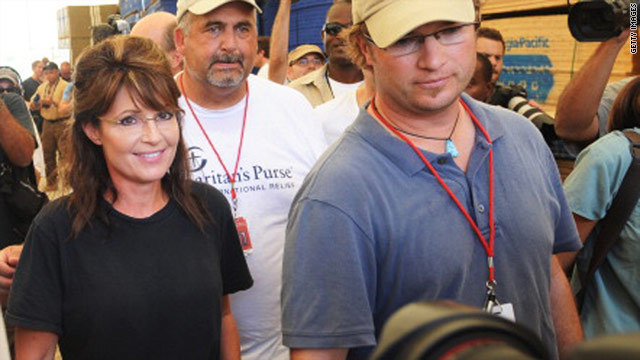 Former Alaska Gov. Sarah Palin was in Haiti on Sunday, urging the U.S government and other Americans to do more to help the earthquake-ravaged country.
"Not to get political, but if some of the politicians would come here and see the conditions perhaps they would see the need for, say, a military airlift to bring the supplies that are so needed here," she said.
Palin spoke at a brief press conference at a warehouse owned by the Samaritan's Purse organization north of Port-au-Prince.
"(I) don't want Americans to forget the need that is here," she said. "More importantly, for Americans and people across the world to know what an individual can do to make a difference, to contribute, to kind of get out of your comfort zone and volunteer to help."
Palin praised Samaritan's Purse for "doing God's work." Samaritan's Purse describes itself on its website as "a nondenominational evangelical Christian organization providing spiritual and physical aid to hurting people around the world."
Palin said she would not take questions from reporters. "The reason I won't be answering questions is because we don't need to be getting political here today," Palin said.
The former Republican vice-presidential nominee thanked her husband and daughter Bristol for joining her on the trip and said she hopes Bristol could help raise awareness of Haiti's needs among young people.
As she was whisked off the makeshift stage to her waiting car, Palin answered one question from CNN's Gary Tuchman, who asked what was different from what she expected to find in Haiti.
"Much harsher than I had expected, the conditions are much rougher," Palin replied.
Palin is widely thought to be considering a run for president in 2012.
Her visit comes as Haiti is fighting a massive cholera outbreak that has killed more than 2,000 people and sickened nearly 100,000.
The country has been struggling to recover from January's massive earthquake that left more than 220,000 dead.
A disputed presidential election has threatened to plunge the country into further chaos. (CNN)
A flamboyant performer, 'Sweet Mickey' is now Haiti's favorite son
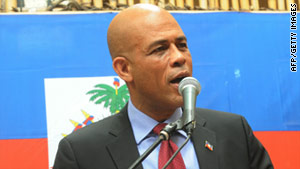 Michel Martelly is not used to being confined to his home.
After all, he made a name for himself on stage, performing Haitian carnival music in flamboyant style, sometimes drinking rum straight from a bottle and ripping his clothes off.
But "Sweet Mickey," as he is known in his role as king of kompa music, says it wasn't Sweet Mickey who went home to his wife and four children at night. That was Michel Martelly, husband and father, who has emerged as Haiti's favorite son.
He shed his bad-boy image off stage to take care of his family, educate his children. Now, he says, he wants to do the same for his homeland.
"My life on stage was very different than it was at home," says Martelly, sitting on a large veranda at his plush home in the hills of Port-au-Prince.
The Provisional Electoral Council placed Martelly in third place with 21.84% of the votes in preliminary results of Haiti's presidential election announced last Tuesday. That means, if the vote holds, Martelly will not be in a January 16 runoff.
The council said Mirlande Manigat, a former first lady and law professor, came out on top with 31.37 percent of the votes and Jude Celestin, the government-backed candidate, won 22.48 percent.
But charges of fraud in the Haitian election have hailed from all corners. The most vocal, perhaps, has been Martelly, who is confident he won based on what pre-election polling had shown.
His supporters took to the streets in the days after the results were announced, chanting "Tet Kale!," another one of his monikers, which means bald head in Creole.
On this Sunday afternoon, Martelly appears in jeans and a button-down shirt. A silver arm cuff hugs his right wrist. He takes a long sip of his favorite ice-cream soda and takes a seat at a table surrounded by a floor-to-ceiling fake Christmas tree, a piano and eight wall-mounted speakers. It's not hard to tell this is a musician's home.
Close by, armed with shotguns, are menacing body guards from a private security firm.
"I never had security before this election," he says.
The opposite, in fact.
When Sweet Mickey stepped out of his car, adoring crowds thronged to get a closer look at the popular star.
But with violent protests erupting on the streets and convinced that there are many who would might like to see him dead, Martelly says he has been forced to hide behind security.
This reporter was led by a bodyguard through a maze of doors and rooms to a sprawling veranda where the interview took place. The smell of sauteing onions and garlic wafted out of the kitchen.
Martelly says he doesn't leave his home anymore. Rarely does he talk on the phone for fear his words will be used against him.
Haiti, he says, is on the brink of revolution.
"This is a very dangerous corner in Haiti's history," he says. "But it's a revolution that can be done peacefully through the election."
Under the father-and-son Duvalier dictatorship, Haitians lacked freedom but the people had clean roads, electricity, jobs, security, Martelly says. When democracy came overnight to this Caribbean nation, people didn't know how to handle it.
Martelly talks about 24 years of troubled times, of an impoverished country that he says hurtled backwards into even more poverty.
"We are ruled by corruption," he says. "The people have no confidence in their government."
Then came a killer earthquake, a hurricane, a cholera epidemic and, now, political turmoil.
"You know how (U.S. President Barack) Obama said it's not about the man, but it's about the plan?" he says. "Here it's more about the man than about the plan."
Haiti will go nowhere, he says, unless the people have a president they can trust, a president who is honest.
"I've been on the ground with them for 22 years," he says of his musical career. "The people know me. I represent the light at the end of the tunnel."
Not that Martelly doesn't have plans.
He says, for instance, that the $12 billion that was pledged by the international community for earthquake assistance should come in the form of infrastructure, not money, because the Haitians don't know how to manage money.
But his immediate plans revolve around how to resolve the electoral dispute. The electoral council is recounting the votes but Martelly says he will not deal with the council.
"From day one, we predicted fraud. But no one seemed to care," he says. "Now the same (council), the same entities want us to go in for a recount. What assurance do we have that this will be a free and fair process?
"We do not trust that process," he says. "We do not believe in going back to the same judge who has already condemned us. I believe everything has been done to ensure that we lose again when we never lost from day one."
Manigad has also said she will not accept a recount.
A European Union backed monitoring group had said Martelly was leading in the vote count. The United States and the United Nations both expressed grave concern over electoral fraud.
Martelly says he has a team of legal experts looking into his options, which he plans to make public soon.
One option that is unlikely, he says, is a new election. Haiti has neither the resources nor the strength to start all over again.
Another is a three-way runoff between Martelly and the two top vote-getters, Manigat and Celestin.
"If I accept that, I'd be starting my political career in a fraudulent system," Martelly says.
He says he is bowing in front of the international community to help bring about a fair outcome.
"This is an SOS," he says.
Then he takes a long sip of his sweet drink. Outside his well-guarded home, the streets are tense.
People have burned down the campaign headquarters of Celestin, a protege of the President Rene Preval, who grew increasingly popular as little progress surfaced in the months after the January 12 earthquake.
They have taken to the streets to demand their political will be respected.
So what makes a man who made a name with dance music think he can change things in Haiti?
Martelly flashes his signature smile; the light glints off his tet kale.
"Well," he says. "Look at what the politicians have done."
(CNN)
Poor Government revenue could lead to cuts
Yesterday Premier and Finance Minister Paula Cox told the House of Assembly Government received $446 million in revenue during the first half of the 2010/2011 fiscal year.
BDA Finance spokesman Michael Fahy said he believed this meant Government was 15.7 percent behind initial predictions and could be facing a $166 million shortfall if the trend continued.
But last night Ms Cox said such a statement was “erroneous” and did not take into account that taxes are not paid evenly year round.
Earlier yesterday Ms Cox answered a Parliamentary Question posed by BDA MP Shawn Crockwell. The question asked how much revenue Government had received between April 1 and September 30, the first half of the fiscal year.
She said Government had received $446 million and added: “[This] is $15 million or 3.5 percent higher than the corresponding period in 2009/2010.”
Speaking outside the House, Mr Fahy said he believed Government should have received $529 million in revenue at the mid-point of the fiscal year based on their budget prediction of earning $1.058 billion in revenue from taxes such as payroll, customs duty and hotel occupancy tax.
“This [$446 million] represents a severe shortfall in revenue for the Government. Some $83 million short,” he said. “It could mean that the actual revenue for 12 months could be $892 million, which is a $166 million shortfall. At the moment the Government is 15.7 percent short on its prediction.
“This is a serious, serious problem. It is clear, per our predictions, that the payroll tax increase has not had the desired effect on increasing Government revenue.
“The situation is so bad that [Deputy Premier] Derrick Burgess reportedly said that the Government has no money to fix accident black spots and prevent road fatalities.
“What else does the Government not have money for? What costs are being cut?
“What is being done to rein in the spending to match the actual revenue collected?”
Last night Ms Cox said the comments were “extremely erroneous” as Government’s revenue are not collected evenly through the year. “For instance, a major revenue earner for Government is international business fees and other company taxes,” she said. “These amounts are collected in January of each year and therefore would not be included in the first six months of a fiscal year. It is anticipated that over $64 million will be collected in various company fees in January 2011.”
Moreover, Ms Cox said the Parliamentary question asked how much Government received during the first half of the 2010/2011 fiscal year, which was the answer that was provided.
This means some of the payroll revenue collected in the first half of the fiscal year are actually revenue from the 2009/2010 fiscal year and were collected on the old rate.
Ms Cox said: “Mr Fahy is assuming that all payroll tax reported in the first six months of this fiscal year has been collected at the increased payroll tax rates. This is not correct.
“It must be noted that the payroll tax collected in the first quarter of the current fiscal year were at the old rates, that is before the payroll tax increases. These taxes related to the prior fiscal year but were collected and recorded in the current fiscal year.
“The new rates came into force on April 1, 2010, and the first payroll tax payments using this rate were made in July 2010. The information provided reported the taxes collected by Government during the first six months of the year on a cash basis.
“Mr Fahy’s assumptions are off base.”
She added that she was confident the Government would be able to “restrain growth in spending” through disciplined financial management.
“The Government continues to institute policies that will instill strong financial discipline, at all levels of government, in the management of taxpayer dollars,” she said.
This is the third year in a row there has been concern about Government’s revenue. In 2008/9 Government collected $32 million less in revenue than expected. The shortfall was blamed on a drop in Customs duty, passenger taxes and stamp duty.
Last year Government projected it would raise $969 million through taxes and duty. Five months into the year revenue were down by $14.9 million, by the end of the year Government was $35 million short of its revenue projects.(ROYAL GAZETTE)
Calm returns to Haiti
An eerie calm has returned to Haiti today, following two full days of riots in the wake of the announced presidential and legislative elections’ results.
Police and political observers here said there has been no widespread violence in the last two days after unrest paralyzed the capital, Port-au-Prince, and two other major cities early last week.
Government construction crews in the last two days have been clearing the streets of charred debris, and markets have opened for a few hours.
Observers said there has been a mad rush inside markets, as people grabbed supplies, and long lines have been forming at gas stations.
Protesters had taken to the streets on Tuesday night after Haitian officials released preliminary election results that showed popular musician, Michel Martelly, wouldn't reach a runoff election scheduled for January but that government-backed candidate, Jude Celestin, was qualified.
Martelly’s supporters and anti-government protesters charged the vote was rigged and responded by torching tires, cars and government buildings. They also squared off with United Nations troops in the streets.
Police say so far the violence has claimed at least two lives, but there were many injuries.
The medical relief team Doctors Without Borders said it has treated 26 patients – 15 suffering from bullet wounds – since Tuesday night.
But as some semblance of normalcy grips Haiti over the weekend two of the top candidates in the disputed elections have rejected a proposed recount of the ballot.
The leading candidate, Mirlande Manigat, and Martelly insist that they will not participate in the recount. (CMC)
False imprisonment costs State $55,000
A Penal resident who was kept for 15 hours in police custody in 2004 after being arrested on an invalid warrant has been awarded $55,094 in damages for false imprisonment. Nankishoer Rajpath was awarded the sum on Friday when he succeeded in his complaint against the State.
San Fernando High Court Judge Joan Charles held that Rajpath’s Constitutional rights were infringed when he was falsely imprisoned on July 22, 2004, on a warrant issued in 2002. Charles said, “A lapse of almost two years between issue and execution is surely a matter for investigation and to subject a man who thought himself to be otherwise free of this burden, is an affront to his right to liberty as guaranteed” by the Constitution.
Rajpath, 50, through attorney Cindy Bhagwandeen, had filed a personal action against the State seeking damages for unlawful arrest and detention or false imprisonment and breach of his Constitutional rights.
On October 25, 2002, Rajpath was convicted on the charge of felling trees without proper permission. He was ordered to pay $1,000 in fines and $920 in compensation before November 22, 2002. The Penal resident paid the fines on December 23, 2002 after the stipulated deadline. On December 18, 2002 a warrant was issued in the Princes Town Magistrates’ Court for Rajpath’s arrest. The warrant was executed some two years later.
Charles, in her eight-page judgment, ruled that “to execute a warrant almost two years after the date of issue without properly verifying it was an act of gross incompetency.” During the trial, police testified that the task of checking whether a warrant was in effect or cancelled would entail an officer manually going through “possibly hundreds of paper warrants in order to find the relevant one.”
Charles admitted such a task would be “daunting.”She did, however, take issue with the State’s position that it was incumbent upon Rajpath to confirm and ensure the court’s records were updated with his payment.
The judge also ruled that it was incumbent on the warrant officer at the time to have been more diligent in investigating a warrant, issued two years prior, to determine its validity. Prior to being taken into custody, Rajpath and his wife attempted to produce the receipt indicating the payment was made but, they were denied the opportunity to do so.“The Court considers this a blatant disregard by the officers of (Rajpath’s) liberty,” Charles said. (TT.Guardian)