
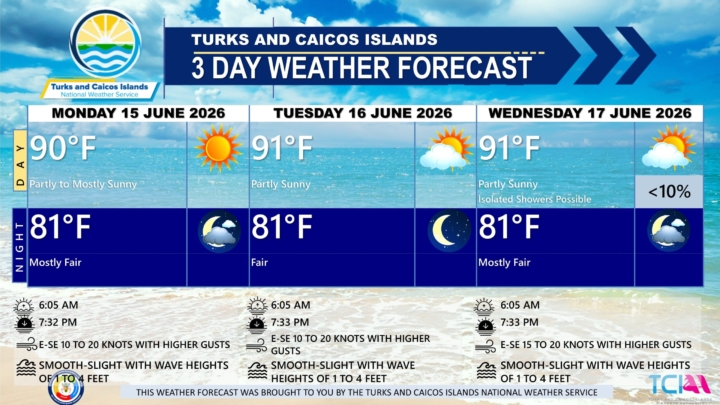
3 DAY PUBLIC WEATHER FORECAST FROM MONDAY JUNE 15TH
PUBLIC FORECAST FOR THE TURKS AND CAICOS ISLANDS FOR THE NEXT THREE DAYS FROM MONDAY JUNE 15TH 2026
GENERAL SITUATION: High pressure will bring breezy and generally stable conditions across the Turks and Caicos Islands
SPECIAL WARNINGS: There are no public warnings in effect at this time.
Heat and UV Index: Members of the public are advised to remain hydrated, wear protective clothing and sunscreen and seek shaded areas while outside during peak sunshine hours (11am – 4pm), as UV indices are expected to be in the very high to extreme range and heat indices may reach the lower triple digits.
ALL AREAS
WEATHER: Partly to mostly sunny. Mostly fair tonight.
WINDS: East to southeast at 10 to 20 knots with higher gusts
SEAS: Smooth to slight at 1 to 4 feet
DAYTIME HIGH TEMPERATURE 90°F 32°C
HEAT INDEX 100°F 38°C
OVERNIGHT LOW TEMPERATURE 81°F 27°C
SUNSET: 07:32 PM
NEXT LOW TIDE: 03:07 PM (0.3 FT)
NEXT HIGH TIDE: 09:43 PM (3.3 FT)
EXTENDED FORECAST: Hot and humid conditions with moderate to fresh breezes are expected to persist through the work week. Daytime heating may trigger the odd shower across the islands during the afternoon hours.
TUESDAY: Partly sunny, with a high near 91°F (33°C).
TUESDAY NIGHT: Fair, with a low around 81°F (27°C).
WINDS: East to southeast at 10 to 20 knots with higher gusts
SEAS: Smooth to slight at 1 to 4 feet
SUNRISE: 06:05 AM
SUNSET: 07:33 PM
LOW TIDE: 04:12 AM (0.7 FT) 03:58 PM (0.3 FT)
HIGH TIDE: 09:48 AM (2.3 FT) 10:33 PM (3.3 FT)
WEDNESDAY: Isolated showers possible. Partly sunny, with a high near 91°F (33°C).
WEDNESDAY NIGHT: Mostly fair, with a low around 81°F (27°C).
WINDS: East to southeast at 15 to 20 knots with higher gusts
SEAS: Smooth to slight at 1 to 4 feet
SUNRISE: 06:05 AM
SUNSET: 07:33 PM
LOW TIDE: 05:01 AM (0.7 FT) 04:49 PM (0.3 FT)
HIGH TIDE: 10:38 AM (2.3 FT) 11:23 PM (3.0 FT)
TROPICAL WEATHER OUTLOOK: A trough of low pressure located over northeastern Mexico continues to produce disorganized shower and thunderstorm activity. The system has a low (30 percent) chance of development through the next seven days over the northwestern Gulf of America.
FORECASTER: DR. H. HAMILTON

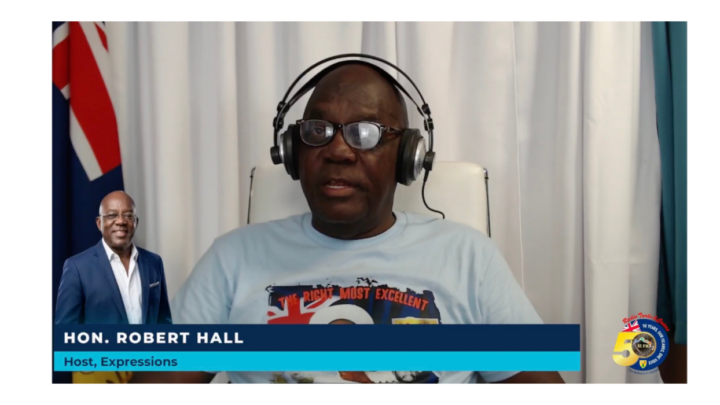
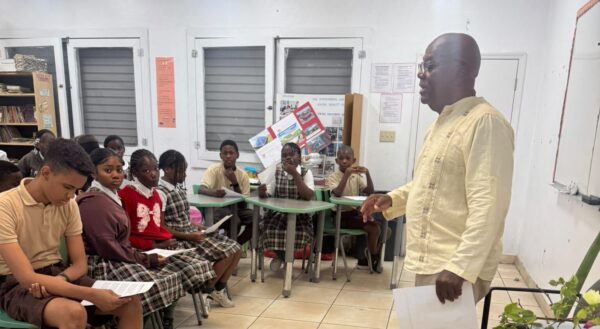
Hon. Robert Hall & Host of RTC's Expressions Launches New Initiative with Students
Our Danae Dennie sat down with a former Minister of Education, no stranger to us at all, Hon. Robert Hall to discuss a new initiative which he has embarked upon.
TCI Wins Honors at 2026 Telly Awards
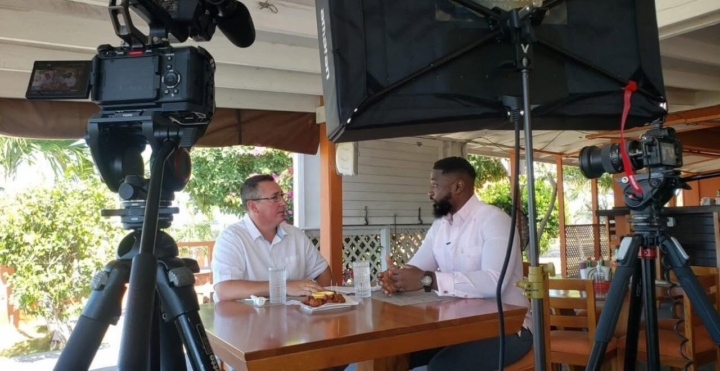
The Turks and Caicos Islands have received international recognition as a leading Caribbean culinary destination after two episodes of The Food Explorer, filmed on the islands, won honours at the 2026 Telly Awards.
The episodes showcased the destination’s unique cuisine, local ingredients, talented chefs, cultural traditions, and authentic dining experiences.
They earned a People’s Telly Award in the Television Series, Shows & Segments category and a Silver Telly Award in the Travel & Tourism category.
Minister of Tourism Hon. Zhavargo Jolly welcomed the achievement, noting that food has become one of the most powerful ways travellers connect with a destination.
“Our cuisine reflects our history, culture, people, and way of life,” This recognition reinforces what we already know—that the Turks and Caicos Islands offer much more than beautiful beaches. We are also home to a vibrant culinary identity and rich cultural traditions.”
The Minister added that the awards align with the Government’s strategy to promote authentic experiences and cultural assets as key drivers of tourism growth.
Culinary tourism remains one of the fastest-growing segments of the travel industry, and the Turks and Caicos Islands continue to strengthen their reputation through diverse dining experiences, fresh local ingredients, and the creativity of local chefs and hospitality professionals.
For years, Turks and Caicos chefs have represented the destination with distinction at regional and international competitions, helping to position the islands as a place where food is an integral part of the visitor experience.
The recognition from The Food Explorer further highlights the growing global appeal of the Turks and Caicos Islands’ cuisine, culture, and people, reinforcing its status as one of the Caribbean’s most distinctive destinations.
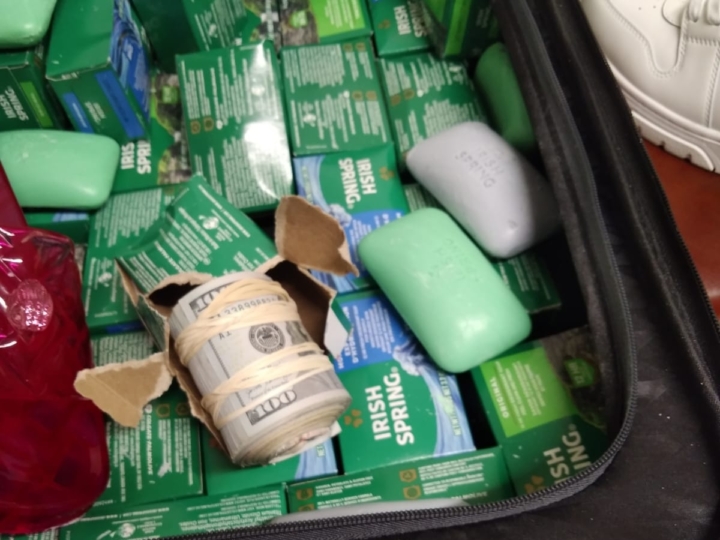
Businessman Arrested for More than $270,000 Concealed in Soap Boxes
A 34-year-old businessman from St Elizabeth has been arrested and charged after authorities allegedly discovered more than US$270,000 concealed inside boxes of bath soap in his luggage at Sangster International Airport in Montego Bay.
The accused, Shawn Walker of Crawford district, faces charges of possession of criminal property, concealment of criminal property, and failure to declare the transportation of cash into or out of Jamaica to the relevant authorities.
According to the Financial Investigations Division (FID), Walker arrived in Jamaica on June 7 aboard a United Airlines flight from New Jersey. During routine screening procedures, officers from the Jamaica Customs Agency reportedly became suspicious of items found in his luggage.
A subsequent search allegedly uncovered 28 sealed boxes of bath soap containing large amounts of United States currency. The cash was later counted and totalled US$270,580.
Investigators stated that Walker was unable to provide satisfactory evidence demonstrating that the funds had been legally obtained.
On Monday, members of the Constabulary Financial Unit conducted a formal interview with Walker in the presence of his attorney, Donnovan Collins. Following the interview, he was formally charged.
Walker has been remanded in custody and is scheduled to appear before the St James Parish Court on June 16.
Cassell Dunkley, director of investigations at the Jamaica Customs Agency, emphasized that the seizure demonstrates the value of strong collaboration between border security and law enforcement agencies in detecting and preventing financial crimes.
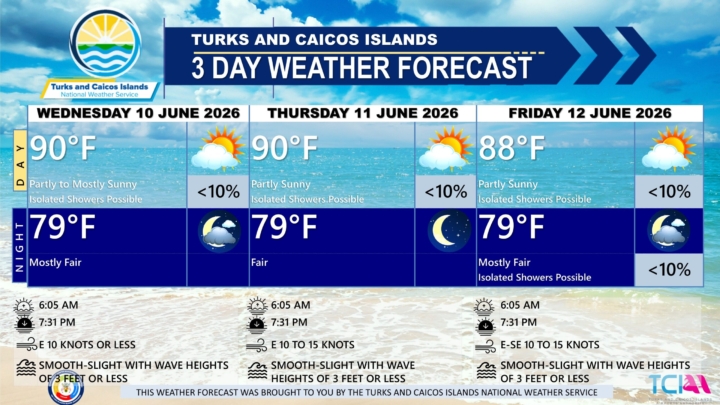
3 DAY PUBLIC WEATHER FORECAST WED JUNE 10TH 2026
PUBLIC FORECAST FOR THE TURKS AND CAICOS ISLANDS FOR THE NEXT THREE DAYS FROM WEDNESDAY JUNE 10TH 2026
GENERAL SITUATION: A strengthening ridge of high pressure will bring gentle breezes, hot temperatures, and generally stable weather conditions across the Turks and Caicos Islands today.
SPECIAL WARNINGS: There are no public warnings in effect at this time.
The public is advised to remain well-hydrated and exercise caution while outdoors during peak sunshine hours (11am-4pm) as UV indices are expected to be in the very high to extreme range today.
ALL AREAS
WEATHER: Partly to mostly sunny with isolated shower possible today. Mostly fair tonight.
WINDS: Easterly at 10 knots or less
SEA STATE: Smooth to slight with wave heights of 3 feet or less
DAYTIME HIGH TEMPERATURE 90°F 32°C
HEAT INDEX 100°F 38°C
OVERNIGHT LOW TEMPERATURE 79°F 26°C
SUNSET: 07:31 PM
NEXT HIGH TIDE: 05:11 PM (2.6 FT)
NEXT LOW TIDE: 11:41 PM (1.0 FT)
EXTENDED FORECAST: Hot temperatures, gentle breezes, and generally stable conditions are expected to persist through the remainder of the week, with little to no shower activity across the islands. By the weekend, isolated shower activity become more likely.
THURSDAY: Isolated showers possible. Partly sunny, with a high near 90°F (32°C).
THURSDAY NIGHT: Fair, with a low around 79°F (26°C).
WINDS: Easterly at 10 to 15 knots
SEAS: Smooth to slight with wave heights of 3 feet or less
SUNRISE: 06:05 AM
SUNSET: 07:31 PM
HIGH TIDE: 05:29 AM (2.3 FT) 06:10 PM (3.0 FT)
LOW TIDE: 11:36 AM (0.7 FT) - - - -
FRIDAY: Isolated showers possible. Partly sunny, with a high near 88°F (31°C).
FRIDAY NIGHT: Isolated showers possible. Mostly fair, with a low around 79°F (26°C
WINDS: East to southeast at 10 to 15 knots
SEAS: Smooth to slight with wave heights of 3 feet or less
SUNRISE: 06:05 AM
SUNSET: 07:31 PM
LOW TIDE: 12:44 AM (0.7 FT) 12:31 PM (0.7 FT)
HIGH TIDE: 06:26 AM (2.3 FT) 07:06 PM (3.0 FT)
TROPICAL WEATHER OUTLOOK: Tropical cyclone activity is not expected during the next 7 days.
FORECASTER: H. HAMILTON

Green Bay Packers Running Back Josh Jacobs Arrested on Charges Related to Domestic Abuse
Green Bay Packers running back Josh Jacobs has been charged with five offenses following his arrest earlier this week in Wisconsin.
According to Hobart/Lawrence Police Chief Michael Renkas, Jacobs was taken into custody Tuesday and booked into the Brown County Jail. The charges include strangulation and suffocation, battery related to domestic abuse, criminal damage to property related to domestic abuse, disorderly conduct related to domestic abuse, and intimidation of a victim.
Police were initially dispatched to a disturbance complaint involving Jacobs on Saturday morning at approximately 8:37 a.m.
Court records indicate that the strangulation and suffocation allegation is a felony charge, while the remaining four charges are misdemeanors.
Jacobs is coming off another productive season with the Packers, leading the team's returning rushers after recording 929 rushing yards and 13 touchdowns last year.
In 2024, he posted 1,329 rushing yards and 15 touchdowns, earning his third Pro Bowl selection.
Before joining Green Bay, Jacobs spent five seasons with the Las Vegas Raiders. His best season came in 2022, when he earned All-Pro honors and led the NFL with 1,653 rushing yards.
Over seven NFL seasons, Jacobs has accumulated 7,803 rushing yards and 74 rushing touchdowns.

German Tennis Player - Alexander Zverev Wins First Grand Slam Title
Alexander Zverev can finally shed the label of being one of the greatest players never to win a Grand Slam title.
The German star captured his first major championship on Sunday, defeating Flavio Cobolli 6-1, 4-6, 6-4, 6-7 (5), 6-1 in the French Open final at Roland Garros.
Playing in his fourth Grand Slam final, Zverev seized a golden opportunity with neither Jannik Sinner nor Carlos Alcaraz standing across the net. The world No. 3 delivered a composed and powerful performance on the Paris clay to secure the biggest victory of his career.
The emotional moment arrived after more than four hours of grueling tennis when Cobolli missed an overhead on championship point. Zverev immediately fell onto his back on the clay, covering his face with his hands as tears streamed down his cheeks. As he rose, his shirt and arms stained with the red dirt of Roland Garros, he once again buried his face in his hands before lifting both arms in triumph.
The celebration continued during the trophy presentation. When presented with the Coupe des Mousquetaires, Zverev raised it high above his head and unleashed a roar of relief and joy.
“This court is so special to me in so many ways,” Zverev said. “I’ve had the best moments of my life on this court; I’ve had the worst moment of my life on these courts.”
His comments referenced the devastating injury he suffered during a semifinal against Rafael Nadal in 2022, when he was forced to leave the court in a wheelchair.
“I was lying in that corner over there four years ago with seven broken ligaments and two fractured bones,” Zverev said. “I lost a Grand Slam final here two years ago, but now finally, it’s a happy ending.”
After years of near misses and heartbreak, Zverev’s perseverance paid off with a long-awaited breakthrough, as he finally claimed the French Open crown and the first Grand Slam title of his career.
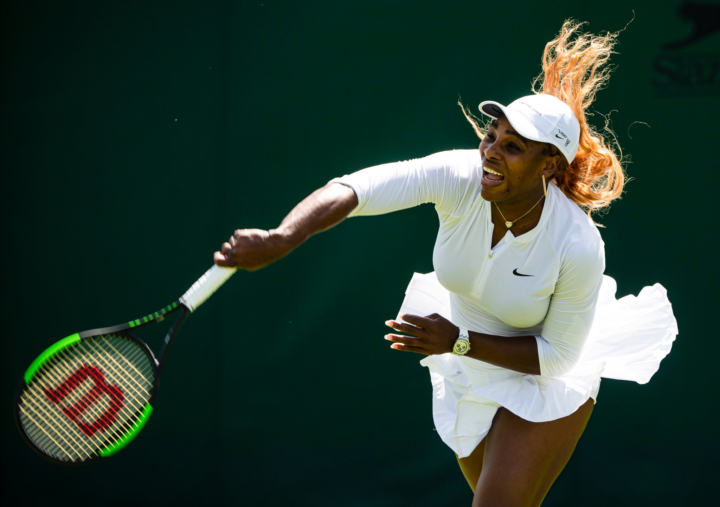
Serena Williams to Make Tennis Return at Queen's Club Championships
Tennis legend Serena Williams is set to make her long-awaited return to competitive action next week, with organizers confirming she will compete in the doubles event at the HSBC Championships at Queen’s Club in London.
Williams, now 44 years old, has not played a professional match since 2022 and has remained away from the sport for nearly four years.
Although she never formally announced her retirement, the 23-time Grand Slam singles champion stepped away from competition after the US Open, describing her decision at the time as “evolving away from tennis.”
Speaking ahead of her comeback, Williams expressed her excitement about returning to a venue she believes is the ideal setting for a new chapter in her career.
Williams said in a statement released by the Lawn Tennis Association. “Queens Club feels like the perfect place to begin this next chapter....Grass has given me some of the most meaningful moments of my career, and I’m excited to be back competing on one of the sport’s most iconic stages.”
Williams’ last appearance came at the 2022 US Open, where she was defeated by Australian player Ajla Tomljanović in the third round.
The HSBC Championships begin on June 6 with women’s qualifying matches, while the main draw starts on June 8. Williams will compete in the doubles tournament, marking her first competitive appearance since leaving the tour.
The grass-court event serves as a key warm-up for Wimbledon Championships, where Williams enjoyed some of the greatest success of her career. She captured seven singles titles, six doubles crowns, and one mixed doubles title at the All England Club.
It remains unclear whether Williams plans to compete at Wimbledon later this year, but her return at Queen’s Club has already generated significant excitement among tennis fans.
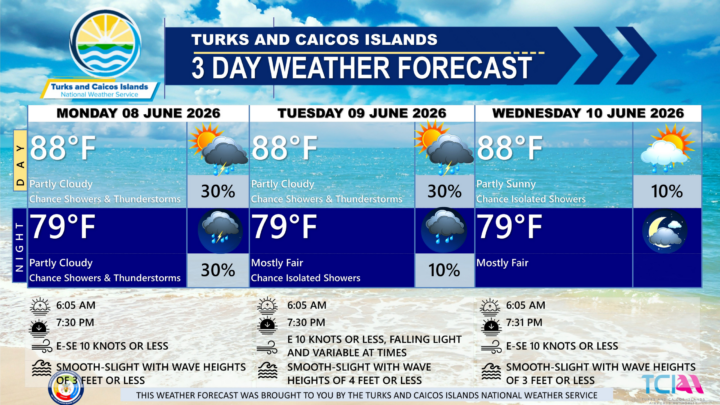
3 DAY PUBLIC WEATHER FORECAST FROM MONDAY JUNE 8TH 2026
PUBLIC FORECAST FOR THE TURKS AND CAICOS ISLANDS FOR THE NEXT THREE DAYS FROM MONDAY JUNE 08TH 2026
GENERAL SITUATION: Weak troughing ahead of an approaching frontal boundary is bringing increased cloudiness and could spark shower activity today.
SPECIAL WARNINGS: There are no public warnings in effect at this time.
AREA: ALL AREAS
WEATHER: Partly cloudy with a low (10 percent) chance of isolated showers today with an isolated thunderstorm possible tonight.
WINDS: East to southeast at 10 to 15 knots
SEA STATE: Slight with wave heights of 2 to 4 feet
DAYTIME HIGH TEMPERATURE 90°F 32°C
HEAT INDEX 100°F 38°C
OVERNIGHT LOW TEMPERATURE 79°F 26°C
SUNSET: 07:29 PM
NEXT HIGH TIDE: 12:15 PM (2.0 FT)
NEXT LOW TIDE: 06:24 PM (0.7 FT)
EXTENDED FORECAST: Unsettled weather conditions are expected to persist across the Turks and Caicos Islands over the weekend and into early next week, as the weakening front and lingering moisture continue to influence the forecast area.
TUESDAY: A medium (60 to 70 percent) chance of scattered showers and isolated thunderstorms in the Caicos Islands, and a low (30 percent) chance of widely scattered showers and isolated thunderstorms in Grand Turk and Salt Cay. Partly to mostly cloudy, with a high near 88°F (31°C).
TUESDAY NIGHT: A low (10 to 20 percent) chance of isolated showers. Partly cloudy, with a low around 79°F (26°C). New total rainfall accumulation of about a half an inch (12.5 mm).
WINDS: East to southeast at 10 to 15 knots
SEA STATE: Slight with wave heights of 2 to 4 feet
SUNRISE: 06:05 AM
SUNSET: 07:29 PM
HIGH TIDE: 01:00 AM (2.6 FT) 01:03 PM (2.0 FT)
LOW TIDE: 07:19 AM (1.0 FT) 07:14 PM (1.0 FT)
WEDNESDAY: A medium (40 percent) chance of scattered showers and isolated thunderstorms. Partly cloudy, with a high near 90°F (32°C).
WEDNESDAY NIGHT: A low (10 to 20 percent) chance of isolated showers and isolated thunderstorms. Partly cloudy, with a low around 79°F (26°C). New total rainfall accumulation of about a third of an inch (8.5 mm).
WINDS: East to southeast at 10 to 15 knots
SEA STATE: Slight with wave heights of 2 to 4 feet
SUNRISE: 06:05 AM
SUNSET: 07:30 PM
HIGH TIDE: 01:44 AM (2.3 FT) 01:59 PM (2.3 FT)
LOW TIDE: 08:04 AM (1.0 FT) 08:12 PM (1.0 FT)
TROPICAL WEATHER OUTLOOK: Tropical cyclone activity is not expected in the next 7 days.
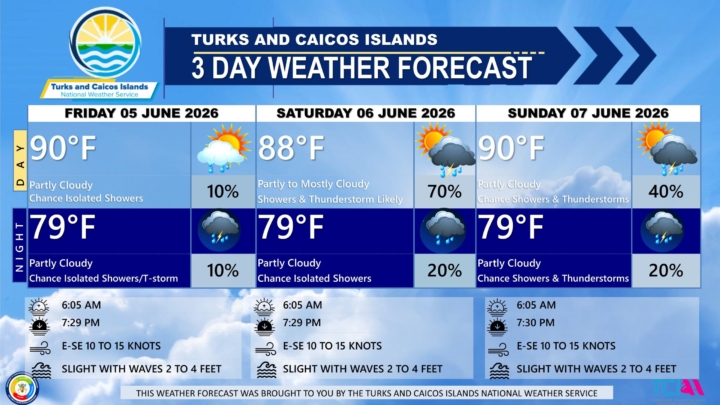
3 DAY PUBLIC WEATHER FORECAST FROM FRIDAY JUNE 5TH 2026
PUBLIC FORECAST FOR THE TURKS AND CAICOS ISLANDS FOR THE NEXT THREE DAYS FROM FRIDAY JUNE 05TH 2026
GENERAL SITUATION: Weak troughing ahead of an approaching frontal boundary is bringing increased cloudiness and could spark shower activity today.
SPECIAL WARNINGS: There are no public warnings in effect at this time.
AREA: ALL AREAS
WEATHER: Partly cloudy with a low (10 percent) chance of isolated showers today with an isolated thunderstorm possible tonight.
WINDS: East to southeast at 10 to 15 knots
SEA STATE: Slight with wave heights of 2 to 4 feet
DAYTIME HIGH TEMPERATURE 90°F 32°C
HEAT INDEX 100°F 38°C
OVERNIGHT LOW TEMPERATURE 79°F 26°C
SUNSET: 07:29 PM
NEXT HIGH TIDE: 12:15 PM (2.0 FT)
NEXT LOW TIDE: 06:24 PM (0.7 FT)
EXTENDED FORECAST: Unsettled weather conditions are expected to persist across the Turks and Caicos Islands over the weekend and into early next week, as the weakening front and lingering moisture continue to influence the forecast area.
SATURDAY: A medium (60 to 70 percent) chance of scattered showers and isolated thunderstorms in the Caicos Islands, and a low (30 percent) chance of widely scattered showers and isolated thunderstorms in Grand Turk and Salt Cay. Partly to mostly cloudy, with a high near 88°F (31°C).
SATURDAY NIGHT: A low (10 to 20 percent) chance of isolated showers. Partly cloudy, with a low around 79°F (26°C). New total rainfall accumulation of about a half an inch (12.5 mm).
WINDS: East to southeast at 10 to 15 knots
SEA STATE: Slight with wave heights of 2 to 4 feet
SUNRISE: 06:05 AM
SUNSET: 07:29 PM
HIGH TIDE: 01:00 AM (2.6 FT) 01:03 PM (2.0 FT)
LOW TIDE: 07:19 AM (1.0 FT) 07:14 PM (1.0 FT)
SUNDAY: A medium (40 percent) chance of scattered showers and isolated thunderstorms. Partly cloudy, with a high near 90°F (32°C).
SUNDAY NIGHT: A low (10 to 20 percent) chance of isolated showers and isolated thunderstorms. Partly cloudy, with a low around 79°F (26°C). New total rainfall accumulation of about a third of an inch (8.5 mm).
WINDS: East to southeast at 10 to 15 knots
SEA STATE: Slight with wave heights of 2 to 4 feet
SUNRISE: 06:05 AM
SUNSET: 07:30 PM
HIGH TIDE: 01:44 AM (2.3 FT) 01:59 PM (2.3 FT)
LOW TIDE: 08:04 AM (1.0 FT) 08:12 PM (1.0 FT)
TROPICAL WEATHER OUTLOOK: Tropical cyclone activity is not expected in the next 7 days.