
Italy, Arab League Head Call for End of Hostilities in Libya
Italy's foreign minister and the outgoing head of the Arab League have each called for a halt to hostilities in Libya.
Foreign Minister Franco Frattini told Italian lawmakers Wednesday the suspension of military operations in Libya is “essential” for immediate humanitarian aid.
Meanwhile, Britain's Guardian newspaper quoted Arab League head Amr Moussa as calling for a ceasefire and saying now is the time to reach a political solution to the crisis. The newspaper said Moussa also expressed reservations about his support for the NATO bombing campaign after seeing civilian casualties.
NATO acknowledged an airstrike on Sunday that caused civilian casualties and one on Friday that hit a column of rebel military vehicles. A NATO military spokesman said the Sunday incident was caused by a “weapon malfunction” and the Friday incident was a case of mistaken identity.
NATO said Tuesday one of its unmanned drones disappeared over Libya, disputing reports that forces loyal to leader Gadhafi had shot down an alliance attack helicopter.
Bracken said the alliance lost track of the helicopter along the central Libyan coast and is investigating the incident.
It is not clear whether ground fire or a mechanical failure brought down the drone.
Libyan state television repeatedly broadcast footage of aircraft wreckage it identified as a manned Apache attack helicopter near Zlitan, about 135 kilometers east of the capital, Tripoli.
France and Britain began deploying attack helicopters as part of the NATO-led mission earlier this month.
Meanwhile, at least four opposition fighters were killed and 50 others wounded in clashes with loyalist forces in Dafniya, west of the rebel-held port city of Misrata.
The Reuters news agency reported that four rockets fired by Libyan government troops landed in Misrata for the first time in several weeks. Reuters said no one was hurt in Tuesday's attack.

Serena wins in emotional return; Federer, Roddick, Wozniacki roll
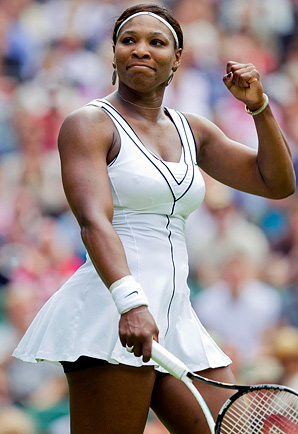 The 352 days Serena Williams lived through between Grand Slam appearances were filled with health problems and hospitalizations, doubts and depression.
Cuts from glass on both feet. One subsequent operation on her right foot, then a second. Clots in her lungs. Surgery to remove a pool of blood under her skin. On and on it went.
Finally healthy, and finally back at a major tournament, Williams was simply overwhelmed by it all at the conclusion of her match at Wimbledon on Tuesday. As soon as she snapped off her 13th ace of the afternoon to close an uneven performance in a 6-3, 3-6, 6-1 victory over Aravane Rezai of France in the first round, Williams placed her right palm on her chest. Her eyes welled with tears.
By the time she walked to the net to shake hands with Rezai, Williams was crying. She sat in her sideline chair, covered her face with a tournament towel and sobbed. And she kept right on bawling through a postmatch TV interview with the BBC.
"It definitely was so emotional for me because, you know, throughout the last 12 months, I've been through a lot of things that's not normal; things you guys don't even know about,'' the 29-year-old American said at her news conference. "So it's just been a long, arduous road. To stand up, still, is pretty awesome.''
A first-round win at a Grand Slam tournament is not exactly the sort of achievement Williams normally would celebrate: Her career mark in such matches is now 44-0, after all. But she'd never before been away from her sport for such an extended time - and, more to the point, she'd never before been through such a series of scares. Williams got the "all clear'' from her doctor about 2 1/2 months ago, only began practicing at full speed about one month ago, and played her first match anywhere since July at a grass-court tournament in Eastbourne last week.
Rezai, once ranked as high as 15th but now 61st, was struck by the high level of Williams' play, particularly down the stretch - and by her reaction at match's end.
"It shows she's not a machine; she's a human being,'' Rezai said. "We all have a heart. We all have emotions. ... If she wins the next two or three matches, I think she can win the tournament.''
Williams wasn't quite ready to pronounce herself the player to beat at Wimbledon, where she has won four of her 13 Grand Slam singles championships, including each of the past two years.
It was only a handful of days after that latest title that Williams was sliced on both feet by glass at a restaurant in Germany. She played an exhibition match in Belgium later that week, but eventually realized she needed surgery. Williams now has a jagged scar that runs several inches from the top of her right foot up her leg.
"She really appreciated this chance to return to tennis, and she couldn't wait to get back,'' her mother, Oracene Price, said after watching the match on Center Court, where singer Diana Ross had a front-row seat in the Royal Box. "Now she has something to get that zeal back. The hunger and the fire that you lose comes back. I know she had been depressed at times.''
There was none of that sort of drama on the day's later matches on Centre Court, which included straight-set victories for Roger Federer, Novak Djokovic and Maria Sharapova.
Not really bothered by swirling wind he called "tricky,'' six-time Wimbledon champion Federer won 68 of 80 points on his serve - including 29 of 31 in the first set - while beating Mikhail Kukushkin of Kazakhstan 7-6 (2), 6-4, 6-2. Djokovic, playing for the first time since his 43-match winning streak was ended by Federer in the French Open semifinals, dropped only 11 points on serve and eliminated Jeremy Chardy of France 6-4, 6-1, 6-1. Andy Roddick, a three-time runner-up at the All England Club, served quite well, too, pounding 30 aces to defeat qualifier Andreas Beck of Germany 6-4, 7-6 (6), 6-3.
Roddick's known Williams for years and considers her a friend. He explained that everyone is anxious before any first-round match at any Grand Slam tournament, so he could only try to imagine how Williams must have felt Tuesday.
That said, Roddick also pointed to her well-known penchant for successful comebacks, whether it's saving a match point on court or recovering from an injury off it.
"One thing we've never really questioned with Serena is her competitive spirit. Especially when she gets out there, I think she just hates losing,'' Roddick said. "I don't think it'd surprise anybody in this room if she went on and won this tournament. I don't know how many people you can say that about after a year (away).''
Other winners included 2009 U.S. Open champion Juan Martin del Potro, two-time French Open finalist Robin Soderling, top-seeded Caroline Wozniacki and French Open champion Li Na. But former No. 1 Jelena Jankovic lost in the first round.
Day 2 of Wimbledon also featured a rematch of the longest match in tennis history. In a sequel that couldn't possibly live up to the original, John Isner beat Nicolas Mahut 7-6 (4), 6-2, 7-6 (6) in 2 hours, 3 minutes - 9 hours, 2 minutes shorter, and 149 fewer games, than their first-round match at the All England Club a year ago, when Isner won 70-68 in the fifth set.
"It wasn't easy,'' Isner said, "but obviously it was considerably quicker than the last time we played.''
The seventh-seeded Williams started slowly against Rezai.
Williams fell behind 2-0 after getting broken in the match's opening game, during which a shrill fire alarm from a nearby building steadily rang for about five minutes, creating an odd, distracting backdrop while play continued uninterrupted.
Rezai won the first game with a drop shot that bounced twice before Williams could get there; that was one of several points that ended with Williams huffing and puffing, trying to catch her breath, a not-all-that-surprising development given that she is still working her way back into form.
But Rezai also helped out, double-faulting twice while getting broken to 2-all, and twice more while falling behind 4-2.
That was enough for Williams to take that set; her own blips arose in the second. She lost her serve to fall behind 4-2, stumbling a bit while missing a backhand, then double-faulting on break point. Three games later, Williams missed a forehand wide, then admonished herself with a high-pitched shriek, and the match was tied at a set apiece.
And then?
"She woke up in the third set,'' Price said.
That she did. Grunting loudly, and swatting serves at up to 117 mph, Williams never faced a break point the rest of the way. She broke Rezai twice, including at love to lead 5-1. That was part of a 10-point run to end the match, her 200th victory at a Grand Slam tournament.
It had been quite a while since her 199th.
"Being out for so long really, really is unfortunate. I love playing tennis. I love being a part of the competition. So I thought if I could make it, I'll try to do my best. And that's what I did,'' said Williams, who wore a long cardigan sweater during prematch warmups, and had two oversized pieces of bandaging on her back, which she said was for warmth.
"I'm still overcoming every day,'' she added. "This isn't the end of the road; it's just the beginning.''
I resigned to save the region - Warner
Football supremo Jack Warner said yesterday he resigned from FIFA to save CONCACAF and the Caribbean Football Union from further chaos in the face of the ongoing cash-for-votes scandal.
Making it clear that he had not been pushed, the Trinidadian said he also believed he would have been acquitted had a fair investigation run its course.
The 67-year-old, one of the most powerful men in world football, quit as one of the vice-presidents of football's world governing body yesterday, and also relinquished his hold on CONCACAF and the CFU.
He had been suspended from all three organisations pending an investigation by FIFA's ethics committee into corruption allegations, which also implicated Asian football chief and former FIFA presidential contender Mohammed bin Hammam.
"This decision is by my own volition and self-determination, albeit it comes during the sequel to the contentious Mohammed bin Hammam meeting in Port-of-Spain in May with CFU Delegates," Warner said.
"I am convinced, and I am advised by counsel, that since my actions did not extend beyond facilitating the meeting that gave Mr bin Hammam an opportunity to pursue his aborted bid for the FIFA presidency, I would be fully exonerated by any objective arbiter.
"I have, nonetheless, arrived at the decision to withdraw from FIFA affairs in order to spare FIFA, CONCACAF, and in particular, CFU and its membership, from further acrimony and divisiveness arising from this and related issues."
A report submitted to FIFA by CONCACAF general secretary Chuck Blazer last month had alleged wrongdoing at the Trinidad meeting and sparked a controversial probe involving CFU member countries.
It was alleged that at the meeting, CFU nations were offered US$40,000 in return for supporting bin Hammam at the June 1 FIFA presidential election against incumbent Sepp Blatter.
Having run CONCACAF and the CFU for the last two decades, Warner said he left both organisations in good shape.
"I am gratified that FIFA has acknowledged my service to international and regional football over several decades," Warner said.
Windies let it slip
West Indies gave up what is already proving to be a decisive lead on first innings as the opening Digicel Test cricket match against India heads into the third day this morning.
Beginning yesterday’s second day aiming to overcome India’s first day total of 246, the home side could not find the necessary inspiration to overcome the Indian bowlers on the helpful strip at Sabina Park. The West Indies batting crumbled in the second session, the last five wickets perishing for just 26 runs as the home side fell for 176, conceding a lead of 73.
It seemed a distinct advantage for India in the conditions. And the visitors had strengthened their grip by the close of play, moving to 91 for three in their second innings and pushing their lead to 164.
Suresh Raina and Harbhajan Singh’s inspired century partnership of 146 on the first afternoon had saved India from the kind of total the West Indians mustered yesterday. Darren Sammy’s men could not execute in the way the circumstances demanded.
It was a personally difficult day for the captain.
He managed just one run before he failed to play straight and was bowled middle stump by Ishant Sharma (17-6-29-3). And then, fielding at second slip with the Indian total standing at 14 for one, Sammy dropped Rahul “The Wall” Dravid.
It was as regulation a chance as slip catches come, Ravi Rampaul creating the opportunity by finding Dravid’s outside edge. The ball went waist-high to Sammy and he dropped it somehow. His players were in disbelief. Vice-captain Brendan Nash in the gully visibly had difficulty suppressing an angry reaction. Rampaul was denied a second wicket in as many overs, having already removed Murali Vijay with his second ball of the innings. Worse, the Windies missed the chance to build momentum and force their way back into the game. Dravid took advantage of that escape when he was six to reach 45 by day’s end.
It was captain Sammy himself who had said before this game: “You need to take all your catches. We paid dearly in the last Test against Pakistan.”
But that was not the only lesson the home side failed to heed. India’s seam bowlers Sharma and debutant Praveen Kumar found the right “three-quarter” length around off-stump that constantly gave them an opportunity to take wickets on a pitch where the bounce was steadily encouraging.
The Windies pacers struggled to maintain that consistency, even in the first innings and again yesterday afternoon.
The exhibition by tall, slender Sharma and Kumar in particular was impressive. Only little Adrian Barath, back in big cricket after nearly seven months out with injury, found the right balance between defence and attack in getting to a very well made second Test half century, 64. His nine fours and the six off Amit Mishra which he deposited well into the North Stand were all the result of nimble and precise movements of the feet. Pugnacious Barath drove through the off-side with great success and was also willing to use the sweep shot, something very rarely seen by his teammates this season.
He made his runs largely in partnership with left-hander Darren Bravo (18) with whom he added 56 for the third wicket. They had come together in the second over when Ramnaresh Sarwan (three) was adjudged lbw by umpire Ian Gould as he offered no shot to a Sharma delivery which cut back from outside off-stump.
Barath and Bravo took the total to 91. Barath was just stepping up the tempo with a four and that six in succession off Mishra when Kumar got him with an irresistible ball. Pitching on off-stump, it left him at the last moment, caught the edge and was snared by captain Mahendra Dhoni behind the stumps.
His ability to get movement both ways and his accurate line always made Kumar a potential wicket-taker. And even though the spinners got wickets late in the innings, they enjoyed the bounce and generous turn. The sustained pressure was such that only the last wicket to fall, Devendra Bishoo’s came from an attacking shot in front of the wicket.
T&T opens CBC title quest against Cuba
The National Basketball Federation of Trinidad and Tobago started training towards participation in the 2011 Caribbean Basketball Confederation (CBC) Championships which takes place in Nassau, Bahamas from August 3-7. The Federation held its first local screening session at the Jean Pierre Sports Complex, Mucurapo under newly appointed head coach Puerto Rican Ivan Flores. Flores, who topped the interview process, will lead the T&T team for the August championships which will feature US Virgin Islands, St Vincent and Grenadines, Cuba, Dominican Republic and host Bahamas. The session attracted 17 local-based players all of whom went through a two and half hour long session conducted by Flores and his staff, including former WNBA player Pietra Gay, who was an assistant last year and former national Trevor “Snail” McLeod, who was also a two-time assistant.
Also in attendance was the Federation’s President Courtney McNish and Obadiah Asher, the sport Technical Director. T&T will play tournament favourites Cuba in its opening match on August 3. The men’s matches will run from July 23 to 29. T&T will not be fielding a team. The Federation also conducted a weekend scouting stint in New York, USA two weeks ago and from all reports a number to very talented players were discovered by the coaching staff.
Teams
Men
1. Antigua & Barbuda
2. Bahamas
3. Bermuda
4. British Virgin Islands
5. Cayman Islands
6. Guyana
7. Jamaica
8. St Vincent and the Grenadines
9. Turks and Caicos
10. US Virgin Islands
Women
1. Bahamas
2. Cuba
3. Dominican Republic
4. St Vincent and the Grenadines
5. Trinidad and Tobago
6. US Virgin Islands
Premier Cox: European Economic Committee
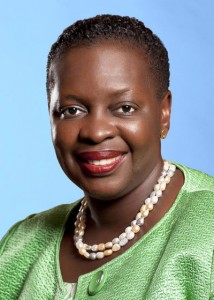 Premier Paula Cox became the first Bermudian Premier to address the Economic Committee of the European Parliament yesterday [June 21].
Chairman of the Committee, Ms. Sharon Bowles welcomed the Premier to the Committee meeting where she was afforded the opportunity to speak to sitting members of the European Parliament in a 10:30- 11:30 am time slot.
After thanking the Committee for affording her the opportunity to speak, the Premier delivered a message that expressed a willingness to partner with the EU on issues of mutual benefit.
She stated, “There is common ground between Bermuda and Europe. Yesterday I had a full agenda of meetings at the Commission.”
“I met with the Secretariat; the Director and Head of Unit of governance and external affairs; the external action committee and the Director with responsibility for the overseas territory association.”
The Premier informed the members that she remained cognizant that in Europe, as was noted during her visit to Washington DC last week, issues related to the economy and raising the debt ceiling loomed large.
The Premier said, “Bermuda is a quality jurisdiction for financial services. We believe in transparency, quality risk-based supervision and collaboration and cooperation with our key trading partners in the EU and the US.
“As hosts of the 2011 OECD Conference a few weeks ago, Bermuda was amongst its peers and firmly stood on its sound regulatory platform. Bermuda is a cooperative and transparent jurisdiction, and there is a lot of common ground between Bermuda’s interests and that of European MEPs in taking the necessary steps to enhance the regulatory and financial system to prevent further economic challenges.”
The Premier Cox concluded, “This has been an extremely positive and supportive gathering of Members of the European Parliament and I believe the Bermuda story will resonate here long after we have gone.
A spokesperson said, “Premier Cox also spoke to the continued engagement of Bermuda’s independent regulator with global supervisors so there was enhanced oversight internationally.”
“In expressing the special relationship and the opportunity for strategic partnering, the Premier was questioned about the types of opportunities that she saw. She replied that she had raised the issue of Bermudians being seconded to work at the Commission and in the Parliament in meetings she’d attended yesterday and this idea, as it had yesterday, met with a favourable reception.”
“The Premier’s ten minute address was followed by a question and answer period. In addition to the Committee, the floor was opened to questions from attending MEP’s whose inquiries ranged from why Bermuda was so attractive to business, and our commitment to tax transparency, to what distinguishes “offshore” financial centres from “onshore” financial centres.”
“These queries gave an opportunity to reinforce Bermuda’s commitment to an equivalent insurance supervisory regime for commercial insurance and reinsurance, however, the Premier stressed to the MEP’s that she believed Bermuda’s captive supervisory regime was already adequate for the limited purpose and risks written by those entities.”
“The Premier closed her remarks by again calling for secondment opportunities for young Bermudians looking to gain exposure on the global front. At the conclusion of the meeting, a number of MEP’s sought the Premier to personally greet and thank her for coming.”
The Premier began the day at a breakfast organized by ABIR, with Member of the European Parliament, Peter Skinner. This morning [June 22] she will unveil the plaque of Mary Prince at the School of Oriental and African Studies, University of London, and later will sign Bermuda’s 25th TIEA with the Republic of Indonesia.
United States Secretary of State Hillary Clinton visits Jamaica
United States Secretary of State Hillary Clinton will today reaffirm her nation's commitment to the region when she visits Montego Bay, St James, to meet with her Caribbean counterparts.
In a release last night, the US Embassy in Kingston said Clinton would be building on the June 2010 Caribbean Ministerial Meeting in Barbados, and underscoring joint partnerships in regional security issues, reconstruction of Haiti, energy and climate change, food security, and regional approaches to economic growth.
RTC News will have more on that visit.
Haiti parliament rejects Martelly’s nomination for PM
The Haitian parliament Tuesday rejected the nomination of Daniel-Gerard Rouzier to serve as prime minister, in a blow to new President Michel Martelly.
More than a month after Martelly took up the reins of power in the quake-hit Caribbean nation, Haiti still lacks a legitimate government, after prime minister Jean-Max Bellerive and his cabinet resigned.
Forty-two deputies voted against Rouzier’s nomination, most of them members of former president Rene Preval’s Unity Party, while 19 deputies voted for him and three abstained.
“We will write to the president to let him know the Chamber of Deputies has rejected Daniel-Gerard Rouzier’s nomination as prime minister, and ask him to nominate a new prime minister,” said speaker Saurel Jacinthe.
In debates before the vote, several deputies expressed concern that Rouzier was a businessman, pointing to a possible conflict of interest if he became prime minister.
Rouzier founded E-Power, a company that holds government contracts.
Fifa vice-president Jack Warner resigns
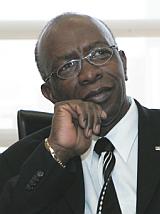 Fifa vice-president Jack Warner has resigned, world football's governing body has confirmed.
"As a consequence of Mr Warner's resignation, all ethics committee procedures against him have been closed and the presumption of innocence is maintained," said a Fifa statement.
Warner was suspended pending an investigation into bribery allegations.
He and fellow Fifa member Mohamed Bin Hammam are alleged to have paid bribes of £600,000 to Caribbean associations.
Chuck Blazer, general secretary of the Concacaf federation Warner had been president of, alleged that violations of Fifa's code of ethics occurred during a meeting organised by Bin Hammam and Warner in May.
In a statement, Warner said: "I am convinced, and I am advised by counsel, that since my actions did not extend beyond facilitating the meeting that gave Mr Bin Hammam an opportunity to pursue his aborted bid for the Fifa presidency, I would be fully exonerated by any objective arbiter.
"I have, nonetheless, arrived at the decision to withdraw from Fifa affairs in order to spare Fifa, Concacaf and, in particular, CFU and its membership, from further acrimony and divisiveness arising from this and related issues."
Warner also told Bloomberg press agency he felt he had been "hung out to dry" and insisted the giving of gifts has been part of Fifa culture during his 30 years in the organisation.
"It's not unusual for such things to happen and gifts have been around throughout the history of Fifa," he said. "What's happening now for me is hypocrisy."
He added: "I have lost my enthusiasm to continue. The general secretary that I had employed, who worked with me for 21 years, with the assistance of elements of Fifa has sought to undermine me in ways that are unimaginable.
"This is giving the impression that Fifa is sanitising itself. I've been hung out to dry continually and I'm not prepared to take that."
Blazer's allegations were preceded by claims made in parliament by the former head of England's failed 2018 World Cup bid, Lord Triesman, about irregularities in the bidding process for the 2018 World Cup.
Triesman, who was also former chairman of the Football Association, accused Warner and three other Fifa Executive Committee members of improper conduct during England's 2018 World Cup bid.
According to Triesman, in exchange for voting for England to host the World Cup, Warner had asked for cash to build an education centre in Trinidad and to buy World Cup television rights for Haiti.
The 68-year-old had been the longest-serving member of Fifa's executive committee, and a Fifa statement continued: "Fifa regrets the turn of events that have led to Mr Warner's decision.
"His resignation has been accepted by world football's governing body, and his contribution to international football and to Caribbean football in particular and the Concacaf confederation are appreciated and acknowledged."
In May, Fifa opened "ethics proceedings" against Warner and Bin Hammam but Warner insisted he was not guilty of a "single iota of wrongdoing".
Football's governing body then suspended Warner and former Fifa presidential candidate Bin Hammam on 29 May, pending an investigation into claims they had offered bribes to members of the Caribbean Football Union (CFU).
Despite claims by Bin Hammam that Fifa president Sepp Blatter was aware of payments made to the CFU, and that he too should be investigated, Fifa's ethics committee stated that "no investigation is warranted" of Blatter.
Following Bin Hammam's suspension, Blatter went on to run unopposed in the Fifa presidential election, despite efforts by the FA to have the election suspended amid the corruption allegations that had engulfed the sport's world governing body.
Blatter was re-elected for a fourth term after receiving 186 of the 203 votes, after 17 member associations supported the FA's request for a delay.
Despite the controversy that has surrounded Fifa and Warner since May, the governing body's statement concluded: "Mr Warner is leaving Fifa by his own volition after nearly 30 years of service.
"The Fifa executive committee, the Fifa president and the Fifa management thank Mr Warner for his services to Caribbean, Concacaf and international football over his many years devoted to football at both regional and international level, and wish him well for the future."
Warner thanked Fifa in his statement and added that he would now commit himself to serving the people of his native Trinidad and Tobago.
"I am gratified that Fifa has acknowledged my service to international and regional football over several decades," he said.
"It is also a special source of satisfaction to me that during my tenure, capacities and facilities in the Caribbean were upgraded to levels that enabled the region to host several Fifa World Cup finals.
"I sincerely hope that the Caribbean Football Union will continue to fight above its weight in Fifa and Concacaf affairs.
"With my withdrawal from service in international football, I shall, henceforth, be concentrating exclusively on my lifelong commitment to the service of the people of Trinidad and Tobago, currently as chairman of the major party in our governing coalition and as a cabinet minister in the government of our republic.
"I shall continue to encourage the youth of the Caribbean and the world to deepen their involvement in football, which has lifted so many young people out of hopelessness and risk to personal achievement, while bringing glory to their respective countries."
Turks and Caicos forum chair welcomes new constitution
 Lillian Misick, the chair of the Turks and Caicos Islands Consultative Forum, has welcomed the new constitution for the territory negotiated at the Foreign and Commonwealth Office (FCO) in London last week with Britain’s minister with responsibility for the overseas territories, Henry Bellingham, saying that she was happy to report the following:
1. Mr Bellingham agreed with our recommendation to leave in place our first past the post electoral system. He also agreed with Doreen Quelch-Misick’s inspired suggestion that the House should be comprised of 19 members: 10 elected from newly drawn constituencies, 5 elected “at large” or nationwide, and 4 appointed. I believe these and related changes will break the provincial stranglehold the two political parties have held on deciding who gets to stand for elective office in the TCI.
2. I remain convinced however that public financing of elections is critical to getting at the root cause of the political corruption that has plagued our beloved country in recent years. Therefore, I look forward to working with FCO officials in the weeks ahead to bring forward legislation to this effect for debate and vote in the Consultative Forum.
3. Mr Bellingham agreed that the term Belonger should be thrown into the dustbin of history. We are now citizens who shall henceforth be called Turks and Caicos Islanders; although, I prefer the term TCIslanders (pronounced T-C-Islanders). It rolls off the tongue easier.
4. Mr Bellingham agreed that the Deputy Governor should be a TCIslander - period!
5. Mr Bellingham agreed that some of the language in the section on the Governor’s powers was unnecessarily imperious. He also agreed however that those powers must remain “sufficiently robust” to foil what I described as the spectacle of local leaders blaming the UK-appointed governor for their corrupt practices.
6. Mr Bellingham agreed that there should be a clear path to TCI citizenship with defined conditions. Those who qualify should not be subjected to untenable delays or the alleged bribes we’ve heard so much about. This should also enlarge the franchise commensurate with our new demographic realities.
7. Mr Bellingham agreed that the trial by jury legislation we enacted earlier this year is sound and should remain in place.
These were the major points of contention and I believe they were all resolved in ways that will serve all TCIslanders well. More importantly, I am confident that, despite the protests of a vocal minority, the vast (silent) majority of our people will proudly embrace our new Constitution when it comes into force in due course.
Apropos of protests, reports are that the party leaders in our delegation are upset because so many of their recommendations were rejected. But I urge them to acknowledge and respect the fact that their recommendations were duly considered. They would also do well to reflect on the consternation they caused by vacillating throughout this process between mounting feckless boycotts and making impudent demands.
In the meantime, I hope this experience will help these party leaders see the wisdom now of working with the Forum to meet the other milestones that Mr Bellingham and Alan Duncan, Minister of State for International Development, set out for return to home rule. Most notable in this respect are the efforts underway to return our budget to surplus and reform our civil service.
Finally, I would like to take this opportunity to congratulate Mr Damian Roderic (Ric) Todd on his appointment as the next Governor of the TCI. I look forward to giving him a warm welcome on behalf of all TCIslanders when he assumes office in September. I am confident that we will enjoy the same cordial, constructive and collaborative relationship that we’ve had with Governor Wetherell over the past three years.