
China’s Growth Slows, Inflation Rises
Chinese officials said Friday that the economy grew at a robust but slightly slower pace in the first quarter of 2011, while inflation rose, despite efforts to lower living costs.
The National Bureau of Statistics said the gross domestic product expanded by 9.7 percent in the first three months of the year, slightly below 9.8 percent in the final quarter of 2010.
However, consumer prices rose 5.4 percent over a year ago, driven by an 11.7 percent surge in food costs. That was up despite officials raising interest rates four times since October in efforts to cool prices.
Premier Wen Jiabao said this week that the government would do whatever it could to bring prices down.

UN to Announce Ruling in Croatian Generals’ Trial
The United Nations war crimes tribunal in The Hague is to deliver verdicts in the trial of three Croatian generals on Friday.
Ante Gotovina, Ivan Cermak and Mladen Markac have been accused of war crimes against ethnic Serbs during a military operation aimed at retaking a Serb-held part of Croatia during the 1990s Balkans conflict.
Prosecutors have charged the generals with aiding and abetting murder, deportation and persecution of Serb civilians in the aftermath of the August 1995 “Operation Storm,” which resulted in the recapture of Croatia's Krajina region.
General Gotovina, the most senior of the three, is facing a prison term of up to 27 years.
The generals have denied any wrongdoing, and their lawyers have expressed confidence that they will be acquitted. The three are considered heroes of liberation in their country.
In Croatia's capital, Zagreb, veterans of the war of independence have scheduled a parade Thursday to be followed by an overnight prayer for the generals.
Prime Minister Jadranka Kosor said she expects the U.N. court will set them free. She has asked supporters to refrain from any extreme reactions in case of a negative verdict.
Hamas: Italian Activist Found Dead in Gaza
Hamas security officials say they have found the body of an Italian peace campaigner in an abandoned Gaza City house following his abduction by radical Palestinian militants.
The officials said Friday that Hamas police stormed an apartment in Gaza City belonging to a member of a Jihadist Salafi group aligned with al-Qaida. They found the body inside.
The group on Thursday released a video of the kidnapped activist, identified as Vittorio Arrigoni of Italy.
In a YouTube clip posted by his abductors, the extremist group demanded that Hamas free its leader and two other members arrested early last month by 1400 GMT Thursday or they would execute Arrigoni.
The Italian national was shown blindfolded with a large bruise on his face. A hand can be seen pulling his head up by his hair to face the camera.
Two suspected kidnappers have been arrested, and others were being sought for Arrigoni's killing. The journalist and writer had worked for a pro-Palestinian group called the International Solidarity Movement.
Before his body was found, the Italian Foreign Ministry said it was aware of the kidnapping and was taking steps to ensure Arrigoni's safety.
The incident is the first kidnapping of a foreigner since Hamas took control of Gaza in 2007.
Most of those previously abducted were foreign journalists, including Alan Johnston of the BBC, who was held for 114 days by an al-Qaida-inspired group before his release in 2007.
Hamas has denied that al-Qaida is present in Gaza.
There are five major Salafist groups in Gaza. The movement espouses an austere form of Sunni Islam that seeks a return to practices common in the early days of the faith. Their religious observances and refusal to abide by various cease-fires with Israel put them at odds with Hamas.
Retail banks should be ring-fenced, says commission
UK banks' retail operations should be "ring-fenced" from their investment banking arms, the Independent Commission on Banking has recommended.
However, in its interim report the commission stopped short of recommending the two should operate as separate entities.
It said more competition was needed in retail banking, including the sell-off of more Lloyds branches.
The commission's final recommendations will be published in September.
The banking commission was set up by the government last June to review UK banks after the financial crisis.
However, the government is under no obligation to implement its recommendations.
Bank shares reacted positively to the report, with Barclays shares up 3.6% and Royal Bank of Scotland 3.2% higher by mid-afternoon trading.
Deputy Prime Minister Nick Clegg welcomed the report, telling BBC Radio 4's Today programme: "It is based on the insight that many people share, which is that it is not right to have very high-risk and very low-risk banking activities so intertwined that, when something goes wrong, it is the taxpayer that picks up the bill".
Shadow chancellor Ed Balls said he felt the report was "tough" on banks.
"The devil will be in the detail of the commission's final proposals, but we must get this right," he added.
But critics insisted that the commission had been too timid, an accusation that Sir John Vickers, the chairman of the commission, flatly denied.
"I absolutely reject any notion that we bottled it," he said at a press conference.
"In no sense at all are these half measures... these are absolutely far-reaching reforms."
Cash reserves
The report said that, in the build-up to the crisis, lenders and borrowers took on "excessive and ill-understood risks".
It added that implicit taxpayer support for the banks encouraged "too much risk taking".
The commission said that banks needed to hold more cash in reserve to protect against future crises, and that creditors, not taxpayers, should be liable for any losses.
It said it was looking at forms of "retail ring-fencing", under which retail banking would be carried out by a separate subsidiary within a wider banking group.
The report recommended that banks should have 10% of their capital set aside to cover potential losses, higher than the 7% set out in new European regulations.
However, the commission said it was not proposing that UK investment banks should hold higher capital ratios than their international rivals.
'Allowed to fail'
Sir John told the BBC that "total separation [of retail and investment banking] is not necessary".
"UK retail banking can be protected by its own capital cushion," he said. "Other parts of the bank should be allowed to fail."
This would lead to additional costs to the banks, some of which would fall on the wider economy, he said.
The cost of capital is going to go up," Sir John said, but the costs to investment banks would be greater than those to retail banks.
Without an implicit government guarantee, which banks currently enjoy, lenders would view investment banks as more risky, and therefore charge more for their money.
Banks would also be less likely to take excessive risks without this implicit guarantee, the commission said.
These costs, however, would be more than offset by the benefits of "materially reducing the probability and impact of financial crises", the report said.
Analysts said that banks might have to increase retail charges to pay for the measures outlined in the report, should they be implemented.
"Rising financial capital cushions are likely to paid for by increased banking charges, whilst the rise of an army of new alternative banks still looks to be a lifetime away," said Keith Bowman at Hargreaves Lansdown.
The report also recommended that Lloyds Banking Group, which has about 30% of current accounts in the UK, should sell more of its branches in order to increase competition on the High Street.
Lloyds is already in the process of selling about 600 branches, but Mr Vickers said competition in High Street banking would benefit from further branch sales.
The commission called for a radical improvement in the ability of bank customers to move their accounts, so that the threat of losing customers would put pressure on banks to improve their services.
To do this, it suggested that bank accounts could have unique numbers valid across the whole of the banking industry, like portable phone numbers.
Consumer groups questioned whether the commission's recommendations went far enough.
"The financial crisis has increased the market power of the largest banks, leading to a worse deal for consumers," said Peter Vicary-Smith, chief executive of Which?.
"We're pleased the commission recognised this, but need to consider whether the recommendations will go far enough to address the parlous state of competition in the UK."
Sir John said far-reaching reforms that would go beyond its focused recommendations had not been ruled out.
"Strict separation and much, much higher capital requirements - those options are not off the table," he said.
IMF says risks not expected to derail economic recovery
The global economy remains firmly on a path to recovery but threats to growth remain, the International Monetary Fund (IMF) has said.
Among the challenges are rising oil prices, unrest in the Middle East, continued inflation in China and debt problems in Europe.
In a new forecast, the IMF says the global economy should grow by 4.4% in 2011, the same figure given in January.
But the IMF cut its UK growth forecast for 2011 to 1.7% from 2%.
It kept its prediction for UK economic growth in 2012 unchanged at 2.3%.
Meanwhile, it raised its forecast for Germany's GDP growth this year to 2.5% from 2.2%, and its forecast for 2012 rose slightly to 2.1%.
Oil supply risk
On the global economy the IMF said: "The recovery has solidified, but unemployment remains high."
In its World Economic Outlook report the IMF also said that growth was not strong enough to make a "major dent in high unemployment rates".
And it said that the major risk to growth came from further oil price rises because of supply disruption.
It said the eurozone economy was expected to grow by 1.6% in 2011 and 1.8% the following year, a 0.1 percentage point increase on its January forecast.
It painted a gloomy picture for Portugal's economy, saying it would stay in recession during 2012, with the unemployment rate expected to rise from its current 11.1% to 12.4% by 2012.
Greece and the Irish Republic also faced tricky financial readjustments, it said.
Meanwhile Spain, which has unveiled spending cuts to try to stave off any potential bail-out, will record growth of 0.8% this year and 1.6% in 2012, the IMF said.
'Boom' fears
Growth in the US was predicted to be 2.8%, down 0.2 percentage points from January, reflecting the effect of higher oil prices.
And the IMF warned about inflation building in Asia's fast-growing economies, cautioning that "boom-like dynamics" should not be allowed to get out of control.
The Washington-based body said if China were to suffer a slowdown - after a credit and property-fuelled boom - it would hurt the entire region.
"Such boom-bust dynamics are also a possibility in other emerging Asian economies," the IMF said.
'Overheating'
China, as well as Brazil and India, largely helped to offset the deep downturns in much of the western world between 2007 and 2009 after asset bubbles burst.
But the IMF said: "The challenge for many emerging and some developing economies is to ensure that present boom-like conditions do not develop into overheating over the coming year."
Turning its attention to Japan, the IMF said the effects of the devastating earthquake and tsunami would reduce economic growth only slightly in 2011.
It also said Japan, which has huge levels of government debt, should refocus on fixing public finances when rebuilding after the March disaster gets under way.
UK 'will get Iceland money back'
Iceland's President Olafur Ragnar Grimsson has said that the UK and the Netherlands will get back the 4bn euros (£3.5bn) they paid when Iceland's banking system collapsed in 2008.
That is despite the country rejecting the latest repayment plan in a referendum at the weekend.
Mr Grimsson told the BBC assets from the collapsed bank Landsbanki would "in all likelihood" cover what was owed.
The UK has said the matter will go to an international court.
Iceland's three main banks collapsed in October 2008.
Landsbanki ran savings accounts in the UK and the Netherlands under the name Icesave.
When it collapsed, the British and Dutch governments had to reimburse 400,000 citizens - and Iceland had to decide how to repay that money.
The weekend result marked the second time a referendum has rejected a repayment deal.
Mr Grimsson said that it was not an issue about paying or not paying, but a question of whether there is a state guarantee and how that would be interpreted under the European regulatory framework.
"I think the primary message [from the referendum] is that before ordinary people are asked to pay for failed banks, the assets inside the estate of these banks should be used to pay the subs," Mr Grimsson told Radio 4's Today.
"That is why the people of Iceland emphasised that Britain and the Netherlands are going to get certainly up to $9bn out of the estate of Landsbanki.
"The first payment will be this December, and in all likelihood this will cover what was paid by Britain and the Netherlands two years ago.
"But to ask for a state guarantee and that ordinary people should shoulder the responsibility is highly doubtful and definitely can be disputed within the European legislative framework."
But he added that if the matter did end up in an international court, "of course" Iceland would abide by the court's ruling.
Ivory Coast: Gunfire in Abidjan despite Gbagbo arrest
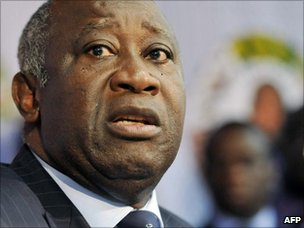 Sporadic gunfire can be heard in Ivory Coast's main city, Abidjan, a day after former President Laurent Gbagbo was arrested.
The BBC's Mark Doyle in the city says it is not clear whether pro-Gbagbo forces or criminals are responsible.
But he has also heard at least one mortar round being fired.
Mr Gbagbo was seized after refusing to accept defeat in last year's elections. His successor, Alassane Ouattara, has appealed for the violence to end.
Our correspondent says Mr Ouattara's first priority will be to restore security.
A joint operation by pro-Ouattara forces, the UN and French military captured Mr Gbagbo from his official residence, where he had been under siege for more than a week.
Mr Ouattara said Mr Gbagbo would be put on trial, and said a truth and reconciliation commission would be set up.
Both sides have been accused of atrocities.
At least 1,000 people have been killed and a million forced from their homes during the four-month stand-off in the world's largest cocoa producer.
The UN and French forces intervened after they accused Mr Gbagbo's forces of using heavy artillery against civilians.
The UN, which helped organise the elections, said Mr Ouattara won, but Mr Gbagbo refused to accept defeat.
'New era'
Our correspondent says some Abidjan residents are still too afraid to leave their homes in case they are caught by gunmen.
Many residents have been trapped for days by the fighting.
Some pro-Gbagbo troops may have refused to surrender, or the shooting could be coming from some of the thousands of Gbagbo supporters who were given weapons to fight the pro-Ouattara forces, our correspondent says.
There are hardly any police on the streets.
The pro-Ouattara forces, who swept down from their northern strongholds earlier this month, include army defectors, as well as ethnic militiamen and traditional hunters, who may not always obey orders or respect military discipline, analysts say.
An end to the insecurity would allow markets to re-open and people to return to their homes.
For life to return to normal, banks must also open.
They have been closed for more than two months because of financial sanctions imposed on Mr Gbagbo to try to force him from power.
Gbagbo son beaten
Speaking on his TV channel hours after Mr Gbagbo's capture, a sombre Mr Ouattara appealed to Ivorians to "abstain from all reprisals and violence".
After more than four months of post-electoral crisis, marked by so many human lives lost, we are finally at the dawn of a new era of hope," he said.
Mr Gbagbo, his wife Simone and his "collaborators" would be investigated by the judicial authorities, Mr Ouattara promised. The personal security of Mr Gbagbo and his family would be guaranteed, he added.
The country had just turned a painful page in its history but better times were on the way, the new president declared.
Mr Gbagbo and his wife have been put under UN police guard at Abidjan's Golf Hotel, where Mr Ouattara has his headquarters.
Mr Gbagbo has been shown on pro-Ouattara TV sitting in a room, looking dazed but apparently uninjured, wearing an open shirt and white vest.
But French TV showed pro-Ouattara forces beating his son, Michel, and other Gbagbo supporters.
Nuclear crisis raised to Chernobyl level
Japanese authorities have raised the severity rating of their nuclear crisis to the highest level, seven.
The decision reflects the total release of radiation at the damaged Fukushima Daiichi power plant, which is ongoing, rather than a sudden deterioration.
Level seven previously only applied to the 1986 Chernobyl disaster, where 10 times as much radiation was emitted.
Japanese Prime Minister Naoto Kan said radiation leaks at the plant were declining.
The Tokyo Electric Power Co (Tepco), the operator of the plant, would soon provide a schedule for getting it under control, he said at a news conference.
"Step by step, the reactors in the Fukushima Daiichi power plant are moving toward stability," he said.
There have been no fatalities resulting from the leaks at Fukushima, and risks to human health are thought to be low.
Meanwhile a 6.0-magnitude earthquake on Tuesday prompted the plant's operator to evacuate its staff.
Tepco said it was checking the status of the plant after the quake, the second to hit in as many days, but said there had been no reports of problems with external power.
The aftershocks come a month after a huge quake and tsunami hit north-east Japan, leaving 13,228 people dead and 14,529 missing. More than 150,000 people have been made homeless.
Impact of leaks
The Nuclear Safety Commission of Japan announced in a statement that the crisis level at the Fukushima Daiichi plant was being raised, adding that it was a preliminary assessment which required further technical evaluation by specialists.
The level seven signifies a "major accident" with "wider consequences" than the previous level, officials say.
"We have upgraded the severity level to seven as the impact of radiation leaks has been widespread from the air, vegetables, tap water and the ocean," said Minoru Oogoda of Japan's Nuclear and Industrial Safety Agency (Nisa), the government's nuclear watchdog.
Reporting the commission's decision, the IAEA said previous level five ratings had been provided separately for accidents at Reactors 1, 2 and 3 but had now been combined as a single event. Another affected unit, Reactor 4, has retained its level three rating, it said.
One official from Tepco said that radiation leaks had not stopped completely and could eventually exceed those at Chernobyl, Reuters news agency reported.
However, a nuclear safety agency spokesman told reporters the leaks were still small compared to those at the plant in Ukraine, then part of the Soviet Union.
"In terms of volume of radioactive materials released, our estimate shows it is about 10% of what was released by Chernobyl," he said.
The decision to raise the threat level was made after radiation of a total up to 630,000 terabequerels had been estimated at the stricken plant.
That would classify the crisis at level seven on the International Nuclear and Radiological Event Scale (Ines).
It was not clear when that level had been reached. The level has subsequently dropped to less than one terabequerel an hour, reports said.
In comparison the Japanese government said the release from Chernobyl was 5.2 million terabecquerels.
Evacuations extended
The severity level of Japan's nuclear crisis had previously been set at five, the same as that of the accident at Three Mile Island in the US in 1979.
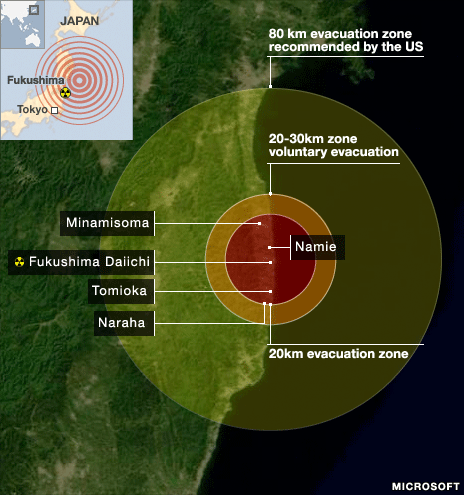
Japan has also said it is extending the evacuation zone around the crippled nuclear plant because of radiation concerns.
The zone will be widened to encompass five communities beyond the existing 20-km (12-mile) radius, following new data about accumulated radiation levels, officials said.
Japan's nuclear commission said that according to preliminary results, the cumulative level of external radiation exceeded the yearly limit of 1 millisievert in areas extending more than 60km (36 miles) to the north-west of the plant and about 40km to the south-southwest.
On Monday, a 7.1-magnitude quake hit north-east Japan, leaving three people dead. It also triggered a brief tsunami warning, and forced workers to evacuate the Fukushima Daiichi plant.
Tuesday's quake rocked buildings in the capital, Tokyo.
There were no immediate reports of fresh damage, though Japan's Narita international airport temporarily closed its runways, and metro and train services were interrupted.
The cooling systems at the Fukushima Daiichi nuclear plant were damaged in last month's disaster and workers have been struggling to prevent several reactors from overheating.
Officials have warned it will be several months before the situation at the nuclear facility is brought fully under control.
Tepco said on Tuesday that a fire had broken out briefly at Reactor 4, before being extinguished.
Libya: Nato must do more, say France and UK
Nato must do more to destroy heavy weaponry used by Muammar Gaddafi's forces in Libya, the French and British foreign ministers have said.
Libyan civilians remain at risk, France's Alain Juppe said, despite the ongoing Nato-led bombing campaign.
The UK's William Hague urged Nato allies to intensify military operations against the Libyan regime and called on Col Gaddafi to step down.
Libyan rebels opposing Col Gaddafi have been pushed back despite the air raids.
'Intensify efforts'
"Nato must play its role fully. It wanted to take the lead in operations," Mr Juppe said, calling efforts so far "not enough".
Mr Hague later echoed Mr Juppe's comments, saying: "We must maintain and intensify our efforts in Nato.
"That is why the United Kingdom has in the last weeks supplied additional aircraft capable of striking ground targets threatening the civilian population.
"Of course it would be welcome if other countries also did the same," he said on arrival at a meeting of EU foreign ministers in Luxembourg.
The US and other Western allies began air strikes on 19 March after UN Security Council Resolution 1973 authorised "all necessary measures" to protect civilians from Col Gaddafi's forces.
After initial sorties were flown under US command, Nato took over operational responsibility for the campaign on 31 March.
Despite this, heavy weapons are still being used to bombard the rebel-held western Libyan city of Misrata, reports say. Mortars and rocket launchers are thought to be hidden in built-up areas that are difficult to target safely from the air.
Libyan government forces began a renewed attack on Misrata on Monday, hours after news emerged of an African Union ceasefire plan.
There are grave concerns for the humanitarian situation in Misrata and for the safety of civilians still inside the city.
"It [Nato] must play its role today which means preventing Gaddafi from using heavy weapons to shell [civilian] populations," Alain Juppe said on Tuesday.
Nato said the scope of Resolution 1973 was the guide to how intense its air campaign should be.
"Nato is conducting its military operations in Libya with vigour within the current mandate. The pace of the operations is determined by the need to protect the population," the alliance said.
'A new Somalia'
State TV in Libya said on Tuesday that Nato air attacks killed a number of civilians overnight in the town of Kiklah, south-west of Tripoli. The report could not be independently confirmed.
Mr Juppe and Mr Hague's remarks came after the African Union (AU) proposed a ceasefire plan that was rejected by rebel leaders in Benghazi.
The plan included a call for an immediate end to hostilities, unhindered humanitarian aid, protection of foreign nationals, dialogue between opposing sides and an end to Nato air strikes.
The AU said Col Gaddafi has accepted the plan, but the rebels said it was unfeasible as it did not include a provision for the Libyan leader to step down.
On Tuesday the AU urged the rebels to reconsider, blaming the Transitional National Council (TNC) - in effect the rebels' parallel government in Benghazi - for imposing preconditions.
The AU "makes an urgent call on the TNC to fully co-operate, for the sake of Libya's higher interests, and assist in the quest for and implementation of a fair and lasting political solution", AFP news agency reported.
In clashes reported on Tuesday, rebels near the town of Ajdabiya said three of their fighters were killed overnight amid battles with pro-Gaddafi forces, Reuters news agency reported.
In the UK, Former Libyan Foreign Minister Moussa Koussa has warned against the risks of civil war and the possibility of his country becoming "a new Somalia".
Mr Koussa, the highest-profile figure to defect from Col Gaddafi's Libya, told the BBC in a prepared statement that the unity of Libya was essential to any settlement.
Libya's Minister for Social Affairs, Ibrahim Zarouk al-Sharif, said he could not comment on Mr Koussa's statement while the former foreign minister was "captured" in a hostile country.
Swaziland police arrest democracy activists in Manzini
Police in Swaziland's main city, Manzini, are arresting anyone in a group ahead of planned protests to demand reform in Africa's last absolute monarchy.
The demonstrations were called to mark the 38th anniversary of the banning of political parties.
The authorities have banned the protests and arrested five organisers.
A BBC correspondent in the main city, Manzini, says there are more security agents than civilians on the streets.
The BBC's Nomsa Maseko saw a group of riot police marching up the street singing: "You will get arrested if you dare."
People can only approach the venue of the planned protests if they are on their own, she says.
Mario Masuku, head of the banned opposition People's United Democratic Movement (Pudemo), has been put under house arrest, his deputy told the BBC.
Most of the protesters are said to be in the capital, Mbabane, and are unable to get to Manzini, a 45-minute drive away.
There are police roadblocks around Manzini and some bus drivers are refusing to transport the protesters in case they are arrested.
The demonstrations are supposed to last for three days.
The organisers say they want the government to resign - to be replaced by a transitional authority - and political parties to be unbanned and allowed to compete for seats in parliament.
Last month, thousands of civil servants held the biggest march in Swaziland for several years, to protest at a pay freeze and demand that the government resigned.
The protesters are keen to stress that they do not want to oust King Mswati III but they want a constitutional monarchy.
The king - who has 14 wives - has been accused of living a lavish lifestyle, while hundreds of thousands live in poverty.
Swaziland has a population of only 1.4 million but 40% of them are unemployed, and 70% of the population is living on less than $1 (75p) a day.