
Japan's carmakers are getting set to restart production
Japanese car manufacturers are looking to restart production after their operations were disrupted by the deadly earthquake and tsunami.
Toyota Motors says it will announce plans to restart production on Tuesday. Production at Honda Motors and Mazda is scheduled to start later this week.
This comes after Nissan Motors resumed work at six of its factories on Monday.
However, analysts said that production will depend on the supply of parts.
They said the main task will be getting the supply chain to work at full capacity, without which company production numbers could be far less than before.
"A start in production does not automatically mean that they have started to work at full capacity," said Vivek Vaidya of Frost & Sullivan.
"They could be working at sub-optimal capacity" he added.
Assembling a car requires thousands of parts to be put together. These are provided by different suppliers.
"Each supplier has to be able to reach the levels before the devastation to reach the full production plan," said Mr Vaidya.
The reason behind a shortfall of parts is down to each company's efficiency plans.
Most of the parts are shipped to the manufacturers a short time ahead of the assembly line requirements, analysts said.
This means that most car factories have relatively low inventories, which can create shortages in supply.
Balancing act
As different vendors get back on track at a different pace, the supply of parts will also be inconsistent in the short to medium term, analysts said.
There might be an excessive supply of parts for one model of the car, while the other models might face a shortage.
According to analysts this will mean the manufacturers will have to make some tough choices.
"They will have to get the product mix correct," said Mr Vaidya.
"Getting that right will be a challenge," he added.

US & European Stocks Make Gains
U.S. stock market indexes made strong gains in Monday's trading.
The Dow Jones Industrial Average gained 1.5 percent to end at 12,037. The S&P 500 moved up 1.5 percent to close at 1,298 while the NASDAQ jumped 1.8 percent to finish at 2,692.
European stock markets advanced strongly by the close of trading. London's Financial Times 100 index rose 1.2 percent to end at 5,786. The CAC-40 in Paris jumped 2.5 percent to finish the day's trading at 3,904 and the DAX in Frankfurt gained 2.3 percent to reach 6,816.
In Asia, Tokyo markets were closed Monday for a national holiday . Hong Kong's Hang Seng index jumped 1.7 percent to end at 22,685.
The price of gold rose more than $8 to trade at $1,427.40 an ounce.
The dollar was higher against the yen but lost value compared to the euro.
World Bank: Five Years, $235 Billion for Japan Recovery
World Bank officials say it may take five years for Japan to recover from the recent earthquake and tsunami with costs running as high as $235 billion.
Monday's report from the bank says the damage may turn out to be the equivalent of 4 percent of the nation's economic output. The bank predicts that growth will pick up as reconstruction efforts accelerate.
Tokyo markets were closed Monday for a national holiday , but share prices declined most of last week. They rallied Friday after the G-7 group of industrialized nations pledged joint action to help Japan by pushing down the value of the yen.
Japan's economy is heavily dependent on exports, and the recent sharp rise in the yen hurts exports by making Japanese-produced products more expensive on world markets. The yen's value had been growing as speculators bought the currency, predicting it would gain as Japanese companies sold foreign assets and brought that money home to fund reconstruction.
In the meantime, Japanese companies are working to restart production at the many factories that closed right after the earthquake. Workers had to cope with damage some plants, shortages of power and parts, as well as transportation problems. Nissan says it can resume activities at five factories this week, while Toyota and some other companies still have a number of plants closed.
Some of the closed facilities produce parts used to assemble autos in other nations, and the parts shortage is causing production problems around the world.
U.S.-based General Motors, for example, is slowing or stopping production at some plants in the United States, Spain, Germany and South Korea.
Shortages of key Japanese-made electronic parts is also slowing production or raising prices at overseas factories that assemble electronic products.

UN Appeals for Patience as Haitians Await Election Results
The United Nations is urging the Haitian people to show patience and restraint as they await the results of Sunday's presidential runoff election, in which former first lady Mirlande Manigat faced off against popular singer Michel Martelly.
The U.N. Stabilization Mission in Haiti issued a statement Monday saying the future of the Caribbean nation is at stake. Officials said despite some logistical and administrative problems and isolated acts of violence, the second round concluded in considerably better condition than the initial round last November.
U.N. Secretary-General Ban Ki-moon also has reaffirmed the U.N.'s commitment to helping Haiti build a prosperous future. Additionally, the European Union praised the way in which the election was conducted.
Opinion polls indicated Martelly was favored to win. The official results are expected at the end of the month.
Martelly was initially excluded from the runoff until international observers reviewed the first round results and recommended he advance to the second round instead of the ruling party candidate, Jude Celestin. The observers cited fraud and irregularities in the first round of balloting.
Sunday's election took place two days after former President Jean-Bertrand Aristide returned to Haiti from South Africa, where he had been living in exile. Mr. Aristide, who was driven from office by armed rebels in 2004, returned to the Caribbean nation despite U.S. concerns that his presence could destabilize the vote.
Mr. Aristide expressed a desire to go back to Haiti after former dictator Jean-Claude Duvalier made a surprise return in January.
The person who wins the election will succeed outgoing President Rene Preval.
Haiti is the Western Hemisphere's poorest country and has been struggling to rebuild following a devastating earthquake in January of last year. The country also has been dealing with a cholera epidemic that broke out in October, leaving thousands dead.
Mr. Ban recently said there are signs the epidemic is finally coming under control.
Extradition treaty compromised Jamaica's sovereignty, says PM
Jamaican Prime Minister Bruce Golding has charged that the extradition treaty between Jamaica and the United States is tilted heavily in favour of the superpower, and has effectively compromised the island's sovereignty.
On Friday, Golding told the commission of enquiry looking into the circumstances surrounding the extradition of alleged drug kingpin Christopher ‘Dudus’ Coke, that the imbalance must be hammered out with urgency.
The Jamaica Gleaner reported that Golding said, "There needs to be some rebalancing of the extradition arrangements between Jamaica and the United States. There is inequity for Jamaica... because Jamaicans are not treated in the same was as United States citizens are treated in that country."
The prime minister noted that this inequity was raised in Washington in 1995 by none other than then minister of national security and justice, attorney K.D, Knight, who is now representing the opposition People's National Party (PNP) at the enquiry hearings.
He said Knight's attempt to renegotiate the extradition arrangements was then met with stubborn resistance from the US.
The prime minister said his administration is determined to pursue discussions with the US, but is awaiting the completion of the commission of enquiry.
CARICOM energy ministers meet this week to discuss oil prices
Amidst the current volatility of oil prices on the world market, ministers responsible for energy in the Caribbean Community (CARICOM) will gather in Georgetown, Guyana, this week to scrutinise an overview of the energy situation and trends in CARICOM.
The Kaieteur News reported that the ministers will also look at national and regional responses to global developments and will consider, endorse and provide direction to those responses.
Further, they will review a report on a regional energy sector assessment commissioned by the CARICOM Secretariat with the support of the Inter-American Development Bank (IDB) in 2010, That assessment was conducted to help make clear the energy situation in CARICOM and to inform strategic responses.
The 35th Special Meeting of the Council for Trade and Economic (COTED) will also consider the draft CARICOM energy policy, which was developed by a task force comprising representatives from Barbados, Grenada, Guyana, Jamaica, Suriname and Trinidad and Tobago.
The policy is intended to address issues such as security of energy supplies, energy pricing policy and the impact on relative competitiveness in the CARICOM Single Market and Economy, and purchasing and transportation arrangements.
Bahamas election to be held 'on time' says PM
Bahamas Prime Minister Hubert Ingraham would not confirm whether the general election will be called this year as has been speculated in some circles, however, he said that it "would be called on time."
"Those who are speculating, that's what they are doing, speculating," the prime minister stressed last week.
"When the [time comes] you'll know. I'll tell you. The one thing you know is that I won't be late in calling it. It would not be that my minister of immigration would be in Marsh Harbour, Abaco, swearing in new citizens -- Haitians -- and they go next door to register to vote and the prime minister in Nassau is announcing that election has been called -- meaning that what you did is ineffective because the register closes the day before election has been announced,” Ingraham said.
He was referring to the allegations in the run-up to the 2007 general election that the Progressive Liberal Party granted some Haitians Bahamian citizenship just in time for the election -- a claim that the PLP has denied.
Ingraham added that he would also cut the boundaries if necessary in enough time so that affected persons can acclimate themselves before the election is called.
"We will not be late,” he said. “The constitution calls for a review of boundaries every five years."
During the last election some voters were disenfranchised because of confusion surrounding late boundary cuts.
"That can't and won't happen on our watch," Ingraham said.
He said the government will seek to ensure equity in the number of voters in all boundaries in New Providence. As for the Family Islands, he said the Boundaries Commission will take into account the populations of the islands and the need for representation.
Some observers have also said the slow rate of registration could mean that the governing party is not getting as much support as it did during the run-up to the last election. However, Ingraham brushed those suggestions aside.
So far, fewer than 30,000 Bahamians have registered, according to Parliamentary Commissioner Errol Bethel.
Bethel told The Guardian last week that about 300 people registered every day since registration started.
Ingraham said he is not very concerned about the pace of registration.
"I'm satisfied that when the time is right we will have adequate numbers on the register,” he said.
Ingraham pointed out that The Bahamas is the only country in the region that requires people to register to vote every five years.
"People like to know that there is some deadline in which they are coming up against to spur them into what they could do without any pressure. At some point I will announce the day in which I will bring the current register to a close,” he said.
"When we announce the new register, there will be a major difference. So any suggestion to the contrary is not taking into account what the reality has been in the last 20 to 25 years,” he added.
Coalition Fires More Missiles at Libyan Targets, Expands No-Fly Zone
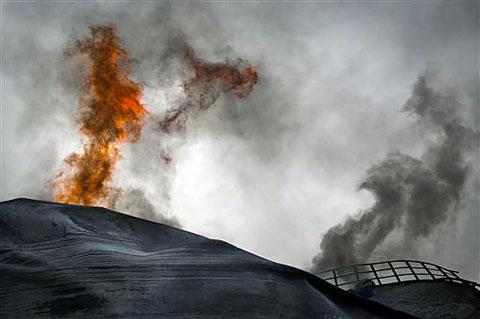
A top U.S. military official said the multinational coalition enforcing the no-fly zone over Libya has fired 12 Tomahawk missiles and flew nearly 80 sorties on Monday.
The U.S. commander in Africa, General Carter Ham, told reporters Monday that the Tomahawk missiles targeted Libyan command and control stations, a Scud missile facility and air defense sites.
Ham said some forces loyal to Libyan leader Moammar Gadhafi are moving away from the rebel stronghold of Benghazi. "And through a variety of reports, we know that regime ground forces that were in the vicinity of Benghazi now possess little will or capability to resume offensive operations."
Speaking by video conference from his headquarters in Germany, Ham said his forces are not in contact and are not coordinating their actions with rebels in Libya who are seeking to topple Gadhafi.
"Our mandate - again, our mission - is to protect civilians from attack by the regime ground forces. Our mission is not to support any opposition forces."
Asked about an air strike on Gadhafi’s compound in Tripoli, Ham said the target was a command and control facility and not the Libyan leader. "I don't know much about the location of the Libyan leader, nor have we expended any military effort in that regard."
Ham said he expects the number of airstrikes on Libyan targets to go down as Gadhafi’s military assets are destroyed and his troops stop attacking civilians.
He also said the current mission could end in a stalemate, with Gadhafi remaining in power in Tripoli. "I could see accomplishing the military mission, which has been assigned to me, and the current leader would remain the current leader. Is that ideal? I don't think anyone would say that that is ideal."
General Ham said the coalition is gradually expanding the no-fly zone to Tripoli and will extend it about 1,000 kilometers along the Libyan coastline.
Israeli Air Strikes Wound 17 in Gaza
Witnesses and militant groups say Israel carried out air strikes in the Gaza Strip late Monday, wounding at least 17 people after militants fired mortar shells and rockets into the Jewish state two days earlier.
Medical officials from the Islamist group Hamas said four militants, seven children and two women were among the wounded.
The Reuters news agency reported that the Israeli military confirmed one of Monday's air raids, saying several militants affiliated with Hamas were targeted in northern Gaza, as well as a tunnel used to smuggle weapons.
Israel killed two Palestinians in Gaza during a separate border confrontation on Saturday.
Before Monday's attack, a spokesman for the armed wing of Hamas said the group would preserve an unofficial truce with Israel, but only if Israeli forces halted strikes on Gaza. The Ezzedine al-Qassam Brigades also claimed responsibility for Saturday's barrage of mortar attacks on Israel.
Venezuela Deports Colombian Drug Suspect Sought by US
Venezuela has deported a Colombian wanted by the United States for drug trafficking.
Officials say 53-year-old Gloria Rojas Valencia was handed over Monday to U.S. authorities. She is accused of being a member of Mexico's violent Zetas drug cartel.
More than 34,000 people have been killed in Mexico's drug war since President Felipe Calderon took office in late 2006 and began cracking down on the cartels. The cartels are locked in a violent battle for control of trafficking routes into the United States.
Separately, Venezuelan authorities say four other Colombians were deported to their home country on drug trafficking charges.