
Cricket World Cup: Injury ends Stuart Broad's campaign
England's Stuart Broad has been ruled out of the World Cup with a side strain, the England and Wales Cricket Board has confirmed.
The seamer, 24, suffered the injury during the win over South Africa on Sunday, when he starred by taking 4-15.
"Scans have confirmed a significant side strain injury," said ECB chief medical officer Dr Nick Peirce.
A replacement has not been chosen but Chris Tremlett, who is on standby with the squad, is the likely candidate.
Broad's absence is the second blow for England in as many days following Kevin Pietersen's withdrawal.
Batsman Pietersen requires hernia surgery, and has now returned to England and been replaced by Eoin Morgan.
An ECB statement confirmed Broad will also leave the squad, which is currently based in Chittagong ahead of Friday's Group B match against Bangladesh, for further assessment in the UK.
The statement continued: "Any participation in the forthcoming IPL [Indian Premier League] will be determined according to his rehabilitation timescale established in due course."
Broad missed the final three Tests of England's Ashes victory this winter because of an abdominal tear, however, the ECB revealed his latest setback, which he first felt during his second spell on the way to his four-wicket haul in Chennai, is a "new injury".
"Stuart felt some discomfort following the South Africa match and our initial assessment indicated a strain to his left side," the statement added.
"Subsequent scans have confirmed a significant side strain injury - where the muscle attaches the rib."
Before the scans Broad had feared the worst, admitting his chances of featuring in the remainder of England's tournament "did not look great".
"I've not had a side strain in this manner before," he added. "It's quite a common injury for bowlers.
"I felt a little bit tight during the South Africa game. It started to throb a little bit throughout my second spell.
"Then after the game it stiffened up when the adrenaline was out of my body."
Broad, though, rejected the suggestion that England's heavy winter schedule in Australia before the World Cup, which featured a five-Test Ashes series, seven one-day internationals and two Twenty20 games over a three-month period, was to blame for their injury problems.

Cricket World Cup: Rush for tickets leads to violence
Police in Nagpur have been involved in confrontations with cricket fans queuing for tickets to see India's match against South Africa on 12 March.
On Tuesday the police charged crowds outside the Vidarbha Cricket Association Stadium with sticks.
Fans had been waiting since Monday evening and some are said to have broken barriers and rushed the ticket offices, prompting the action.
There have been reports of minor injuries in the Indian press.
The ICC would not comment on the matter, while the Board of Control for Cricket in India (BCCI) could not be reached for comment.
It is not the first time there have been such scenes in India, after similar violent clashes between spectators and police occurred in Bangalore on 24 February.
On that occasion tens of thousands of fans had camped outside the M Chinnaswamy Stadium to purchase tickets for the match between India and England that took place on 27 February.
There was violence when they were told the 7,000 tickets allocated for the public had all been sold, so the police responded with baton charges.
The stadium has a capacity of 38,400.
The rest of the tickets were distributed among the ICC and clubs affiliated to local cricket associations.
Demand for tickets has been particularly high whenever India, the co-host along with Bangladesh and Sri Lanka, have been playing. The final and semi-finals have also attracted huge interest.
The website selling 1,000 tickets for the World Cup final crashed when 10 million hits were recorded in only 20 minutes. A ballot system was subsequently set up to manage demand.
The Group B game with India will be important for South Africa, who are still hoping to finish top of England's group.
India, however, are the favourites to lift the trophy in April.
Bryant, streaking Lakers drop Hawks, 101-87
Larry Drew remembers thinking as a young Lakers assistant coach that Kobe Bryant's talent "was off the charts" when the teen made his NBA debut with Los Angeles in 1996.
Fifteen years later, Drew isn't surprised to see Bryant still climbing the charts as the sixth-best scorer in NBA history.
Bryant scored 26 points to pass Moses Malone for sixth on the career scoring list and the Lakers beat Drew's Atlanta Hawks 101-87 on Tuesday night for their eighth straight win.
"He's very unique," said Drew, in his first season as the Hawks' coach, of the Lakers' star. "I was in L.A. when we traded for him, and you saw the talent.
"It was a matter of understanding and picking his spots and learning to play the game on the NBA level. And he did that. ... He's a phenomenal player."
Bryant, a 13-time All-Star, began the night 12 points from matching Malone's 27,409 points. He passed Malone when he made three free throws with 2:05 remaining in the first half.
Bryant has moved past an impressive list of Hall of Fame scorers this season. He passed Malone one week after eclipsing Elvin Hayes for seventh. He also has topped the scoring totals of Hakeem Olajuwon, Oscar Robertson, Dominique Wilkins and John Havlicek this season.
"I'm just very fortunate, that's all," Bryant said.
The Lakers took a three-game losing streak into the All-Star break. Since then, they've won eight straight, a streak that began with a similar 104-80 home win over the Hawks on Feb. 22.
Bryant said the Lakers "are just all on the same page."
"We're making people take contested shots and taking them out of areas they're comfortable in," Bryant said.
"It's not necessarily that we're winning games, but how we're winning them. We're really playing well. We're not making too many mistakes."
Bryant had good support as the Lakers overwhelmed the Hawks with their depth and power game inside.
The Lakers' 7-footers - Andrew Bynum and Pau Gasol - both had double-doubles and dramatically affected the Hawks' shot selection. Center Al Horford relied on jump shots for his 17 points.
Bynum had 16 points, 16 rebounds and three blocked shots. It was his third straight game with 16 or more rebounds.
"He wasn't the leading scorer but he still impacted the game," said the Lakers' Lamar Odom of Bynum. "That shows you how important he is to us."
Gasol had 14 points and 11 rebounds.
"Kobe is going to get his shots," said Atlanta's Joe Johnson. "I think we all knew we had to try to limit guys around him. I think the guys around him played big."
Josh Smith scored 16 points for the Hawks, who have lost four of five.
Drew used his small lineup, with Horford joined by Smith and Marvin Williams on Atlanta's front line. Drew wanted the Hawks to use their running game to beat the Lakers.
"We tried to put a lot of emphasis on playing up-tempo, and it seemed like we ran out of gas," Drew said.
After leading 57-49 at halftime, the Lakers scored the first six points of the second half and stretched their lead to 22 points at 79-57 late in the third period. Smith had a three-point play in a 9-0 run for Atlanta to cut the lead to 90-82.
The Lakers answered with an 8-0 run, including Bryant's 3-pointer with 3:22 remaining.
Lakers fans chanted "MVP! MVP!" as Bryant made two free throws with 1:02 remaining. The free throws gave Los Angeles a 100-84 lead. Lakers coach Phil Jackson stuck with most of his starters for the final minute.
"It was a good performance, but after the game the mood was 'Let's get on to the next game,"' Jackson said.
Los Angeles had five players in double figures before the end of the third period.

Attorney accuses Jamaican justice minister of being dishonest
Sparks continued to fly on Tuesday at the Commission of Enquiry into the extradition of Christopher ‘Dudus’ Coke now in progress in Kingston, Jamaica.
K.D. Knight QC, for the opposition Jamaica's Peoples National Party (PNP) was in a combative mood, accusing attorney general and justice minister, Senator Dorothy Lightbourne of being "mendacious", an allegation that was flatly denied by the minister.
Knight, who started his cross examination on Lightbourne on Monday, continued all morning on Tuesday and grilled the minister, but she stood her ground.
The Jamaica Gleaner reported that she has backed up claims by Prime Minister Bruce Golding that attorney at law Harold Brady was asked to resign from all government boards because he disobeyed his instructions for the Manatt matter to be kept strictly within the Jamaica Labour Party (JLP).
Brady has rejected the assertions that he was asked to resign from all state boards and that he stepped down from the JLP's central executive because of his role in the Manatt matter.
The Gleaner reported that Brady is suing the prime minister for his comments over the matter.
Cuba and US in online controversy
The internet seems to have become the latest front in the long ideological war between Cuba and the United States.
A BBC Caribbean report stated that Havana is now accusing Washington of trying to use illegal satellite communications equipment to destabilise the Cuban government.
In the first of a series of documentaries aired on Monday on local television, Cuba said it will lay open the United States’ effort of relaying illegal communications there.
Internet access is state-controlled and limited in Cuba.
The television programme comes just two days after Havana concluded a trial against an American man who is being accused of trying to subvert the government.
The man, Alan Gross, has denied the charge and the Obama administration is demanding his release.
Cuba has said the tribunal will announce a verdict and sentence in the next few days.
Antigua-Barbuda workers to protest on Thursday against government actions
The Antigua Trades and Labour Union (ATLU) has planned a massive demonstration on Thursday in St John's, the capital of Antigua and Barbuda, to protest the policies of the government that are claimed will cause further unemployment, growing hardship and massive dislocation of workers and their families.
The ATLU has issued a call on all its members and workers throughout the country to join the "National White March" protest rally.
In a statement, the union said it is of the view that the governance crisis in which the country now finds itself stems exclusively from uninformed policy choices and wrongheaded notions adopted by the government.
"The planned layoffs at the Port, the sale of the State insurance, the massive increase in taxes since 2004, the excessive borrowings, and the acceptance of an IMF programme have driven Antigua and Barbuda to the edge of the precipice,” the statement said.
The union added that it believes that the deepening economic crisis, the late payment of wages to workers by the government, and the outstanding wages owed to ATLU members at the Public Works Department and the Central Board of Health and other Ministries, are reasons sufficient for the workers of Antigua and Barbuda to send a clear message to the government that the vast majority are dissatisfied.
The workers will be addressed by the president of ATLU, Wrigley George, and other top union officials.
In Haiti, officials promise fixes ahead of March runoff election
Inside a former gym turned elections headquarters, 120 operators field calls from confused Haitian voters needing to know where to cast their votes on election day.
The 24-hour call center is among several fixes Haitian elections officials have started putting into place ahead of March 20's critical presidential and legislative runoff.
But many doubt whether the improvements, including new education requirements for poll workers and color tally sheets to help deter fraud, will be enough to boost voter confidence and prevent the high level of fraud and disorganization that marred November's first round of balloting.
"We are preparing to observe — what, we don't know," said Pierre Esperance, whose election observer group published detailed reports of fraud and voter intimidation at polling stations. "I have no confidence in the electoral machine."
Provisional Electoral Council President Gaillot Dorsinville recently told legislative candidates and representatives of presidential contenders Mirlande Manigat and Michel "Sweet Micky" Martelly that his beleaguered body was "prepared to make all of the corrections necessary to better the second round."
Among the changes:
—Firing about 500 poll workers and supervisors from voting centers marred by high numbers of fraudulent and irregular votes.
The change is a welcomed one but critics say arresting poll workers and imposing sanctions on candidates found guilty of orchestrating the fraud and voter intimidation would send a much stronger message.
—Increased education requirements for poll workers and supervisors, along with additional training for them and poll security personnel. Political parties are being asked to send workers with the equivalent of a 12th-grade education, and the elections body warned competence tests will be given. Electoral lists' type-size will be enlarged, and boy scouts will guide voters in finding their names.
Voters complained in November about being unable to locate their names on lists. In some cases, workers sent by political parties were either functionally illiterate or paid to tell voters they were not on the lists.
—The cleaning up of the list of 4.7 million voters by matching the information from both the elections council and the Office of National Identification, which issues voters' cards.
Elections officials were accused of conspiring to keep voters from casting ballots by wrongly assigning voters and dividing up households. There was no conspiracy, they argue, but admit there were problems. For example, even Haiti Prime Minister Jean-Max Bellerive reported he had trouble locating his correct polling station after he was assigned to the wrong location.
But even with the clean up, voters can expect problems. Since the 2006 presidential elections, about 1 million new voters have joined the voting roll, 43?percent of the voting centers in the quake-struck areas disappeared in the January 2010 earthquake, and a campaign to get voters living in camps to change their polling stations failed to mobilize people.
—Improved security. The United Nations, which is responsible for delivering ballots to voting centers, came under fire for security after candidates and observers reported that some ballot boxes were stuffed even before the doors opened. U.N. officials said that they have the responsibility to protect election workers and materials, but that monitoring for fraud falls to national and international observer teams.
Kevin Kennedy, deputy U.N. special representative who has been working on security, said a review and changes are in process.
Still, critics fear that with 9,000 U.N. personnel and 3,500 Haitian National Police involved in security, there hasn't been much change between the first and second round of the U.N. security manual or contingency planning.
"We can support and advise, but it is the (Provisional Electoral Council) that has to fix the problems," Kennedy said.
Manigat and Martelly have called on elections officials to make specific changes that go beyond suggestions from the Organization of American States. Martelly has demanded that Dorsinville and Pierre-Louis Opont, the director general, be replaced. Manigat wants an overhaul of the voting centers and polling stations. So far, it appears that neither will get his or her demands.
At a rally in Carrefour last week, Manigat warned supporters to be prepared: "This time they are not going to steal your votes. This time they are not going to turn you away. This time we are going to show them that the people know what they want: They voted Mirlande."
For his part, Martelly said at a recent news conference: "We would still like for the changes to be respected, implemented. I believe that the CEP should do everything in their power to reassure the population so we avoid the same type of crisis we had in the first round."
Even before the OAS suggested that he — and not the government-backed candidate be in the runoff — Martelly maintained that he would not go into a second round with the same elections council. He has since changed his tone.
"As far as forcing their hands, we are not there for that," he said about his request.
Aware that anything could go wrong on election day, the OAS announced that it will boost its foreigner observer mission from 120 to 200. The number of observers is still too low, some contend, given the high-stakes battle for control of parliament in the legislative runoff.
Elections officials also have agreed to increase the number of lawyers at the voting tabulation center, designed to catch fraudulent ballots and tallies.
An elections report by the OAS elections experts' technical mission showed that while the government-backed candidate lost votes to fraud, all 19 presidential candidates had fraudulent and irregular votes. Also, the vote tabulation center missed about 50,000 ballots that should have been eliminated.
Rosny Desroches, a former university professor who heads a civil society group, said despite the pledges, he remains "uncomfortable."
"I have to be vigilant because of our culture of fraud in this country," Desroches said. "If they do it to succeed in exams, they will do it to succeed in elections."
Foreign observers say there was nothing sophisticated about the fraud that hampered the vote but rather "it was good old Haitian cheating" and perhaps vote buying.
Jean Hector Anacasis, a senator and one of the 17 presidential candidates who failed to make it into the runoffs, said several presidential candidates' camps purchased "voting bureaus" to guarantee a certain number of votes. He said he had refused offers to buy whole vote centers.
Rooting out the corruption, he said, is simple: there must be a rotation of elections workers, using university students and high school students in their final years.
"It's always the same people they take each year," he said. "You have to renew the electoral machine each year with new workers. Because you don't have the same people, elections work will be viewed as part of one's civic duty and the youth will become implicated in politics. You will diminish the mafia."
(c) 2011, The Miami Herald.
Police kept busy during Trinidad carnival
The 2011 carnival celebrations in Trinidad and Tobago were very successful and on Monday nearly all the ministers and other lawmakers had their fun tramping on stage.
The US Ambassador Beatrice Wilkinson Welters joined in the merrymaking, prancing with Prime Minister Kamla Persad Bissessar and Culture Minister "Gypsy" Peters.
But while the merrymaking was going on the police were very busy.
The Guardian newspaper reported that a series of minor offences committed during J'Ouvert celebrations led to the arrest of 150 people in north Trinidad for robbery, possession of firearms and ammunition, weapons, possession of marijuana and cocaine, wounding, larceny and other crimes.
The newspaper report stated that, as result, the cells at Belmont, Central and Woodbrook Police Stations and across the East-West Corridor were reported to be "packed to capacity".
There were numerous reports of fights and pick-pocketing. Dozens of knives were seized by the police during searches of people entering City Gate at the maxi taxi hub.
Twenty-three persons were also arrested during the Carnival celebrations in Toco, Matura, Manzanilla and Sangre Grande.
36 bands cross the stage
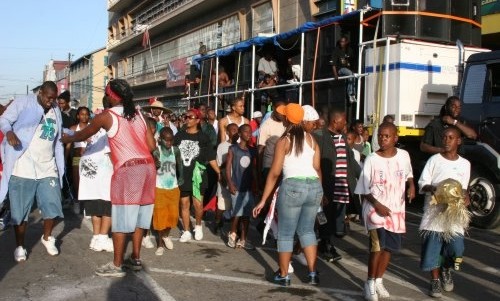 Carnival Tuesday in Tobago got off to a fantastic colourful filled day, with approximately 36 bands crossing the stage, before the judges in Scarborough and at Old Milford Road.
Some of those bands included The Happy Lost Sailors led by Robert Marshall, armed with its powder and pipes, one sailor was so happy he dropped his pants and danced before the judges.
Another band crossing the stage was Lue Ann Melville and Associates with its presentation I Am Legend. Five sections of the past and present, the red and white section, the Queen of the Band the female washer woman, The Queen of the Nile in her yellow red and white costume, and the King of the Jungle Andell McIntosh.
McIntosh following his presentation on stage, told the Express, this has been one of the biggest celebrations for Tobago, over the years.
"What is different with Carnival this year than previous years is the turn-out of masqueraders, more people spend money, and they come to enjoy themselves. The best place to be is Trinidad and Tobago, so to all those across the globe, come to Tobago next time," McIntosh said.
Also enjoying mas on the streets of Scarborough and Old Milford Road, was Tobago House of Assembly Chief Secretary Orville London, who said with the return of masqueraders, and new band leaders, he is proud of what he has seen so far. And while he said there was room for improvement, mas in Tobago is in good hands.
"Yeah, definitely in good hands, from the perspective of the management because one of the things that I found particularly interesting, is that when I talk to the officials, they were proactive, in fact they did give to all bandleaders money, not a lot of money, but enough to give them the encouragement to start the process."
When asked what was his favourite soca tune, London with a broad smile said, he is more a calypso type of person.
"Well let me tell you something. I think I am the least qualified person because my favourite calypsoes are Stalin's Black Man Feeling to Party, and Lord Nelson's My Lover."
Carnival celebrations continued in nightfall, ending with a mud mas band.
Source: TNT Express
Machel set for 4th Road March title
 Machel Montano marshalled his forces in Island People’s Shade Of The Universe.
Blazing the trail with his hit Advantageous, International Soca Monarch Machel Montano is confident that the song will lead him to his fourth Road March title. Speaking to reporters yesterday after Island People mas band crossed the stage around 4 pm, Montano said he did not expect the song to be “this intense.”
Montano said he was “ecstatic,” a word which he cherished. Asked if the Road March title was “already in the bag” possibly making it his fourth win, Montano replied: “I don’t even know it was number four. “I wasn’t expecting to get Road March. “I told Kernel (Roberts) if I’m coming back, I must come back strong.”
Montano won the Road March titles in 1997 with Big Truck, in 2007 with Jumbie and in 2009 with Band of D’ Year, alongside Patrice Roberts. He said he did not expect to perform in last Friday’s International Soca Monarch competition which he won, taking home the top prize of $2 million. “It was one of the major decisions in my life to take part and to follow my instincts and I think it rallied a lot of support,” Montano said. He added it also garnered “counter-support.”
Speaking about his freestyle performance at the Soca Monarch, where he bashed his rivals Bunji Garlin and his wife Faye-Ann, Destra and Iwer George, Montano said there was no animosity but “what I said is the truth.” He said whoever didn’t like what he said on Friday could “lie down on the stage and sleep on it”—an apparent reference to the performance of Destra Garcia—because (in a singing voice) “I feel like I just win two million dollars.” Montano said the season was wonderful and with a lot of adrenaline.
He said: “The stage is back in front of us. “Big up the Government. “Big up Gypsy (Winston Peters). “Big up the Prime Minister. “Let us give praise and give thanks and give credit where credit is due