
Obama Warns Violence by Libya Government ‘Unacceptable’
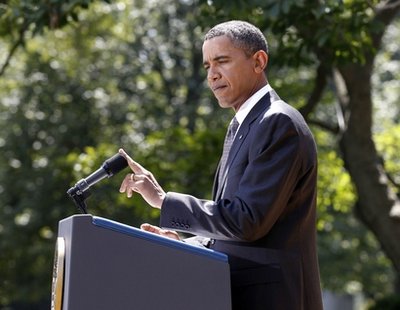 U.S. President Barack Obama says the U.S. and its NATO allies are considering a “wide range of potential options” including military options to stop what he called the “unacceptable” violence being carried out by the Libyan government and its supporters against anti-Gadhafi rebels.
Mr. Obama said Monday at the White House that he wanted to send a clear message that those working for Libyan leader Moammar Gadhafi will be held accountable for their choices.
The president also said he has authorized an additional $15 million in humanitarian aid for the people of Libya.
Mr. Obama spoke after an Oval Office meeting with Australian Prime Minister Julia Gillard. He said the United States and Australia are united in their view on Libya, standing for democracy in the face of “unwarranted violence.”
Mr. Obama also thanked Australian troops for making what he described as extraordinary contributions in Afghanistan. He offered condolences for those Australians affected by January's floods in the state of Queensland.
Ms. Gillard said she is “personally committed” to the war in Afghanistan and that she and Mr. Obama had discussed the transition of security responsibility from NATO to Afghanistan.
She also said she is “pleased and grateful” for the rare opportunity to address a joint meeting of the U.S. Congress during her visit.

Pakistan Urges Strong Ties With US Despite Tensions
Pakistan's president said on Monday the United States and his country cannot afford a downturn in their strategic relationship.
Asif Ali Zardari told the new U.S. special representative to Pakistan and Afghanistan, Marc Grossman, that both Pakistan and the United States should not be swayed by "misperceptions" and "isolated incidents" that may be used by some to increase tensions and mistrust.
Mr. Zardari issued the statement Monday after meeting with Grossman in Islamabad. He said Pakistan and the U.S. should remain focused on long-term strategic ties.
The talks come during a time of strained relations between both nations following the arrest of an American CIA contractor who is accused of killing two Pakistanis.
U.S. officials say Raymond Davis has diplomatic immunity and acted in self-defense during an attempted robbery in Lahore in January. Pakistan has resisted releasing him, saying the matter will be decided by the courts.
Grossman is on his first official visit to Pakistan as U.S. envoy since replacing Richard Holbrooke, who died suddenly late last year.
Also Monday, a Pakistani court set bail for an American worker jailed for overstaying his visa.
Aaron Mark DeHaven was arrested last month in Peshawar. DeHaven will have to remain in the area after posting the $23,500 bail and still faces court hearings.
Authorities say DeHaven had been working for a security and logistics company called Catalyst that is staffed by former U.S. military personnel and has contracts with the U.S. government.
US Stocks falls
U.S. stock market indexes dropped sharply in Monday's midday trading. The Dow Jones Industrial Average lost eight-tenths of a percent, the S&P 500 fell 1.1 percent, and the NASDAQ plunged 1.9 percent.
European stock markets were lower at the close of trading. London's Financial Times 100 index retreated three-tenths of a percent to end at 5,974. The CAC-40 in Paris moved down seven-tenths of a percent to reach 3,990 and the DAX in Frankfurt slid two-tenths of a percent to finish at 7,162.
Earlier in Asia, Tokyo's Nikkei index dropped 1.8 percent , to close at 10,505. Hong Kong's Hang Seng lost four-tenths of a percent , to end at 23,313.
The price of gold rose more than $2 to trade at $1,433.35 an ounce.
The dollar was lower against the yen but made gains compared to the euro.
Former French President on Trial for Corruption Charges
Former French President Jacques Chirac went on trial Monday on corruption charges related to hirings that allegedly benefited his center-right party. Chirac becomes the first French head of state to go on trial.
The charges date back to when former President Jacques Chirac was mayor of Paris, between 1977 and 1995. The 78-year-old former head of state is accused of giving people city hall jobs when they really worked for his then center-right Rally for the Republic Party.
He denies the allegations, arguing all the posts were legitimate.
Corruption allegations against Chirac have persisted for years. But as president, he enjoyed immunity from prosecution – which ended when he left office. If convicted, he faces up to 10 years in jail and a fine of about $207,000 dollars.
In brief remarks Sunday to France's Europe 1 radio, Chirac said he was as well as could be expected – French media have reported he may have Alzheimer's disease although his wife has denied this. He refused to discuss the trial.
During his last years in office, Chirac battled high unpopularity ratings. But now, he is among the most popular figures in France – and the French are divided over whether he should stand trial.
Dominique Paille, spokesman for the ruling, center-right UMP party – which was founded under Chirac's presidency – said the French justice system could have avoided a trial.
Paille told France Info radio it was sad that Chirac should be on trial at the end of his life. He said Chirac's political legacy dwarfed the allegations against him – and that the trial would hurt France's image.
Last year, Paris city hall dropped separate civil charges against Chirac following a $3 million settlement. Chirac, however, did not acknowledge any wrongdoing.
Greek Government Says Credit Downgrade Is Wrong
The Greek government says the most recent downgrade of its credit rating is “completely unjustified” and ignores the substantial progress the nation has made toward cutting its deficit.
Moody's Investor Services downgraded Greece's credit rating by three notches further below junk status . Moody's said it is concerned about the country's ability to raise revenues after a European Union bailout package ends in 2013.
A lower credit rating means Greece is likely to pay higher interest rates to borrow money to finance new projects or re-finance old debts.
Greece was saved from bankruptcy last May by a $154 billion bailout from partners in the EU and the International Monetary Fund.
Karzai to Petraeus: Apologies are not enough
 Apologies are not sufficient when it comes to civilian casualties, Afghan President Hamid Karzai told the NATO commander Sunday, days after a NATO airstrike killed nine Afghan boys.
Karzai told Gen. David Petraeus, the commander of U.S. and NATO forces in Afghanistan, that incidents of civilian casualties during coalition military operations are the main reason for tensions in the U.S.-Afghan relationship and he demanded there be no more, according to a statement from Karzai's office.
The comments came in a private conversation between the two men Sunday, according to an official with NATO's International Security Assistance Force who asked not to be named.
Petraeus made a public apology Wednesday for the deaths, which happened the day before in the province of Kunar, along Afghanistan's eastern border.
U.S. President Barack Obama also expressed regret for the deaths, calling it a "tragic accident." A White House statement said Obama and Karzai agreed that such incidents undermine shared U.S. and Afghan efforts in fighting terrorism.
The incident happened after insurgents in mountains above a coalition base launched a rocket attack that wounded a U.S. civilian, according to U.S. Lt. Gen. David Rodriguez. Troops returned fire and insurgents later shot another rocket at the troops.
Two attack helicopters flew to the location where they were told the rockets originated, identified who they thought were insurgents and killed nine people. Rodriguez said. Later, they found that the slain people were boys cutting wood.
Rodriguez called the incident "a terrible mistake" and promised disciplinary action if warranted.
The statement from Karzai's office said Petraeus repeated his apology Sunday and promised "it will not happen again."
Karzai said the Afghan people are suffering as a result of civilian casualties and that apologizing and condemning these actions cannot ease their pain, according to his office.
"The trust of Afghanistan's government and people definitively depend on this issue," Karzai told Petraeus. Recurrence of such incidents, he said, is "unacceptable."
The NATO force official said Sunday, "We take all civilian casualties very seriously. In light of the recent event that tragically killed nine children, commanders have been given the direction to review our tactical directive that is intended to reduce civilian casualties to the absolute minimum. We will continue to reinforce the need to protect the lives of innocent Afghans as we pursue a ruthless enemy."
Rodriguez said last week such incidents are "rare" when considering all the operations the coalition undertakes. He said a lot of time is spent training soldiers on how to engage the right targets and that directives are constantly reviewed.
"We have done much better preventing civilian casualties," he said. "But we acknowledge we have to do better."
Rodriguez said the military understands families' grief over such deaths, and he said soldiers "feel worse than they can express" when they "do something terrible like mistakenly killing young boys."
"They have to live with that for the rest of their lives," he said.
Rodriguez also urged Afghans to help their security forces battle insurgents.
Karzai previously noted the Tuesday incident occurred less than 10 days after another one "that left many civilians dead in the same province."
On February 20, Kunar Governor Sayed Fazlullah Wahidi said 64 civilians had died in a joint operation by the NATO force and Afghan security forces over several days. The dead included 20 women and 15 children, he said.
Petraeus recently directed military commanders in Afghanistan to review changes meant to minimize civilian casualties. He has ordered commanders to brief helicopter attack crews again on the changes, he said.
Gas prices top $3.50
U.S. gasoline prices increased nearly 33 cents in a two-week period, the second-biggest price jump in the history of the gasoline market, according to a survey of filling stations.
The latest Lundberg Survey of cities in the continental United States was conducted Friday. It showed the national average for a price of self-serve unleaded gasoline at $3.51, an increase of 32.7 cents from the last survey two weeks earlier, survey publisher Trilby Lundberg said.
The jump was the biggest since a 38-cent hike between August and September of 2005. At the time, the price increase was driven by damage caused by Hurricane Katrina.
"This time around, the spike comes not from nature, but from people," Lundberg said. "The armed struggle in Libya has shocked international oil markets and here it is at the pump."
As the fighting between opposition forces and Libyan leader Moammar Gadhafi's troops begins to look more like a civil war, expect prices to continue to rise, she said.
Prices have risen nearly 82 cents since September of last year, the survey found.
While Libya is not among the top suppliers of U.S. oil, and only 3% of Libyan oil exports head to the United States, global economics link the events there to the pumps at home.
Libya produces a light, high-gravity crude oil that is most in demand by less complex refineries around the world, Lundberg said. As this oil becomes unavailable, it forces buyers of crude to find substitutes from other oil producers, starting a chain reaction that raises prices of crude and gasoline in the United States.
The current average price of $3.51 is 61 cents below the all-time high price recorded in July 2008. Today's price is 78 cents higher than a year ago, Lundberg said.
The Lundberg Survey sampled prices at about 2,500 gas stations. Of the cities surveyed, the highest average price in the continental United States was in San Diego at $3.87 per gallon. The lowest price was in Billings, Montana, at $3.15.
California has garnered headlines lately for its high gas prices, though the average price in the state remained below $4, at $3.83 per gallon for regular gas. The average California price for premium does break that barrier, at $4.04 per gallon.
Average per-gallon prices in other cities:
-Charleston, South Carolina: $3.32
-Houston: $3.36
-Atlanta: $3.43
-Boston: $3.48
-Las Vegas: $3.51
-Seattle: $3.60
Happy 2nd birthday, bull market!
The bull market is celebrating its second birthday. Banks and retail stocks have led the way but investors may want to think about changing their bets if they think the party is going to continue.
The S&P 500 has doubled in value from the bear market low of 666.79 on March 6, 2009. All ten sectors in that index have rallied, according to Standard & Poor's Equity Research.
But if the economic recovery continues to pick up steam, different sectors of the market will begin to take the lead.
"It's important for investors to understand how different sectors perform during different periods of a stock market's cycle and as the economic recovery matures," said James Stack, a market historian and president of InvesTech Research.
According to Stack, the average period between the start of a bull market and the start of the subsequent bear market is less than four years.
"As we come upon the bull market's second birthday, we're moving into the latter half of this rally," he said.
By historical standards, that means financial firms and consumer discretionary companies, which have been among the current bull market's biggest winners, may lose some of their luster.
"Financial companies suffered the most severe pain during the recession and have bounced back to become the best performing sector because the government stepped into to offer support," said Christian Hviid, chief market strategist at Genworth Financial Asset Management.
That includes AIG (AIG, Fortune 500), which nearly collapsed in September 2008 before the government bailed it out with $182 billion. The insurer's stock has shot up a remarkable 430% since the market bottomed and is among the S&P 500's best performers during the past two years.
While they may not shine as brightly, Hviid said financial company shares will continue to deliver solid returns.
"The financial sector is still unloved, so it may be a good contrarian play," he said. "Banks are still trading at deep discounts, and it seems like we're turning a corner in terms of loan growth and charge-offs."
Bulls on parade. Is rally getting ridiculous?
Meanwhile, the retail sector, which has surged nearly 150% from two years ago, won't continue its stellar run, Hviid said. He thinks profit margins will come under pressure from higher commodity costs.
Technology stocks are also typically strong performers in the early part of a bull market, but since consumer and business spending has been only slowly recovering, the sector has barely outperformed the broader market.
But as consumers and corporations begin to loosen their purse strings, experts say tech stocks will continue to rise.
Take me to your new leaders
As the bull market continues its course, energy stocks, which have thus far underperformed the market, are likely to take the spotlight.
"Investors are already looking at the energy sector because of surging oil prices, but the sector will do well even beyond the unrest in the Middle East," Hviid said. "It's attractive based on global growth outlooks, especially as energy consumption increases in emerging markets."
Materials, industrials and telecom stocks are also poised for solid gains, InvesTech Research's Stack said.
While the health care sector is usually a defensive pick during a falling market, the sector may begin to surprise investors a bit earlier.
"Health care stocks didn't have a good 2010, but we're past the aftermath of health care reform," said Joe Milano, portfolio manager of T. Rowe Price's New America Growth Fund (PRWAX). Health care companies, including Covance (CVD) and WellPoint (WLP, Fortune 500), represent about 10% of the fund's holdings.
Plus, even though experts largely agree that the broader market has yet to peak, it's never too early to play it a little safe.
"We have all the ingredients for the bull market to continue," Stack said. "But we know it won't last forever, and it's better to add some defensive positions on a gradual basis than it is to make a dramatic move after all the warning flags pop up."
Turks and Caicos lawyers up in arms over special prosecutor's letter
 The Turks and Caicos Islands (TCI) Bar Council has received a letter from the British-funded Special Investigations and Prosecution Team (SIPT) investigating allegations of widespread government corruption stating that the SIPT may refuse to deal with certain local attorneys if the team feels that it may prejudice their investigation.
The SIPT is reportedly concerned that, in a small jurisdiction such as the TCI, attorneys representing an individual under investigation may also themselves be implicated.
In her letter, Special Prosecutor Helen Garlick emphasised “close family” connections between attorney and accused. Garlick therefore concluded that the investigations may be “prejudiced” or otherwise put at risk.
The Bar Council convened an emergency meeting on Saturday morning and reportedly concluded that the TCI Bar will not agree to the suggestion by the SIPT that certain lawyers who have relationships with other co-defendants should not be allowed to defend individuals caught up in the investigations.
The Council reportedly views this as a high handed approach to have more imported lawyers from Britain to get paid out of the investigation funding.
Furthermore, coming on the heels of the suspension of jury trials when Britain partially suspended the TCI constitution in 2009, local lawyers feel that this is another unacceptable derogation of the rights of an accused person, this time to be represented by the attorney of his or her choice.
According to one source, if the investigations are thought to be in danger of being compromised, the investigators should figure out a better way to pursue such investigations.
CLEAN UP TCI
The Department of Planning will be embarking on a massive cleanup drive throughout ALL communities of the Turks and Caicos Islands.
In order to curtail and eliminate the problems of unsightly properties, which are destroying the visual environment, the Department under Section 58 of the Physical Planning Ordinance will be issuing Amenity Orders to persons to remove ALL waste, rubbish, derelict or abandoned machinery, vehicles, dilapidated or derelict structures or boundary walls or articles or materials of whatsoever kind.
The Department is urging all persons to be proactive by commencing the removal of ALL illegally erected structures, dilapidated structures (especially those severely damaged by Hurricane Ike) derelict or abandoned machinery/equipment or articles or materials of whatsoever kind from their property.
The Planning Department will begin the issuance of Amenity Orders in the month of April 2011 to ALL persons who do not comply with this Planning Notice.
Any person who fails to comply with the Amenity Order shall be guilty of an offense and liable on summary conviction to a maximum fine of US$10,000 or six (6) months imprisonment or both fine and imprisonment. To this end, The Department of Planning is urging the general Public to comply with this Planning Notice.