
Aubrey O'Day Says She Fantasizes About Sex With Rapper Eminem
Former Danity Kane member/"All About Aubrey" star Aubrey O'Day recently revealed that she has sexual fantasy's about superstar rapper Eminem.
Aubrey, who has her own reality show on Oxygen, revealed her desires in a new video series on PopDust.com titled "Magic Box," where readers ask embarrassing questions to some of today's popular celebrities.
During Aubrey's session, she said revealed that she has a recurring fantasy about having sex with Eminem in a bathtub.
"I can like hear his voice, I can hear him talking to me, I can feel him touching me, they're are really gnarly," Aubrey O'Day said, before revealing that she lost her virginity in her junior year of college.
Aubrey O'Day was a member of Diddy's all girl-group, Danity Kane from the reality series "Making the Band III."
She was booted from the group in 2008, when Diddy accused her of hogging the spotlight, amongst other things.
On her new reality show "All About Aubrey," the singer mounts her come back and lets viewers witness the recording of her first solo album.
"All About Aubrey" debut on (March 7th) at 10:00PM, on Oxygen.

Young Buck Indicted On Gun Charge; Facing 10 Years In Prison
Rapper Young Buck is facing serious jail time after being indicted today (March 7th), after being charged with being a convicted felon in possession of a .40 caliber pistol and ammunition.
Nashville's WSMV Channel 4 reports that prosecutors unsealed the indictment today, for an incident that occurred around August 3rd, just as Federal agents raided his Hendersonville home over a $300,000 tax dispute with the IRS.
Young Buck has pleaded not guilty to the gun possession charge and has been released on $100,000 bond.
The rapper has a 2004 felony conviction for stabbing a man named Jimmy Lee Johnson during a fight at the Vibe Awards, after Johnson punched superstar producer Dr. Dre.
As a result of this conviction and the pending gun possession charge, Young Buck is facing up to ten years in prison.
The rapper was also forced to surrender his passport.

Foreign and Commonwealth Office publishes draft Turks and Caicos Islands Constitution
The Foreign and Commonwealth Office (FCO) has today published a draft Constitution for consultation throughout the Turks and Caicos Islands. The draft Constitution has been prepared as part of the constitutional and electoral reform process in TCI which was announced in 2009 following the suspension of parts of the 2006 Constitution.
The process included the work of constitutional and electoral reform adviser, Kate Sullivan, who consulted widely throughout the Islands and published two rounds of recommendations in 2010. The FCO has now received Ms Sullivan's final recommendations which are also published today.
Minister for the Overseas Territories, Henry Bellingham, said:
"I am pleased that the people of the Turks and Caicos Islands will now have the opportunity to consider a draft Constitution. The draft Constitution contains measures to embed good governance and sound public financial management firmly in the Turks and Caicos Islands.”
“A team of FCO representatives will hold meetings soon to give people an opportunity to discuss the proposed changes. The team will also meet community groups and leaders. I encourage all interested persons in the Islands to participate in these meetings, which will inform our final decisions on the Constitution.”
The draft Constitution published today is based on the text of the 2006 Constitution. It reflects Ms Sullivan’s recommendations, and those of the Commission of Inquiry. The draft Constitution also incorporates amendments that reflect wider FCO policy with regard to the overseas territories and good constitutional practice from other territories. The draft is accompanied by a commentary explaining the origin of the main changes proposed.
The implementation of a new Turks and Caicos Islands Constitution Order, in support of recommendations of the Commission of Inquiry, will enable significant progress to be made against some of the milestones detailed in Mr Bellingham’s Written Ministerial Statement of 9 December 2010.
The period for consultation on the draft Constitution will end on 3 May 2011. During this period, in addition to the consultation events that will be held across the Islands by the FCO representatives, it is hoped that other public meetings will be organised in-territory to give people as much chance as possible to express their views.
Written responses to the consultation can be sent to the Governor’s Office, Waterloo, Grand Turk, TCI, or by email to: TCIDraft.Constitution@fco.gov.uk
The draft constitution can be read or downloaded in our press releases section via this website.
Governor releases statement on demonstration
 RTC News received the following statement from H.E Governors office today that treads:
The Interim Government was notified on Friday 4 March by a group called Turks and Caicos United for Justice and Equality, that unless an announcement was made by 4pm on Monday 7 March setting a date for general elections to be held in the TCI, a ‘sustained campaign’ would
begin.
They will have known that this request was unrealistic.
UK Government Ministers published a statement on 9 December 2010 specifying the milestones that have to be met before elections can take place. Broadly, these address the TCI’s deep crisis in public finance and need to achieve a fiscal surplus, and the need to significantly strengthen the
governance of the Territory to prevent a repeat of the widespread mismanagement seen under previous administrations. Ministers were clear that they hoped elections could take place in 2012.
The UK Government has been consistent in its support for the people of the Turks and Caicos Islands during this difficult time. The Interim Government continues to work hard towards the fulfilment of these milestones and is grateful for the contribution made by the Advisory Council,
the Consultative Forum, and members of the public who have taken part in the consultations we have held so far. Like the governments of many countries, we have had to take difficult decisions made against the backdrop of the continuing world economic downturn that has further damaged
the local economy. Nevertheless, the Interim Government appreciates the general support it receives from the wider TCI population.
We have been informed by the police that today’s demonstration in Providenciales attracted approximately 30 protestors who deliberately blocked the airport road. In doing so, the protestors frustrated access to and from the airport by tourists, Turks and Caicos Islanders and others going
about their work. The demonstrators present a distorted and negative impression of an otherwise friendly and hospitable people. Their actions show no respect for the right of law-abiding people to go about their legitimate business.
Although protestors have a right to peaceful demonstration, ultimately, targeting the tourist industry is self-destructive. It risks damaging the TCI’s reputation as a top destination and represents a serious threat to the jobs of many hard working Turks and Caicos Islanders employed
in the tourism sector.
Fire set to PPC poles

RTC news has learnt that at approximately 2:00 a.m. on Tuesday, March 08, 2011, PPC Ltd received a report that 2 utility poles located opposite the Power Plant on Leeward Highway were on fire.
The fire caused intermittent outages to occur throughout Providenciales from 2:00a.m until 11:45 a.m. Service was restored to all affected areas by 11:45 a.m. on the same day. Given PPC’s initial assessment, an official report has been filed with the TCI Royal Police Force and their CID team is currently investigating the matter.
In a brief statement to RTC News, PPC Ltd issued apologises for any inconvenience caused to its customers and stated they will updating everyone accordingly once they have more information on the matter.
Demonstration in Providenciales
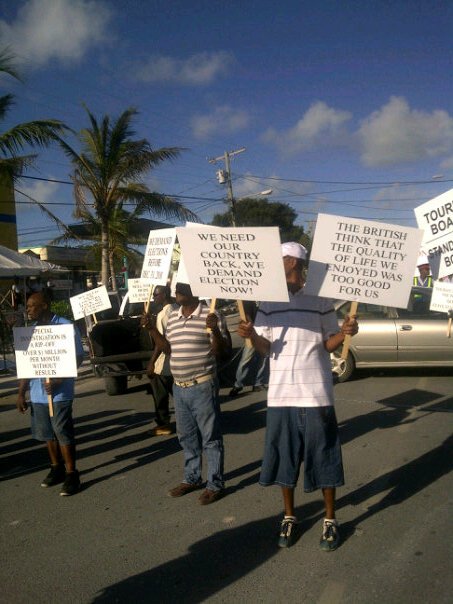
The road to the Provo international Airport has been blocked off by scores of residents protesting the British occupation of the Turks and Caicos Islands and are demanding for Governor Gordon Wetherell to announce a date for General Elections.
The drama unfolded from as early as 6:30 this morning when residents joined with members of the social group Turks and Caicos United for Justice and Equality in making their demands- and in the process blocked off access to the airport where some persons were seen walking with their bags to the airport.
Among those protesting and making speeches are former Premier Michael Misick, members of his former cabinet, Euwonka Selver, Devon Williams and Robert Hall. So serious were members of this protest that they have chained themselves to vehicles and vowed not to move until the Governor provides them with an answer.
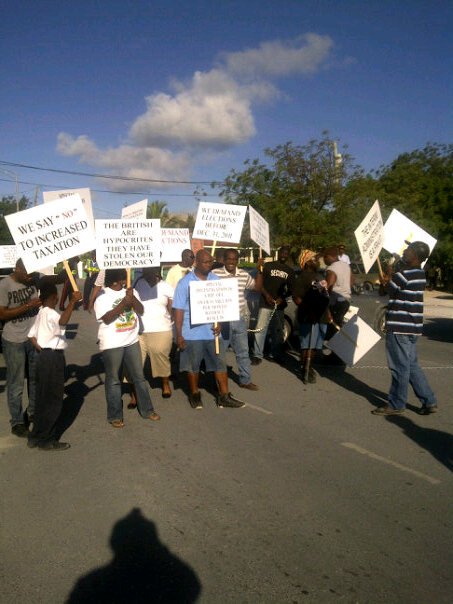
With the prospect of a 24 hour or possibly longer standoff local police according to reports are currently considering a plan of action to have traffic resumed on the bus street. There were reports of Selver being threatened with arrest but Police have denied that report.
RTC News received a press release from the Royal Turks & Caicos Police Force Press officer, Calvin Chase that reads: On Tuesday 8th March 2011 Turks & Caicos Islands Police Officers in Providenciales invoked a very measured response to what was an anticipated and guaranteed peaceful demonstration by members of the public on Airport Road Providenciales.
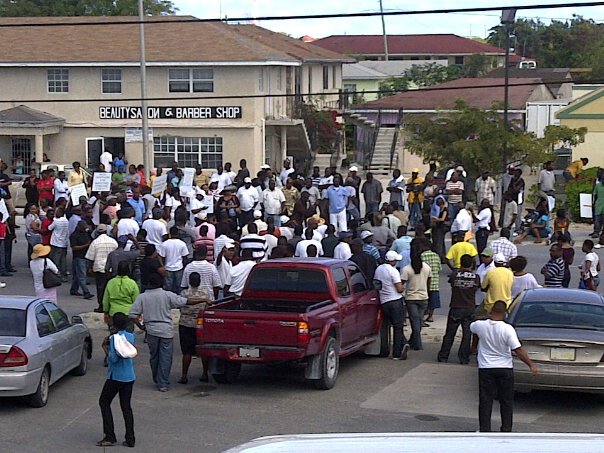
However the demonstration took an unexpected stand where vehicles were used to block the free flow of traffic along the said road. As a result of that action TCI Police incorporated alternatives measures to ensure timely and safe passage of persons utilizing the Providenciales International Airport.
TCI Police will not tolerate any acts of unlawful behavior moving forward and there will be a zero tolerance to such activity. Those responsible for any unlawful acts can expect to be dealt with accordingly.
We will have more on this developing story throughout the day…..
Zhivargo Laing impressed by The Turks and Caicos
It is no longer the rustic retreat with a distant chance of becoming a highly sought after destination; The Turks and Caicos has a myriad of accolades and awards to solidify that it is now one of the most famous and fabulous vacation escapes in the world and Minister of State for the Bahamas, Hon Zhivargo Laing was able to see the appeal of the island nation, southwest of his country.
“Well, from what I have seen so far, fantastic properties and from what I can tell, tourism at the moment seems to be booming, I mean there are lots of tourists and occupancy levels are extremely high.”
Hon. Laing and his wife were treated to a lavish weekend stay at the Point Grace Resort, where their ocean view suite sat perched right above ‘the Caribbean’s best beach’, Grace Bay.
“Point Grace is heavenly, just excellent. What I find especially impressive about the property is the hospitality of the staff; that they are courteous and welcoming. So what they have is a great physical property with outstanding human resources… we couldn’t have asked for anything better.”
Two decades had passed since the last visit by Minister Laing; Magnetic Media, a new Public Relations and Marketing firm in The Turks and Caicos sent the invite for the former full time business consultant to launch its Motivational Moments series. Laing acquiesced to the ‘four great events meant to inspire.’
“It has been far from easy for many in the country and Magnetic Media selected the Minister because of his prowess as an able speaker and for his diversity of appeal. The Christian Church, the business community and the Youth would all get a message tailored to their specific challenges, but with a resounding harmony of hope in these tough economic times,” said Deandrea Hamilton, Managing Director of Magnetic Media.
Among the activities was a tour of the island prior to his presentation to the business sector, Hon Laing and his wife observed some of the most stunning vistas including Chalk Sound and Silly Creek, in Southern Providenciales but it was the all-inclusive family resort, Beaches Turks and Caicos which appealed to the parents of four most of all.
“This Beaches property though is really fantastic. The diversity, the variety, the offerings for various age groupings is really, really impressive.”
Minister Laing who once held the portfolio of economic planning and development in his native Bahamas, explained that businesses in The Turks and Caicos were not regrettably like all others around the world; not immune to the financial dire straits of both private and public sector; nonetheless, his perspective promoted potential for a rebound.
“All across the world, including in The Bahamas, we have had to endure the consequences of one of the worst global and economic crises since the great depression, that has obviously resulted in a great many businesses falling back or behind in their own profit earnings. But these are part and parcel of the world’s economic cycles and I always say to business people everywhere that the world is batting a thousand on economic turn-around.”
While this was being communicated by Hon. Laing, who is the Member of Parliament for Marco City in Freeport, Grand Bahama - The Turks and Caicos was recording a surge in tourism business with near capacity bookings for its resorts, the addition of three new flights from the US, car rental companies all reaching peak performance and tourism figures surging as much as 15% over last year. There is a cautious optimism on the ground:
“Really the question for business people is, ‘what adjustments are required to be made and how do I then tap into the existing and new opportunities that might present themselves to me?’” Laing continued, “There is always hope if you are prepared to make adjustments and to focus on the assignment.”
The Minister first addressed the Church at Community Fellowship Center church on Thursday March 3; next the Business sector at Point Grace on Friday March 4; the Youth of the nation on Saturday March 5, at the Gus Lightbourne Gym and Bahamians resident in TCI were given a chance to speak to the Minister about matters at home.
UK to pay for Special Investigation bill
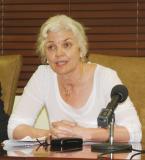 The people of the Turks and Caicos Islands will soon no longer have to bear the costs of the US$7million per year corruption investigation by Helen Garlick and her Special Investigations and Prosecutions (SIPT) team and the Civil Recovery Unit (CRU).
That’s because the United Kingdom (UK) Government is in the process of refunding the Turks and Caicos Islands Government for all of the costs associated with the SIPT and the CRU so far, in addition to paying for all of the future expenses of the SIPT and CRU, which, combined, are in the range of close to one million dollars each month.
On February 9, 2011, in the House of Commons, Andrew Rosindell asked the Secretary of State for Foreign and Commonwealth Affairs how much funding his Department has contributed to the Turks and Caicos Special Investigation and Prosecution Team since its creation.
Mr Bellingham replied: “The Foreign and Commonwealth Office (FCO) covered the initial costs of the Turks and Caicos Special Investigation and Prosecution Team (SIPT). These were approximately £660,000 in the financial year ending March 2010. Since then, the FCO has continued to pay the accommodation costs for the SIPT office in London. From April 2010 to end of January 2011, the cost was approximately £104,000. We are considering whether we can provide further support.”
It was revealed that the initial costs of setting up the SIPT have been met by the FCO. This amounted to a total spend of approximately £435,000 to the end of January 2010 (including the fees of the five-strong senior management team, one researcher, the rental costs of offices and associated IT, and telephone and travel costs).
It was stated that the FCO "stretched the limited resources" of the Overseas Territories Programme Fund to cover the cost of the core team until 10 February 2010 and agreed to provide an additional £36,000 to allow Ms Garlick to begin to recruit the core intelligence and research unit and to rent more UK office space.
With regard to the longer-term funding of the SIPT, the Special Prosecutor noted that she signed her contract on the basis of a "distinct understanding" that while the UK Government "would not fund the investigation indefinitely, the most probable outcome would be that it would advance a loan to TCIG". In her letter to Ministers of 24 November, Ms Garlick commented that:
“In October I learned first, that the UK Government would neither make a loan, nor guarantee a separate line of credit agreed by the TCIG. In the absence of any support from HMG, the only option open to TCIG was to negotiate one or more facilities backed by hypothecation of an identified stream of income. [...] If it is agreed, the facility will be syndicated. I am informed that the facility is close to being agreed and that funds are expected to be in place by early January. In the meantime our initial two-month contracts have been extended to 10 February 2010 and we are being funded by the FCO. As from that date, we will be a charge on the budget of TCIG.”
The FAC report noted that Garlick expressed concern at the consequences of her investigation becoming a burden on the budget of the Islands Government.
As Oil Prices Surge, So Do Airfares
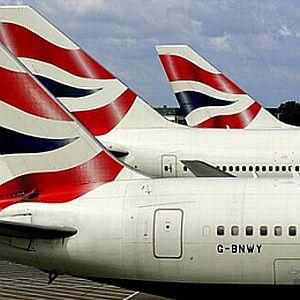 As the price of oil has surged because of the unrest in the Middle East, so have airline fares.
Airlines around the world are quickly boosting their fares to keep pace with higher jet fuel costs, which account for 30 percent of the carriers' operation expenses. The price of oil has risen sharply as the turmoil in oil-producing states like Libya has traders worried that the world's daily flow of oil will be diminished.
Some U.S. air carriers have already raised fares six times this year, topping the four price hikes for all of last year. Now, U.S. business travelers are paying about $100 more per round trip than a year ago, while fares for leisure travelers are up by $40 to $60. U.S. airlines have also boosted fuel surcharges on overseas flights to Paris, Frankfurt and other European destinations from $360 to $400.
Chinese airlines have also increased their fuel surcharges for passengers, as have airlines in the Ukraine, Britain and Canada.
Even as air carriers increase their fares, the airline industry says its profits will erode this year. The industry's main trade group (the International Air Transport Association) says airlines overall had net profits of $16 billion in 2010. But now the industry is predicting that with the higher fuel costs the figure will fall 46 percent this year to $8.6 billion.
Some airlines have been able to limit airfare increases because they bought jet fuel at cheaper prices, before the recent jump in oil prices that now have reached $115 a barrel for crude oil on the London market and more than $104 in New York.
But the industry says that for each dollar more for a barrel of oil it has to pay, the airlines' costs increase by $1.6 billion.
Sanctions Hurt Ivory Coast Economy
Economic sanctions against Ivory Coast are hurting business in the world's top cocoa producer.
Thousands of civil servants line up along Abidjan's Rue des Banques, waiting to be paid their February salaries. When foreign banks closed last month because of regional sanctions against incumbent President Laurent Gbagbo, his government faced its biggest economic challenge yet: finding the cash to pay its workers, especially its soldiers.
Gbagbo's government quickly took charge of those banks and reopened them this week, just in time to pay civil servants 80 percent of their normal salaries.
"That will be a great success. I am sure they will be able to do it," said English teacher Ibrahim Kalo. He says the regional central bank move to cut off the Gbagbo government was a challenge to all Ivorians - a challenge that has been met.
"I think this was an operation to diabolize [demonize] the government of Cote d'Ivoire,” Kalo added. “But I think they can pay us. That is why we are standing now in the queue. You can see from all the banks here long lines of people waiting for money, and they will be paid. You can be sure of that. There is no trouble."
Winceslas Appia, general manager of Abidjan's Bank for Agricultural Financing says there is enough cash to take care of everyone. So people should remain calm, he said. Appia said the banks have put in place measures to reinforce their staff so everyone will be served.
Withdrawals limited
Personal withdrawals are limited to about $425 a day. Gbagbo's Minister of Economy and Finance, Desire Dallo says those limits are meant to help the banking system stay solvent.
Dallo is asking people not to withdraw all their money because the banking system works only if there is a balance between deposits and loans. Dallo said it is obvious that people are afraid that banks will close again. But he said these are now state-run banks that will not fail, so account holders should not panic and withdraw all their money because that will not help.
Why sanctions?
Economic sanctions are meant to drive Gbagbo from power after he claimed re-election in last November's disputed presidential runoff. The constitutional council annulled nearly 10 percent of the ballots as fraudulent. Ivory Coast's electoral commission and the United Nations certified results that say former Prime Minister Alassane Ouattara won that vote.
Ouattara's call for a ban on cocoa exports has brought most of that industry to a halt, denying the Gbagbo government an important source of tax revenue. Sanctions have led to a shortage of cooking gas and the collapse of money transfers and credit cards, making Ivory Coast a cash-only economy.
Economic impact
Senegalese businessman Mouctar Bah sells mobile phones in Abidjan's Treichville neighborhood.
Bah says Seneglese merchants were in Ivory Coast when it was good. Now nothing is working. There is not Western Union or banks to transfer money. Businessmen are not politicians, Bah says, so when things are not working, it is time to leave.
At a Total Petrol station on Boulevard du General DeGaulle, motorists are no longer allowed to buy fuel in jerry cans. It is part of a government campaign to prevent hoarding as Abidjan's refinery is reducing production because it is having trouble buying crude.
Effective?
Ouattara supporters say sanctions against Gbagbo are working, though more slowly than they hoped.
"We will see that the effects will be quite remarkable,” said Jean-Marie Kacou Gervais, Ouattara's foreign minister. “We can't see it by now, but it's on. And I am sure he will not be able to stand the heat when the time comes."
Even those who do not recognize Gbagbo's authority agree that his is the de facto government in Ivory Coast so long as it pays its soldiers.
"He has the army and he also has got the finance to pay,” said Hamadoun Toure, the United Nations mission spokesman. “As long as he has the two powers, he will be in control of the situation."
Pro-Gbagbo parliamentarian Bamba Massany says Ivorians will not be cowed by the international community.
Massany said sanctions against the Gbagbo government are inhuman and nonsensical. Now is the time for people to help the government, as Massany said it is working to strengthen Ivory Coast's economic foundations.