
Grammy Awards 'has lost touch with pop'
A veteran music executive has criticised the Grammy Awards in a full-page advert in the New York Times.
 Steve Stoute said Grammy voters had "lost touch with contemporary popular culture" by snubbing artists like Eminem and Justin Bieber.
He added the show had become "a series of hypocrisies and contradictions", claiming both acts were only asked to perform to boost TV ratings.
Last week's ceremony attracted 27m viewers - the largest since 2001.
Stoute, who is most famous for managing hip-hop arts Nas, is the chief executive of marketing company Translation and is considered to be one of the most influential voices in entertainment marketing and pop culture.
He also took the National Academy of Recording Arts and Sciences to task for snubbing Eminem in 2001, which saw the rapper's Marshall Mathers LP miss out on album of the year in favour of Steely Dan.
Stoute's letter also questioned why Kanye West's Graduation was also passed over for the same award three years ago by Herbie Hancock's River: The Joni Letters.
"We must acknowledge the massive cultural impact of Eminem and Kanye West and how their music is shaping, influencing and defining the voice of a generation," Stoute wrote.
'Change this system'
Eminem, who led this year's Grammys with 10 nominations, picked up only two awards, while Bieber went home empty-handed despite his two nominations.
Eminem, who led this year's Grammys with 10 nominations, picked up only two awards, while Bieber went home empty-handed despite his two nominations.
"How is it that Justin Bieber, an artist that defines what it means to be a modern artist, did not win best new artist?" Stoute said.
His cultural impact and success are even more quantifiable if you factor in his YouTube and Vevo viewership."
Beiber lost out to singer and bassist Esperanza Spalding for the award in question.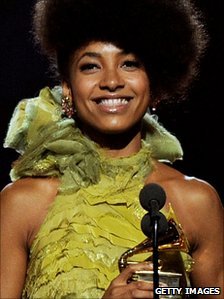
Stoute added: "Interesting that the Grammys understands cultural relevance when it comes to using Eminem's, Kanye West's or Justin Bieber's name in the billing to ensure viewership and to deliver the all-too-important ratings for its advertisers."
He also said his "suspicions" over a link between performers and winners appeared to be proven true, citing Arcade Fire's surprise album of the year win just after they had finished performing on stage.
"Does the Grammys intentionally use artists for their celebrity, popularity and cultural appeal when they already know the winners and then program a show against this expectation?" he said.
He finished by calling on artists to "demand they change this system" and uphold "its mission for advocacy and support of artistry as culture evolves".

Nuggets trade Carmelo to Knicks
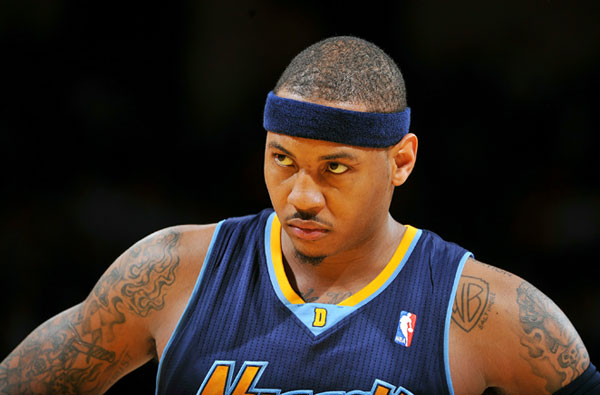 The long-anticipated trade of Carmelo Anthony to the Knicks was completed Monday night, multiple league sources told SI.com.
The sides moved close to the agreement earlier in the day when the Knicks agreed to include 24-year-old rookie center Timofey Mozgov in their offer. He was not a key player in the trade, but his inclusion was a deal-maker for the Nuggets.
The Nuggets will receive forwards Danilo Gallinari and Wilson Chandler, point guard Raymond Felton, Mozgov, the Knicks' first-round pick in 2014, and second-round picks in the 2012 and 2013 drafts that originally belonged to the Warriors.
In return the Knicks will enter the final two months of the season with Anthony, point guards Chauncey Billups and Anthony Carter, big man Shelden Williams and forward Renaldo Balkman, a former Knick.
New York will also receive a second-round pick and Corey Brewer from the Timberwolves, with Eddy Curry's expiring contract, Anthony Randolph and $3 million heading to Minnesota.
A league source insisted that none of the acquisitions would be shipped to the Nets, contrary to reports Monday that Denver was considering a secondary trade of Gallinari to New Jersey.
The trade consummates rumors that were launched at Anthony's wedding last July, when LeBron James and Chris Paul launched a series of toasts that predicted Anthony would come to play in New York with fellow All-Star Amar'e Stoudemire, who signed with the Knicks last summer as a free agent.
The Nuggets could have attempted to trade Anthony to the Nets, but it was known that he wanted to sign a three-year, $65 million extension with the Knicks. The package from New York was more palatable to the Nuggets because they're receiving four Knicks starters who are all 26 or younger, which should hasten Denver's rebuilding efforts without Anthony.
Winston Reid sympathises with New Zealand quake victims
New Zealand's Winston Reid said his joy at scoring his first goal for West Ham was quickly put into perspective by the earthquake in Christchurch.
Reid scored West Ham's fourth goal in a 5-1 FA Cup win over Burnley on Monday.
He told BBC Sport: "It was a fantastic night, but the earthquake put it into perspective. It is devastating and my heart goes out to everyone back home."
The 22-year-old has friends and cousins in the Christchurch area, which was hit by the 6.3-magnitude quake on Tuesday.
When Reid heard the news he called home immediately but had some initial problems reaching his loved ones.
"Because of the quake, the phone lines and cables were all down, so it took a bit of time to get through, which was worrying," he explained.
"I had to get messages through and get them sent on to others, but my family and friends are OK.
"Everything is turned upside down, but they are all feeling so fortunate and so am I, that they are all alive. That is the main thing, because people have lost their lives, which is tragic."
The defender, who joined West Ham from Danish side FC Midtjylland in August 2010, has admitted that he is still in shock and has been watching the news intently for updates.
"Even if you live in a country where earthquakes happen, I don't think you are ever fully prepared for it," he reflected.
"I am thinking of everyone back home, especially those who have lost loved ones and have had their lives changed because of this.
"It is not a large country, but the spirit among the people there will be what gets them through. They will all help each other out and help each other recover from what has happened. My thoughts are with everyone."
Reid's headed goal on 59 minutes helped West Ham stroll into an FA Cup sixth-round tie at Stoke.
FC Copenhagen 0 - 2 Chelsea
Chelsea eased the pressure on manager Carlo Ancelotti as they cruised to a win over Copenhagen in the first leg of their last-16 Champions League tie.
Nicolas Anelka seized on a misplaced pass from ex-Blues winger Jesper Gronkjaer to fire the visitors ahead.
The Premier League club added to their lead when Frank Lampard's reverse pass found Anelka and he drove in a second.
Ancelotti's men were dominant but £50m striker Fernando Torres could not register his first goal for the club.
It was all too easy for Chelsea as the lacklustre Danish champions looked every bit like a team that had not played a competitive game since 7 December because of their league's winter break.
With the visitors desperate to keep alive their Champions League hopes after being knocked out of the FA Cup last Saturday and their chances of defending their Premier League crown seemingly over, Copenhagen had a chance to add to Chelsea's misery.
Instead, a timid home side stood off their opponents and the Blues were too good not to take advantage and earn a commanding lead for the return leg at Stamford Bridge on 16 March.
Ancelotti paired Anelka with Torres in attack as Didier Drogba dropped to the bench and the duo, helped by some poor defending, responded with a performance of hunger and desire, which was also epitomised by their team-mates.
Anelka grabbed the glory with the goals but, if the finishing prowess of Torres had been as clinical as his partner's, the Spaniard would have scored his first goal for Chelsea since his January move from Liverpool.
However, while Anelka ruthlessly punished Gronkjaer by powering in a shot from just inside the edge of the area to put the Blues in front after 17 minutes, Torres failed to round off some of his pace and movement with a goal.
The Spanish forward's first real chance came when an off-target Ramires shot left him with a sight of goal but his first touch let him down and allowed Copenhagen keeper Johan Wiland to fend away the danger.
Torres jinked his way into a promising opening as he produced the type of play which unnerves defenders, but his poked shot was again saved by Wiland.
A lunging Mathias Jorgensen tackle was next to foil Torres as Chelsea dominated proceedings but failed to add to their lead.
Copenhagen appeared to be fearful of the Blues and this was apparent when Anelka was allowed the time and space to turn and shoot at goal with his effort going high.
Visiting keeper Petr Cech was belatedly called into action when he had a Martin Vingaard long-range shot to save after the break.
The Danes had drawn against Barcelona at the Parken Stadium in the group stages earlier this season but could not rediscover the same sort of form as they looked a yard off the pace.
And Chelsea wrapped things up when Anelka again showed Torres how to finish with a first-time shot from Lampard's exquisite pass.
After a faltering season, it was a welcome win for Ancelotti's side and a surprisingly comfortable one given the fact Copenhagen had never before suffered defeat at home in the Champions League.
NBA hopes to speed up games by implementing warning horns
The NBA has a message for players and officials: Be ready to start when a timeout is over.
The league's scoreboard operators have been told to sound warning horns during breaks in the action in an effort to cut down on the length of games. According to a courtside memo Tuesday night at the Detroit Pistons' game against the Houston Rockets, games have been taking longer, "largely due to prolonged delays after breaks."
NBA spokesman Tim Frank confirmed to The Associated Press that the new protocol went into effect Tuesday night.
Memos outlined new procedures for locally telecast games, including warning horns to be sounded shortly before the ends of timeouts and breaks between periods.
Those warning horns are to be followed by final horns ending those breaks, and referees are directed to make sure huddles break promptly.
"We communicated to teams that the first horn was a warning that the TO was to end and that they should be on their way to resume by the second," Frank said in an e-mail.
Detroit's 108-100 loss to Houston ended in 2 hours, 4 minutes -- the Pistons' fastest home game of the season.
Elsewhere, Indiana's game at Washington ended in 2:21.
"I'm a rookie coach, and I need to get my guys out of the huddle faster," Indiana's Frank Vogel said.
Charlotte's home game against Toronto was over in 2:12, and players said the change wasn't a big deal.
"I didn't notice it. I really didn't even know about it," Toronto guard Jerryd Bayless said. "I'm not really worried about the horn too much, I'm worried about what (coach) Jay (Triano) and everybody else is saying. I don't know, I didn't hear it."
Cricket World Cup: Ragged England sneak past Dutch
A ragged England survived a major scare in their opening World Cup match as they beat a spirited Netherlands with only eight balls to spare in Nagpur.
All-rounder Ryan ten Doeschate smashed 119 from 110 balls as the Dutch took advantage of some poor England bowling and abject fielding to post 292-6.
Andrew Strauss (88) and Jonathan Trott (62) gave England a solid start.
But after runs dried up in the middle overs, Paul Collingwood and Ravi Bopara (both 30 not out) saw England home.
The duo brought a nerve-wracking run chase to a conclusion in the penultimate over, with Bopara crashing a six and two fours off medium pacer Bernard Loots.
However, the day belonged to South Africa-born Ten Doeschate, whose innings paved the way for the closest finish yet of the 2011 World Cup.
After taking 12 balls to get off the mark, he thereafter scored at a rate of a run per ball, scampering intelligent singles, smashing nine fours and three huge sixes.
But, for all the Essex all-rounder's brilliance, Ten Doeschate was also helped by a wretched performance in the field from England, whose body language was devoid of the energy and aggression that won them so much praise during the 2010-11 Ashes series in Australia.
The negative vibe was encapsulated in a horrible mix-up between Kevin Pietersen and James Anderson, who allowed a skied drive from Ten Doeschate - on 47 - to drop harmlessly between them to the obvious anger of bowler Graeme Swann and the general bemusement of all those watching.
The innings was punctuated by mis-fields, no-balls, and untidy wicketkeeping by Matt Prior, while both Pietersen and Trott spilled difficult chances, which on a good day would have stuck.
In the penultimate over, captain Peter Borren was bowled by Stuart Broad but he was recalled because England only had three men inside the circle, one fewer than the regulations permit. And, to round off a comedy of errors, in the last over Swann allowed a routine chance to slide inexplicably through his fingers.
The performance may prompt a rethink ahead of Sunday's day-night Group B match against India after the decision to leave out left-arm spinner Michael Yardy backfired.
Back-up spin bowler Pietersen gave away 19 runs from his two overs, while a lack of alternatives meant an off-colour Anderson (0-72) was obliged to run through his full 10 overs.
The Dutch had made a positive start to their innings with Wesley Barresi striking three fours off an over from Broad.
But, in the following over, Tim Bresnan made the breakthrough as Worcestershire opener Alexei Kervezee's attempted pull skimmed off the top edge of his bat and into the gloves of Prior.
Netherlands' bright start forced Strauss to turn to the spin of Swann in the 12th over and England's off-spinner reproduced his handy habit of striking in his first over.
A skilfully flighted ball at a tempting length outside off stump passed Barresi's outside edge and Prior whipped off the bails moments before the batsman could get his foot back behind the line.
Tom Cooper, dropped by Pietersen at fine-leg on 46, was out one run later when he flicked a Collingwood ball straight to Anderson at mid-on.
Bas Zuiderent got himself squared-up and gifted a dolly of a catch to Collingwood and Tim de Grooth was bowled by a Broad yorker after a decent 28 off 31 balls.
Ten Doeschate motored into the 90s with two successive fours off Bresnan before reaching three figures courtesy of more hapless fielding from England as Trott's attempt at a run out cannoned off the stumps and flew away to the boundary for four overthrows.
A magnificent innings finally came to an end in the penultimate over when a slog off Broad picked out Bopara at deep square leg.
But there was still time for the Dutch to take advantage of some comical fielding to post the second highest total by an associate nation against a Test side in all one-day internationals - behind Zimbabwe's 312-4 against Sri Lanka in 1992.
Strauss set the tone for England's reply with three fours in the first over, one of which flew off an edge and almost took out his off stump.
With the Dutch bowlers struggling to adjust their line to the left-hander, the England captain made the most of some leg-stump bowling to race to his fifty off 34 balls with nine boundaries.
Pietersen made a positive start to his innings before getting bogged down by some tight bowling, and prodding left-arm spinner Pieter Seelaar straight to short extra cover for 39.
Strauss looked on course for his sixth one-day international hundred before he got a little greedy and pulled the ball straight to deep square leg.
Trott and Ian Bell kept things ticking along with ones and twos but with the required run rate creeping above seven and boundaries a rarity, the game remained in the balance going into the final 10 overs.
Ten Doeschate proved his qualities with the ball by having Trott stumped and clean bowling Bell, who only managed one boundary in his 40-ball 33.
That left Collingwood and Bopara needing 52 from 7 overs and luckily for England they were up to the task.
Airports operator BAA narrows losses to £317m
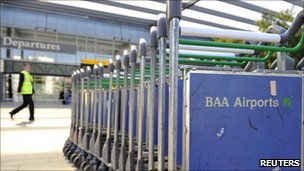 UK airports operator BAA has reported a loss of £317m for 2010 after a year of volcanic ash, strikes and snow.
The company said these disruptions meant 2.8 million fewer passengers passed through its airports last year, most of these lost at Heathrow.
The company's chief executive, Colin Matthews, said he expected the company to deliver a strong increase in profits and cash flow in 2011.
The pre-tax, unadjusted figure is an improvement on 2009's loss of £822m.
The loss has narrowed because the 2009 figure included losses from its forced sale of Gatwick airport and a £218m charge for its pension deficit.
BAA, which is owned by Spain's Ferrovial, owns and operates Heathrow, Stansted, Southampton, Edinburgh, Glasgow and Aberdeen airports.
However, the Competition Commission wants BAA to sell Stansted and either Glasgow or Edinburgh airports. Last week, BAA lost its latest court challenge against the ruling to sell these airports.
Learning lessons
The three exceptional events affecting the results began in April last year with the Icelandic volcano eruption. That closed Heathrow and Stansted for five days.
BAA also pointed to the 22 days of strike action by BA cabin crew strikes which resulted in 34 days of service disruption at Heathrow.
That was followed by airport closures and flight cancellations caused by December's heavy snow, which BAA said last month had cost it £24m.
The company has appointed an external panel of experts to establish what lessons could be learnt from the disruption in order that the airport can better respond to future problems.
It is due to report its findings next month.
Barnes & Noble profits fall by a quarter
Barnes & Noble has reported a slump in profits and suspended its dividend payments as it continues to invest heavily in its e-book strategy.
Net profits for the three months to the end of January came in at $60.6m (£37.6m), a drop of 25% on the $80.4m it made a year earlier.
Shares in what is the largest US bookseller fell 11% after the results.
Last week, rival bookstore Borders filed for bankruptcy protection amid declining sales.
Barnes & Noble also said it would not be making any sales or profits forecasts for the current quarter.
It has invested heavily in its Nook electronic book reader in an attempt to gain ground on market leader Amazon and its Kindle reader.
"We intend for Barnes & Noble to be a leader in the exploding market for digital content," said the group's chief executive William Lynch.
Both Barnes & Noble and Borders have struggled in the face of fierce competition from supermarkets, online sales and digital books.
Wal-Mart reports seventh quarter of declining US sales
Retail giant Wal-Mart has reported a seventh straight quarterly decline in underlying sales at its US stores, as it loses customers to cheaper rivals.
In the fourth quarter of 2010, same-store sales fell by 1.8% in the US, but the firm benefited from strong overseas sales.
Wal-Mart posted a consolidated net income of $6.2bn (£3.8bn) in the fourth quarter, up from $4.9bn a year earlier.
For 2010 as a whole, consolidated net income was $17bn, up from $14.9bn 2009.
The profit figures were boosted by cost cutting and strong international sales, which benefitted from exchange rate movements.
The company told analysts at its previous quarterly profits announcement that it had turned the corner and US sales would turn positive in the fourth quarter.
But sales at its US stores open at least a year fell by 1.8% and are forecast by the company to continue to be below last year's levels for this current quarter.
Wal-Mart shares fell by 3.2% following the announcement.
Regret
The company has been losing customers in its heartland US stores to so-called "dollar" stores after it changed its "every day low prices" strategy and introduced selected price cuts.
It also cut down the range of goods it offered, a decision the firm said it had since regretted and reversed.
The company's chief executive, Mike Duke, said these problems would take time to correct.
"Some of the pricing and merchandising issues in Wal-Mart ran deeper than we initially expected and they require a response that will take time to see results," he said.
Although most of Wal-Mart's business is in the US, its international operations, including the UK's 386 Asda stores, are providing the best growth with sales up by 9% for the quarter.
Asda, whose strategy included a sharp focus on price - it promised its groceries would be 10% cheaper than rivals - and the widening of its product range - reported sales growth over the Christmas quarter picked up strongly with a 1.6% increase in shops open for more than a year.
Wal-Mart as a group made sales of $419bn in the year to the end of January, with the US accounting for about 60% of that
Mexico economic growth hits 10-year high
The Mexican economy recovered from a sharp contraction in 2009 to grow by 5.5% last year, its fastest annual rate in 10 years, official figures show.
The National Statistics Institute said that the agriculture, manufacturing and services sectors all made a strong improvement over the year.
The manufacturing sector was one of the key drivers with a growth rate of 6.1% in 2010.
"Growth is now more balanced," said Finance Minister Ernesto Cordero.
"Manufacturing was stronger but most importantly the services sector grew significantly," said Gabriel Casillas at JP Morgan.
The Institute said the final three months of the year grew at 1.3% compared with the previous quarter.
Unlike many emerging market economies, Mexico is not currently troubled by high inflation, which is currently running at 3.8%, down from 4.4% at the end of last year.
For this reason, interest rates are expected to remain on hold at 4.5%, analysts say.