Libya protests: UN Security Council condemns crackdown
The UN Security Council has condemned the Libyan authorities for using force against protesters, calling for those responsible to be held to account.
 In a statement, the council demanded an immediate end to the violence and said Libya's rulers had to "address the legitimate demands of the population".
Nearly 300 people have been killed so far, according to Human Rights Watch.
Earlier, Col Muammar Gaddafi urged his supporters to attack the "cockroaches" and "rats" protesting against his rule.
Anyone who took up arms against Libya would be executed, he warned.
Interior Minister Abdel Fattah Younes al-Abidi later resigned and called on the armed forces to "join and heed the people's demands".
'Extremely strong'
The UN Security Council's statement came after a day of debate on the uprising in Libya, which has seen the state lose control of much of the east of the country, foreign mercenaries allegedly attacking civilians on the streets and warplanes reportedly shooting and bombing protesters.
The council's 15 members said the Libyan authorities should "meet its responsibility to protect its population", act with restraint, and respect human rights and international humanitarian law.
The Libyan authorities should also hold accountable those people responsible for attacking civilians, and respect the rights of its citizens to peaceful assembly, freedom of expression and press freedom, they added.
British Ambassador Mark Lyall Grant said the statement was "extremely strong" and indicated further measures were likely in the coming days.
Libya's deputy permanent representative to the UN in New York, Ibrahim Dabbashi, who on Monday called on Col Gaddafi to step down, said the council's statement was "not strong enough" but still "a good message to the regime in Libya about stopping the bloodshed".
But his superior, Abdul Rahman Mohammed Shalqam, dissociated himself from the remarks, calling Libya's ruler "my friend".
The Arab League also condemned the "crimes" against protesters in Libya and said it would bar the country from League meetings.
'Genocide has started'
But Col Gaddafi was defiant in a rambling 75-minute speech broadcast on state television, saying he vowing to crush the revolt by "rats and mercenaries".
Standing outside the Bab al-Aziza barracks in Tripoli, which was damaged by a US air strike in 1986, he vowed: "I am not going to leave this land. I will die here as a martyr. I shall remain here defiant."
He also called on his supporters to "cleanse Libya house by house" unless the protesters surrendered.
"All of you who love Muammar Gaddafi, go out on the streets, secure the streets, don't be afraid of them... Chase them, arrest them, hand them over," he said.
He portrayed the protesters as misguided youths who had been given drugs and money by a "small, sick group", and blamed "bearded men" - a reference to Islamist - and Libyans living abroad for fomenting the violence.
"The hour of work is here, the hour of onslaught is here, the hour of victory is here. No retreat, forward, forward, forward. Revolution, revolution," he shouted at the end of the speech, pumping both fists in the air.
Shortly after the speech, a BBC correspondent in Tripoli heard the sound of guns being fired, apparently into the air. She said fireworks were also set off and cars drove through the city at high speed, their horns blaring.
In the eastern city of Benghazi, people watching the address reportedly threw shoes at television screens as a sign of their anger.
German Chancellor Angela Merkel said Col Gaddafi's speech was "very, very appalling" and "amounted to him declaring war on his own people".
In New York, Mr Dabbashi said he had received information that the Libyan leader's supporters had started attacking people in all western cities.
"The Gaddafi statement was just code for his collaborators to start the genocide against the Libyan people. It just started a few hours ago. I hope the information I get is not accurate but if it is, it will be a real genocide," he told reporters.
Refugees
Earlier in the day, Tripoli was reported to be tense, with almost-empty streets enlivened only by lines of people queuing for bread and petrol.
In Sabratah, 80km (50 miles) west of the capital, a large number of soldiers were deployed after protesters destroyed the offices of the security services, the Quryna newspaper reported.
There were also reports that the western city of Ajdabiya was now controlled by the opposition. Ajdabiya is situated close to Libya's main oil fields. Government forces have also been ejected from the cities of Tobruk and Benghazi.
Witnesses in the eastern town of al-Bayda told the Reuters news agency that 26 people had been shot dead overnight by Gaddafi loyalists.
Refugees also streamed across Libya's eastern border with Egypt. Many said the Libyan authorities had been using tanks, warplanes and mercenaries.
The BBC's Jon Leyne, in eastern Libya, says the region appears to be wholly under opposition control and people are deliriously happy. Many of the army and police have defected and have been accepted by the opposition.
Local people said the government there had collapsed on Thursday after the first protests. They believe the only people now supporting Col Gaddafi are foreign fighters in the country.
Our correspondent says there is little doubt that Col Gaddafi's rule is finished, but it is not clear how long it will take or how bloody it will be.

New Zealand earthquake: Death toll rises to 75
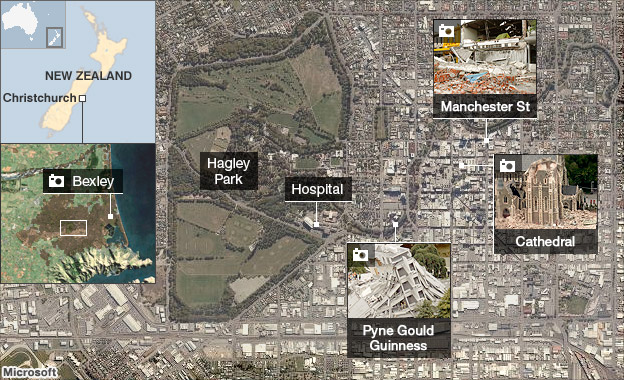
New Zealand Prime Minister John Key has declared a national state of emergency as the death toll from Tuesday's earthquake in Christchurch rose to 75.
There are now 55 bodies in a morgue and another 20 being transported there following the 6.3-magnitude tremor.
Police have said there is "incredible carnage right throughout the city", with "bodies littering the streets".
More than 300 people are still missing. Forty-eight were pulled out from collapsed buildings alive overnight.
The earthquake struck at a shallow depth of 5km (3.1 miles) on Tuesday lunchtime, when the South Island city was at its busiest.
It was Christchurch's second major tremor in five months, and New Zealand's deadliest natural disaster in 80 years.
More than 500 search and rescue personnel, police, fire service staff, soldiers and volunteers worked throughout the night to find survivors trapped under the rubble, many using only their bare hands.
"There is incredible carnage right throughout the city," Police Superintendent Russell Gibson said. "There are bodies littering the streets, they are trapped in cars and crushed under rubble."
"We are getting texts and tapping sounds from some of these buildings and that's where our focus is," he added.
"It's quite amazing, we have some people we've pulled out and they haven't got so much as a scratch on them, we've had other people where we've had to amputate limbs to get them out."
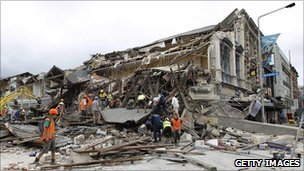 Asked how many may still be trapped, Supt Gibson said: "It could be another 100 - it could be more."
Later, officials said a total of 300 people were believed to be missing, but details are unclear and officials are currently trying to refine that list. Some people may simply not have been able to contact friends and relatives.
The ministry of civil defence said 22 people alone were missing in Christchurch Cathedral, which lost its spire and a section of roof.
Twenty-four others have meanwhile been rescued from the Pyne Gould Guinness building and dogs have detected another seven still alive. The earthquake flattened the four-storey structure where hundreds worked.
"I rang my kids to say goodbye," Ann Voss told TV3 from underneath her desk inside the building. "It was absolutely horrible. My daughter was crying and I was crying because I honestly thought that was it."
Iranian warships sail through Suez Canal
Two Iranian warships sailed through the Suez Canal on their way to the Mediterranean Sea, canal officials said Tuesday.
They are the first such ships to sail through the Suez since the Islamic republic's 1979 revolution.
The move, which occurred four days after Egypt's post-Hosni Mubarak government gave the green light to the passage, put Egypt's new military regime in a prickly position with its Israeli neighbor.
The canal is an internal body of water, and as such, Egypt has sovereignty over it. But Egypt also is bound by the 1978 Camp David Accords, which guarantee the right of free passage by ships belonging to Israel and all other nations on the basis of the Constantinople Convention of 1888. Before that, Egypt did not allow Israeli ships to sail through the canal.
Earlier this month, Egypt's newly empowered military government said it would honor all its international treaties, including Camp David.
Israeli Prime Minister Benjamin Netanyahu accused Iran on Sunday of trying to expand its influence in the region by planning to send the warships.
Netanyahu said Israel views the crossing of the Iranian ships through the Suez Canal "gravely."
The vessels, a frigate and supply ship, are on a yearlong intelligence-gathering mission to prepare cadets to defend Iran's cargo ships and oil tankers from the threat of attack by Somali pirates, Iranian officials have said, according to Fars. The ships, which passed through the canal without incident, are headed to Syria, Fars said, citing officials.
David Schenker, director of the Program on Arab Politics at the Washington Institute for Near East Policy, said last week that both ships are armed with missiles, and warned that their passage could create more uncertainty in the region.
The Suez Canal is a key waterway for international trade. It connects the Mediterranean Sea with the Red Sea, allowing ships to navigate between Europe and Asia without having to go around Africa. Millions of barrels of oil move through the Suez every day en route to Europe and North America.
31 found guilty in deadly 2002 train arson in India
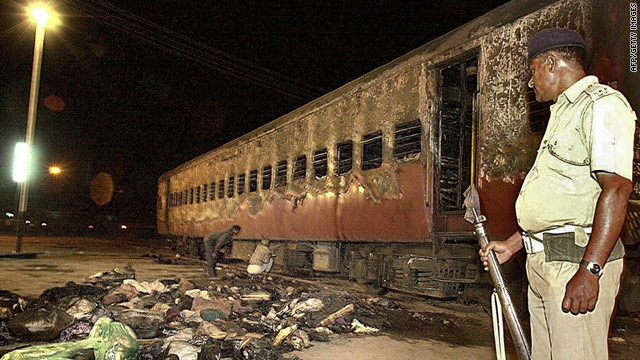
An Indian court in the western state of Gujarat has convicted 31 of the 94 people charged with conspiracy and murder for setting fire to a passenger train in 2002 which triggered widespread religious violence, resulting in the death of more than 1,000 people.
Sixty-three of the accused, including one of the main conspirators, were acquitted Tuesday due to lack of evidence, prosecutors said.
A suspected Muslim mob attacked the Sabarmati Express near the town of Godhra on 27 February, 2002, killing more than 50 people, most of whom were Hindu pilgrims.
The Hindu pilgrims were returning from the north Indian town of Ayodhya where they had been demanding that the government build a temple on the ruins of a 16th century mosque.
The train fire sparked days of rioting in which more than a thousand people, mostly Muslims, were killed.
The cause of the train fire has long been disputed.
Special security arrangements were made throughout the state ahead of the sensitive verdict to maintain peace.
Indian authorities have also imposed restrictions on broadcasting video or photographs of the original carnage on the day of the verdict.
So far, no violence has been reported following the verdict.
Jet Blue Launches 16th destination to Turks & Caicos
JetBlue Airways  is pleased to launch its award-winning, low-fare service and preferred product to its newest Caribbean destination, Providenciales, in the Turks & Caicos Islands. Providenciales will be JetBlue's 16th successful destination in the Caribbean. Daily flights from New York's John F. Kennedy Airport (JFK) begin today, and weekly Saturday service will begin on Feb. 19 from Boston Logan International Airport. To celebrate the opening of its newest destination, customers can enter to win a JetBlue Getaways vacation package, complete with roundtrip airfare for two to Turks & Caicos and hotel accommodations for four days and three nights, and other great prizes at www.jetblue.com/pls.
"We're excited to begin this new Caribbean adventure," said Scott Laurence, JetBlue's vice president of network planning. "Providenciales and the more than 40 islands that make up the Turks and Caicos are a perfect addition to our wide array of Caribbean leisure destinations. We know our customers will enjoy the islands as much as they enjoy the JetBlue Experience, complete with more options and entertainment."
"The entire Turks and Caicos is pleased to have JetBlue providing service to our Islands," said Ralph Higgs, Director of the Turks and Caicos Tourist Board. "JetBlue's brand complements our destination's attributes beautifully; this is a win-win situation for all involved."
"The Turks and Caicos Islands Airports Authority joins the many others, stakeholders and passengers alike, in welcoming JetBlue to its developing Providenciales International Airport," said John T. Smith, CEO of the Turks and Caicos Islands Airports Authority. "We look forward to a long, strong and symbiotic relationship."
JetBlue will operate its Providenciales service with spacious 150-seat Airbus A320 aircraft. The A320 offers travelers all of the amenities for which JetBlue has become well-regarded: complimentary seatback television programming including free first-run movies (b), comfortable leather seats, the most legroom in coach of any U.S. airline (c), unlimited free snacks and industry-leading customer service. JetBlue's live in-flight entertainment system boasts 36 channels of free DIRECTV(r) programming and more than 100 channels of free XM Radio(r) on personal seatback TVs. Customers can now kick back at every comfortable leather seat and enjoy their trip to Providenciales with complimentary snacks and drinks along with JetBlue's award-winning customer service.
PRESS STATEMENT BY CARLOS W. SIMONS QC CONSTITUTIONAL AND ELECTORAL REFORM; LOOKING ROUND THE CORNER
With Kate Sullivan’s revised constitutional and electoral reform recommendations having been considered and responded to we ought now, we are told, to expect a new draft order in council at some point in the future. We have not been told when, but we do know that the mandate of the interim government has now been extended beyond the 2 years initially envisaged and that a new Order in Council is open-ended.
The situation is most unsatisfactory, and I join with my colleague E.J. Saunders in calling on Foreign Office Minister Bellingham to set target dates for the achievement of the objectives he has set out and to give the people of the TCI a clear indication of when they can expect a return to democratically elected government in their homeland.
The question though, that I have been asked constantly is what will the new constitution look like, and what will we do about it if we don’t like it. To answer that question is like looking round the corner, but I will give it my best effort. Although Ms Sullivan says that she took the 2006 Constitution as her starting point, her recommendations suggest that the new constitution will be radically different in significant respects.
It is equally clear to me that we won’t like it and that something will have to be done about it. During Ms Sullivan’s consultations, a clear preference was shown for the 2006 Constitution and despite the lip service she has paid to it, most citizens will find that her recommendations are like the apple that has fallen far from the tree. I must confess a special liking for the 2006 Constitution myself, having played the role I did in bringing it about.
First to the differences, only two of which time and space will allow me to deal with in this statement:
-
Politicians and regular citizens alike will immediately notice the massive claw-back of power and responsibility to the Governor. The 2006 Constitution provided perhaps the greatest measure of local control over domestic affairs that was possible within the context of the overseas territory relationship; we enjoyed virtual internal self-government. The Sullivan recommendations however will set us back decades in terms of the comparative balance between the powers and responsibilities of the Governor and those of the elected government. This is unfortunate and regrettable. Unfortunate because it will represent a failure of UKG’s obligation to move TCI steadily towards self-determination and, looking forward, a denial of the opportunity for local politicians and elected governments to have a hand on the levers of power and to develop a culture of sound and responsible government. The fact of the matter is that the only way to learn to drive the bus is to get behind the wheel! It is unfortunate also because it is so unnecessary. I, like most reasonable people, do not believe there was anything wrong with the 2006 Constitution which relatively minor amendments could not remedy. It was a framework that politicians and citizenry alike had become accustomed to and liked. This must be the first time in history that a constitution was torn up not because it was inadequate but because those charged with administering it were, including the functionaries of those doing the tearing up!
-
The second significant respect in which the new constitution will be different is in the constituency structure. Ms Sullivan proposes 6 Island seats and 9 territory wide seats as opposed to the one man one vote, first past the post, 15 constituency structure of the 2006 Constitution. The mischief this is intended to remedy is TCI’s propensity for “transactional” politics. This is code for buying and selling of votes and the example that was played upon in the Commission of Inquiry hearings was the amount of money spent in South Caicos during the 2007 general election campaign as compared with the number of electors in the two constituencies there. But if that was the problem one would have thought the answer to be campaign finance regulation such as is proposed elsewhere in Ms Sullivan’s recommendations.
The irrationality of it all is demonstrated by the fact that her current constituency structure model creates one constituency that is even smaller than either of the South Caicos constituencies, namely Salt Cay, and leaves intact another, namely Middle Caicos. As to the 9 territory wide seats, the mechanics of it all will be difficult to explain to an electorate that has become accustomed to the sheer simplicity of the one man one vote, first past the post model. The underlying “get used to it” approach just will not do! History proves it – we’ve had variations of these models before and have rejected them as Ms Sullivan herself concedes.
We now move to the question of what do we do with a constitution that we don’t like but are told that we must have. The answer is simple: we consider our options and we chose the best option that is available to us. Three options are broadly available in the circumstances, namely acceptance, negotiation of something better, and independence.
Let’s begin with independence. The case for independence is emotionally and ideologically compelling. Independence is the natural consequence of the internationally recognized right of all peoples to be free to determine their own destiny. Such freedom can only be exercised in the absence of external constraints. Colonialism was consigned to the dustbin of history ages ago and most ordinary Britons would be probably be surprised to learn that their government continues to hold what are in effect “colonies” being masqueraded as “ overseas territories”.
But history is replete with examples to show that, in practice, independence, particularly for small countries with little natural resources, carries with it very real risks of political instability, economic decline and failed statehood. Besides, even in the case of much larger countries, political independence is often diluted by reliance on international financial institutions such as the IMF, the World Bank and the OECD.
Independence could therefore be prohibitively expensive and ultimately, illusory. As attractive as I find the independence case on emotional and ideological grounds, my considered view is that on a practical level we must spend at least next several years recovering lost ground and preparing purposefully for that eventuality.
The second option is acceptance. We reject this option for the simple reason that no people should be forced to live under a constitution that they didn’t ask for and don’t like, particularly when the constitution they themselves crafted, liked and wanted was snatched away from them through no fault of their own. Such an approach would be wholly contrary to the UK Government’s obligation to respect, and so far as possible, to accommodate the wishes the peoples of the Overseas Territories.
So then we are left with the third option of negotiating something better as being far and away the best option available to us. With God’s help and the support and trust of the people, I intend to lead the Progressive National Party into those negotiations. Clearly there is more than sufficient room for a greater measure of self-rule within the overseas territory frame-work than the Kate Sullivan recommendations promise. I intend to achieve that for the benefit of the people of the TCI.
I am aware that Foreign Office Minister Bellingham has recently said there will be no direct negotiations with political representatives, but with respect, the Minister must be wrong in taking that approach. In a representative democracy there are only two ways of gauging the will of the people on such issues, (a) by direct consultation, i.e. referendum, or (b) by reference to their political leaders. Perhaps Minister Bellingham intends to offer the people of the TCI a referendum on the new constitution. If so, he has my support. If not, then final negotiations with political representatives are inevitable and it would be better for those negotiations to take place before, rather than after, elections under the new constitution.
I end by urging the people of the TCI to take heart, have faith and look to the future with hope. After the darkest night then comes the morning.
Carlos W. Simons QC
15/02/2011
PDM delegation returns from London
Members of a delegation of the Peoples Democratic Movement (PDM) returned last weekend after a busy week in London networking with British government officials, including members of the House of Commons and House of Lords and other organisations and individuals who may be in a position to influence the immediate and mid-term future of governance and the economy of the Turks and Caicos Islands.
The delegation which was formed and led by PDM leader Douglas Parnell is reported by sources to have had four principal agenda items: 1) To inquire into the current positions taken by top decision makers and how they will play into the reformation process now underway in the islands, including timing for elections; 2) To determine the terms of the new $260 million loan, including the priorities for application of the loan proceeds; 3) To summarise and input the desires of the people of the TCI as they apply to the reformation process; 4) To seek advice from prominent organisations and individuals on how to maximize the input from the people of the islands in the process.
Britain’s Minister of Overseas Territories Henry Bellingham met with the key members of the delegation to discuss these issues. Member of Parliament and chairman of the British TCI All Party Group Andrew Rosindell and some of the Group’s other MP members met with the entire PDM delegation. The delegation included Parnell, deputy leader Clarence Selver, national chairman Princie Harris, former chief minister Derek Taylor and branch chairman David Tapfer.
Others accompanying the group were representatives of the TCI All Party Constitutional Review Group, attorney Wendal Swan, and Rev. Dr Conrad Howell. Howell was appointed by former PNP leader Galmo Williams to represent the Progressive National Party (PNP) with the All Party Group during their meetings with residents on all the populated islands. Current PNP leader Clayton Greene has opted to exclude himself from the reformation process, with which he apparently disagrees.
The delegation held ten meetings with interested organisations and key individuals throughout the week.
One key meeting was held with Director of Overseas Territories Colin Roberts and his staff. The full delegation, including Swan and Howell, also met with Kate Sullivan, the British constitutional reform advisor, for two working sessions
Mid-week Wednesday evening, the PDM hosted a reception that attracted about 40 attendees. These included officials from the Foreign and Commonwealth Office, Members of Parliament and their staff, business people, investors and academics.
Talks with PDM leader useful, says Britain's Lord Jones
Britain’s Lord Nigel Jones has described talks with Peoples Democratic Movement (PDM) leader Doug Parnell in London last week as “useful and encouraging”.
The Liberal Democrat peer and Parnell met during the TCI politician’s week-long visit to Britain.
Lord Jones is vice-chairman of the UK Government’s All Party Committee on the TCI and has long been an expert on Overseas Territories. He is also an outspoken critic of the TCI being currently under British rule.
He said, “It was a real pleasure to catch up with Doug Parnell. He is both an interesting and passionate person with a deep love and concern for his country.
“It was useful to meet him and his colleagues to receive an update on current conditions in the TCI and concerns of the islanders.
“We discussed a number of topics and I learned a lot. This was encouraging and will enable me to press the UK Government further on an early resolution of TCI's democratic limbo status and early elections.
“Much depends on the work of the Special Prosecutor's team to end the uncertainty. I know they are working hard, but it does seem to be taking rather a long time to come to any conclusions.”
He added, “I am now more aware of the financial pressures on the TCI budget regarding reduced revenues and fixed costs.
“I hope Mr Parnell and his delegation feel that their visit was useful as I certainly did. At least they know that TCI has some real friends in the UK Parliament.”
Lady Gaga claims 1,000th number one on Billboard chart
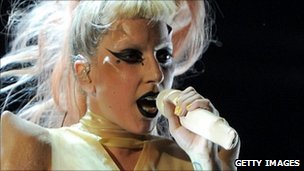 Lady Gaga's latest single has made US chart history by becoming the 1,000th number one on Billboard's Hot 100.
The Grammy-winning singer told Billboard magazine the milestone was "the greatest honour" of her career.
Born This Way is the 24-year-old's third US number one single, following her 2009 hits Just Dance and Poker Face.
The Hot 100 chart, which began in 1958, ranks songs by a mix of radio airplay, sales and streaming activity data.
Born This Way, which Lady Gaga performed at the Grammy awards last weekend, is only the 19th single to debut at number one in the Hot 100's history.
With digital sales of 448,000, the track also broke the record for the largest amount of downloads of a song by a female artist in its first week on release.
In other chart news, the cast of US show Glee has set a new record for the act with most songs on the Billboard chart.
Thanks to the show's policy of releasing multiple songs digitally after each episode, its cast has seen 113 tracks in the Hot 100 - five more than Elvis Presley charted over his entire career.
'The King's Speech' leads Oscar races
A film about a stuttering British monarch, a movie about the founder of Facebook, a sci-fi thriller and a John Wayne classic remake topped the list of movies honored with Oscar nominations announced Tuesday.
"The King's Speech," about Britain's King George VI, gathered 12 nominations, including for best picture and in three of the four acting categories.
"True Grit," based on the same book as the 1969 John Wayne film, was nominated 10 times, including for Jeff Bridges for best actor, Hailee Steinfeld for best supporting actress and in the best movie competition.
"The Social Network," which told the story of how a college student created Facebook, is up for Academy Awards in eight categories, including best picture and Jesse Eisenberg's nomination for best actor.
"Inception," a film that explores the human mind and dreams, got eight nominations, including for best picture.
The nominees for best picture are "The Social Network," "The King's Speech," "The Fighter," "True Grit," "Black Swan," "The Kids Are All Right," "Inception," "Toy Story 3," "127 Hours" and "Winter's Bone."
The best actor nominees are Javier Bardem, who starred in "Biutiful," Bridges for "True Grit," Eisenberg for "The Social Network," Colin Firth for "The King's Speech" and James Franco for "127 Hours."
The best actress nominees are Annette Bening for "The Kids Are Alright," Nicole Kidman for "Rabbit Hole," Jennifer Lawrence for "Winter's Bone," Natalie Portman for "Black Swan" and Michelle Williams for "Blue Valentine."
"What an extraordinary journey this film has taken me on," Nicole Kidman said. "'Rabbit Hole' has been a labor of love and I'm so thankful to John Cameron Mitchell, David Lindsay-Abaire and the brilliant cast. This nomination reflects all of the heart and soul that these people have put into it, and I can't thank them enough."
Nominees for best supporting actress are Amy Adams for "The Fighter," Helena Bonham Carter for "The King's Speech," Melissa Leo for "The Fighter," Steinfeld for "True Grit" and Jacki Weaver in "Animal Kingdom."
Best supporting actor nominees include Christian Bale for "The Fighter," John Hawkes for "Winter's Bone," Jeremy Renner for "The Town," Mark Ruffalo for "The Kids Are All Right" and Geoffrey Rush in "The King's Speech."
Australian actor Rush learned about his best supporting actor nomination after performing in a stage play in Sydney, Australia. "Suddenly at the end they gave us this roaring standing ovation," Rush said.
"This story has struck such a rich, resonant chord with audiences of all ages, which is very exciting," Rush said. "To have your work honored by your industry peers is even better."
"Inception," a film that explores the human mind and dreams, was nominated for eight Oscars, mostly in the technical categories.
Other best movie contenders that received multiple nominations include "The Fighter" with seven, "127 Hours" with six, and "Black Swan" with five.
"The Kids Are All Right," "Toy Story 3" and "Winter's Bone" each received four Oscar nominations.
The winners will be announced in a live broadcast from Hollywood's Kodak Theatre on February 27.