
Indian billionaire Ambani questioned in telecom scandal
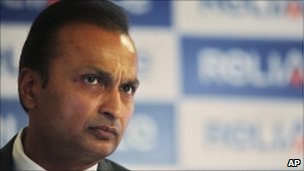 Anil Ambani, the billionaire chairman of Reliance Communications, has been questioned as part of a probe into a phone-license selling scandal.
A statement from the company said the visit was voluntary.
The ongoing investigation is looking into whether mobile phone licences were sold at below-market prices in 2008.
Claims that the government lost more than $30bn (£18.6bn) in revenue have caused months of political conflict and shaken investor confidence.
Reliance Communications shares have declined 30% in value this year, making them among the worst performers on the Bombay Stock Exchange's main Sensitive Index.
On Thursday, JP Morgan cut its target price on the mobile operator by 49% to 82 rupees.
It cited lower estimates for the firm's wireless and broadband businessnes and issues related to license regulations.
Shares of Reliance Communications were at 98.90 rupees in early morning trade in Mumbai.
Wider reach
As well as hurting the stock market, the scandal has caused political turmoil in India as well.
They allege that Mr Raja violated guidelines in the second-generation (2G) phone license sale, and conspired to favour certain telecom companies.
India's chief auditor said in November that the 2G licences were sold for about a tenth of their value. The government has questioned the figure, claiming it is too low.
One of the phone companies that allegedly benefited during the license sale was Swan Telecom, in which Reliance Communications is an investor.
However, Reliance Communications said that it only held a small percentage of the equity share capital of Swan Telecom at the time and that none of its employees benefited.
Deeper problem?
This and other corruption scandals have rocked India's ruling coalition government.
On Wednesday, Prime Minister Manmohan Singh vowed to punish those found guilty of fraud.
"I wish to assure the country as a whole that our government is dead serious in bringing to book all wrongdoers, regardless of the position they may occupy," the prime minister said.
Last week, the stock market found itself caught up in the twists and turns of this scandal.
A sudden sell off last Wednesday in Mr Ambani's Reliance ADA Group wiped $2.5bn from its value.
Reliance ADA Group is the parent company of Reliance Communication and five other subsidiaries.
The company blamed the slump in share price on "baseless and motivated rumours" spread by rivals.

Bernard Madoff says banks knew of Ponzi scheme
Convicted fraudster Bernard Madoff has blamed others for being "complicit" in his scheme, which fleeced investors of billions of dollars.
Madoff is serving 150 years in jail in the US for a $65bn (£40bn) fraud which deprived thousands of investors of their savings.
Now he has told the New York Times a variety of banks and hedge funds "had to know" about his Ponzi scheme.
Such schemes pay out using new investor money rather than from any profits.
Madoff claimed banks and hedge funds who had dealings with his investment advisory firm showed a "willful blindness" toward his activities.
He also alleged they failed to examine discrepancies between his regulatory filings and other information.
"But the attitude was sort of, 'If you're doing something wrong, we don't want to know'," he said.
However, he did not assert that any specific bank or hedge fund knew about or was an accomplice in his Ponzi scheme.
His scheme had been running since the early 1990s.
It unravelled when Madoff's investors, hit by the economic downturn, tried to withdraw about $7bn, but he could not produce the money.
Madoff also told the New York Times that his family knew nothing about his crimes.
UK unemployment total rises again
UK unemployment rose by 44,000 to almost 2.5 million in the three months to the end of December, the Office for National Statistics (ONS) has said.
Youth unemployment rose to a fresh record high, with more than one in five 16 to 24-year-olds out of work after a rise of 66,000 to 965,000.
The unemployment rate is now 7.9%, with youth unemployment running at 20.5%.
The number of people claiming Jobseeker's Allowance also increased, by 2,400 last month to 1.46 million.
Prime Minister David Cameron said unemployment, particularly among the young, was "a matter of great regret".
But he stressed that it had been a problem for some time.
The number of people in part-time work because they could not find a full-time job rose by 44,000 to 1.19 million, another high since records began in 1992.
"The latest UK labour market figures provide further evidence that the jobs recovery has gone into reverse," said economist Vicky Redwood.
Long-term unemployment also deteriorated, with 17,000 more people out of work for more than a year, to a total of 833,000.
Other data from the ONS showed that average earnings rose by 1.8% in the year to December last year, slightly down on the 2.1% growth in the year to November.
The figures also showed that unemployment fell in Scotland by 13,000, but rose in England, Wales and Northern Ireland.
'Less impressive'
The government said the latest figures showed that unemployment was starting to stabilise.
"We've got a long way to go and I want to see these figures start to come down, but certainly the evidence is over the past month things have settled down and we are not seeing the increases we saw earlier in the last quarter," said Employment Minister Chris Grayling.
There were 40,000 more job vacancies in the three months to January than in the previous three months. This is often seen as an indicator of the health of the economy and whether companies are creating jobs.
But the ONS said that most of these new vacancies were temporary jobs, working on the 2011 Census. Excluding this, there were 8,000 more vacancies.
Shadow work and pensions secretary Liam Byrne said this was a sign that the government could not rely on the private sector to create jobs.
"There are still five people chasing every single job and in about a hundred constituencies, 10 people are chasing every job," he told BBC News.
'Disappointing'
Most analysts still expect unemployment to rise in the coming months, largely because of public sector spending cuts implemented by the government, which are designed to bring down the UK's budget deficit.
"The labour market data are disappointingly softer overall and fuel our suspicion that unemployment is likely to trend up gradually in 2011 in the face of below-trend growth and increasing job losses in the public sector," said Howard Archer at IHS Global Insight.
Economists suggest the economy would have to grow at an annual rate of about 2% for unemployment to fall.
In the final three months of last year, the economy shrank by 0.5%, and although many analysts expect a return to growth in the current quarter, few expect GDP to top 2% this year.
Speaking at a press conference to launch the latest Inflation Report, the governor of the Bank of England said it had lowered its growth forecasts following the weak growth data at the end of the year.
Mervyn King also said the Bank expected inflation to remain high over the next year.
Latest figures released on Tuesday showed that the Consumer Prices Index measure of inflation had hit 4%. This was expected to increase pressure on the Monetary Policy Committee to start raising interest rates.
The markets are expecting a series of rate rises this year. The question for many is how far rates will have to rise.
However, there is still the concern about the possible effect any increases would have on the economic recovery.
For that reason, economist James Knightley from ING said the unemployment figures supported their view that interest rates may not rise as much as the market anticipates.
Oil prices rising on concerns of spreading unrest
Oil prices climbed yesterday as anti-government demonstrations broke out in Libya and Israel’s foreign minister claimed that Iran is about to send two warships through the Suez Canal on the way to Syria. The news added to tension in the region and “absolutely moved markets,” according to PFGBest oil analyst Phil Flynn. He said traders are worried that spreading unrest in the Middle East will disrupt oil production and shipments in the region. “The face of the Middle East is changing in pretty dramatic fashion in a very short period of time,” he said. “The risk to supply is going up.”
Benchmark West Texas Intermediate crude for March delivery rose 67 cents to settle at $84.99 a barrel on the New York Mercantile Exchange. In London, Brent crude rose US$2.14 to settle at US$103.78 per barrel on the ICE Futures exchange. Analyst Fadel Gheit noted that the regime change in Egypt could bleed into other countries and cause supply disruptions in Saudi Arabia and other major producers. Crude prices rose even though oil supplies grew in the US, the world’s largest petroleum consumer.
The US Energy Department said Wednesday that US stockpiles of crude and gasoline both rose again last week while distillates, which include heating oil and diesel, declined. All three products are at or above the average range for the past five years. Meanwhile, gasoline pump prices reached a 28-month high yesterday even though demand for gas is weak. The US average for regular gasoline rose to US$3.133 a gallon. That’s about US$1.20 a gallon more than the price at the pump two years ago, according to AAA, Wright Express and the Oil Price Information Service.
Higher gas prices are a result of several factors that have created a bottleneck for supplies of West Texas Intermediate crude stored at Cushing, Oklahoma, which is the delivery point for oil traded on the Nymex. More North American oil is being produced and delivered to the Cushing facility, but existing pipelines can’t move all of the crude out to refineries. And there are no pipelines to Gulf coast refineries, which have the capacity to produce about half the nation’s daily supply of gasoline.
In addition, the price of Brent crude, used by refineries on the US East Coast, is soaring. Although it is produced in Europe’s North Sea, Brent is used to price oil produced in other parts of the world, including South America and Africa, which is shipped to refineries in the US. In other Nymex trading, heating oil rose 4.58 cents to settle at US$2.7748 a gallon and gasoline gained 5.59 cents to settle at US$2.5447 a gallon. Natural gas lost 5.5 cents to settle at US$3.921 per 1,000 cubic feet.
Inflation will rise sharply, says Mervyn King
nflation will rise sharply in the first half of this year before falling back next year, the Governor of the Bank of England, Mervyn King, has said.
But he said there were "large risks" that inflation could overshoot or undershoot the Bank's 2% target.
He reiterated his belief that external factors, such as rising food and energy prices, are the main cause of rising prices in the UK.
Mr King said growth would be weaker than the Bank forecast in November.
He also sought to play down reports the Bank had signalled that interest rates would need to rise this year in order to try to bring down inflation.
"Some people are running ahead of themselves and saying that we are pre-announcing or laying the ground for a rate rise," Mr King said.
"That decision has not been taken and won't be taken until we get to the next meeting or the following meeting, or it may be many quarters."
'Large risks'
In the Bank's inflation report, the governor said that once cost pressures from high commodity prices subside, "CPI inflation will then fall back. But the extent to which it will do so is uncertain, and there are large risks in both directions."
The governor said if businesses and households expected that high inflation was here to stay, prices and wages might rise even more quickly.
On the other hand, as the effects of the rise in VAT to 20% implemented in January and imported cost pressures began to diminish, there was a risk that weak growth "will push inflation well below target," he said.
On Thursday, official figures showed that inflation, as measured by the Consumer Price Index (CPI), rose to 4% in January from 3% in December. Measured by the Retail Price Index (RPI), which includes mortgage interest payments, it rose to 5.1% from 4.8%.
Mr King was forced to write a letter to the Chancellor, George Osborne, to explain why CPI inflation was twice the Bank's target rate.
Mr King said there were "real differences of view" in the Bank's Monetary Policy Committee (MPC), which sets interest rates, about "the likely path of inflation in the medium term".
Two members, Andrew Sentance and Martin Weale, have already voted to raise interest rates, currently at a record low of 0.5%, to combat rising prices.
The split reflects the wider debate among economists, with some arguing that rates should be increased to prevent inflation rising further, and others maintaining that a rate rise would jeopardise the fragile economic recovery.
In light of Tuesday's figures showing inflation rising faster, and Mr King's letter to the chancellor, more observers believed the Bank would raise rates sometime over the summer.
Mr King wrote: "The MPC's-central judgement, under the assumption that Bank Rate increases in line with market expectations, remains that inflation will fall back so that it is about as likely to be above the target as below it two to three years ahead."
Before the inflation report, the market was expecting a rate rise in May, with perhaps two further rises later in the year.
Previously, Mr King had said that inflation would come down without interest rate rises.
'Over-interpreted'
However, some observers read Mr King's comments on Wednesday as meaning a rate rise was not imminent.
"It looks as though markets may have over-interpreted [Mr] King's line on inflation in yesterday's letter to the chancellor," said Philip Shaw at Investec.
Raghav Subbarao at Barclays Capital said: "We think the market interpreted the letter yesterday as being more hawkish... Clearly the inflation report is dovish and downplays the possibility of a rate rise."
Mr King said the recovery was "unlikely to be smooth", while the Bank's economic growth projection for most of this year was now "weaker" than it forecast towards the end of last year.
The BBC's Stephanie Flanders suggested that the Bank's expectation of slower growth and higher inflation would have an impact on its interest rate policy.
"The implication is that Bank Rate will need to go up sooner than the MPC previously thought, and without such a strong economic recovery," she said.
Captain Bruno ensures police advance to the finals
 A superb century from Police Captain Garvin Bruno ensured that Police beat the Jamaican All-Stars to advance to the Finals as the Minster Energy Drink Cricket Competition continued on Saturday 5th February 2011 at the Down Town Ball Park.
The All-Stars won the toss and asked the Police to take the first Strike who then posted a massive total of 261 runs for 6 wickets from 20 overs. Garvin Bruno made 112 runs which was decorated with13 fours and five sixes and Damian St Ange made boundary filled 56 Runs ten fours and one six and Marcus Charlemagne chipped in with forty runs which consisted of six fours.
Bowling for The All-Stars Tyrone Wright claimed 3wickets for forty eight runs from four overs and Ian Heath took two wickets for forty two runs from four overs.
When the All- Stars batted the reached 155 runs for 8 wickets from 20 overs.
Top scorers were Calvin Aaron with 32 runs and Gareth Butler with 31 runs
Bowling for the Police Vaurice Jervis Captured 3 wickets for 31 runs from 4 overs and Garvin Bruno had 2 wickets for 12 runs from 3 overs.
Meanwhile as the competition continued yesterday 6th February at the same venue, Beaches remain unbeaten to move on to the finals as the washed away Quality.
Quality won the toss and elected to bat first and made 134 runs for 8 wickets from 20 overs. The top scorer was Naga kutha-lingham with 38 runs and Pawan Kumar contributed 31 runs
Bowling for Beaches Odayne Ewart bagged 3 wickets for 23 runs from 4 overs and Jesse Alexander took 2 wickets for 16 runs from 4 overs.
Beaches, in reply reached 135 runs for 2 wickets from 13.4 overs. Jesse Alexander was the top scorer with an unbeaten 59 runs and Odayne Ewart scored 33 runs.
Bowling for quality Andy Kutha-lingham took 1 wicket for 24 runs from 4 overs.
The final cricket match is set for Sunday with the Police taking on Beaches. Match Starts at 12 pm.
Mulling latest trade reports as deadline nears

For the next eight days, the trade reports are going to come more and more quickly. Reporters will disagree on lots of details — how serious certain talks are, whether the Knicks will have enough cap space to sign Carmelo Anthony as a free agent — but if you look carefully, some larger truths will begin to emerge. Here are a few, with my take:
• New York’s package in ‘Melo deal. The talks between Denver and New York have reached their most serious stage. The question now is whether the Knicks can get the Nuggets to accept an offer that is palatable from New York’s perspective. If the two sides can’t meet in the middle, Denver may simply keep Anthony and force him to either accept its extension or take his chances in free agency under a new collective bargaining agreement that will be less favorable to the players.
What, then, is the middle between Denver and New York? That’s impossible to know for certain, but if you read the most recent reports from Yahoo! Sports’ Adrian Wojnarowski, Newsday‘s Alan Hahn and the New York Daily News’ Frank Isola, a few things come into view.
The Knicks appear content to center a package on Wilson Chandler or Danilo Gallinari, but not both. And according to Hahn, the Knicks may be open to including a swap of Raymond Felton for Chauncey Billups. Such a move would trim Denver’s player salary bill this season by about $6.1 million — a significant thing for a team set to pay the luxury tax. It also gives the Nuggets a veteran point guard to help guide Ty Lawson for another season. Toss in Eddy Curry’s expiring contract and a first-rounder the Knicks could pry from Minnesota for Anthony Randolph, and you may have something.
The guess here — and it’s just a guess — is that the Knicks would rather part with Chandler than Gallinari. Both are positional tweeners, but Chandler, with more of a mid-range game and a less proven track record from three-point range, is more duplicative of Anthony. He’s also a restricted free agent in line for a decent payday; the Knicks will have to renounce Chandler if they end up having to chase Carmelo in the free-agent market.
If the Nuggets insist on Gallinari instead of Chandler — or on adding Landry Fields into the Chandler package — does that end things? What if they attempt to pawn off Al Harrington or Chris Andersen? For a Knicks team looking to maintain some future payroll flexibility, those long-term deals could be lethal to their Chris Paul/Deron Williams/Dwight Howard dreams.
• Could Knicks get ‘Melo in free agency? Let’s revisit this one last time: There is some major disagreement over whether the Knicks could sign Anthony as a free agent if it comes to that, but all that analysis — including what I’ve written — is ultimately not very meaningful, since we don’t know what the next collective bargaining agreement will look like.
Here’s what we do know: The current salary cap is a shade more than $58 million. The Knicks have $43.4 million in salary committed for next season, and that doesn’t include Chandler or Andy Rautins’ non-guaranteed deal. They’ll also have to set aside some money for their first-round pick and a small charge for each empty roster slot.
Would that leave enough room, under current rules, to sign Anthony to a max contract? Maybe — if the Knicks can move Randolph and one other player (such as Ronny Turiaf), they could open the requisite space.
But as Larry Coon reminds us, we don’t know what the salary cap will be when Anthony can actually become a free agent. It could be $58 million. It could be $50 million with fewer exceptions. It could include a much lower maximum salary. Heck, it could even include some sort of amnesty provision for Anthony’s class of free agents and teams unlucky (or unwise) enough to have their cap room slated for the exact moment the CBA disappears.
We just don’t know, which is why saying the Knicks are guaranteed to be able to snag ‘Melo as a free agent may be assuming too much.
• Hornets eyeing J.R. Smith, Jamison.
The Hornets are active, according to both Wojnarowski and Ken Berger of CBSSports. That’s not a surprise. This team, ranked just 21st in points per possession, needs more reliable scoring options if it wants to seriously compete in the Western Conference playoffs. Two names keep coming up in reports: Smith and Antawn Jamison.
Smith is an on expiring contract, which makes him extra attractive. The Hornets would seem to already have a Smith-like spark plug in Marcus Thornton, but they are not quite equivalent players. Smith is a couple of inches taller, allowing him to play some nominal small forward when the Hornets go to three-guard sets. He’s better off the dribble and a far more creative passer when he decides to play solid team ball (which isn’t close to all the time).
Both are inconsistent defenders, but I’d like to see what Smith could do on this end in a more focused, accountable system.
As for Jamison? I’d steer clear. He’s a pick-and-pop upgrade over Jason Smith and David Andersen, and he has an array of flip shots they couldn’t dream of. But he’s set to make $15 million next season, and that’s a lot to pay a guy who would serve as a backup player on the current Hornets team. That’s money I’d rather use to try to re-sign David West (via Bird Rights, if they still exist), who is a much better defender and rebounder than Jamison now.
The Hornets have expiring or non-guaranteed (in terms of future money) deals tied to Willie Green, Marcus Banks and Andersen to use as trade bait.
• Cavs working hard to deal. That seems to be the consensus, and the Cavs would obviously love to dump Jamison. They also have the huge trade exception they received in the LeBron James deal, and Berger reports that they are willing to use it to absorb another team’s unwanted contract — if they get something nice (a young asset, a first-rounder) in return. That exception also positions the Cavs to be facilitators in three- or four-team deals.
Their most marketable player, in terms of talent, is probably Anthony Parker, with both Chicago and Boston potentially interested, according to Berger. That’s not surprising; I mentioned Parker as someone the Celtics might target should they receive indications it might take Marquis Daniels longer than hoped to recover from a bruised spinal cord.
Parker’s deal is expiring, so the Cavs would need some incentive to flip him. It will be interesting to see if anyone bids anything more than a second-rounder and a small chunk of cash.
• The buyout candidates. The Celtics are reportedly interested in both Troy Murphy and Richard Hamilton should either become available, and Wojnarowski lists a bunch of teams that would give Murphy a look. I gave my thoughts on this Tuesday.
• The Suns are floating Josh Childress, according to Wojnarowski. Good luck. He’s set to make $27 million over the four seasons after this one. He can be a very useful player, but he’s going to be tough to move at that price. I’d have liked to have seen Phoenix give him a little more run earlier in the season, but that ship may have sailed now that Mickael Pietrus is playing so well as the team’s designated lockdown wing defender off the bench (along with Jared Dudley).
Source:Zac Lowe on 'The Point Forward'
Lance Armstrong confirms retirement from cycling
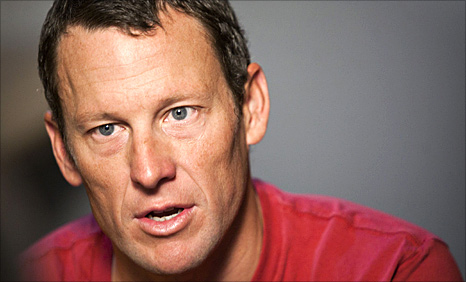 Seven-time Tour de France winner Lance Armstrong has confirmed he has retired from competitive cycling for good.
The American, 39, retired from cycling in 2005 but returned for the 2009 Tour, where he finished in third place behind winner Alberto Contador.
"I can't say I have any regrets. It's been an excellent ride," he said.
Armstrong is facing a US federal investigation into allegations of doping after former team-mate Floyd Landis claimed he used banned drugs.
The investigation is examining whether Armstrong used government money to dope and win his seven Tours while riding with the now-disbanded US Postal team.
It follows allegations made by Landis, who was stripped of the 2006 Tour de France title following a positive drugs test.
But Armstrong, who has never tested positive for performance-enhancing drugs, has consistently denied the allegations.
"I can't control what goes on in regards to the investigation," said the Texan. "That's why I hire people to help me with that. I try not to let it bother me and just keep rolling right along. I know what I know.
"I know what I do and I know what I did. That's not going to change."
Armstrong finished in 67th place in his final competitive race of his career in last month's Tour Down Under in Australia, finishing six minutes and 42 seconds behind race winner Cameron Meyer.
In 1996 Armstrong had been given less than a 50-50 chance of survival after being diagnosed with testicular cancer as the disease spread to his lungs and brain.
However, after an aggressive bout of chemotherapy, he made a full recovery and returned to the sport in early 1998, going on to dominate the race from 1999 to 2005.
He set up the Livestrong cancer charity which gained international recognition as the organisation's distinctive yellow wristbands were worn by millions of people worldwide.
Last year he rode for the Astana team but after a public dispute with team-mate Alberto Contador he left to form his own team, backed by American retailer RadioShack, finishing the blue riband race in 23rd place.
"I have no regrets about last year either," added Armstrong. "The crashes, the problems with the bike - those were things that were beyond my control."
Armstrong remains the only rider in the history of cycling to win the Tour de France on seven different occasions.
"His contribution to cycling has been enormous, from both the sporting point of view and his personality," said International Cycling Union president Pat McQuaid.
"All sports need global icons and he has become a global icon for cycling. The sport of cycling has a lot to be thankful for because of Lance Armstrong."
3 members of the Haitian U-17 team have malaria
The Ministry of Health last night confirmed that three members of the Haitian football team which is in Jamaica for the CONCACAF 17 World Cup qualifying championships were found to have malaria.
In a release, the ministry said the three people with the imported cases of malaria are currently being treated. Other members of the team are displaying symptoms of the illness and are also being treated, the ministry said.
The Ministry has recommended that in the circumstances those found to have the disease not participate in the tournament and therefore return to Haiti. These arrangements are presently being made.
The Ministry has implemented its surveillance system to be able to quickly identify and treat any other cases. Vector control measures, including fogging of adult mosquitoes have also been put in place.
There have been no locally transmitted cases of malaria since the start of the year.
Malaria is transmitted when a female Anopheles mosquito infected with a malaria parasite bites an individual.
Symptoms include fever, chills and headaches, muscle aches and tiredness.
Sri Lankans cool Windies
 West Indies suffered a dent to their preparations for the World Cup, when Kumar Sangakkara, Tillakaratne Dilshan, and Thilan Samaraweera struck half-centuries to lead Sri Lanka to a four-wicket victory in their final 'official' warm-up match yesterday.
West Indies again failed to ease concerns about their bowling, as the Sri Lankans successfully chased 282 for victory with 15 balls remaining at the Premadasa Stadium.
Sulieman Benn was the pick of the West Indies bowlers with three wickets for 40 runs from his allotment of 10 overs, but none of the other bowlers matched either his control or penetration, as Sangakkara, the Sri Lanka captain, led the way with 71, Dilshan supported with 62, and Samaraweera made 55.
The teams now continue their final preparations for the World Cup, which opens on Saturday, but West Indies will have to wait until Thursday next week to play their opening match against South Africa at the Feroz Shah Kotla Stadium in Delhi.
Chris Gayle had top-scored with eight fours and one six in 58 from 38 balls, and Darren Bravo struck five boundaries in 54 from 78 balls, as West Indies, choosing to bat, were dismissed for 281 in their allocation of 50 overs.
Supporting knocks
Supporting knocks came from Ramnaresh Sarwan (39), Carlton Baugh Jr (29 retired out), West Indies captain Darren Sammy (21), and Dwayne Bravo (20).
West Indies' batting was again undone by Lasith Malinga with three for 33 from eight overs, Rangana Herath with three for 39 from his 10 overs, and fellow spinner Ajantha Mendis with two for 25 also from 10 overs.
West Indies were put on the back foot early, when Sri Lanka started their chase, with Dilshan marauding the visitors' seam bowlers to dominate an opening stand of 67 with left-hander Upul Tharanga.
Benn made the breakthrough when he snared Tharanga, and Sri Lanka laboured to 137 for three in the 24th over, when Samaraweera joined Sangakkara and the put home team firmly on course with a stand of 100 for the fourth wicket.
Although Benn snared Samaraweera and Mathews, as Sri Lanka stumbled through the closing overs, the result was never in question.