Greece approves austerity budget amid new strike
The Greek parliament has approved next year's budget, bringing in sweeping austerity measures.
The budget imposes more spending cuts and tax rises, as required by the European Union and the International Monetary Fund in exchange for a bailout to tackle the country's debts.
Ahead of the vote, public transport unions protesting over cuts to wages staged another 24-hour strike.
The governing Socialists won the vote by 156-142.
The budget aims to effect a deficit of 7.4% of GDP next year, down from about 9.4% this year.
Growth pledge
Greece needed to approve the budget to continue to receive a $144bn bailout fund created by European countries and the IMF.
Prime Minister George Papandreou insisted his austerity measures were working.
"We will not go bankrupt. In 2012 we will return to a path of growth. We will not give speculators or ratings agencies the pleasure.
"We will do whatever it takes to succeed. We will change this country."
The 24-hour strike caused traffic chaos in Athens as commuters struggled to get to work by car or taxi.
The strike included public transport such as buses and metro, although flights and ferries were not affected.
"The struggle by the workers, the pensioners and the unemployed against these anti-worker and anti-social measures continues," private sector union GSEE said in a statement.
"The workers and unions of the country will continue and intensify their action and struggles as long as these unjust and harsh neo-liberal policies continue," it added.
The BBC's Malcolm Brabant in Athens says the budget was expected to pass, but that dissent among MPs of the governing socialist party is growing.
The country has seen several general strikes this year.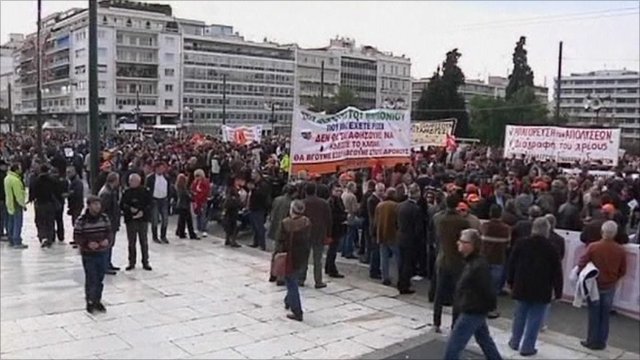

Snow paralyses transport in parts of Western Europe
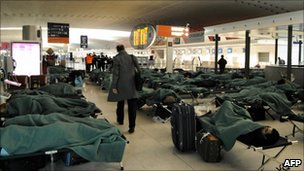 Two thousand travellers have been left stranded at the main Paris airport, Roissy-Charles de Gaulle, as further snow is hitting France, Belgium, Germany and the Netherlands.
Half the flights at Charles de Gaulle have been cancelled, largely because of a shortage of de-icing fluid.
In Belgium, police advised drivers to stay at home. Hundreds of accidents were reported across Germany.
While in northern Italy, heavy rain has caused flooding in parts of Venice.
Unusually high water levels were reported in the Venice lagoon and in the town of Vicenza, west of Venice, people were moved from their homes because of high river levels.
Traffic paralysed
In western Germany, traffic was described as paralysed in parts of North Rhine Westphalia. Further east, the railway line between Berlin and Hanover was blocked because of frozen overhead power-lines.
The French authorities, struggling to cope with the country's third major snowfall of the winter, said fresh supplies of de-icing fluid were on their way to Charles de Gaulle airport but would not arrive before Monday.
Passengers were also stranded overnight at Charleroi airport in Belgium although some flights were operating on Friday morning.
Cancellations were also reported at Brussels airport and buses were not running in the capital and other areas.
Heavy snow was forecast for parts of Scotland and north-east England on Friday and passengers hoping to return home for Christmas by train were warned of reduced services on several lines.
Taliban launch attacks along north Pakistan border
At least 11 soldiers and 24 militants have been killed in clashes near the Afghan border in north-west Pakistan, officials have said.
About 150 Taliban launched co-ordinated attacks against five Frontier Corps checkpoints in Mohmand tribal region, they said.
The Taliban said only two of their fighters had died.
The military has launched offensives in the region in recent months, but insurgent attacks have continued.
Amjad Ali Khan, administrator of Mohmand, confirmed that 11 soldiers had been killed following initial reports that three had died. He said 12 other soldiers had been injured.
Mr Khan said the Frontier Corps paramilitary troops had "repulsed" the militant attacks in the Baizai area which began at 0200 local time.
"The troops responded with artillery fire and raids by helicopter gunships, killing 24 militants," he said.
"Seven of their bodies are in our possession."
He said that the fighting ended later Friday morning.
However, Sajjad Mohmand, spokesman for the Taliban in Mohmand, told the BBC that only two insurgents had been killed in the clashes.
He said they had captured two soldiers alive and held the bodies of six others.
Security officials have rejected the claim, saying no soldiers are unaccounted for.
Mohmand is a transit point for insurgents crossing between Pakistan and Afghanistan and a stronghold of the Taliban and al-Qaeda.
The BBC's Aleem Maqbool in Islamabad says militants are proving that they can still carry out attacks, despite the military campaign against them.
Earlier this month, a twin suicide bomb attack at a government compound in Mohmand's main town of Ghalanai left 43 people dead. Local officials had been meeting tribal elders to discuss forming an anti-Taliban militia at the time of the blasts.
In July, another twin suicide bombing attack, also targeting tribal elders, killed more than 100 people in the village of Yakaghund in Mohmand.
Mohmand is one of seven Pakistani tribal areas.
Pakistan has faced growing pressure from Washington to launch a major ground offensive in the tribal region of North Waziristan, considered a fortress for militants fighting US-led troops in Afghanistan.
Islamabad has denied accusations that it is not doing enough to fight the Taliban in the restive north-west of the country.
It says more than 2,40 Pakistani soldiers have been killed fighting Islamist insurgents since 2002.
Pakistan supported the Taliban regime in Afghanistan from 1996-2001, but later became an ally of the US when it led an invasion in 2001.
Medvedev and Obama hail 'historic' nuclear arms treaty
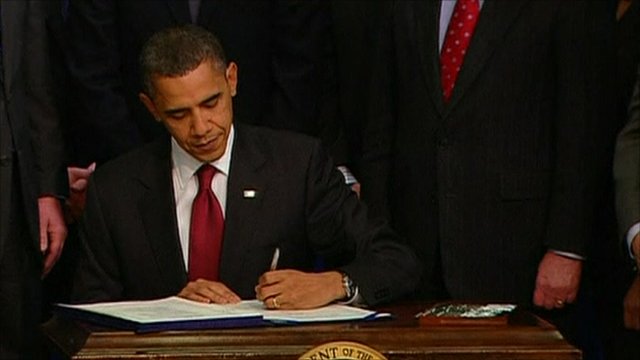
US President Barack Obama and Russian President Dmitry Medvedev have hailed the New Start nuclear arms treaty as a "historic event", the White House says.
In a telephone call on Thursday, Mr Medvedev congratulated Mr Obama on achieving Senate approval of the pact.
Mr Obama in turn said that the two had a "very productive year".
The US Senate approved the pact, which would reduce nuclear arsenals and allow their inspection, on Wednesday after some Republicans agreed to back it.
'Extra Russian checks'
In Russia, meanwhile, the Speaker of the State Duma (lower house), Boris Gryzlov, said MPs might approve the pact on Friday, with the upper house, the Federation Council, approving it in next year.
Mr Gryzlov said the Russian parliament would first check that the US Senate's ratification motion had not changed the text of the agreement.
The US Senate on Wednesday approved the treaty by 71 votes to 26, after months of wrangling and over the objections of some of the top Republicans in the chamber. Thirteen Republican Senators broke with party leadership and voted with the Democrats.
He has argued that ratification of New Start is vital to US national security and made the agreement a key plank of the president's much-heralded "re-set" of relations with Russia.
After the vote, Secretary of State Hillary Clinton said in a statement: "A responsible partnership between the world's two largest nuclear powers that limits our nuclear arsenals while maintaining strategic stability is imperative to promoting global security."
The New Start treaty, which will replace its lapsed predecessor, Start (Strategic Arms Reduction Treaty), was signed by the two presidents in April 2010.
It trims US and Russian nuclear arsenals to 1,550 deployed nuclear warheads - a cut of about 30% from a limit set eight years ago.
The treaty would also allow each side visually to inspect the other's nuclear capability, with the aim of verifying how many warheads each missile carries.
A previous inspection regime - part of the old Start treaty - expired a year ago.
In addition, there will be legally binding limits on the number of warheads and missiles that can be deployed on land, on submarines, and on bombers, at any one time.
Laurent Gbagbo denied access to Ivory Coast state funds
The Central Bank of West African States has blocked Laurent Gbagbo's access to Ivory Coast's funds and has recognised Alassane Ouattara as president.
The bank says only appointed members of Ivory Coast's "legitimate government" will have access to the deposits there.
The BCEAO had been urged to restrict access as it will make it difficult for Mr Gbagbo to pay the military, and increase pressure on him to step down.
Violence since last month's disputed election has left 173 people dead.
A senior UN official said its investigators had also found evidence of extrajudicial executions, more than 90 cases of torture and 500 arrests, as well as abductions, kidnappings, acts of sexual violence, and destruction of property.
The UN Human Rights Council expressed deep concern about the unrest, and unanimously adopted a resolution condemning the "atrocities".
Mr Gbagbo says the 28 November poll, meant to unify a country split by civil war in 2002, was rigged in rebel areas that backed Mr Ouattara.
The Independent Electoral Commission ruled that Mr Ouattara had won, a decision later certified by the UN. But the Constitutional Council said Mr Gbagbo had been elected, citing vote rigging in some areas.
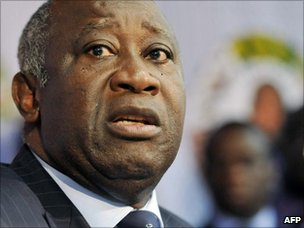 The UN General Assembly gave Mr Ouattara a further boost late on Thursday, by unanimously deciding to recognise his choice of diplomats as the sole official representatives of Ivory Coast to the UN.
At the same time as the UN Human Rights Council met in Geneva, finance ministers in West African Economic and Monetary Union (UEMOA) agreed to tell the BCEAO to hand over control of Ivory Coast's state accounts to Mr Ouattara.
"The Council of Ministers has noted the decisions of the UN, African Union and Ecowas [Economic Community of West African States] to recognise Alassane Ouattara as the legitimately elected president of Ivory Coast," a statement said, according to the Agence France-Presse news agency.
The council had decided that only "officials regularly designated by the legitimate government of Ivory Coast" could access the country's deposits and represent it within the UEMOA, the statement added.
The ministers instructed the central bank and all regional banks "to take all security measures to ensure the rigorous application of these measures".
The BBC's John James in Abidjan says the decision cuts off a major source of funds for Mr Gbagbo, who has shown no sign of stepping down.
Mr Gbagbo still has control of state television and the public support of the army, but without access to Ivory Coast's state accounts it is going to be extremely difficult to pay the salaries of soldiers and civil servants next month, even if he almost certainly has other financial reserves, our correspondent says.
But, analysts say the move by the finance ministers is risky, because Ivory Coast is by far the most important economy in the West African CFA monetary zone, whose eight members all use the franc CFA.
Although Mr Gbagbo has tried to paint the international condemnation of his decision to stay on in power as a plot by former colonial power France, West Africa's leaders have been some of the most vocal critics, our correspondent says.
On Friday, they will gather in Nigeria for an emergency meeting of the Economic Community of West African States (Ecowas) and are likely to consider a range of measures against Mr Gbagbo, including the possibility of military action, he adds.
It sent troops to bring peace to Liberia and Sierra Leone in the 1990s.
Assange dismisses threat of extradition to US
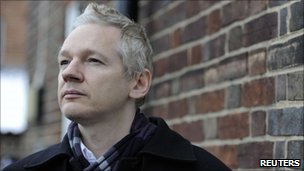
WikiLeaks founder Julian Assange has said it would be "politically impossible" for Britain to extradite him to the United States for espionage.
Mr Assange told the Guardian newspaper there was a "high chance" he would be killed if he was jailed in America.
US authorities are thought to be considering whether they could extradite him on espionage charges.
He is currently on bail facing extradition proceedings to Sweden on sexual assault allegations.
Mr Assange denies the claims and says the case is politically motivated.
His Wikileaks website has published tens of thousands of leaked US diplomatic cables.
Mr Assange said strong public support for him in the UK would make it difficult for the British to hand him over to the Americans.
"It's all a matter of politics. We can presume there will be an attempt to influence UK political opinion, and to influence the perception of our standing as a moral actor," he said.
"Legally the UK has the right to not extradite for political crimes. Espionage is the classic case of political crimes. It is at the discretion of the UK government as to whether to apply to that exception."
He also said that if was extradited to the US, there was a "high chance" of him being killed "Jack Ruby-style".
This is a reference to the man who killed Lee Harvey Oswald before he was brought to trial for the murder of President John F Kennedy.
Avatar is 'most pirated film of 2010'
Sci-fi epic Avatar was the most pirated film of 2010, according to data released by a file-sharing blog.
James Cameron's blockbuster was downloaded 16.6m times on one file-sharing site alone, TorrentFreak said.
Second on the list was comic book action film Kick-Ass, with 11.4m downloads, followed by Leonardo DiCaprio in Inception with 9.7m.
Last year's top-pirated film was JJ Abrams' Star Trek reboot, which was downloaded close to 11m times.
Cameron frequently touted 3D film making as the industry's best hope for combating piracy, however, it did not stop millions from downloading it for free.
Despite topping the list, Avatar still took nearly $2.8bn (£1.8bn) at the worldwide box office to become the highest-grossing movie ever.
Oscar-winning film The Hurt Locker also featured in the top 10 list at number nine.
Although the film had already been available on file-sharing sites for most of 2009, its popularity increased online after it won six Oscars this year.
Box office
Notable absentees from the top 10 include two of the best grossing movies at the box office this year - Toy Story 3 and Alice in Wonderland.
However, Kick-Ass and Matt Damon war film Green Zone were both hugely popular among the downloading public, while their box office figures were relatively modest.
TorrentFreak said the figures were collected from several sources, including reports from thousands of BitTorrent trackers.
All release formats, including versions filmed using cameras in cinemas were counted.
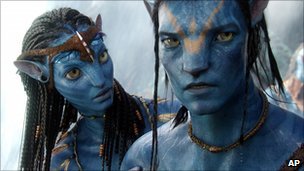
1. Avatar - 16,580,000 downloads
2. Kick-Ass - 11,400,000 downloads
3. Inception - 9,720,000 downloads
4. Shutter Island - 9,490,000 downloads
5. Iron Man 2 - 8,810,000 downloads
6. Clash of the Titans - 8,040,000 downloads
7. Green Zone - 7,730,000 downloads
8. Sherlock Holmes - 7,160,000 downloads
9. The Hurt Locker - 6,850,000 downloads
10. Salt - 6,700,000 downloads
Torrentfreak.com
Barack Obama to sign gay military law
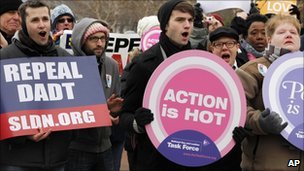
US President Barack Obama is to sign a landmark law allowing gay people serving in the military to be open about their sexuality.
Mr Obama had campaigned to change the 1993 "don't ask, don't tell" law, overturned by Congress last week.
More than 13,000 service members have been dismissed under the policy, enacted under President Bill Clinton in 1993 as a compromise.
Opponents argue that the change will damage troop morale at a time of war.
But earlier this month, a Pentagon report said that allowing openly gay troops would have little impact on the cohesion of US forces fighting in Iraq and Afghanistan.
The outgoing Senate and House of Representatives approved the new law last week, with moderate Republicans joining the Democratic majority.
Guidelines
So many activists are expected at the signing ceremony that the White House has booked a larger room for the event.
But correspondents say that the planned celebration parties by gay rights campaigners and members of the military may be premature.
Guidelines need to be finalised on practical questions ranging from how to educate troops to how sexual preference should be handled when army staff are organising sleeping arrangements in military barracks.
Those guidelines need to be signed off by President Obama, Defence Secretary Robert Gates and Admiral Mike Mullen, chairman of the Joint Chiefs of Staff.
And even once that is complete, the new law will not officially take effect for another 60 days. Until then, the current ban remains in place.
Kew beat Bottle Creek in Soccer


The North Caicos community football league, which started in early September came to an end when the finals was staged on Sunday 19th December 2010.
The competition had three teams, each representing a settlement; Whitby, Bottle Creek & Kew. Last year's winner Whitby, was eliminated by Bottle Creek, who only needed a draw to join Kew in the final...
The game started on time at 2:30pm and immediately after kick off KEW F.C. took the initiative and pounced on Bottle Creek with a series of crafty plays and a barrage of shots to goal. This forced bottle Creek's goal-keeper on the defense creating outstanding saves. However the offensive onslaught by KEW paid divident in the 21st minute. The main striker for KEW broke loose from his marker with only the goalkeeper to beat, he craftily "chipped" the ball around the keeper into the back of the net...The fans stormed the field in jubilation and excitement...
The score remained 1-0 until the 83rd minute, when KEW extended their lead with a thunderous shot from one of their midfielders that gave Bottle Creek moments of glory in the game but, to no avail. They squandered their opportunities with hurried shots and weak attempts to goal which left them empty at the end of play...
The vistors prevailrf and KEW F.C. hoisted the 2010 trophy...

Players' union wants 2022 World Cup switched to winter
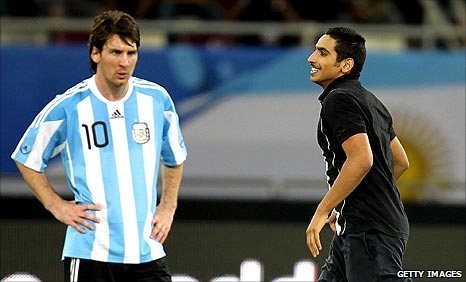
The world footballers' union believes the 2022 World Cup in Qatar should be held in the winter instead of summer.
With Gulf summer temperatures hitting 50C, FIFPro has said it is pleased Fifa is open to changing the tournament's timing to address the issue of heat.
The president of world football's governing body, Sepp Blatter, backed a possible switch to January 2022.
And in a statement, FIFPro said it "does not foresee any insurmountable problems in this regard".
In the vote by Fifa's executive committee on 2 December, Qatar beat Australia, Japan, South Korea and the United States to host the World Cup, which is traditionally held in June and July.
But the secretary of FIFPro's technical committee, Tijs Tummers, has questioned the decision to award Qatar the tournament based on it still being held in the summer.
"It is not sensible in a country with an average temperature of 41C in June and July, a midday temperature of 50C and, above all, extremely high humidity," Tummers said.
"Tourists are advised not to travel to Qatar in the summer months and inhabitants leave the country en masse during this period.
"[So] the summer months in Qatar also do not provide suitable conditions for a festival of football such as the World Cup should be, including for the supporters."
When Qatar was announced as host, German World Cup-winning captain and coach Franz Beckenbauer voiced concerns about the health risk the heat could pose for players.
However Tummers insisted that by switching the dates the weather concerns could be countered, while players might be in better condition than if the tournament was held in its traditional slot at the end of a gruelling European season.
"Space will have to be made for the tournament, even though many countries already have a winter break," the secretary of FIFPro's technical committee added.
"In Europe, competitive matches will have to be played in August and the second half of May and the first half of June.
"If you look at what happened last weekend with weather problems in Europe because of heavy snowfall, you could see this as an advantage rather than as a problem.
"And it might, perhaps, turn out that the players will be fitter at the start of a winter World Cup than was the case last summer at the World Cup in South Africa."