
Shaquille O’Neal Conducts the Boston Pops
The Boston Globe now refers to him as “The Big Maestro.”
NBA star Shaquille O’Neal – in traditional black tie and tails – was the featured guest conductor for the Boston Pops Orchestra and Tanglewood Festival Chorus during a concert Monday (Dec. 20) at Boston’s Symphony Hall.
Before his big moment, the Boston Celtics center got some tips from Pops conductor Keith Lockhart, who told him to “just keep going’’ when he got a little nervous with the baton.
But the NBA legend quickly caught on during rehearsal, guiding the Pops in his own way through lively renditions of “Sleigh Ride,’’ The Jacksons’ “Can You Feel It?’’ and, perhaps to pad the hopes of Celtics fans, “We Are the Champions.’’
He told reporters before going live that he had a newfound respect for conductors.
“My arms are shot, he said.
Asked how appearing with Lockhart compared to sharing the stage with teen idol Justin Beiber, he said, “I gotta put him a notch above Justin Beiber.’’

Hot 97 DJ Apologizes for Offending Haitians
DJ Cipha Sounds of New York’s Hot 97 has angered local leaders and members of the Haitian community after saying on-air Friday morning, “The reason I’m HIV negative is because I don’t mess with Haitian girls.”
The jock, whose real name is Luis Diaz, immediately apologized after the station was flooded with phone calls. He was also slammed on Twitter and Facebook.
Many listeners had originally thought his co-host, Peter Rosenberg, made the remark. But Diaz, a 34-year-old Bronx native of Puerto Rican descent, admitted that it was him, according to the New York Daily News.
“I made a stupid, tasteless joke that was a one-liner that was taken totally the wrong way,” he said in an on-air apology. “I want to say sincerely that I apologize.”
Diaz, who also deejays parties and has hosted shows on MTV, said during his apology that he does “nothing but rep for the Haitian people.”
He continued, “I said something stupid that I’m embarrassed about.”
But the apology wasn’t enough for a coalition of Haitian community leaders planned a rally earlier today outside of the Hot 97 headquarters on Hudson Street.
Stanford suspicions seen in the WikiLeaks cables
Financier Allen Stanford was suspected of irregular dealing, long before he was accused in a $7.2 billion Ponzi scheme, WikiLeaks cables report.
WikiLeaks is the international cyber organization at the center of massive diplomatic and military leaks during 2010.
As reported Monday by The Guardian, a British newspaper, the cables show that US diplomats were told to avoid contact with Stanford or being photographed with him at least two years before his 2009 fall from grace.
Stanford, four executives with Stanford Financial Group, and a Antiguan bank regulator, were indicted in 2009. He is set to go on trial in Texas in January, although federal court observers there speculate that it won't begin then after numerous attorney changes and other court drama surrounding Stanford.
Embassy staff concerns are revealed in a cable dated May 3, 2006, detailing the first meeting between Stanford and the US ambassador at a breakfast meeting in Barbados which was also attended by the Barbados prime minister and cricket legends signed up by Stanford to push his idea for a series of Twenty20 competitions.
Emphasizing the chance nature of the encounter, the cable notes: "Allen Stanford is a controversial Texan billionaire who has made significant investments in offshore finance, aviation, and property development in Antigua and throughout the region. His companies are rumoured to engage in bribery, money-laundering and political manipulation."
According to the cable, Stanford outlined his ambitious property development plans for the region and talked about his investment in a new airline.
Copyright (c) 2010, Northeast Mississippi Daily Journal
Lawsuit Accuses Kelis Of Failing To Pay Talent Agency
R&B singer Kelis has been hit with a lawsuit for failing to pay a talent agency for "goods and services" for Kelis' performances on a variety of shows, including The Tonight Show with Jay Leno, the Today Show and Late Night with Jimmy Fallon.
Plaintiff Drive Talent Inc. filed the lawsuit in the Supreme Court of the State of New York on December 17th, claiming Kelis stiff them for $11, 817.91.
The lawsuit claims that Plaintiff Drive Talent was hired by Kelis and her management team between March 30th, 2010 and July 13th, 2010.
The company claims they worked with Kelis on a variety of television shows and non-televised appearances in the United Kingdom, France and other countries.
Drive Talent claims that Interscope paid the money to Kelis, who only made partial reimbursements for travel, labor and production items purchased for her appearances.
Kelis has a 16-month old baby with her ex-husband, Queens rapper, Nas.
Men Arrested For Breaking Into 50's Mansion And Drinking Wine
Two men were arrested in Farmington, Connecticut, for breaking into the lavish mansion owned by world famous rap star, 50 Cent.
According to the New Britain Police Department, officers responded to a call from the rapper's mansion around 6:00AM, when they noticed a suspicious car parked in at the driveway of the 19-bedroom mansion.
Another security guard patrolling the inside of the huge mansion found an intruder named Alexander Hernandez inside one of 50 Cent's closets - drinking a bottle of wine he had taken from inside the house.
His accomplice, Santos Padilla, was found in another section of the mansion.
Alexander Hernandez was released on $50,000 bond, while Padilla was held in jail for the same amount, according to Connecticut's NBC Channel 30.
50, who was not home at the time of the break-in, is attempting to sell the house, which is currently listed at $9.9 million dollars.
Assassin reacts...as Grenada churches protest his performance there
Dancehall artiste Assassin says he believes the Grenada Conference of Churches is protesting his performance in the island based on his name.
The artiste, who also goes by the name Agent Sasco, said their protest is baseless.
"I don't think they took any time to see what my work is about. My last number one in Grenada was Almighty Protect, so it's ironic that the church would be carrying out a campaign based on a name. It is unfortunate that this is how the church go about dem ting," he told THE STAR.
Late last week, the Grenada Conference of Churches issued a statement in which they said their island's Christian heritage was under attack.
"Our heritage is under attack by mega-shows such as the one advertised for Christmas Eve in the National Stadium," said the church leaders of the concert that will feature the likes of Beenie Man, Mr Vegas and Assassin among other acts from Grenada.
The statement said that it is regrettable that shows by foreign artistes, who promote culture contrary to their Christian values, are being held in what is a 'silent night' and a 'holy night'. The Conference of Churches urged persons to celebrate Christmas in ways consistent with Christian values and not bow to other pressures.
Meanwhile, Assassin said he was still baffled by their protest.
"Dem preach reason and not to be judgmental but that is what they are doing here. It's a narrow-minded approach and it was surprising to me," he said.
While the church's protest continues, Assassin said his manager spoke with the promoter and he will be leaving to perform at the show on December 23 as planned.
Source: The Star
Haiti looks for a way out of election chaos
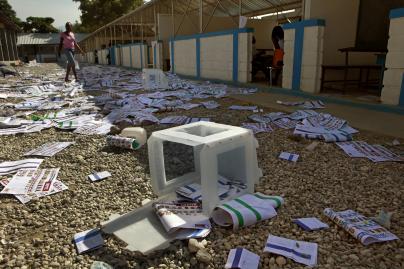
In a traumatized nation with a poor history of clean voting, Haiti's recent elections were a disaster waiting to happen.
There was -- and is -- pervasive lack of confidence in the eight members of the electoral council because some perceive them as being hand-picked by President Rene Preval.
Allegations of widespread fraud were rampant even before polling stations opened for the Nov. 28 presidential and legislative elections, whose final results are yet to be released.
And the international community, which paid most of the $29 million tab for the elections, vacillated between paternalistic bullying of Haitian officials and a hands-off partnership.
Now that same international community — unsure over what should come next as Haiti's electoral commission delays the final vote count while technical experts from the United States and elsewhere sift through tally sheets — is faced with how to get Haiti back on track.
What everyone wants to avoid is a downward spiral into chaos that would hamper efforts to help the earthquake-battered nation recover.
The way forward is not clear, and there are no easy choices. They range from an outright annulment of the vote with an interim government charged with organizing new elections — in perhaps two years — to a power-sharing agreement.
Among the ideas that have been suggested:
-- Cancellation of this round of elections and Preval's early departure. So far opposed by the international community, this idea was put forth by 12 presidential candidates in a letter-writing campaign with Canadian and U.S. lawmakers launched last week.
-- A second round with the presumed top three vote-getters: former first lady and academic Mirlande Manigat, former government agency head and Preval pick Jude Celestin, and musician Michel "Sweet Micky" Martelly, whose backers set the streets ablaze after the council said he had been edged out of a runoff spot by Celestin.
Brazil has pushed for this alternative. Questions have been raised about the constitutionality of such a move. Manigat opposes it.
-- A new winner-take-all election with all 17 presidential candidates taking part and appointment of a new electoral council. Martelly suggested this. Some say it has little chance of winning favor.
-- A runoff between Martelly and Manigat, courtesy of Celestin, who would voluntarily withdraw. There would also be a runoff for legislative seats with the likely outcome of Preval's INITE (UNITY) coalition controlling a majority in parliament.
-- A second round with Manigat and Celestin, after which the winner would face questions of legitimacy.
-- Formation of a coalition government with the opposition.
"We now have an electoral challenge that is acute," US Secretary of State Hillary Rodham Clinton said last week during a visit to Canada. "The electoral challenge, the instability in the government, the lack of a clear way forward as to who will be assuming leadership responsibilities, requires the international community to act and provide technical assistance, provide support for unraveling the complexities and questions surrounding the election."
The story of how Haiti and its foreign friends reached this dangerous impasse is a tale of good intentions by outsiders clashing with the harsh realities of a nation with weak institutions, a shattered government and a history of electoral fraud.
"We've had elections since 1987, and with the exception of 1990, all of them quite bad. I don't think we've made much progress," said Robert Fatton, a Haiti expert at the University of Virginia.
Even before the November vote, many Haitians doubted whether their country could pull off acceptable elections.
While a gentleman's agreement to postpone the vote might have worked in some other countries, it couldn't in a nation with a history of dictatorship and distrust.
A national survey of 1,275 Haitians taken on behalf of the United States Agency for International Development revealed that while an increasing number of Haitians planned to vote, respondents were equally split on whether the elections would be fair or not.
In fact, the survey showed that 39 percent of respondents interviewed between Aug. 18 and Sept. 2 believed the electoral council was corrupt. Overall confidence in the council had fallen to 56 percent in June of 2010 from a high of 78 percent the previous June.
Weeks before the vote, Colin Granderson, head of the joint Organization of American States-Caribbean Community observer mission, remarked that the main obstacle to good elections had nothing to do with the technical expertise or know-how of the council.
It had to do with "the total lack of trust in the impartiality of the council."
Preval said earlier this year that twice he had changed the council on the recommendation of various groups and opposition leaders. Each time, he said, the opposition complained about the new appointees.
Haiti watchers say Preval should have recognized that it was in his own interest and that of the country's to completely replace the council.
Others criticize the international community, especially the United States, for wavering on how to handle the election. Adding to the challenge: The entire United Nations electoral brain trust died in the cataclysmic earthquake.
Yvon Neptune, one of the few presidential candidates not calling for a cancellation of the vote, faulted the provisional electoral council for the mess.
"What we are seeing now in the electoral process is a reflection of Haitian society. You take all of the sectors that are involved in the electoral process, directly or indirectly, and there is a question of credibility," he said. "We are a product of our history. It has been a history of turmoil. It has been a history of corruption."
Since doing away with dictatorship 24 years ago, Haiti has struggled to build democracy and institutions up against inequities in wealth distribution, a lack of rule of law, overthrown governments — and now a feeling of despair after the January earthquake.
A deadly cholera outbreak and largely invisible reconstruction effort have contributed to the general atmosphere of gloom and disappointment.
Meanwhile, the international community has wavered between wanting to allow Haitians to chart their own course and getting more involved in the details.
"However unpopular Preval may be, he represents continuity, which is the single most important thing the international community values," Fatton said. "In other words bad elections will be tolerated in the name of continuity. The problem though is that continuity is not necessarily what Haitians want."
Some argue that a political agreement is needed now -- not later.
With opposition to Preval far from monolithic, he remains the key actor in Haitian politics.
Still, some in the international community have given up on the man once viewed as Haiti's "indispensable" politician. "Eighty percent of the Haitians voted against him," said one foreign diplomat, since his candidate, Celestin, got only 22 percent of the vote.
That reality along with the accusations of fraud by INITE, and the fear of violence in the coming days, has diplomats wondering about what will become of Preval. Will he, like most of his predecessors, exit into exile — or will he become Haiti's elder statesman?
Eduardo Gamarra, a Florida International University professor and political analyst, said the most important thing over the longer term will be getting a credible government in place.
"But that credible government will have to come from among the three top vote-getters. The question is who among them is best able to help Haiti on that path -- a singer with no real record of administrating, a former first lady who is dignified but has no real record or a man who has run a government construction company with extraordinary ties to the old Haitian establishment and all that means?"
Source: Miami Herald
IMF providing emergency funds to St Lucia
The International Monetary Fund (IMF) on Tuesday said the emergency funding being provided to St Lucia should play a catalytic role in mobilising financial support from other financial institutions as the island deals with the aftermath of the damage caused by Hurricane Tomas in October.
CMC reported that the Mission Chief for St Lucia at the IMF, Alfred Schipke, in a statement said that the IMF will be providing US$8 million to St Lucia to deal with the effects of the hurricane that caused landslides, resulting in human causalities and severe damage to road and water supply infrastructure and agriculture.
"The emergency financing is subject to approval by IMF management and the executive board, which could consider the request in mid January 2011," said Schipke.
He said the total emergency financing of US$8.20 million would be allocated to St Lucia's budget to support the authorities' emergency response.
"The funds are expected to play a catalytic role in mobilising financial support from other international/regional financial institutions. The emergency assistance also would come on top of the US$10.74 million provided under the IMF's Rapid-Access Component of the Exogenous Shocks Facility approved in July 2009 to buffer the adverse impact of the global economic and financial crisis," he added.
New York investment firm to build $127 million power plant in Jamaica
Conduit Capital Partners, a private equity investment firm based in New York City and focused on energy infrastructure investment and development in Latin America and the Caribbean, plans to build a $127 million power plant in West Kingston, Jamaica.
The thermal power plant, which will initially run on oil but can also be fitted to run on natural gas, is a greenfield project. Construction work for the 66 megawatt plant has begun and the project is expected to achieve commercial operation in early 2012.
The project is operated and managed by Conduit’s Jamaica Energy Partners on behalf of its sister company West Kingston Power Partners (WKPP). In 2008, WKPP won a public RFP for the supply of power under a long-term power sales contract with the local utility, Jamaica Public Service Co.
Juan Páez, a partner at Conduit Capital said, “We have worked closely with the Jamaican government and the independent regulator for more than two years under very difficult market volatility; this project represents a first step for the government under a highly ambitious plan to ensure the country remains globally competitive through the improvement of its existing infrastructure and the reduction of today’s high energy costs. We look forward to building a plant that positions Jamaica on a path for success.”
Financing for the project is being provided by IFC and a diverse group of institutions that have come together to support this project: Bank of Nova Scotia and FirstCaribbean International Bank, Finnvera, the export credit agency of Finland; and four development finance organizations: DEG of Germany; FMO of the Netherlands; CAF, the Andean Development Bank; and CIFI, the regional infrastructure development bank.
“This project shows Conduit’s ability to execute across market conditions,” said Scott Swensen, chairman of Conduit. “In the Jamaican market, where the government is supportive of foreign investment in infrastructure, developed projects are nonexistent. Greenfield is the only approach here and we have the local presence to win bids and build, and the financial expertise to secure appropriate financing.”
Jamaica Energy Partners consists of two diesel barges that together produce 124 megawatts. Conduit’s Latin Power III fund repurchased JEP in June 2009 after liquidating its original investment in the company in 2007.
Government finally pays teachers, JTA raises concerns about payments
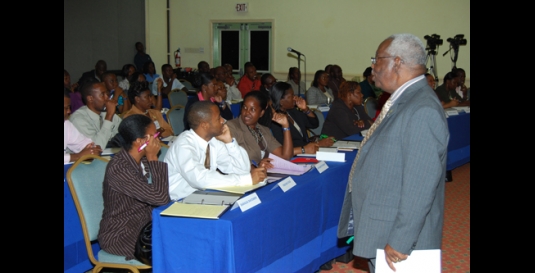 The Jamaican Government says it has forwarded long-awaited retroactive payments to schools islandwide for distribution to public sector teachers.
The teachers and the government have been at odds over the issue for some time, with the matter ending up at the Industrial Disputes Tribunal (IDT).
In October, the IDT ruled that the government should pay $500 million of the $8 billion owed to public sector teachers this year.
In a release this afternoon, the education ministry advised that the cheques were sent out yesterday.
It says regular salaries for teachers at bursar paid institutions were also uploaded by the National Commercial Bank (NCB) yesterday.
The ministry says accounts in banks other than the NCB were expected to be credited by 3 o’clock this afternoon.
And the education ministry says cheques for teachers at non bursar-paid schools were sent out today.
Meanwhile, the education ministry says cheques for the retroactive sums and regular salaries of watchmen will be sent out tomorrow morning for payment on December 23.
In the meantime immediate past president of the Jamaica Teachers’ Association (JTA), Michael Stewart, says some teachers in Regions two, three, four and five have been having difficulties encashing their cheques.
Stewart says the JTA has received information that teachers are being told to hold on to the cheques until they are further advised.
However, when contacted Director of Communications in the education ministry, Colin Blair said the delay in some teachers getting their money is due to the lag-time it takes NCB to pass on the funds to other banks.
Blair says the ministry has been assured that those accounts should be updated within the hour.
SOURCE: JA Gleaner