
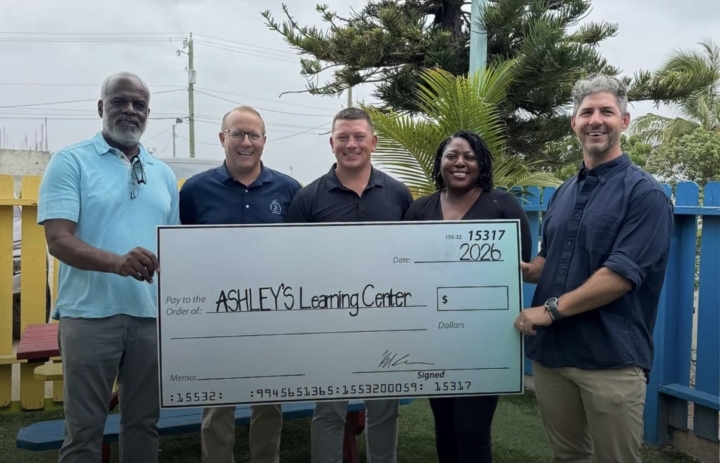
Ashley's Learning Center Receives Big from Corporate Charity Challenge
Ashley’s Learning Center (ALC) has received another major financial boost from the Corporate Charity Challenge (CCC), with this year’s initiative raising $76,426 to support the special education school and improve its facilities.
ALC, the Turks and Caicos Islands’ only private special education school dedicated to children with mild to moderate learning disabilities, autism and developmental delays, said the funding will support capital improvements aimed at providing students with a safer, more accessible and inspiring learning environment.
The latest contribution builds on the success of the 2024 Corporate Charity Challenge, which raised more than $66,000 for the school.
Of that amount, $60,871 was used to complete major capital improvements, including the installation of a much-needed new roof and several other facility upgrades. The improvements have helped strengthen the school’s capacity to provide specialised education and support to children with additional learning needs.
ALC Board Chairman Ben Avenant said the continued backing from the business community demonstrates confidence in the school’s mission and long-term development.
Since opening in 2015 with just one student, Ashley’s Learning Center has grown into an important educational resource for families throughout the Turks and Caicos Islands.
The school provides individualised education and therapeutic support to children whose learning needs may not be fully accommodated in traditional classroom environments.
ALC founder Angela Williams said improvements to the school’s campus can have a direct impact on students’ development.
The Corporate Charity Challenge has developed into a major corporate philanthropic initiative in the Turks and Caicos Islands, bringing together businesses, volunteers, donors and community leaders to raise funds for charitable causes.
The committee also recognised headline sponsor Projetech, participating businesses, volunteers, donors and other individuals who have supported the initiative over the years.
Organisers are now looking ahead to the next Corporate Charity Challenge, scheduled for October 18, 2026.

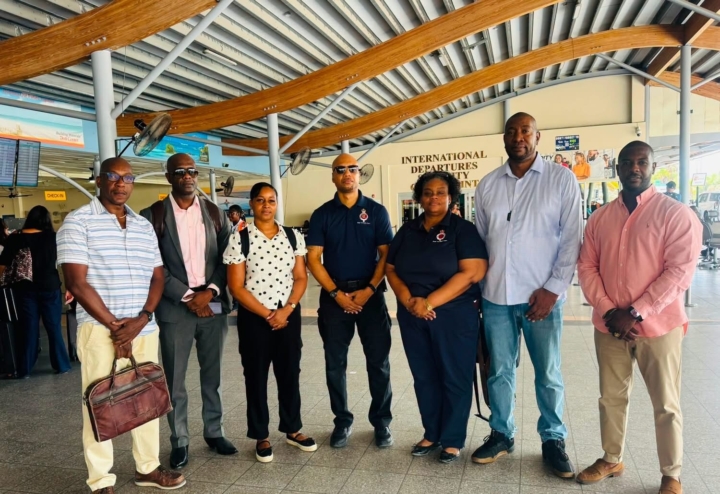
Five Officers from Royal Turks and Caicos Islands Police Force Depart for Training in Jamaica
Five inspectors from the Royal Turks and Caicos Islands Police Force (RTCIPF) and a senior Turks and Caicos Islands Border Force officer have travelled to Jamaica to participate in an advanced regional leadership development programme.
The six officers departed the Turks and Caicos Islands on Saturday, August 1st to undertake Level II of the 92nd Staff and Junior Command Course at the National Police College of Jamaica in Spanish Town.
Representing the RTCIPF are Inspectors Winston Diamond, Valanda Barranco, Neal Stanislaus, Damien Mitchell, and Huntley Forbes Jr. They are joined by Teren K. Smith, newly appointed Assistant Director of the Turks and Caicos Islands Border Force.
According to an RTCIPF press release issued, the programme is hosted through the National Police College’s Faculty of Leadership and Professional Development.
The course is designed to strengthen the leadership capabilities of middle managers by developing their strategic thinking, operational effectiveness and decision-making skills as they respond to the evolving demands of modern policing.
The programme also places emphasis on the critical role middle managers play in advancing organisational objectives through effective leadership and sound management practices.
The National Police College of Jamaica is the Jamaica Constabulary Force’s premier law enforcement training institution and is recognised as a regional centre of excellence in police education.
Acting Commissioner of Police Dwight Gardiner said the latest group represents the fourth cohort of RTCIPF middle managers to participate in the programme. He said the Force was pleased to continue its partnership with the Turks and Caicos Islands Border Force, noting that the collaboration reflects both organisations’ commitment to strengthening leadership capacity, professional development and effective succession planning.
Acting Commissioner Gardiner and Assistant Superintendent Inga Taylor were at the airport to see the officers off ahead of their departure for Jamaica.
The participation of these officers in the programme also demonstrates the Force’s continued commitment to investing in its personnel through professional development and leadership training while preparing the next generation of leaders within the RTCIPF.
We wish you all the best during your training and much success!

Department of Motor Vehicles Reaches Quota Limit on Certain Categories
The Department of Motor Vehicles is advising the general public that several categories of Public Service Vehicle licences have reached their current quota limits and will remain closed to new applications.
According to the DMV, there are currently 26 licences available for Community Cabs and 16 for Private Charters.
However, the quota for taxis, Private Transfer Reserve or VIP vehicles, and Omnibuses has been fully exhausted.
The department says applications for the remaining Community Cab and Private Charter spaces will be processed on a first-come, first-served basis.
No new applications will be accepted for categories that have reached zero capacity.
The DMV also announced that the Public Service Vehicle industry is undergoing a comprehensive audit and operational overhaul.
Minister with responsibility for Home Affairs, Honourable Akierra Missick, says the government recognises the importance of the Public Service Vehicle industry to residents, visitors and the wider economy, but acknowledged that authorities also have a responsibility to ensure the industry is properly regulated and that operators comply with the necessary requirements.
Hon. Missick said the audit and overhaul will address longstanding issues and strengthen the overall system.
Members of the public seeking further information can contact the Department of Motor Vehicles at telephone number 649-338-5022.

Father of Argentine Soccer Star - Jorge Messi Passes Away
Jorge Messi, father and longtime representative of Argentine soccer icon Lionel Messi, passed away Saturday August 8th 2026, at the age of 68, according to Sanatorio Centro, the medical center in Rosario, Argentina, where he had been receiving medical treatment.
Dr. Carlos Mackey, the hospital’s medical director, confirmed that Messi died in the early hours of Saturday morning. Out of respect for the family’s privacy, he said no additional information about the cause of death would be disclosed.
Jorge Messi played a central role throughout his son’s extraordinary football career, remaining by Lionel’s side through some of the most significant moments of his journey. He was there during Messi’s historic years at Barcelona, his difficult departure from the club, and his subsequent moves to Paris Saint-Germain and Inter Miami.
He also witnessed the highs and lows of Messi’s more than two decades with the Argentine national team, including the team’s triumphs and disappointments on the world stage.
The Royal Spanish Football Federation (RFEF), the governing body of Spanish football, also expressed its condolences, sending its “love and affection to Lionel and his loved ones in these moments of deep sorrow” following Jorge Messi’s death.
The news comes just weeks after the Messi family publicly addressed concerns about Jorge Messi’s health during the 2026 FIFA World Cup. At the time, the family confirmed that he was undergoing medical monitoring for a health issue and said he was “recovering and progressing favorably.”
It remains unclear whether his death was connected to the health problems previously reported.
A private funeral service was held in Rosario on Sunday, 9 August 2026, attended by Lionel Messi and close family members.
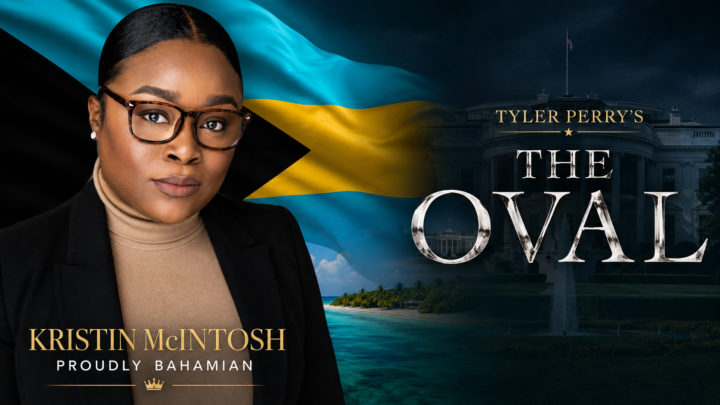
Bahamian Actress Lands Role on Tyler Perry's The Oval
Growing up in Abaco, Kristin McIntosh watched stars on television without imagining that she might one day appear on the screen herself.
Now, the 35-year-old Bahamian actress is building her own television career with a recurring guest role as a reporter on Tyler Perry’s hit drama The Oval.
McIntosh landed the breakthrough opportunity in 2023 and has been contracted to appear in seasons six and seven of the series as a news reporter.
When she initially auditioned, she had no idea the project was a Tyler Perry production. She was simply told she was trying out for the role of a reporter. Although she felt the part suited her naturally, she did not expect it to develop into a recurring character.
She was hired the same day she auditioned.
The role became a significant step forward in her career.
Since adding Tyler Perry Studios to her résumé, McIntosh said she has received opportunities to audition for larger projects and has attracted greater interest from casting directors.
Her portrayal of a reporter also gave her an opportunity to draw on memories from her childhood in The Bahamas. To prepare for the role, she studied old broadcasts featuring journalists at ZNS.
McIntosh continues to live in Atlanta and sharpen her acting skills through industry masterclasses. She acknowledges that building a career in entertainment can be difficult but credits the support of her family with helping her remain persistent through the setbacks.
Now enjoying one of the biggest opportunities of her career, McIntosh is encouraging other aspiring Bahamian actors not to give up on their ambitions.
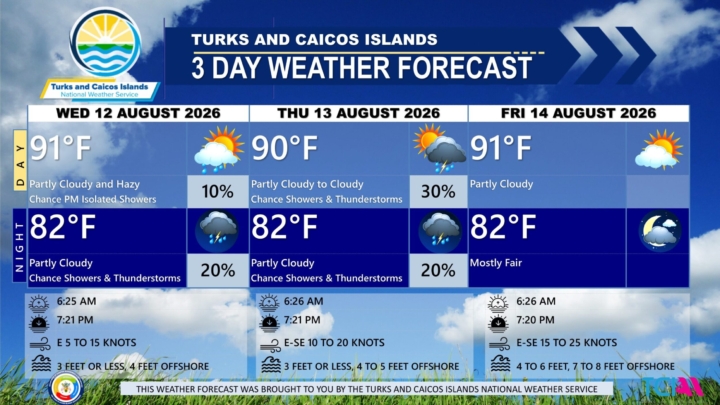
3 DAY PUBLIC WEATHER FORECAST FROM WEDNESDAY AUGUST 12TH 2026
PUBLIC FORECAST FOR THE TURKS AND CAICOS ISLANDS FOR THE NEXT THREE DAYS FROM WEDNESDAY AUGUST 12TH 2026
GENERAL SITUATION: High pressure ridging will continue to maintain mostly stable conditions for the early part of the day, with shower chances increasing this afternoon as a tropical wave approaches the Turks and Caicos Islands.
SPECIAL WARNINGS:
A Heat Advisory remains in effect for the Turks and Caicos Islands. Residents and visitors should take the necessary precautions while outdoors during peak sunshine hours (10 am – 4 pm) and to safeguard their health as heat indices ranging from 100ºF to 105ºF are anticipated.
UV Index: The public is advised to wear protective clothing and sunscreen and seek shaded areas while outside during peak sunshine hours (10am – 4pm), as UV indices are expected to be in the very high to extreme range.
Saharan Dust: A plume of Saharan dust is producing milky/hazy skies across portions of the Turks and Caicos Islands today, which will filter out by this afternoon.
ALL AREAS
WEATHER: Partly cloudy and hazy with a low (10 percent) chance of isolated showers and possibly an isolated thunderstorm this afternoon. Partly cloudy with a low (10 to 20 percent) chance of showers and isolated thunderstorms tonight.
WINDS: Easterly at 5 to 15 knots
SEAS: Slight to moderate with wave heights of 3 feet or less nearshore, building up to 4 feet offshore
DAYTIME HIGH TEMPERATURE 91°F 32°C
HEAT INDEX 105°F 41°C
OVERNIGHT LOW TEMPERATURE 82°F 28°C
SUNSET: 07:21 PM
NEXT LOW TIDE: 02:39 PM (0.3 FT)
NEXT HIGH TIDE: 09:05 PM (3.0 FT)
EXTENDED FORECAST: The chance of shower and thunderstorm activity will persist across the Turks and Caicos Islands through Thursday as the tropical wave moves westward. Conditions will improve on Friday as high pressure builds across the area.
THURSDAY: A low (20 to 30 percent) chance of showers and isolated thunderstorms. Partly cloudy to cloudy, with a high near 90°F (32°C).
THURSDAY NIGHT: A low (10 to 20 percent) chance of showers and isolated thunderstorms. Partly cloudy, with a low around 82°F (28°C). New rainfall accumulation between a tenth to a quarter of an inch (2.5 to 6.5 mm).
WINDS: East to southeast at 10 to 20 knots, with higher gusts in the evening.
SEAS: Slight to moderate with wave heights of 3 feet or less nearshore, building up to 4 to 5 feet offshore
SUNRISE: 06:26 AM
SUNSET: 07:21 PM
LOW TIDE: 03:30 AM (0.7 FT) 03:33 PM (0.3 FT)
HIGH TIDE: 09:22 AM (2.6 FT) 09:52 PM (3.0 FT)
FRIDAY: Partly cloudy, with a high near 91°F (32°C).
FRIDAY NIGHT: Mostly fair, with a low around 82°F (28°C).
WINDS: East to southeast at 15 to 25 knots with higher gusts
SEAS: Slight to moderate with wave heights of 4 to 6 feet nearshore, building up to 7 to 8 feet offshore
SUNRISE: 06:26 AM
SUNSET: 07:20 PM
LOW TIDE: 04:14 AM (0.7 FT) 04:27 PM (0.7 FT)
HIGH TIDE: 10:13 AM (2.6 FT) 10:38 PM (3.0 FT)
TROPICAL WEATHER OUTLOOK:
1. Central Tropical Atlantic (AL92): An area of showers and thunderstorms associated with a tropical wave is located about 900 miles west-southwest of the Cabo Verde Islands. There is a high chance of formation through 48 hours and through 7 days. A tropical depression will likely form within a couple of days while the system moves westward to west-northwestward across the central tropical Atlantic.
2. Central Subtropical Atlantic (AL93): An area of low pressure is located about 1050 miles east-northeast of Bermuda. The system has a medium chance of formation through 48 hours and through 7 days. A short-lived tropical storm could form while it moves eastward to east-northeastward at around 20 mph across the central subtropical Atlantic.
3. Eastern Tropical Atlantic: A tropical wave just offshore of the coast of west Africa is producing disorganized showers and thunderstorms. This system has low chance of formation through 7 days while it moves westward or west-northwestward across the eastern and central tropical Atlantic.
FORECASTER: H. HAMILTON
Large Cocaine Operation Uncovered at Kingston Port
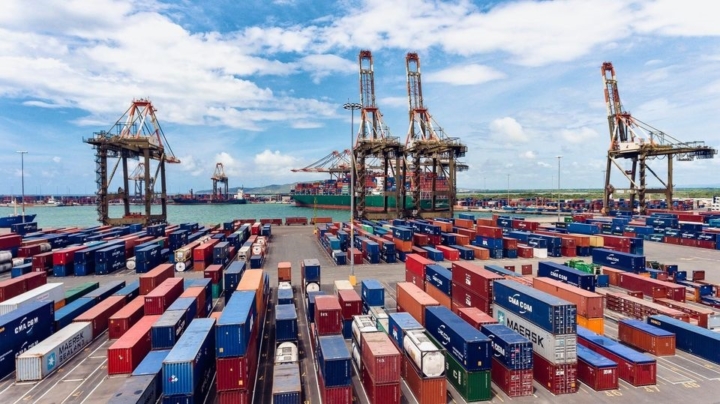
A massive multi-agency operation at the Kingston Freeport Terminal (KFTL) in Jamaica between August 5 and August 7, 2026, resulted in the seizure of over two tonnes of cocaine with an estimated global street value exceeding J$21 billion (approx. US$135 million).
The operation led to a temporary lockdown of the terminal and the arrest of at least eight port employees suspected of running an internal drug-smuggling syndicate.
The operation was jointly executed by the Jamaica Constabulary Force's (JCF) Firearms and Narcotics Investigation Division, the Jamaica Customs Agency, and the Specialised Operations Branch. Security forces intercepted the following contraband hidden inside commercial cargo containers.
* Wednesday, August 5: Authorities uncovered 885 parcels (1,017 kilograms) of cocaine hidden in a shipping container bound for Spain.
* Thursday, August 6: Officers found another 825 parcels (932 kilograms) of cocaine in a second container also destined for Spain.
* Friday, August 7: A final search revealed 118.4 kilograms of cocaine and 256 pounds of ganja (marijuana) inside a shipping container bound for Florida, United States.
This targeted crackdown is part of an amplified counter-narcotics strategy in Jamaica, which has seen record-breaking figures of over 7,226 kilograms of cocaine seized since the start of 2026.
13 Year Old Girl Recovering from Barracuda Attack in the Turks and Caicos Islands
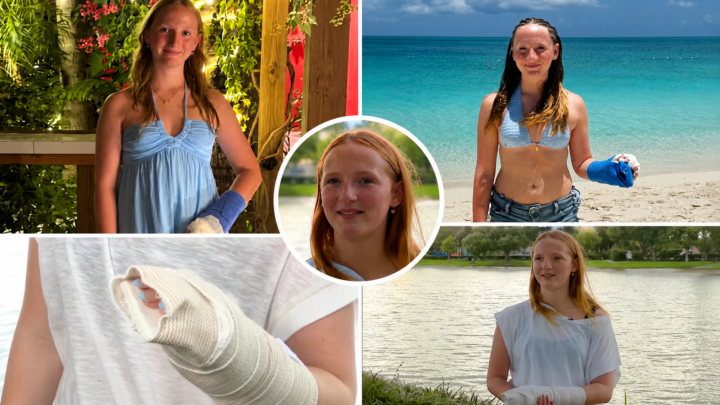
A 13-year-old girl is recovering after being bitten by a barracuda while doing handstands in shallow water during a birthday vacation in the Turks and Caicos Islands.
Claire Macdonel, of Sugar Land, Texas, was in about four feet of water on July 19th when a barracuda struck her left hand, causing severe injuries that required emergency treatment on island and reconstructive surgery after she returned home.
The incident happened on the first full day of a family trip celebrating Claire’s birthday.
Claire said that she was doing handstands in the water when the fish suddenly bit her hand. The attack caused heavy bleeding and severely lacerated four tendons, a ligament and a nerve.
An off-duty nurse who was at the beach rushed to help and fashioned a makeshift tourniquet to control the bleeding while the family waited for emergency responders.
Claire was taken to hospital, where medical staff spent about five hours treating the injury. Much of the procedure focused on thoroughly cleaning the wounds to reduce the risk of infection.
She later returned to the Houston area without developing an infection and began preparing for specialized surgery to repair the damaged tendons and other structures in her hand.
In an interview with ABC news, Claire spoke about how she felt during the incident.
Claire and her family believe the barracuda may have been attracted to the reflection from shiny jewelry she was wearing. Barracudas are known to investigate flashes and reflections that can resemble the scales of small prey fish.
The encounter highlights the potential risks of wearing shiny objects while swimming in waters inhabited by barracudas, although attacks on humans are considered rare.
In an interview with FOX 26 Houston, Claire and her mother spoke about how rare these things are, and you must still enjoy your time.
Claire later nicknamed the fish “Suzie” and has used her experience to warn other swimmers about wearing reflective jewelry in the ocean.
Despite the severity of the attack, Claire said the experience has not diminished her love of the sea. She remains interested in marine life and still hopes to become a marine biologist.
We wish you a speedy recovery Claire!
Listen to the story below:
FEMA Provides Water Trailers to Puerto Rico
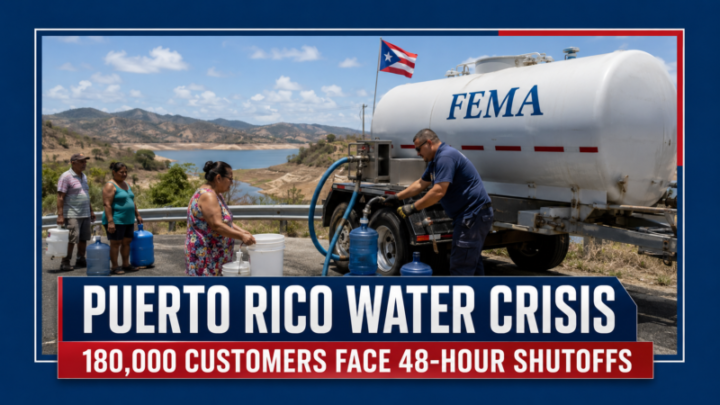
The Federal Emergency Management Agency (FEMA) said Monday August 10th, 2026 that it is providing water trailers to Puerto Rico as the U.S. territory confronts a worsening water crisis fueled by severe drought and declining reservoir levels.
The trailers will initially be deployed for up to 30 days after the Puerto Rican government requested federal assistance.
Puerto Rican, Governor Jenniffer González-Colón said Sunday that local authorities are coordinating closely with federal agencies as more than 180,000 households face water rationing and rotating 48-hour service interruptions.
González-Colón declared a state of emergency on July 31st as drought conditions intensified and water levels in the island’s reservoirs continued to fall.
Authorities began implementing rotating 48-hour shutoffs Friday in parts of the capital, San Juan, as well as communities in Carolina, Juncos, Gurabo, Trujillo Alto, Canóvanas and Loíza.
During a news conference Sunday, the governor said officials had activated an “interagency support plan for municipalities” to coordinate assistance for affected communities across the island.
As part of the response, Puerto Rico’s Public Housing Administration has begun installing community cisterns at public housing complexes. Potable water is also being delivered directly to residents with assistance from the Fire Department.
The emergency follows an exceptionally hot and dry July. San Juan recorded its driest July in more than 120 years of recordkeeping, while temperatures made it the capital’s fourth-hottest July on record.
According to the U.S. Drought Monitor, nearly 25% of Puerto Rico was experiencing severe drought as of Aug. 4, while another 36% of the island was classified as being in moderate drought conditions.
Powerful 7.4 Earthquake Strikes Columbia
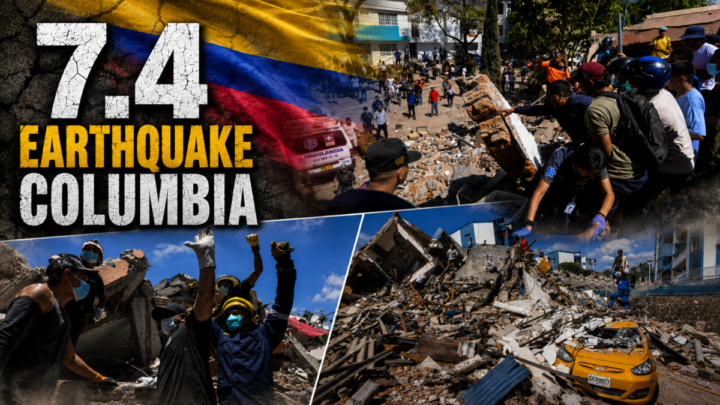
At least 169 people have been killed and more than 600 injured after a powerful 7.4-magnitude earthquake struck western Colombia on Monday morning, August 10th 2026, causing widespread destruction and prompting the government to declare a national disaster emergency.
The earthquake struck at 7:34 a.m. local time, with its epicenter near San José del Palmar in Colombia’s Chocó region, according to the U.S. Geological Survey and the Colombian Geological Survey.
The quake originated at an intermediate depth of roughly 96 to 107 kilometers, or about 60 to 66 miles.
President Abelardo de la Espriella declared a national disaster as emergency crews responded to collapsed buildings, damaged roads and disrupted utilities across several provinces.
Some of the most severe destruction was reported in Cali, Pereira and Manizales, as well as communities throughout Colombia’s Coffee Axis.
More than 60 major structures have collapsed, while thousands of homes have been damaged or destroyed. Health facilities, community centers and roads have also sustained significant damage.
In Cali, more than 20 buildings collapsed, leaving people trapped beneath the rubble and triggering large-scale search-and-rescue operations. Emergency crews were working at multiple sites in an effort to locate survivors.
The earthquake also triggered landslides and debris flows that blocked several strategic highways. Water and electricity services were disrupted across multiple departments, complicating rescue and recovery efforts.
Flight operations were suspended at several regional airports as authorities carried out inspections for possible structural damage.
The powerful shaking was felt across much of Colombia, including Bogotá and Medellín, as well as in neighboring Venezuela, Ecuador and Panama.
Residents in several cities rushed into the streets as buildings shook, though Colombia’s two largest cities were not initially reporting destruction on the scale seen in the country’s west.
The Colombian Geological Survey described Monday’s earthquake as the country’s strongest in a decade. Western Colombia is particularly vulnerable to earthquakes because of its location near an active tectonic boundary where major plates converge.
Authorities imposed an overnight curfew in Cali to keep streets clear for rescue crews and heavy equipment as teams continued searching collapsed structures for survivors.
The disaster represents an immediate challenge for de la Espriella, who was inaugurated as president just days before the earthquake.
Rescue operations remained underway Monday, and authorities warned that the number of casualties could change as emergency teams reach heavily damaged communities and continue searching through collapsed buildings.